Wednesday, December 31, 2008

Livability Indicator #9: Dog Shit


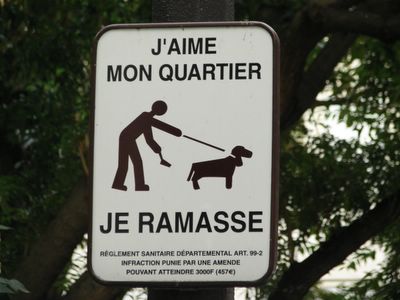
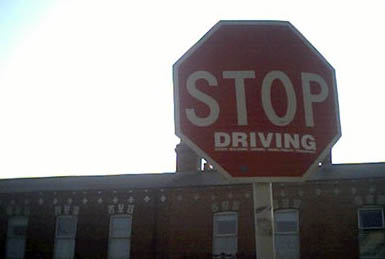
[The only thing that could make this sign better is if it showed the doggie in action...unless that is not a tail - in that case, it must eat like my mutt.]

Why? Well, ideally it means that a lot of people are living there and walking their dogs. The two cities that immediately come to mind as the most notorious for doggie doo doo are Paris and Rome. I'm sure many other large, livable cities have similar reputations.


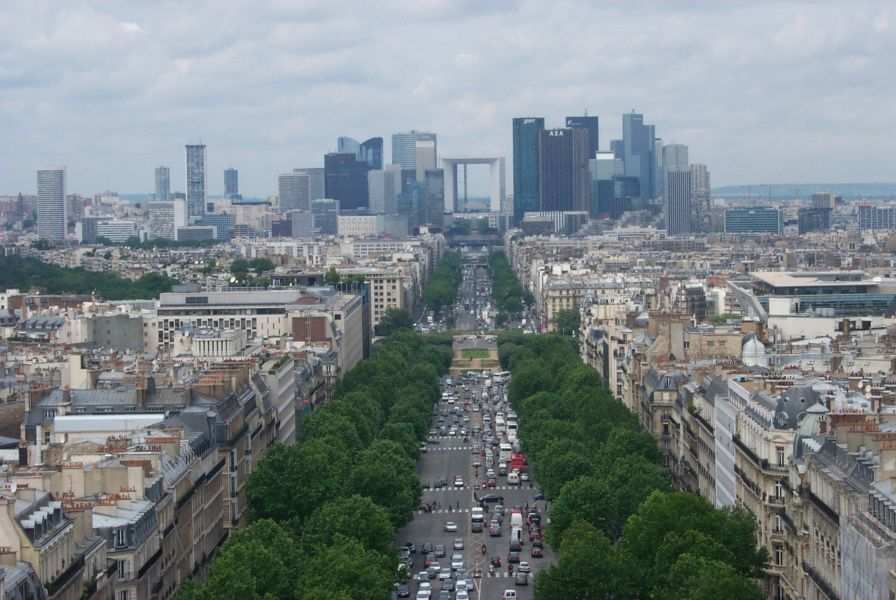
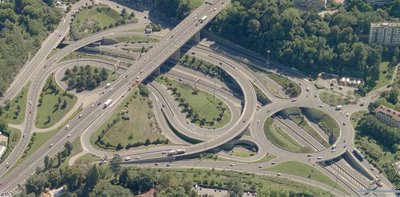
[La Defense is so uninspiring isn't int? Perhaps the point was to contrast it with the beauty of the rest of the city. Clever Architects.]

As for Dallas? Well, I've mentioned before in the Olfactory Map of DTD about the smell of dog piss and the presence of dog shit in the little pocket doggie park at the DP&L building. This is one of the very few places in DTD dedicated to doggie defecation [if you think I'm letting this alliteration thing go, you'd be wrong].

In all of downtown, there is currently about 5,500 residents. Naturally, some will be douchebags and not pick up after their dog. I can't recall if I've ever seen anybody deliberately not pick up their doggie diarrhea, but the presence is there. That's fifty-five hundred people potentially using a 5,000 sq.ft. patch of knobby grass.


Even some like to let them go in their building of residence without cleaning up after their pikey mutt. I have even cleaned up some in my hallway just to avoid any potential blame addressed at mine. I reflexively (and probably incorrectly) like to blame spoiled SMU coeds who have never lifted a finger for their little Sparkles or Sprinkles or whatever lame name they heap upon their little Maltese, probably get their rent covered by Daddy, and in all likelihood made a mistake moving downtown, don't fit in, and CAN'T WAIT to get back to uptown where all is sweetness and light, with gumdrops falling from the trees, oh and the serial rapist there. [Has that dude ever been caught?]

I have a personal quandary, albeit a minor one. Use a permanent grocery getter bag [the obviously more sustainable choice] or collect the plastic bags? Considering that the doggie digger upper bags are never stocked, I choose to stockpile my plastic bags in a drawer that I always carry around whilst walking my pooch. Mine tends to like to hop behind bushes to be lady-like, so I often am taking her to other lesser utilized green spaces.

Fortunately, before the end of 2009, Main Street Gardens will open downtown replete with doggie run. Certainly, it will have similar issues of insconsiderate owners, but at this point, let's just be glad we have dog owners downtown because even some of the best cities in the world face this problem just because it's a product of people (not directly, from their dogs - well, in Dallas can also be from the people - which yes, I have seen) living there.

We could use the people and all the problems they bring with them.


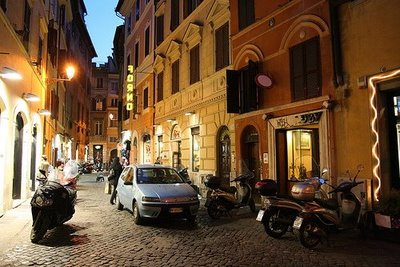
[The street I lived on in Rome. Littered with merda, no doubt.]

Tuesday, December 30, 2008

Kunstler's Yearly Forecast

Every year, James Howard Kunstler types up a long screed (redundant?) forecasting the events of the coming year. While he may not be exactly right about what happens, he has generally been accurate re: the meta issues and outcomes. The line that I couldn't agree more with and has been my underlying point with all the generational studies talks and writings:
My hope for the year, at least for my own society, is that we will transition away from being a nation of complacent, distracted, over-fed clowns, to become a purposeful and responsible people willing to put their shoulders to the wheel to get some things done. My motto for the new year: "no more crybabies!"
I've written before that we generally have two choices when society collapses, one of violence and retribution and one of rebuilding positively. In the 1930s-40s-50s, it was the latter for us creating the "Great Generation" and the former for the Germans after their entire economy collapsed. I worry that we might not be a well-educated enough society to appropriately handle the shock to the system that 2009 (exactly 80 years or four generations, ahem, Fourth Turning) might bring. Keeping the religious motif going, my point is to preach the positivity of the Millennial generation, as a rallying cry for all to get behind.

Have we chosen to stick our collective head in the sand and pray for the bad to go away? Or, was that just the Boomers, while everyone else was already working on creating a new society, away from merely "sustaining the unsustainable" (which is a perfect turn of phrase by Kunstler to frame the situation we face).

My question is, what are you doing to build a [intentionally left the word "more" out here] sustainable world?


Hint: Buying a hybrid car or tossing used cans into recycling bins ain't it. These are actions of the Boomer, sustaining the unsustainable - attempting to make ourselves feel good without actually having to put in any of the legwork to affect any real change. Something for Nothing - sort of the motto of the boomer eh (wasn't there a song back in the 80s that went something like that - not coincidentally)?

And by boomer, I don't mean to cast aspersion to any particular individual. It is merely a short hand for the accumulation of all the wrong decisions over the last fifty years, the construction of a failed world, and the decision-making process and framework that we currently operate in - a sort of self-reinforcing circle of shit.

As for my part, I promise to never link or reference Dire Straits ever again.

Pic o' the Day

Which I found at Drunk and In Charge - which I haven't spent enough time at yet to fully know, but it sure sounds like my kind of place.


If you ever feel like committing vandalism, here is an act that I condone.

NPR's Car Talk Guys Agree with the CarFree Guy

Link to Hub and Spokes blog about it:

In their last show, Ray called for a national gas tax, and suggested the Big Three of Detroit should become train manufacturers. (If Click and Clack agree, maybe my train idea wasn't so crazy after all.) They're quoted at the blog Hub and Spokes: "I think it's an idea whose time has come," Ray said. "I know most politicians have been too wussy to do it, but I think the logic of raising the gasoline tax right now is unassailable.

"Gas is less than two bucks a gallon. There's never been a better time to do this. If we added a 50-cent national, gasoline tax right now, and gas cost $2.50 a gallon, would that be the end of the world? Hardly.

"This new tax would generate between 50 and 100 billion dollars every year for the treasury. That money could be used to help rebuild our crumbling roads and bridges, and develop new technologies for more fuel-efficient cars... further decreasing demand for oil. This is a way for us to get on the wagon, and stop sending money to countries that don't like us. We could become energy independent.

"The other thing that the gas tax revenue could fund is high-speed-train infrastructure between major cities. And who would build all of the new high-tech, high-speed trains we'd need? GM and Ford! We'd help them start a mass-transit division, convert some of those factories from building inefficient gas hogs to building high-speed trains."

I've said this here, and here, and here...and you get the point.

Quote for the Day

I've only seen parts of this movie and certainly had never heard this line, but it's on the same track of many things I've said before:
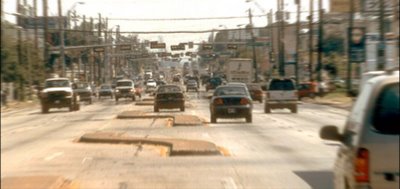
"It's the sense of touch....What?....In a real city you walk....you know....You brush past pople. People bump into you. In LA, nobody touches you....always behind this metal and glass. I think we miss that touch so much that we crash into each other just so that we can feel something."
Crash @ IMDB

Back from Vacation

I was gone all last week. The CarFree guy actually rented a car and drove cross-country with his trusty and troublesome mutt. But, now I'm back in Dallas and back at it .

Monday, December 22, 2008

Gas Tax and Downtown Development

Making up for lost time over the past week and probably into the next week. Here is a proponent to drop the payroll tax and raise the gas tax, which I agree with. When gas hit $4 this year, Americans did two things: 1) got out of their cars or 2) showed a willingness to pay a great deal for gas.

With gas at a fraction of that cost, I believe it is time to increase the gas tax (at least to something approaching real market rates - see: European prices for Petrol). When in doubt, tax consumption (heavily) and reduce taxes on labor and wages, IMO, which leads me to this thought:

The more car-dependent a place/property/neighborhood/city is (defined by what the local market rate for parking demand would suggest) will ultimately hold back some regions/cities as we begin to dig out of this recession (depression? my alcohol tab would certainly suggest as such) rebuild our cities in a more sustainably urban and walkable fashion.

Why? This stems from one of my thoughts I've harped on for a while, but also associate with downtown Dallas moving forward. A major cost/barrier to entry (as in 20% of total construction budget) is spent on parking, in dense cities (or at least in places that dream of density like Dallas - but wish to hold onto our status symbols, I mean cars) this means garages which build at a minimum of about 12,000 to 15,000 dolla dolla bills y'all per space.

Yet, with that said (and as I'm proving that in Dallas, owning a car is not necessary, or even a satisfactory existence!) the local zoning mandates a certain amount of parking per unit/or bedroom for private development. This requirement will HAVE to be repealed if Dallas is to in anyway approach the necessary 30,000 residents in downtown that is suggested (and needed - see this post about a similar sized (or smaller) area in lower Manhattan that has doubled in population to 50,000).

I'm guessing that few, if any, developers will be able to deliver the residential units DTD needs whilst coerced into paying to construct its own parking, despite the demand not nearly equal to the requirement. My garage was half full at most, until spaces were outsourced to a local valet company which has become its own nightmare - see below.

Coincidentially, years ago as part of their redevelopment process, the City of Portland built four large public parking facilities and waived the private parking requirement, one of the major factors to that city's redevelopment and increase in downtown residential population. Furthermore, this allows for improved maintenance and control of parking spaces...and if everybody dares mention the simplistic dogma that private side always does it (in the fanatics' view (business schools where Herman Daly doesn't teach) = anything) better and more efficiently, read the posts about what is happening to my building; its parking garage, under new management.

Sadly, I moved into this building when it had the highest approval/recommendation rating in all of downtown (and much of the city of that matter) at 80%. It has plummeted to 51% in the past two weeks.

Goodbye to Generation Me

Hello to Generation We, which is the basic premise of a recent article I wrote condemning perfunctory architectural treatment of sustainability as some sort of new Baby Boom generation-like fad, when in fact it is a necessary shift in fundamental thinking of all things, economic; environmental; daily.

I'm not sure if I'm at liberty to post the draft of that article yet or not, but someday it will be on these pages. Until then, other people are beginning to come to a similar realization. However, mine is driven by something deeper than mere stylistic representation (the physical embodiment of a new Generation taking hold of public consciousness).

I received this email today as part of the Pro-Urb ListServ for professionals in the urban design world from one of the founding members of the Congress of New Urbanism:
Just in the same way that the excessive eclecticism of the 20's and 30's was identified with the financial excesses preceding the Great Depression, Starchitects and Starchitecture are now clearly identified with the mad off of the last twenty years.

Even Nicolai Ouroussoff admits it in a well hidden article in the NY Times today: Arts and Leisure Section, page 27, "It was fun till the money run out"

There will be no more extravagant programs, extravagant budgets, extravagant forms or any other form of excess in architecture and urbanism for many years to come. The party is over. Good bye cynicism, irony, megalomania, egocentricity, arbitrariness, and chaos. God bye Rem, Frank, Thom, Zaha, Jean. We will not only not miss you. We will make sure to forever remember your direct contributions to the collapse of our economy and culture.

We must now focus on making clear to the world that what we have been advocating for two decades, a socially, economically and physically sustainable architecture and urbanism, is the way of the future.

Silence in the light of this immense opportunity is a betrayal of all that the new urbanism stands for. We must begin with the Congress in Denver. Paraphrasing Churchill in 1942, Ladies and Gentlemen, we are out of allies, territory, resources and hope. It is time to think!!!! (and to act)

Stefanos
As for Ouroussoff's article in the NYT, he's a bit erratic and all over the map in sticking to his ultimate point, but see for yourself (link):
...Serious architecture was beginning to look like a service for the rich, like private jets and spa treatments. Nowhere was that poisonous cocktail of vanity and self-delusion more visible than in Manhattan. Although some important cultural projects were commissioned, this era will probably be remembered as much for its vulgarity as its ambition.
It's always the sycophants to be the first rats off the ship, isn't it?

Me? I'm of the feeling that like all things Kunstlerian, everything will downsize; Architecture included. We need a heaping helping of good, urban 3- and 4-story buildings fronting on high quality streets and public spaces, integrated correctly within their context (i.e. not turning their back on their neighbor or putting up gates around the property). And what architects need to realize is that their new clients will have different tastes that Generation Me. It will be more about public spaces and places for us, Generation We, and buildings will move back to their appropriate place, the background.

LaHood to be Transpo Secretary

A lovely waste of real estate:


I've been following who this appointment might be with considerably greater interest than many of the other cabinet positions, as posted here and my thoughts on how Texas should be appropriating federal transportation dollars here.

While initially, one might convulse over the thought of a Republican in this position given many of their ties to lobbyists of the road building/sprawl industry (though it clearly poisons both sides of the aisle), I am cautiously optimistic about this appointment.

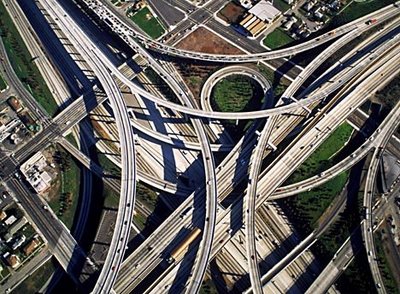
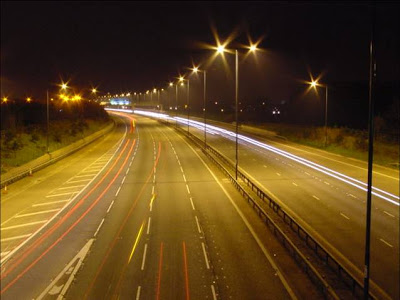
The legacy of the 20th century.


I have been a long proponent of thinking about transportation more holistically, meaning 1) beyond just cars (mistake numero uno) and 2) building roads/transportation networks as investment tools with the pertinent question being "what kind of return on investment are we getting as taxpayers?"

As I've mentioned a million times, development (of all shapes and sizes) is always, ALWAYS reactive to the primary means of transportation to access the site. Big, ugly roads (remember: Freeways = Farts in Elevators) get equally as obnoxious treatments to buildings to defend the buildings from the visual and sound pollution (not to mention air) of choked arterials. Buildings get set far back, one to get away from the roads, and two, to accommodate the convenient surface parking lot. Then, billboards, buildings, signage, parking lots, service docks, everything is scaled up to the size of cars, as if we're merely the brains and our tin cans are our new bodies.


When we bump into each other on the street, we say sorry. When we do it in our cars, people are maimed at an alarming rate.

With LaHood's reputation as a practical pragmatist, I will take a wait and see approach (shouldn't alert vigilance be taken with all elected officials?). But, call me crazy, if I think it's prudent to take a fiscal conservative that has been one of the few sane representatives of the last 14 years of Republican leadership in the house, that might actually understand that good roads (complete streets) and more balanced transportation policies (read: efficient, appropriately scaled mass transit) is a good long-term investment that increases property values intelligently and allows for more sustainable, compact development.

With a fiscal conservative (and one that gets a 0% rating from those corrupt d'bags at Club for Growth which I rate as a badge of honor), maybe we'll stop the immensely wasteful spending on highway construction across this country. Please, let it be so. I don't know how much more tax burden I can handle over the next fifty years of my life.

The most sustainable thing we can do is build aesthetically, beautifully which begs the question, "in which kind of world do we want to live?"

This?


or this?


This?


or this?


[edit: It should be noted that many feel Rep. Oberstar from MN as chair of the House Transportation and Infrastructure committee actually has more power than the Secretary of Transpo. Today, he is suggesting a substantive increase in overall proportional spending on mass transit from 25% of that of highways to 40%.]

Brad Pitt's First House Built....Finally


...as part of his Make It Right campaign, which proposes more architectural experimentation on the poor and downtrodden...or at least to turn all their buildings PINK! Link.

I prefer the comments section:
While the project is certainly well-intended, the designs seem so out of touch with the recipients. It's hard to imagine that the people who will be living in these houses would actually choose these houses over the vernacular styles — the shotguns, camelbacks, and creole cottages — that for 100 years have meant home to this culturally-rich, close-knit, vibrant community now in tatters.

Friday, December 19, 2008

Mayor's Wish Lists

So the mayors across this country have put together their christmas wish lists for Santa Obama hoping that some federal dollars will solve all of their problems. You can see them all here.

Let's take a look at some shall we, see who might be using principles of sustainable urbanism, or at the very least investing in the greatest resource we (or any nation) has, it's people...

First, my hometown of Harrisburg, PA. I see lots of rail and transit, downtown streetscape improvements, energy efficiencies to public buildings, etc. etc. Essentially, the types of things that the City generally wouldn't think of (or be able to) fund on its own, plotting a direction (if not to, at least towards) a different future, the types of projects that aren't covered by simple, sound city management currently.

Now, let's take a look at Dallas. Here is what I see... NO substantive policy shifts for fundamentally improving the sustainability and livability of the City. Rather, many of these appear just to be ways of shifting the burden of responsibility and payment from their own budget to the national coffers (or printing presses - deflation here we come without sound investment projects).

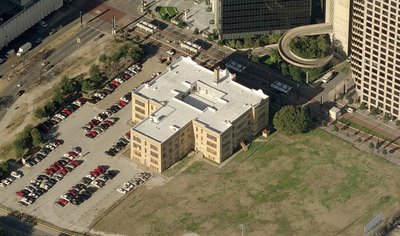
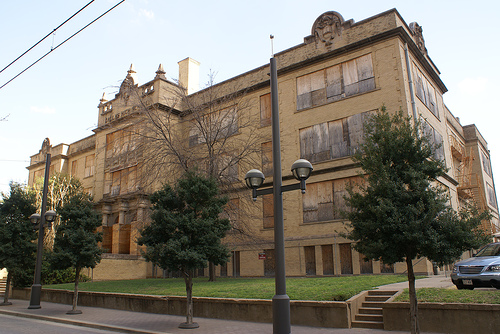
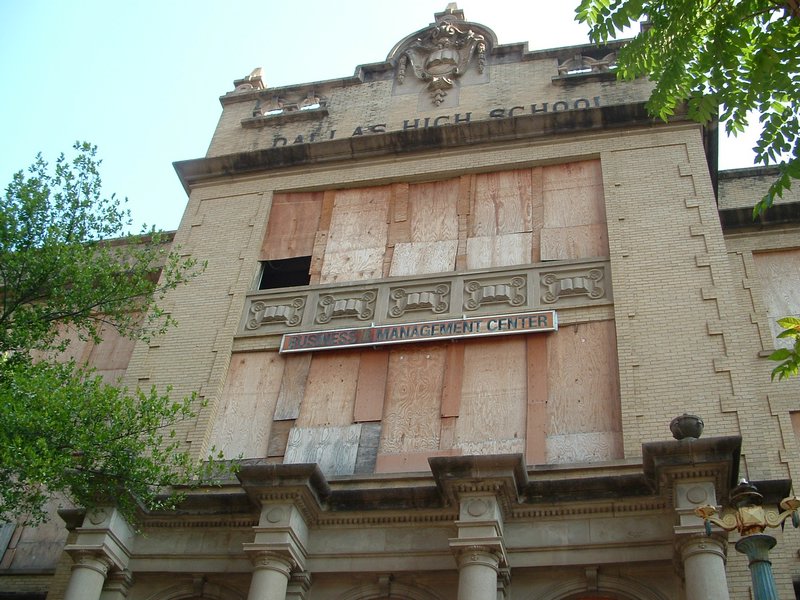
No transit on here at all. You know what should be on this list? Restoration of Old Dallas High School. Below, is the best picture I have been able to find of it, which does not show the front door unfortunately, but you can see the transit stop that is right freakin' there. You can also see what Dallasites really value this site for: it's surface parking lot.


This is a building on the national historic registry, as seen here (hint: the address is 2218 Bryan). I recall when I first moved here that somebody (maybe it was the City or the current owner) was looking to redevelop this entire site. Of course, because the building is protected, to make it habitable, it cost something like $18 million in asbestos abatement that developer nor City could pencil out in their pro formas.

This is the type of stuff that we should be redeveloping with the aid of the New New Deal. The pie in the sky that Cities only wish they could do. This is merely $18 million whilst the City of Dallas is asking for $1.2 billion and change in projects including an entirely ineffectual convention center hotel that will be impotent in its efforts at revitalizing downtown in any sort of substantive manner.

This is building sits on over five acres of land in the CBD, adjacent to 75, and immediately on a DART station. This is solid gold real estate, yet we are letting $18 million in environmental remediation prevent us from giving life to a great old building AND creating an entirely new mixed-use district around it. Furthermore, it's relationship to the nearby Arts District will necessitate this mixed-use entertainment, b/c the Arts District sure as sh!t isn't providing it.

I would estimate that with downtown densities, we could probably get upwards of 500 new residents on this land, and in the neighborhood of 100-200K of commercial space. Downtown needs residents, it needs life, as does this building. It is far too valuable to be a parking lot for 200 cars.

This makes me think of the way we, as a society, treat prisons, homeless shelters, and hell, even schools and homes for the elderly; essentially warehousing them. Throwing some money to mothball our kids, our parents, the ne'er-do-wells and keep them out of sight, out of mind. Yeah, it's a cost, but what is the return? Can't we rethink the way we treat all of these, just like (metaphor coming) this school.

[Obviously, by "return on investment," I am assigning value to those apparently worthless things like an educated and competent populace, drinkable water or breathable air that doesn't poison on and up the GDP through increased healthcare, low crime, ya know, the things that economists like to externalize from their equations.]

I can think of no better return on investment than paying for children to become educated so they can all be productive, tax paying, innovative members of society. Or, rehabilitating and/or training the homeless or the convicted. Certainly, some don't want to be helped, but is it not a better investment to "improve" some into self-sufficiency rather than paying down the road for shelter, food, increased policing, and potentially 40K a year for incarceration? (if you notice in the HBG list, there is this exact rehab/training facility.)

How about all of these projects listed for Dallas. What will be the return for any of these investments. Rather than band-aids for their own budgetary issues, the federal government's will to invest in cities should be taken advantage of to bridge the gaps that are holding the City back from real qualitative growth.

Or, we could just mothball this old school so we never have to think about it...except to daydream in imaginationland what once was and what might one day be as we ride the DART on by, lost in our ipod world.

The potential of this building reminds me of the Kennedy (no relation) School in Portland, OR, which was renovated with multiple pubs, restaurants, a theater, and a hotel where you get to stay in a converted classroom.


Rome to Milan in 3 Hours

New high speed rail line opens in Italy. 300 miles in 3.5 hours, city center to city center, not bad. Here, we can fly 180 from Dallas to Austin and with travel to/fro the airports, security, boarding, taxiing (in the plane), the flight, etc. we can manage that in about the same amount of time...and with 10x the stress!!

More impressive:
Work on the hotly contested high-speed TAV line between Turin and Lyon in neighboring France was halted due to protests before the 2006 Winter Olympic Games — and still has not resumed. The stretch is part of a European-wide project to connect Lisbon, Portugal and Kiev, Ukraine, by train.
...yet we're lucky to have Dallas and Fort Worth linked by train. If we want to call ourselves the greatest country in the world, we need to start acting like it. No more empty platitudes. Just do it.

Thursday, December 18, 2008

Best Careers: 2009

Urban Planning makes the list. Architecture gets tagged as 'overrated.'

Wednesday, December 17, 2008

Unheralded Green Leaders

From TreeHugger.

Mayor Shirley Franklin is probably the elected official to the highest office that I've ever heard mention the words zoning and mixed-use and walkability on a national stage. Kudos to her and the citizens of Atlanta that elected her.

We, in Dallas, are still doing things like this, and this, and this, which would make the acropolis known as downtown Detroit proud.

Reasons to Love NYC

#3:

Because Robert Moses Would Have a Coronary If He Were to See Our Streets Now:

Public space comes in a range of shades. In the sixties, its cultivation was effectively delegated to private developers, who were permitted to put up bigger office buildings if they provided sidewalk-level oases where workers could eat their lunch. In the eighties and nineties, New York began to rejuvenate its parks, restoring enclaves that offer a cushion from noise and congestion. Now the Department of Transportation has realized that its jurisdiction covers the basic unit of urban life: the street. There, lifestyles intersect and city dwellers co-exist with people different from themselves. It’s where we learn toleration, where leisure shares space with urgency, commerce with activism, baby carriages with handcarts. When it is narrowed by garbage or overwhelmed by traffic, then the street reverts to its most primitive use: as a corridor. But a truly public place allows people to move at many different paces, or not to move at all.

Monday, December 15, 2008

World's Ten Ugliest Buildings

It's hard to argue with any of them.

Stealing my Ideas

Using Google Maps to Show Unusual Smells.

I started one for Dallas here:

Which I should probably add to...

Monday Morning Kunstler

Always a wake-up slap to the face...
That economy [ed. note: the one of oil-based forever growth of the insipid quantitative variety] is now in its death throes. The "normality" it represents to so many Americans is gone and can't be brought back, no matter how wistfully we watch it recede. Even so, it was obviously not good for the country. The terrain of North America has been left scarred by unlovable objects and baleful futureless vistas that, from now on, will shed whatever pecuniary value they once had. It represents the physical counterpart to the financial mess that has been left to the young generations to clean up -- and the job will take a very long time.

Tuesday, December 9, 2008

Lolz

Consider TxDOT in the queue:

http://www.dallasnews.com/sharedcontent/dws/dn/latestnews/stories/120908dnmetstimulus.3dfb5bb.html

The money quotes:

"If they are going to hand out this kind of money, we are sure not going to walk away from it," said Texas Transportation Commission member Ted Houghton of El Paso. "Not if 49 other states are lining up for the money. ... Whether it's the right thing to do, that is an entirely different question."

And with key details still in flux, some critics worry that the once-in-a-lifetime spending plan will be wasted if it is spent only on ready-to-go projects. Most of the projects on the lists submitted by Texas are small ones, ranging from paving jobs to overpass repairs and highway widening.

Missing, for the most part, are long-range projects that experts say would do far more to solve Texas' and America's transportation problems, such as big urban transit expansions, comprehensive passenger rail service that could extend beyond the Northeast, or costly relief for backed-up freight corridors that have clogged highways in states like Texas.

"We're playing the cards that are being dealt us," said Coby Chase, top governmental affairs official at TxDOT. "This may or may not be the highest and best use of these transportation dollars, but at this time, that's not the point of the money. The package is aimed at stimulating the economy."

Ummm...Yeah, That's Exactly It.

I've disagreed with David Brooks in the past, like here. But amazingly, when he contradicts himself (or in this case, it appears to be more of a change in mindset), I couldn't agree more!!!

David Brooks come to Jeezus moment:

Some of the most telling excerpts:
If you asked people in that age of go-go suburbia what they wanted in their new housing developments, they often said they wanted a golf course. But the culture has changed. If you ask people today what they want, they’re more likely to say coffee shops, hiking trails and community centers.
This is the guy who wrote a book praising the exurbs.
There are restaurant and entertainment zones, mixed-use streetscape malls, suburban theater districts, farmers’ markets and concert halls. In addition, downtown areas in places like Charlotte and Dallas are reviving as many people move back into the city in search of human contact. Joel Kotkin, the author of “The New Geography,” calls this clustering phenomenon the New Localism.

...If, indeed, we are going to have a once-in-a-half-century infrastructure investment, it would be great if the program would build on today’s emerging patterns. It would be great if Obama’s spending, instead of just dissolving into the maw of construction, would actually encourage the clustering and leave a legacy that would be visible and beloved 50 years from now.

...This kind of stimulus would be consistent with Obama’s campaign, which was all about bringing Americans together in new ways. It would help maintain the social capital that’s about to be decimated by the economic downturn.

But alas, there’s no evidence so far that the Obama infrastructure plan is attached to any larger social vision. In fact, there is a real danger that the plan will retard innovation and entrench the past.
anddddd, for the key point...
This is the federal version of “This Old House.” And this is before the stimulus money gets diverted, as it inevitably will, to refurbish old companies. The auto bailout could eventually swallow $125 billion. After that, it could be the airlines and so on.
In other words, all of the industries that were created by the "great big bang" sending citizens adrift into a sea of Mickey D's. We're going to support them while, we create new growth industries that will kill them? Gawd, I hope not.

The next big question is, once we see a turn around and we create these new growth industries how do we ween them off the teet? It happened with Rail in the late 1800s, then with highway/road construction from 1940 to...hell, still today...

Monday, December 8, 2008

Links o' the Day with a Lil' Commentary

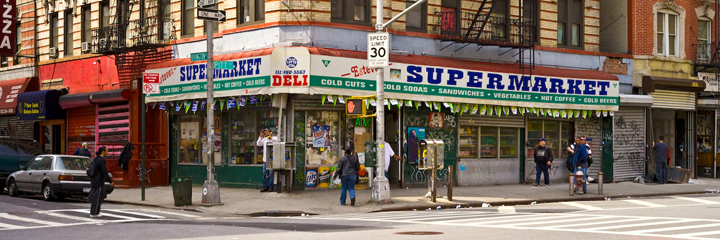
First, the good...every street corner in Manhattan, photographed.

An example:


Next, the bad...a class action law suit against Halliburton-KBR for among other things exposing "everyone at the largest U.S. installation in Iraq to unsafe water and food and hazardous fumes from a burn pit."

Do you want to know who the winners were in the (latest iteration of) the Iraq War? Not the U.S. people, not the military, not the iraqi people, but incorporated business. They are the only ones. Since it is always easy to simply cut costs to increase profit rather than improve services, why not just ship ice in trucks that haven't been properly cleaned from the decaying corpses that were inside...or improperly incinerating human bodies and amputated body parts in open air bonfires while wild dogs carried around human remains. Yes, these occurred (according to the lawsuit). And, you know what? They are all logical results of allowing the profit (only) motivated corporations to dictate the rules, rather than the other way around.

Quality of life? Clean air, water, and sanitation? Mehhhhhhhhh. Who needs 'em?

annnnnd, the ugly...Kunstler's monday post:
...Anyway, some parts of our highway-bridge-and-tunnel system are already so decrepit that they pose a menace right now, and the clamor to direct "stimulation" there is already very strong -- backed by all the fraternities of engineers.

Stimulus aimed at perpetuating mass motoring will be a tragic waste of our dwindling resources. We'd be better off aiming it at fixing the railroads (especially electrifying them), refitting our harbors with piers and warehouses in preparation to move more stuff by boats, and in repairing the electric grid. Unfortunately, our tendency will be to try to rescue the totemic touchstones of everyday life, things familiar and comfortable, regardless of whether they have a future or not.
I post this because local news here in Texas yesterday said the state has 800 highway expansion and construciton projects backlogged in waiting for this public works stimulus. Way to be ready for the future...fixing a broken past...which has a similar positive effect as rewriting history. Doesn't actually change a thing.

Friday, December 5, 2008

Is this Man Obama's New Sec. of Transpo?

Floats my Boat
That said, the best guy for the job may well be R.T. Rybak, the forward-thinking mayor of Minneapolis. He's made sensible and sustainable transportation policy a hallmark of his tenure. His Access Minneapolis transportation plan calls for bringing streetcars back to the city, building a robust pedestrian network, increasing transit access and capacity and making city streets more bike-friendly. When the Minneapolis bridge collapsed, he insisted that its replacement have the capacity to support light rail. His progressive transportation policies have nearly doubled the number of cyclists and, more impressive, made downtown Minneapolis one of the few urban areas to return to the population levels it saw before the flight to the suburbs that followed World War II.

Tuesday, December 2, 2008

Newsworthy - aka The "I Was Finally Able to Eat Lunch" Post

Auto "unveils" its super-big, really great ideas. or not.

So....it's all "for show" changes. Well, they caught flack for flying in on corporate jets, so they'll sell them. The CEOs will take salary cuts to $1. How about the rest of their compensation package of which salary comprises, what? 10? 20 percent? Sounds like a move to lessen their own tax burden. What a world when making less salary is actually advantageous to these schmucks. Otherwise, not a single substantive change to product line or manufacturing is proposed.

Congress, tell them to take a hike (and rot in hell).

From Marketwatch: Reaganomics (capitalism 2.0) vs. Obamanomics (3.0)
Yes, it will be a historic transition, Obama replacing Bush. But an even more monumental transition is the coming paradigm shift from a "Capitalism 2.0" that "devours nature, widens inequality and makes us unhappy" to a saner "Capitalism 3.0," as Peter Barnes calls it.
What it really means, is a change from voodoo economics as George Bush Senior once called it, i.e. neoliberal or neoclassical economics to old school John Stuart Mill classical economic thinking. Of which the author of the article is citing the right guy: Herman Daly...Can't go wrong with a guy named Herman...unless his last name is Goering, I suppose.
In "A Steady-State Economy" Daly offered 10 principles which may well slowly filter into America's domestic economic policies in the years to come. We've edited them here, but clearly a new greener economy would be a paradigm shift in America's public policy in all these areas:
  1. Use cap-auction-trade systems for basic resources with the goal of controlling carbon emissions
  2. Amend tax policies to reinforce the pricing of resource depletion.
  3. Limiting income inequities at the margins
  4. Flexible employment options that support national and personal growth
  5. Re-regulation of commerce and finance
  6. New missions for the IMF, WB and WTO going beyond the old Capitalism 2.0 lending and trading policies that primarily favor developed nations
  7. Control global money supplies by maximizing bank reserve requirements
  8. Put scarce natural resources in public trusts
  9. Stabilize global population growth
  10. Reform national accounting by separating costs from benefits. Today's GDP adds the two and that's absurd, Daly says. "Compare them at the margin, stop growing when marginal costs equal marginal benefits."

Lamenting the Loss of Third Places

...in this economy, as this writer does in the LA Times:
It's been two decades since sociologist Ray Oldenburg wrote "The Great Good Place," his homage to "third places" -- neither work nor home -- that help us get through life. "The structure of the urban, industrialized society is not conducive to good human relations," he wrote. "Its high degree of specialization brutalizes many of the relationships people have with one another. The resulting compartmentalization ... leaves individuals ignorant of the 'interests, ideas, habits, problems, likes and dislikes' of those not in their own group." Coffeehouses, corner bars and restaurants free people from "the obligations of social roles and the styles and demeanor with which those roles must be played. Here, individuals may uncork that which other situations require them to bottle up."
But, the better question is, did we ever have them? Sure, you can find the neighborhood hangouts, coffee shops, and watering holes in NYC or Portland, but where else? I discusses the Cheers of Downtown Dallas in this post, the City Tavern. Urban Cafe seems to be another spot because of its coffee, its WiFi, its grocery store, and the bar, but is a little overscaled for the usual quaintness of many Third Places. It remains to be seen how well Opening Bell Coffee does in the Mosaic, but the one in Southside on Lamar certainly operates as a Third Place.

It's critical to note the "urban world" of which Oldenburg writes, for the most part no longer exists, or at least is fading away. The real point is that for third places to be successful, there has to be the framework in place to support them: meaning the density to populate them and the safety to walk to them. Nobody wants to drive to third places.

They have to be convenient. In the ground floor. At the corner. Down the block. They are usually smaller, have to accommodate a unique spatial plan, and combined with the density (and risk), this generally favors locally owned businesses. Locally owned Biz operate better as Third Places than do, say a Starbucks. The livelihood of the owner, the business, and their staff is generally based on repeat customers that they generate relationships with and continue to nurture.

And that's the world we're heading towards.

Monday, December 1, 2008

While I Was Away

Well, given constraints from work and the thousands of words I'm tapping away on for various other outlets, I might be a little slower on the blogs in the next two weeks than usual. So here, check out this article on urban loneliness:
And then there was Christina Copeman. She famously did die alone in her apartment in East Flatbush. Her skeletal remains were discovered around Christmastime last year, an estimated twelve to eighteen months after she’d died, still neatly dressed in a beret and overcoat.
The rest of the article isn't nearly as morbid, but I'll share that I've had similar fears? nightmares? daymares??

Monday, November 24, 2008

Quote from Richard Florida

From a WSJ article:

In Mr. Florida's universe, the number of local bands on the pop charts becomes more important to the economy than tax codes. "It is hard to think of a major high-tech region that doesn't have a distinct audio identity," Mr. Florida writes, sounding more like a rock critic than an economics prof. Creative workers want to live and work in "authentic" neighborhoods of historic buildings, not areas that are "full of chain stores, chain restaurants and nightclubs," he asserts. Accordingly, cities should stop approving expansive new condo developments on their outer boundaries and instead focus on retooling former warehouse and factory districts.

Friday, November 21, 2008

Your Friday Free Beer Guess the City

I'm not sure if this one will be very easy or very difficult. There is no in between.


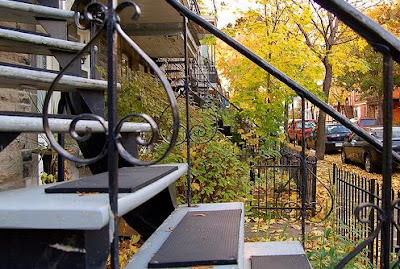
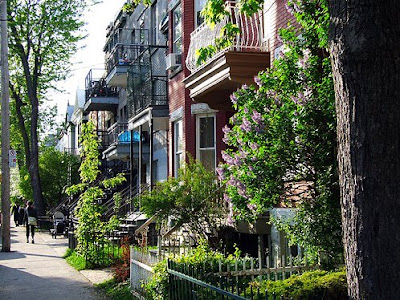
High stoops like these are a signature of this city. I'm not totally sure why. Perhaps you could tell me. Maybe these were additions to turn townhomes into flats to provide more and more affordable housing types?


Or maybe it was to get out of the snow?


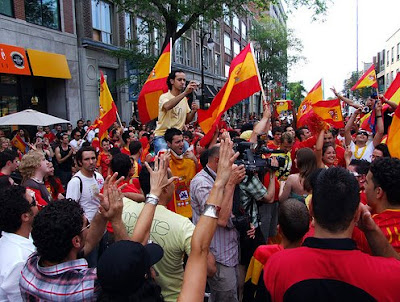
Is it somewhere in Spain?


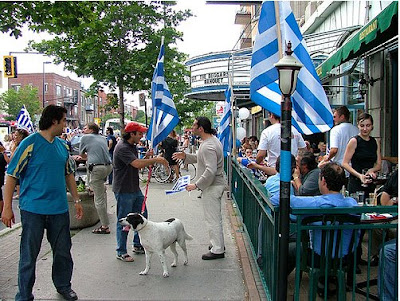
No, Greece maybe?


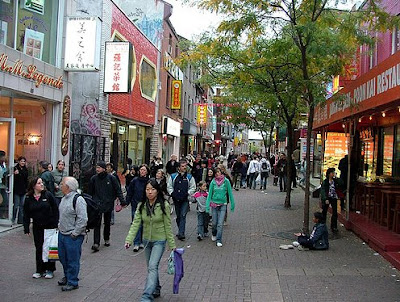
or.....China?? Just know it is also known for its multi-culturalism.


It's old...


...sorta old..


...and new.

New Guy(?) on the Block

Another blogger on Dallas issues has sprung up about "Oak Cliff Urbanism", with a post on 4- and 5-story urbanism with some good photos, if I'm playing "Guess the City," I'd say the majority are Amsterdam. They managed to keep the camera in focus.

I made a comment, we'll see if it gets thru "moderation."

Thursday, November 20, 2008

Quote for the Day

From The Oil Drum:
This may seem like just a feel good story about something that just increases quality of life for some people in NYC that doesn't have much implication for the rest of the country, but consider this: As the Commissioner states, NYC is planning on a million new residents over the next 20 years. Think about how many square miles of suburban/exurban development that will save for farming. Think about how many fewer cars will be produced if those million people come to NYC. What if every city across the country were a more desirable place to live, work, play, shop than its surrounding suburbs?

Wednesday, November 19, 2008

Texas, Next on the Teet

...or maybe not. Interesting article on Politico about Texas losing its influence:
And while The Hammer’s redistricting crusade in 2003 certainly helped Texas Republicans at the time, it has come back to haunt the state under Democratic rule. If not for DeLay’s machinations, three Texas Democrats would likely be sitting pretty these days as chairmen of powerful House committees: former Reps. Jim Turner (Homeland Security), Martin Frost (Rules) and Charlie Stenholm (Agriculture). Instead, they’re all now exes, living in Texas, having lost their elections in 2004. “I guess it’s unrealistic for any state to continue to enjoy national influence dating back to the ’20s and ’30s,” says Frost. “Texas has had this unbroken run. And sooner or later, it had to come to an end.”
Obviously, given the fondness for corruption by many of those elected officials, and their nature as corporatists, since I can't use Mussolini's definition without sounding shrill, this is probably a good thing for the nation. But, what about Texas?

Rahm Emanuel laid down the law at the Wall Street Journal's CEO council offering a sneak peak at what we can expect in or soon after January's inauguration day (and gawd, that day can't get here soon enough - or as Letterman says, "can't the new guy just start early?").

Mr. Emanuel promised that a major economic stimulus would be "the first order of business" for Mr. Obama when he takes office Jan. 20. The focus of spending will be on infrastructure, specifically "green infrastructure," which he said would include mass transit, upgraded electricity transmission lines, "smart" electrical meters that allow consumers to save money by using electricity at off-peak hours, and universal broadband Internet access, which he said would encourage telecommuting.

He stressed that the new administration would "throw long and deep," taking advantage of the economic crisis to push wholesale changes in health care, taxes, financial re-regulation and energy. "The American people in two successive elections have voted for change, and change cannot be allowed to die on the doorsteps of Washington," Mr. Emanuel said.

So, the administration, as we might expect, is planning a broad "green," market-based stimulus package, which is the right thing to do at this stage of the game, a New Green Deal. I would expect greener, more efficient infrastructure would be a part of that, most likely including rail.

So, without Texas officials in important chairmanships, how will Texan representatives position themselves to help their constituents? Arguably, this is the state MOST in need of an overhaul of its infrastructure and transportation, at least towards diverting all of the corrupt highway spending towards rail, especially considering the low rankings we achieved in Cities Prepared for a Post-Oil Future list.

I could certainly go for some of that good, old-fashioned 1880's rail corruption right about now couldn't you? At least, it would give us something useful in the 21st century.

The thing is about rail, is that it scales better and more appropriately than do highways to their context. A highway in Plano, is the same as Woodall Rogers, is the same as I-35 E and W. And, as we've learned, they're like farts in an elevator, they're loud, noisy, smelly, and in some cases, they kill. We went crazy building these things within the city and outside, without knowing the consequences.

Surely, roads, could scale better than they do now, i.e. highways connect cities to outer loops, then boulevards connect the main population centers within cities and a grid is overlapped for local movement. But, we screwed that up and went all highway crazy, because it meant spending, and jobs, and progress (link to 1939 GM (go figure) exhibit at the NY World's Fair)!

[That's a lot of cars to sell]
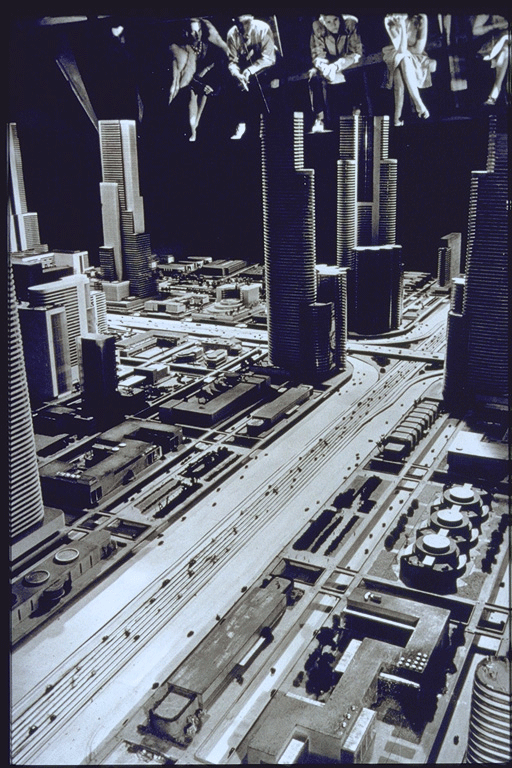

Or, so we thought.

All of those are gone now, and we're left with only the Boa Constrictor around our nexts, tightening, slowly killing before devouring and digesting into a pit of paving, pollution, and pei-weis. Rail, on the other hand, DOES scale appropriately to the distance of travel and scale of development around the station areas, as I have mentioned before.

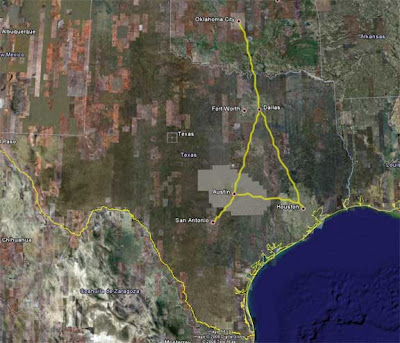
High-speed heavy rail links the major cities of a region, at least in the initial phases, with one station per metroplex:
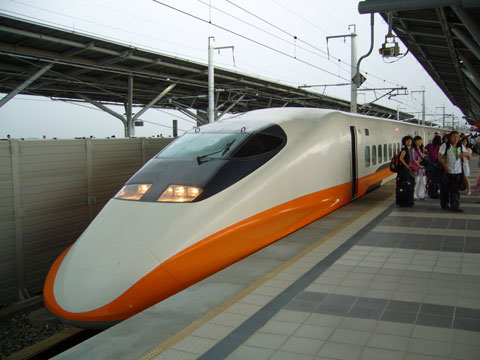


I'm guessing given its location and existing rail network (even if the tracks must be overhauled the rights-of-way are there) that Dallas will have to be a hub for an interstate system. If an initial high-speed rail network in Texas is ONLY in Texas, without cooperation from adjoining states, that would really position Austin to evolve into the capital of Texas in more ways that merely the state capital .


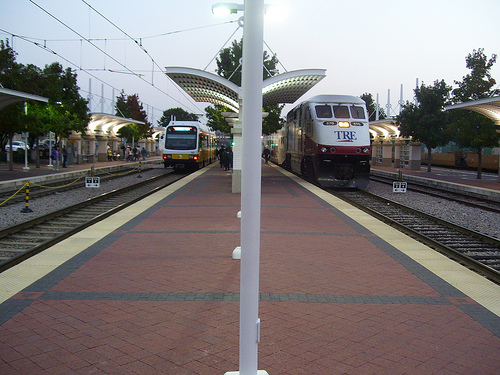
The next level of scale would be the heavy-rail commuter lines linking smaller cities within a region, say North Texas. These would have stations approximately every 3-5 miles, preferrably located near major thoroughfares to allow convenient access for the private automobile and feeder bus systems from harder to reach towns and neighborhoods.

Shown is the TRE and DART trains downtown.


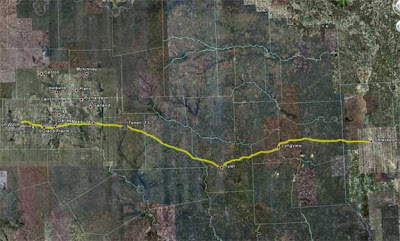
This could also include Amtrak, and from what I understand there is already some push for the cities of Northeast Texas to link to Dallas and Fort Worth via TRE and/or Amtrak.


Next would be light rail, linking centers within a metropolis. These would be the most common of the transit stations with approximately 1-mile service areas for drive-up, bike-up, and walk-up access.

Shown: Mockingbird Station. RTKL project.


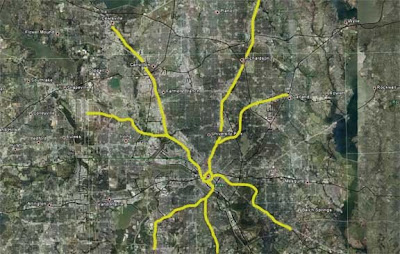
Rough approximation of both current lines and those under-construction or planned.


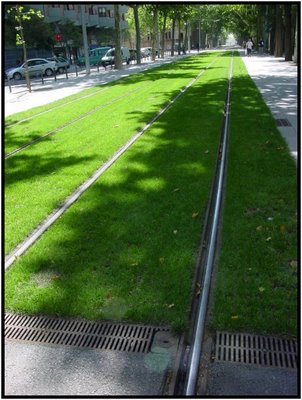
And lastly, the streetcar or modern streetcar as shown. These can have frequent stops, run on the street, often but not always in shared traffic lanes. They support the adjacent neighborhoods and often serve walk-up populations within a 1/4 to 1/2 mile of stops.

Shown: modern streetcar
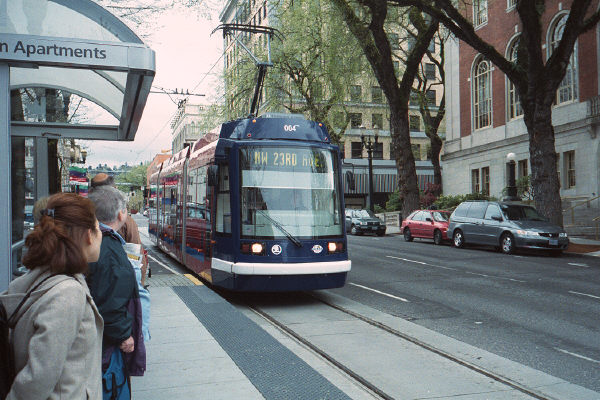


These, with their frequent stops, join neighborhood centers together. I've often said that Dallas feels like a collection of small towns. There are several dying to be linked by modern streetcar (or expansion of the existing M-line historic streetcar) such as Lakewood, Lower Greenville, and Bishop Arts in particular with downtown and the rest of uptown.

Not coincidentally, these were originally built as streetcar suburbs in the early 20th century and as luck would have it, remnants still exist.

Ghost of Cities Past, Present, and Future

More on Obama's office of Urban Policy, Advocating for Urbanism:
There is a certain vogue gathering around urban issues. No -- not inner-city poverty, crime, or joblessness -- but, rather, those issues that might broadly be described as ones of "human geography." Where do people live, where do they work, and how should they travel between the two? How can resources, ranging from good schools to public transit to clean air, be more fairly allocated within regions?
Next Link: PedShed links to two studies on connectivity. Key points:

Twenty-four California cities were analyzed at the block level; half were classified as “safe cites” (severe/fatal crash rates one-third of the state average), and half as “less safe cities” (severe/fatal crash rates close to the state average). The safe cities had

  • an average intersection density of 106/sq mi
  • a walking/biking/transit mode share of 16 percent
  • a fatality rate per 100,000 people of 3.2 per year.

The less safe cities had

  • an average intersection density of 63/sq mi
  • a walking/biking/transit mode share of 4 percent
  • a fatality rate per 100,000 people of 10.5 per year.
Interestingly, the safe cities were well established prior to 1950.
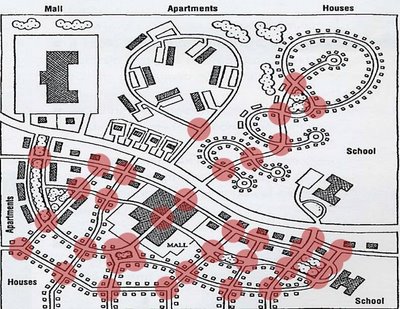
The critical statistic cited above is intersection density. A tight-knit grid (pre-fifties) will have a higher intersection density, or number of intersections per square-mile than the dendritic highway, arterial, and cul-de-sac pattern of post-WWII car-first culture and design.

Shown in graphic form. Sprawl on the North side of the arterial. Interconnected grid network on the South side.


Above, notice the difference between the mall and "the mall." In this crude (when I'm at my best, btw) graph from way back in the beginning of this blog, I discuss how we got to these disparate points and where we are now on our way back to effective and WORTHwhile city building.

One is single use, singularly zoned, singularly accessed by car on freeways and choked arterials (because they're the only way). The mall on the south half forms the same function as a mall (shopping, gathering, strolling, meeting, working) but is appropriately and strongly integrated with its surroundings, accessed by an appropriate variety of transportation modes, and includes various uses such as office, residential, parks, civic, and cultural functions that ensure constant population (or customers for the cynic) and cross-shopping (oh, there I go getting all cynical and "retail-y").

It's called synergy: the art of placemaking; making places worth more than the sum of the parts.


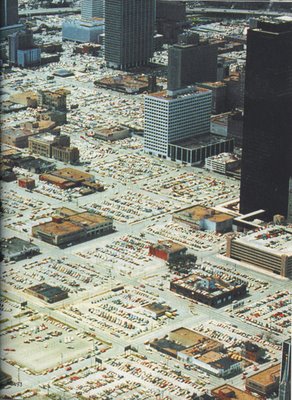
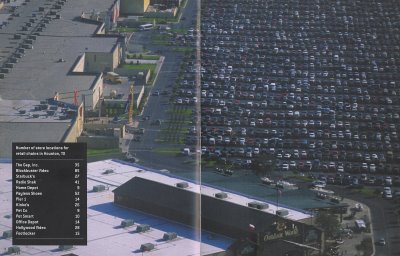
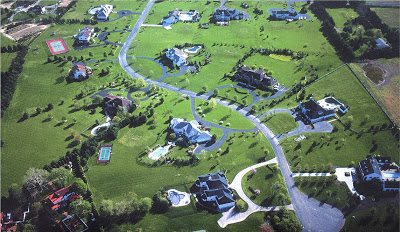
The end product of an auto-centric world, people as consumers:


I'm not saying I'm in favor of banning development like the above. Hey, if there is a market for it, why not. My point is that, the value of these will fall to near zero when we end the subsidies for this type of development, i.e. highway construction and public financing of the infrastructure for less dense development.
These are private driveways essentially, that I/we are being taxed to build. While I'm not in favor of things like congestion taxing (which I plan on discussing in more detail), I am in favor of public service boundaries (which I also need to discuss soon) to make these types of developments pay their full share to live in a manner that takes more out of the public coffers than say I would, living in town with shared infrastructure.

As in the article Conservative Case for Urbanism states:

...common sense came from Congressman John Mica of Florida, the ranking Republican on the House Transportation and Infrastructure Committee. "I can't just continue to pave over every metro area," he said. "Our goal is to reduce the negative impact on the environment and also reduce our dependence on energy."

But the federal government is a hindrance as often as a help, Mica admitted, throwing years worth of bureaucratic red tape in front of states that want to construct light rail lines. "As the federal government, we're a very unreliable partner, and we haven't decided what our policy is," Mica said, adding that he has been working since 1989 on building one light rail line in his central Florida home district, and expects to see grandchildren before the project is completed.

It certainly appears that Obama's office of urban policy plans on, if not getting out of the way, streamlining the federal funding and regulatory red tape, as I have suspected, in favor of a more positive direction. Furthering my point:
Density is cost effective, it fosters small business development at the local level, and it strengthens ties within communities. None of that should be anathema to either national party -- unless they continue to put the interests of construction behemoths and automakers above the interests of ordinary Americans.
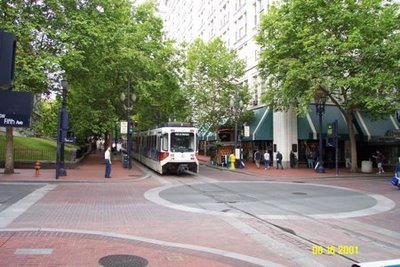
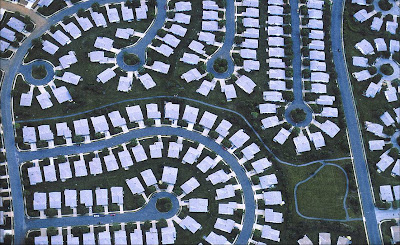
Now, here is People and Community first development, people as humans:


Which looks more pleasant? It's the same that generates a premium in the market place.

Ding Dong, Car Culture is Dead

I'll just go ahead and be the first to say it, "car culture is dead." NYT on import sales down. Think of how much time, material, and energy went into making all of those pictured below at the Port of Long Beach. Sitting. And, we're supposed to give the American automakers public money for getting their ass kicked by these?

I Guess That Answers That

President-Elect Obama responds to the campaign petition from Transportation for America:

Key lines:

...how to convert this moment of crisis into a moment of opportunity. And I think you’ve identified an important part of the answer as well. Our economy is slowing down, we need to stimulate it. Jobs are disappearing; we need to create new ones. At the same time, our infrastructure is crumbling and we need to rebuild it.

Now is the time to invest in our future and strengthen our core infrastructure. You said we must build to compete in the global economy and fix what’s broken, and I agree. I’ll put two million more Americans to work rebuilding our crumbling roads, bridges and transit systems - because it is time to build an American infrastructure for the 21st century. Early in this campaign, I had already proposed creating a National Infrastructure Reinvestment Bank, funded with $60 billion over 10 years, to expand and enhance, not replace, existing federal transportation investments. Now, with unemployment rising, these investments are even more important.

You said we need to invest in green technology, and I agree. I will invest $150 billion over the next decade in renewable sources of energy to create five million new, green jobs - jobs that pay well and can’t be outsourced; jobs building solar panels and wind turbines and fuel- efficient cars; jobs that will help us end our dependence on oil from Middle East dictators.

I support Amtrak funding and the development of high-speed freight and passenger rail networks across the country. As you may know, I cosponsored the Passenger Rail Investment and Improvement Act in the U.S. Senate, and supported the successful effort to get this important legislation to the President’s desk this year. And I’m pleased that the President signed this bill into law just last week. I will also re-commit federal resources to public mass transportation projects across the country. I’ve worked to improve transportation access to jobs for people with lower incomes since my time in the Illinois State Senate, and I will continue this work as President. And I will further promote transit by creating incentives for transit usage that are equal to the current incentives for driving.

Tuesday, November 18, 2008

More Rankings!!!

This time, one that actually makes some sense, as opposed to those Money Magazine best places to live or various other well-published rankings that suggest you should live in Bismarck, North Dakota or BFE, Alabama because the houses are cheap (no shit Sherlock - because nobody wants to live there. How's that fit in your calculations?!) or the public schools won't get your kids shot.

CommonCurrent recently published a report ranking the fifty largest American Cities for their Post-Oil Preparedness. From the ExecSumm:
High gas prices have resulted in sweeping economic impacts. Real estate values in lowdensity, completely car-dependent exurban development—also known as sprawl—have plummeted in comparison to real estate values in central urban or higher-density suburban real estate served by public transit and walkable amenities, which have been holding their relative value.
And I'm going to have to borrow this line, if only because it speaks directly to bizness head's language:
“Sprawl has become the biggest risk factor in real estate,” according to Jeffrey Norquist, President of the Congress for New Urbanism, in reference to the US housing foreclosure crisis of 2008."
Unfortunately, for this report, is that it is John Norquist, not Jeffrey.

Some rankings of note:

The top ten:
1. San Francisco
2. New York
3. Washington, DC
4. Seattle
5. Oakland
6. Chicago
7. Portland, OR
8. Philadelphia
9. Baltimore
10. Boston
It is pretty hard to argue with any of those, although one could probably quibble intuitively with this city over that city or vice versa. Rather, we should probably look at them in quadrants, such as the top 10 (and learn from these cities), the bottom 10, etc.

How's Dallas measure up:

Overall: 32. Behind other notables: Atlanta (14 - wow), Austin (23 - not exactly the nirvana it is made out to be), and (ghasp) Houston (26). That last one hurts. However, Dallas did manage to edge out San Antonio (33), Arlington (34), and Fort Worth (45). Actually, Dallas doesn't beat out a single major city in the country.

With that said, I'm going to have to drill into the content and methodology more closely to see where Dallas fails. While it certainly isn't the model of urban form, it is positioned fairly well (or at least better than Atlanta, Austin, and Houston) with regards to mass transit (DART) and the future of interconnected multi-modal, multi-centric cities/dense cores under a metropolitan planning agency.

So what that tells me is Dallas is doing terribly when it comes to personal lifestyle and mobility choice. Let's see how it does according to these rankings:

Carpooling: 6th with 14.1% - I find this number hard to believe, but whatevs.
Telemarketing: 26th at 3.5% - not exactly taking up the market share people predicted in the 90s eh?
Public Transit Ridership: 26th at 4.2%. Sad, that Dallas probably has better transit than half the cities ahead of it including (F)Arlington which actually is the largest city in the country WITHOUT mass transit, but still...those rankings aren't so bad. Which leads us to:

Walking/Biking to Work: 46th (out of 50). 1.4% walk to work, 0.2% bike. Wow, so I'm actually in less of a minority than a coworker who bikes.

And lastly, most sprawling (which I'm assuming would deal with density per acre or something similar): 43rd. Well, at least not in the part of the city that I choose to inhabit.

ReTooling Auto

Gaining Steam. Harvey Wasserman says, GM must rebuild the mass transit system it murdered, which I suggested here.

In a 1922 memo that will live in infamy, GM President Alfred P. Sloan established a unit aimed at dumping electrified mass transit in favor of gas-burning cars, trucks and buses.

Just one American family in 10 then owned an automobile. Instead, we loved our 44,000 miles of passenger rail routes managed by 1,200 companies employing 300,000 Americans who ran 15 billion annual trips generating an income of $1 billion. According to Snell, "virtually every city and town in America of more than 2,500 people had its own electric rail system."

But GM lost $65 million in 1921. So Sloan enlisted Standard Oil (now Exxon), Philips Petroleum, glass and rubber companies and an army of financiers and politicians to kill mass transit.

Friday, November 14, 2008

Guess The City : Free Beer and a Bonus Beer

For all you fascists and hags. I wish I could come up with a clever line. Have a go mates:

[edit: oh, the bonus is for the movie that was primarily shot in this 'picturesque' town - but someone else must get the movie than the first correctly guessed city]