Monday, January 16, 2012
We Can Do a Lot of Things, But We Can't Do That
Thursday, July 8, 2010
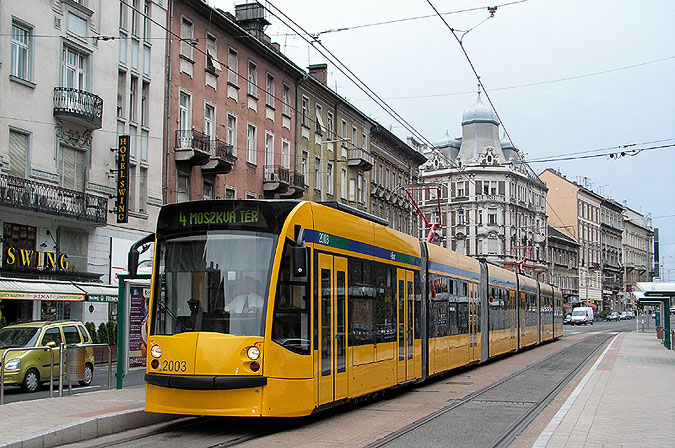
Toot Toot!

It looks like Fort Worth is one of the big winners for more hot stinky federal cash money for new transit lines. From the FTA announcement website:
Project: Fort Worth Streetcar Loop (Urban Circulator)
Sponsor: The City of Fort Worth and the Fort Worth Transportation Authority
Amount: $24,990,000The City of Fort Worth and the Fort Worth Transportation Authority will construct a 2.5-mile one-way streetcar loop with between 20 and 25 stops and three vehicles to connect a Trinity Railway Express commuter rail station and Intermodal Transportation Center with the central business district. This will be the hub of a planned streetcar network connecting six designated “urban villages” targeted for redevelopment to the city’s major employment centers, such as downtown and the Near Southside Medical District. Ultimately, the streetcar system will connect residents in four economically disadvantaged areas to job opportunities in major employment centers, while stimulating the redevelopment of walkable urban neighborhoods with a variety of housing choices.
Dallas also gets a hand in the pocket to extend the MATA to St. Paul DART station and loop back on Olive:
That is about it for Texas projects except for some chump change to Brownsville. Just kidding. Brownsville is probably doing backflips over a $4 million grant for intermodal station. But the question is, what the heck are Austin and Houston up to???Project: Olive/St. Paul Street Loop (Urban Circulator)
Sponsor: Dallas Area Rapid Transit Authority (DART)
Amount: $4,900,000The Dallas Area Rapid Transit Authority (DART) will build a 0.65-mile urban streetcar track extension to an existing system. This project would link the current McKinney Trolley to the existing DART light rail St. Paul Station and to the McKinney Trolley Olive Street Extension in the heart of Downtown Dallas. The connection to the Olive Street extension would form an entire reversing loop for the trolley, making operations safer and more efficient, while connecting downtown destinations such as the Dallas Museum of Art and the Nasher Sculpture Center to Uptown Dallas.
Friday, July 2, 2010
The Man Behind the Curtain

In this case the man, isn't actually a man at all. I am speaking about one of the many root causes facing depressed or underperforming downtowns much like Dallas while too many focus on the superficial issues. If we are to change the way our City looks and functions, we have to amend the urban "genotype" (underlying coding and dynamics) and the phenotype (physical form) will take care of itself.
Last night, like one of many in a standing room only crowd at the Belmont Hotel, I listened to former Vancouver City Planning Director Larry Beasley talk about stuff, while everybody nodded in affirmation exactly as they were there to do.
Beasley, did what just about any of us would do in a similar situation, and that is to capitalize on being in the right place at the right time and enter the private sector to export his experiences elsewhere.
In Vancouver, a city that smartly rejected highways into its City to protect the intricate urban ecology of personal and economic interdependent connectivity, helped mold the regulatory environment when Japanese money by the gazillions found a safe haven during their lost decade in the form of real estate in a land locked City where there was literally nowhere to go but up, and the job was to establish the invisible volumes where investment filled in the form of a livable, urban structure. A beautiful city no doubt, but also not without its problems and advantages.
We listened to him discuss HIS theories on cities which are really no different than anybody else's, but like an experienced marketer, they are his. He talked about how he will do work in Abu Dhabi, but Dubai as if one is really different than the other (ya know, besides the fact that Abu Dhabi actually has oil, therefore still has real money to pay him unlike the flaunting, dancing, showboating, self-conscious sister city).
Eventually the dialogue turned specifically to Dallas where a Q about downtown led to the following A:
Downtown Dallas has too many surface parking lots and vacancies.Glad he's here. Sorry, for the so revered, I look for more nuggets of useful brilliance at $300 per hour or whatever his consultancy rate is. These kind of simple, superficial observations lead to the rabble asking, "why don't we just fill'em all in?!" without asking the real questions, the tough questions of ourselves.
To bring Dallas to the standard we pretend it to be, we hope it to be, this must be a deeply introspective process. The less we are willing to directly and honestly address them, the more expensive the revitalization process will be.
The real issues at hand are written deep into the DNA of the City and it will take political action to undo and rewire the double-helix toward a sustainable, enjoyable, productive City of the 21st Century.
The particular issue of downtown vacancy and underdevelopment must first acknowledge that the surface parking lots and parking garages littering the downtown core are the highest and best use of a downtown designed and built as a supersized office park with its suburban car delivery system.
That highway system undermines demand. Demand which manifests itself as desirability, which in turn becomes investment which fills those invisible volumes in the way of vertical buildings and leasable space stacked to the limit demand will allow.
Downtown Dallas isn't New York City but we pretend it can yield similar heights of buildings, which in turn projects itself into land costs, which parking lot owners (currently generating revenue) won't unload until they get a number that puts a sparkle in their eye. That difference of opinion regarding value of the land, then manifests itself as a gigantic gap between cost and profitability, which must be made up by city subsidization.
Rather than making a potentially politically difficult move of "taking" away the perceived value of the land by declaring surface parking lots dangerous to public health or applying height limits on land to establish a more predictable value, we seem to be intent on the simple and expensive route where investment greatly exceeds the return for the City.
Looking deeper, a recent article in Seattle rhetorically and self-indulgently asked, "which is the real problem suburbia or auto-dependence?" Being a self-aware, politically astute article, it didn't want to demonize the failed model of suburbia where most people lived. It knew its point before it started and declared, car-dependence as the problem without acknowledging both are not causes but rather symptoms of deeper policies, which effectively subsidize parking, free roads, and more and never-ending road construction.
One of these codification issues is that of traffic engineering and the supposedly scientific but decidedly inaccurate methodology of traffic projecting (and potentially even disingenuous if not corrupt).
These formulae are intended to determine how much traffic will potential development generate and how much road capacity must be expanded by to accommodate. By making every trip a car trip, a truly suburban model, it becomes a self-fulfilling prophecy. All roads must be widened.
And as we know, wide roads and fast moving traffic provide a negative experience between building interface and conduit (if I'm to use the terms of a Houston blogger), much like putting two North-poled magnets next to each other.
The other issue is that this is a completely backwards way of city building. Historically, before more speculative supply-side expansion, infrastructure followed growth rather than expanded infrastructure leading growth. When it happens backwards like this, not being demand driven, it ends up cannibalizing from the core city leading to an unsustainable condition of overextended infrastructure. But, road building meant jobs and profligate Keynesian spending and greenfields once provided a promise that city's plagued by poverty and pollution once couldn't live up to. They can now, as suburbs have proven to be desolate deserts of mental and emotional stimulation.
The process works by often arbitrarily saying that x amount of square footage of y land use will go here and we will have to build a road to it, to make it achieve that promised level of tax base. As mentioned, the problems arise in that all uses, no matter location, modal choice, street network, density, etc. is properly factored into the equation. My loft downtown generates the same amount of trips as does a house on a cul-de-sac in Wylie.
Fortunately, other people are acutely aware of the bluntness of our urban instruments and some cities are actively working to establish proven hierarchies for better traffic modeling, such as San Diego which recently adopted a classification dichotomy of essentially walkable urban mixed-use and conventional suburban development.
The question then becomes, is this enough? I would say no, but optimistically suggest this is just a baby step towards a smarter system. One reason, is that I'm already aware of a third level in the hierarchy from local developments. Rather than walkable urban and suburban, there should at least also be walkable suburban. I say this because residential mixed-use projects in very urban areas of Dallas have shown a 40% decrease in car trips from the conventional standard and residential mixed-use in walkable suburban projects have shown a 20% decrease (of course, there is a quality of planning and design quotient to be applied here -- not all "mixed-use" projects are the same).
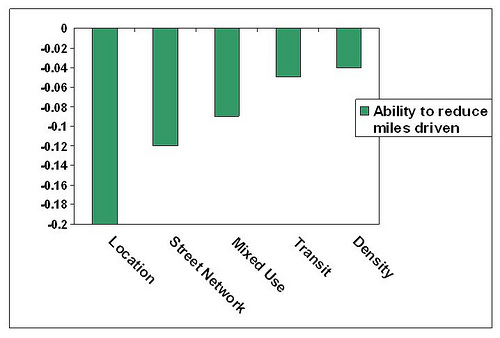
Furthermore, these are all about car trips and the majority of car trips are less than 5 miles. As we build distance appropriate infrastructure amenable to sustainable transportation, the mode share of other forms increases, which in turn increases the capacity of infrastructure as a road can handle far more people on dispersed forms of transportation (foot, bike, bus, and car, etc.) than car only.
This means both further reduction in necessary pavement down the road by reducing trips and increasing the share of other forms of transit thus increasing the capacity of existing streets. For broke cities, states, and DOTs, over-abundance of right-of-way will be the number one long-term strategy for getting out from under the budget crunch, and building more resilient, efficient lovable cities.
But, we have to have the tools to get there.
Tuesday, April 20, 2010
A Clockwork Orange Line

Eye-opening ideas.
With funding problems a plenty for not just the orange line, but virtually all planned transit lines the DMN Transpo blog has an excellent idea up from the awesomely Texan-named Garl Boyd Latham.
What we are learning is that we actually can't have our steaky-wakes AND eggy-weggs AND eath them too all at the same time despite knowing full well that transit capacity and hierarchy of service is necessary for the city's and region's long-term viability. The world is no longer made of funny money...and this is a good thing. Funny money makes for incredibly (and sometimes indelibly) stupid and short-sighted city planning. It gives us time to pause...and prioritize. What is most important?
Latham's idea is to finish the Orange Line to the airport and I agree with him that connecting downtown to the airport(s) should be a priority, representing a carfree link to the global economy. If your city doesn't have that, good luck in the competition of cities of the 21st century.
One issue with the Orange Line as currently planned is that once complete, it will create a logjam of trains on the existing downtown line along with the Red, Blue, and Green all converging along the same corridor of limited capacity and inherent (in)efficiency to move them all through the City. Hence the reason for D2. The thought was that D2 would run through the southern portion of downtown, alleviate pressure on the current line and leverage private investment in the neglected areas of town.
Sounds pretty good right. Of course, there are also financial realities. One D2 alignment costs approximately $300 million. That's the cheapest. The City's preferred alignment, to the new "bricks and mortar" project, the convention center hotel, costs approximately $600 million (jaw ->floor).
Oooooooh-Kay. Time to rethink. Rather than run a second line through downtown, Latham suggests running the Orange line directly to Union Station, eschewing the train traffic snarl on the current line.
A direct link from airport to Union Station immediately increases Union Station's significance within the city. Currently, it is an afterthought. If that becomes the single place for businessmen (and women) to catch their ride to the airport, it once again becomes a hub of activity. Furthermore, it is only two blocks from the Convention Center Hotel and provides the opportunity to leverage the value of land around Belo into functional urban fabric.
His other idea is to effectively replace D2 with streetcar. I like this idea for several reasons:
- Streetcar is cheaper than DART lines which are much closer to heavy rail than they are light rail. Streetcar can cost around $20mil/mile where DART lines could be anywhere from $80mil/mile or in downtown or subway type conditions upwards of $200mill/mile.
- Streetcars run on the street and help to calm traffic making downtown roads more walkable, which is necessary for urban investment and development.
- DART hasn't shown the ability to leverage much in the way of retail activity. My guess is the reasons are two-fold: it serves a much larger area meaning that, like highways, it serves macro-destination to macro-destination: 'burb to job center (downtown) whereas streetcar is much more fine-grained. Second, it hasn't shown the ability to "mingle" with cars and pedestrians alike the way streetcar can.
- The geometries of a heavier rail like DART make it difficult to turn and corner within the confines of downtown urban fabric. We end up with more spaghetti under in and around the freeway spaghetti which act as barriers, further disconnecting downtown from its foundations, the neighborhoods adjacent.
- Streetcar is best at leveraging investment in areas immediately adjacent to downtowns, which I'm slowly but surely leaning to the opinion that Downtown is so constrained that if you don't remove the freeways, you have to build up the value around downtown in order to make downtown viable.
- Because streetcar is more pedestrian friendly AND cheaper, it generates more bang for the buck by way of private investment, which means...
1) Run streetcar from Union Station to Oak Cliff as is currently planned.
2) Run streetcar from Union Station down Canton/Young into Deep Ellum.
3) Do NOT move MATA off of St. Paul and extend it past Main Street Gardens to intersect with the new Canton/Young line with plans to eventually run it to the Cedars.

Everything is linked into Union Station, and if we ever plan on having High Speed Rail, Union becomes a true multi-modal facility serving the various necessary hierarchies of transportation in order to properly link downtown with the local, metropolitan, regional, state, national, and international economies and returning "pride of place" back to Union Station as downtown Dallas's front door to the world.
Thumbs up.
Tuesday, April 6, 2010
Lessons from Charlotte and the Challenge Defining Livability
A sampling of the remainder of the article, about a City that suffers similar maladies as does our own hometown here in the Big D: a choking inner ring highway around its downtown (what they call uptown - backwards, I know), areas of the city completely disconnected and isolated by freeways and railroad lines, overly wide streets with a preponderance of one-ways, over-scaled bank towers and their enormous supportive infrastructure and delivery systems, and surface parking in the downtown as far as the eye can see (once again proving that with all of those highways and roads, surface parking is the highest and best use):
Charlotte's vision:
In year four of a 25-year plan, the city is laying the tracks for an intermodal passenger system with a full menu of mass-transit options, complete with light-rail trains dropping off passengers in Uptown and at a central high-speed rail station, and streetcars running from center city to the international airport.
The ineffectual nature of buses:
The ridership numbers for the city's first light rail line help to make the case: More than 70 percent of the system's riders had previously never been regular passengers on Charlotte's bus service, according to the city.
The invisible hand is always attached to an invisible arm of gub'mint:
Leinberger likened transportation planning to "a rudder of a ship" that ultimately controls where and how private investment flows.
The challenge facing cities with no additional Federal funding support:
"With no additional revenue coming from the federal government, this is going to be up to local jurisdictions to raise the money," said Leinberger. "There's just not sufficient money coming out of the federal government."
Projected return on investment:
To that end, Charlotte's planners say the city is expecting $1.8 billion worth of investments to be made along the first line by 2011.
The question then becomes, how do you foot that big ol' bill when both the calculable and incalculable returns on investment are well documented locally and nationally? Does the city raise taxes to pay for it? Does it issue bond packages? Is there a way private investment can capitalize on the opportunity through development potential, considering the biggest winners will be land owners near proposed transit hubs, the public sector through increased tax base, and a citizenry no longer shackled to the cost and tyranny of automobile usership (usurp-ship?).
Considering streetcar lines were privately built to unlock the value of land outside the immediate downtown (what we now call "inner ring neighborhoods"), I am guessing that it will require some or all of the above in a cooperative public-private partnership, only made more difficult this time around with fractured, parcelized land ownership of the targeted and oft-faltering neighborhoods.
The planning and design part is easy. On the financial side, it is most certainly going to take some brain damage, but it will be well worth the effort.