Showing posts with label pent-up demand. Show all posts

Wednesday, January 25, 2012

Why Are Skylines Roughly Conical?

I want to take a graphic look at some concepts I've been developing lately, in conjunction of course with the work it builds upon, including the Bartlett School at the University College of London and their work on mathematical models of spatial integration as well as the Andres and Douglas Duany codeveloped concept of the transect.

Spatial integration began as a scientific examination searching for objective realities to urbanism. Why were cities and their patterns so similar? Where and when have we begun to go wrong? And is the aesthetic, subjective driven world of Modernist architecture partially to blame?

Completely independent of this work, the Duany brothers saw similarities in the gradient of intensification of cities as you got closer to the core with various ecologies, particularly coastal regions:
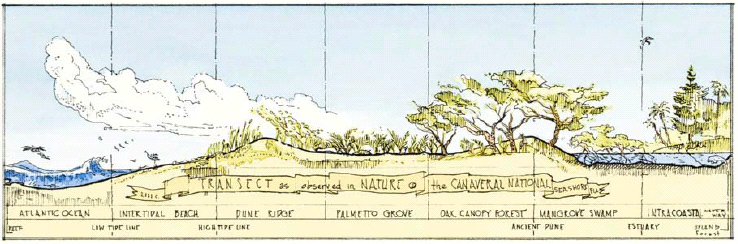


This, became this:
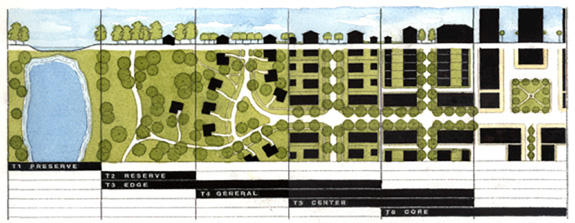

Both relied, perhaps intuitively on the concept of centrality, which has its origins in the study of social networks. Since cities are the physical platform for social and economic exchange, empowering the links between them, network studies had direct relevance. Cities are networks.
But the Transect never really digs into why what was where. Sure there is a dense node at the center, with an decreasing gradient the further you get away from it. But what created centers in the first place? That is where space syntax began examining infrastructural networks. Professor Bill Hillier and his pupils/colleagues found a correlation between social network analysis and infrastructural networks. That is, social hubs have the most connections. The highest degree of integration. Likewise, this parallels with the internet. The highest trafficked sites are hubs that all others link to. Think Google. From there exists a hierarchy from most to least.

Likewise, cities have a similar hierarchy. The most connected places, have the highest degree of integration, which in turn means the highest degree of opportunity. Where there exists the greatest demand, to which the market responds with supply. Building space. Where demand is greater than supply exists the most opportunity for developers. Where integration is highest is the most opportunity for every citizen to meet their needs for social and economic exchange.

This concept exists locally, within one city, as well as globally, amongst all cities. New York, London, Tokyo, Paris, etc., are global cities because they are the most connected, both locally and globally. Within a single city, you also have a hierarchy of centers. All cities are polycentric once they get above the scale of the tiniest of hamlets. This is what sprawl apologist hacks like Joel Kotkin fail to understand. When they talk of polycentric, sprawl-based cities as polycentric cities of the future, they fail to see that New York is also polycentric. Those centers just blur together rather seamlessly, except where geographic barriers (water bodies) or physical barriers (such as highways) divide and isolate them.

Space Syntax map of London:
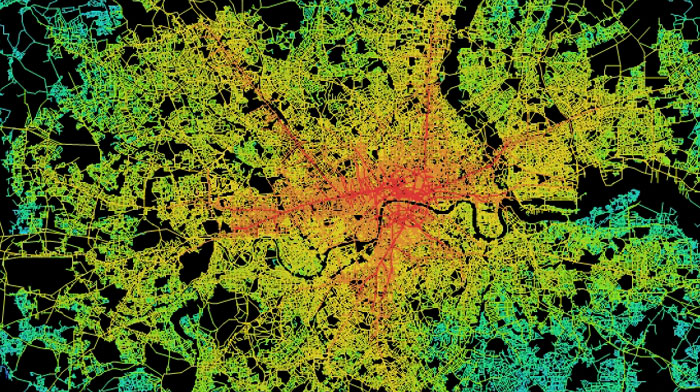
What they found was that there is a correlation between traffic and value. Just like with any network, particularly the web. The most trafficked sites have the most value. Remember that traffic doesn't mean cars, but people. This is a direct relationship in what I call logical cities. High pedestrian areas have far more people moving past, and capable of interacting with you (economically or socially) in these high traffic areas than does car-based traffic, which has to turn, wait for lights, find parking, etc., all of which accounts for increasing degrees of disconnection, dislocation, and inflexibility.

In the logical city, such as the London-based map above, there is another chicken/egg based component to it as with all complex, interconnected systems. The infrastructure funnels traffic to specific places and specific places also "bend" the infrastructure to them. This is why I call them centers of gravity, what many planner types call "nodes". They literally shape the city around them. Increasing their level of interconnectivity, raising demand, and eventually via opportunity, supply.

Because of the chicken/egg scenario, this also means that infrastructure can create places out of thin air, such as when two railroads meet in the midwest. The traffic intersection becomes an opportunity. And many cities are here today because of such a phenomenon. I'll look at that a little more later.

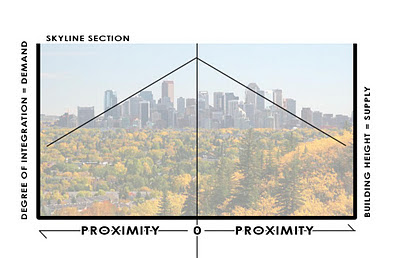
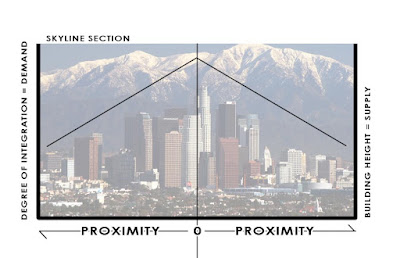
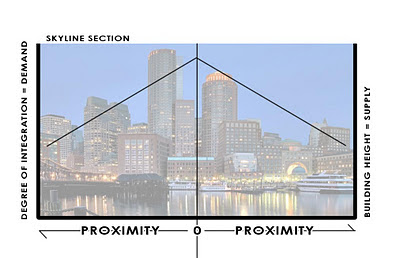
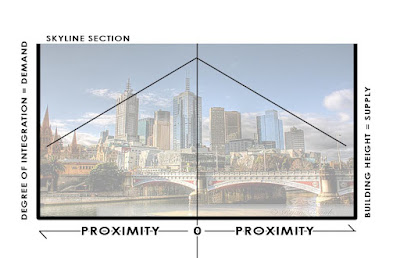
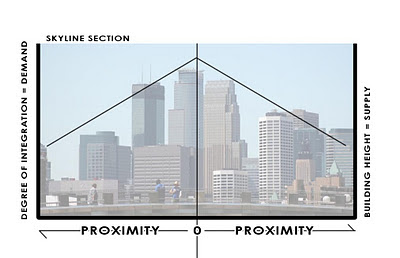
But first, here are several skylines:
While this is Dallas and the exercise is admittedly abstract, I want to show why downtowns have the biggest buildings. And why severing the interconnectivity to them, is why many of Dallas's buildings in downtown are quite empty, for example. As I have written before, Dallas experienced a building boom (high-rises) at the exact same time that the city, state, and federal level were gorging on highway building. Supply was being added while demand was being undercut, shipped out towards the suburbs.

Those polycenters, instead of being closely interconnected, became Las Colinas and the various highway adjacent corporate office parks around the metroplex. That they were newer or the space is better and they are "grade A" office is irrelevant. The newer development would be in and around more walkable, more highly integrated and interconnected places (more authentic places). They would also prove to be more resilient. I expect, unless they drastically reposition themselves, many of these office parks will fade into dust. With new light rail (another degree of interconnection) and residential, Las Colinas is already doing that.

Compare our growth to say, L'Eixample neighborhoods in Barcelona and Valencia. These were rapidly expanding areas, literally doubling city size, but they did so aggregately. These are both now considered the "old money" areas of those particular cities, and very much still central city as growth then enveloped them.
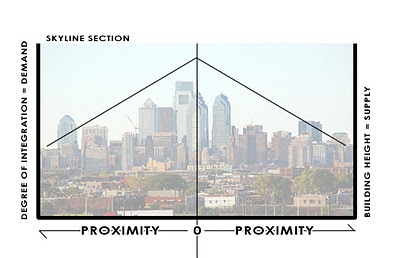
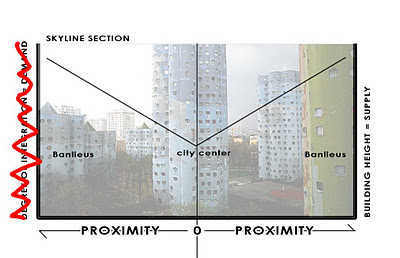


The dynamic changes a bit for cities like Paris or Washington, D.C. Both cities with extremely high levels of integration, locally and globally. Remember, that local integration is the foundation from which density and resilience lie upon. The most connections can be made locally in dense, walkable environments.
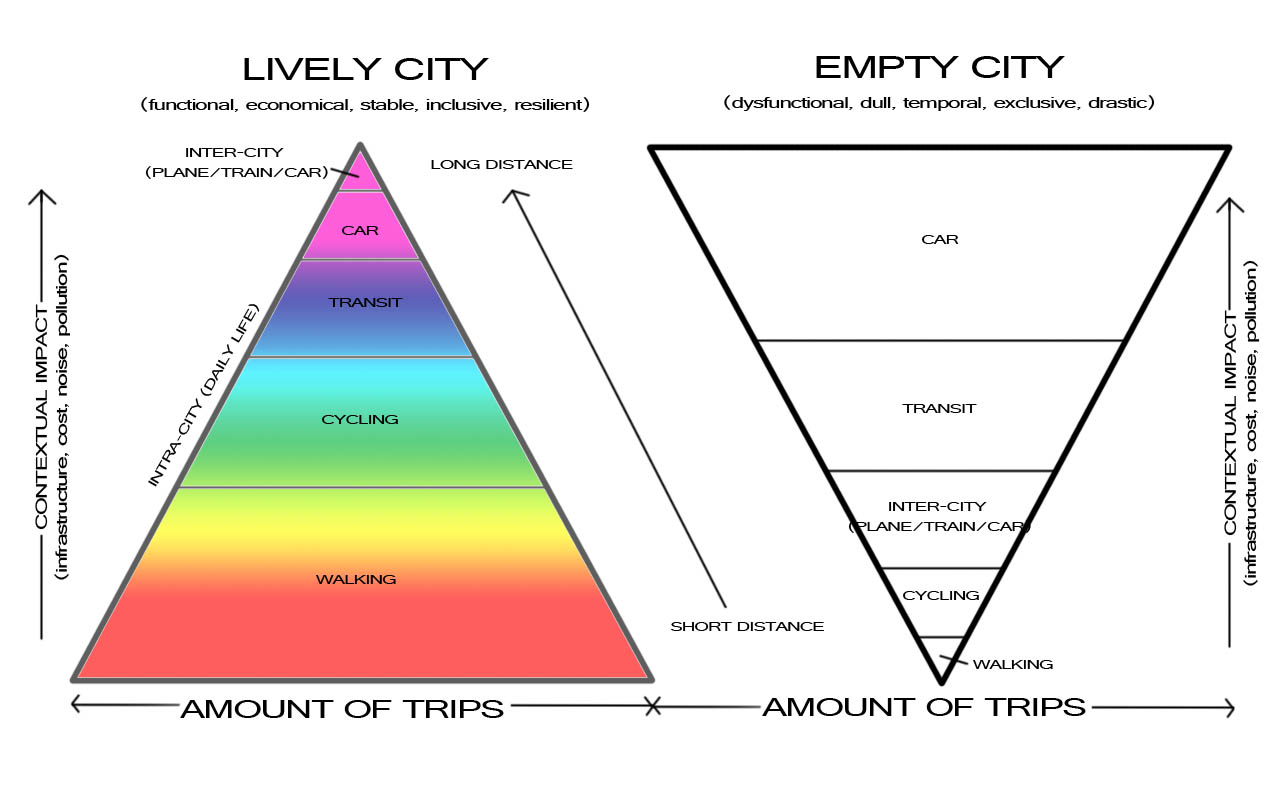
Because the level of integration is so, demand is extremely high to be in the center of Paris (or D.C.). But height restrictions limit the amount of supply of usable building space, making prices skyrocket. The center of Paris is amazing. Who doesn't love it? But it also leads to this condition where opportunity then shifts outward, toward the Banlieus, or suburbs:
The supply is much greater than the demand, which is to be actually in Paris where opportunity is high. But it the market can't meet the demand, so it spills outward. Too much supply, with too low levels of integration. There isn't a natural, organic match. This is made even worse with the design of the "towers in the park" housing for the poor. Whether they were built for the poor or not, eventually they were doomed to devolve because of supply being much greater than the demand. These types of Corbusien buildings are physically isolating, cul-de-sacs in the sky. In effect, the supply is borrowed from the areas with higher integration, higher value. Not coincidentally, these are the areas where Paris experiences the most civil unrest, in homogenous areas of poverty exemplified by socio-economic isolation. Isolation. As in not integrated.

However, this is not to say whether Paris or DC's restriction on building height is wrong. That is a political debate. In my estimation, these cities heights or lackthereof is precisely what makes them so special. 1) The building heights remain humane, lower to the street level, and more interactive. And perhaps more importantly, 2) the demand pressure exerted upon a limited supply ensures that the limited space will always, ALWAYS be maximized. And buildings will be preserved rather than destroyed.

The real issue is improving the connectivity, integration, and walkability within and to the suburbs. Here is where I shift in language from banlieus to suburbs because the need is universal. American suburbs may not have many, if any, high-rises, but supply is currently way above demand, as defined by spatial integration values. Values are plummeting across the country, not only because of the evaporation of liquidity (real or imagined), but also a general market realization and price correction towards this supply/demand imbalance.

There is a movement afoot to "retrofit suburbs." While there is certainly opportunity to do this, and a necessity in many cases. I'm afraid that while some areas will be fine, some will need salvaging, while others are fairly doomed. We simply won't have the capability of retrofitting ALL of them. And by retrofitting, I mean increasing their local connectivity/integration quotient to instill, increase the demand to catalyze the new infill that the retrofitters propose. There will be extreme levels of competition and upheaval, I expect, in American suburbs.

As for city growth:

As I mentioned earlier, it all starts with an intersection. This could be anything:

Two railroads crossing
Two ancient trade routes
Fertile soil and a deep water port

The connection globally has to be strong enough to maintain the raison d'etre. The local connections, like walkability, ensure that the place is efficient and livable. And that people like living there as opposed to the competitors. It is also important to note that no cities current place within the hierarchy is the place it will reside in 10-, 20-, 50-, or 1000-years. Such is the competition amongst cities. And such is the need to maximize local and global connectivity, as well as the raison d'etre for that city, whether it be energy production, idea production, or a socially vibrant place. Whatever it is, it better be timeless. See: Detroit, autos. West Texas, exhausted oil wells. Heterogeny ensures timelessness. Or something approaching it.

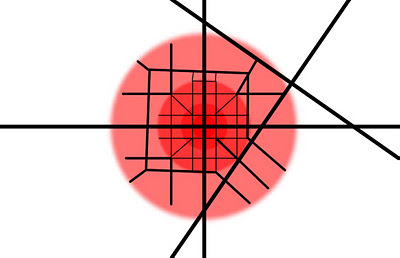
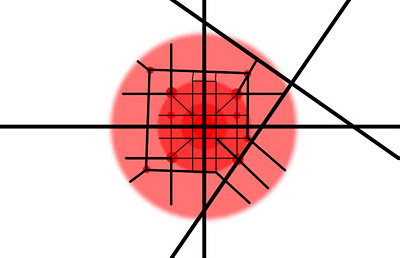
Here is the intersection. Imagine it is any of the aforementioned. The red implies the neighborhood development.


If the raison d'etre is strong enough, its opportunity level persists. It attracts more people. The city expands, aggregates:


Eventually, maybe it grows to the point where it needs more global connections. And as technology advances, the infrastructure is needed for those global connections, such as an airport and an interstate. However, all global movement is destructive to fragile local interconnections. Highways and airports can have negative effects upon overall interconnectivity despite increasing global connectivity. Local connectivity drops, therefore demand drops, therefore desirability and opportunity drop and eventually people will leave that city. That is why these global infrastructural networks must be treated very carefully, connecting with cities tangentially.

Vancouver didn't allow freeways into their city. Paris is removing all of them inside the peripherique. They're connected to their airports via subway. Subways are built because at-grade and above grade tracks are disconnective. Below grade is supremely expensive, but as all cities who have them have found, worth the high initial cost to preserve the fabric above.


And within those overall connections, smaller nodes or centers of gravity will emerge at the various convergence points. That is, only in the logical city. In the illogical city, where connections are disruptive and diminish overall connectivity and the ability of its citizens to meet their social and economic needs for exchange, a tension is created. The tension is two countervailing forces. That towards traffic, ie traffic = value. And the opposite force is the repulsive nature of those global connections, ie highways and airports.


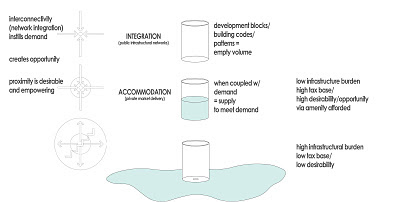
You may have to click on the below image to expand it. It's one I've been working on to explain this concept. At the top left we have attractive nature of convergence. People create infrastructure to create opportunities for social and economic exchange, meeting points, trading places, markets. When you disrupt that network, you shift the magnetism so to speak, like putting two like poles of magnets next two each other.
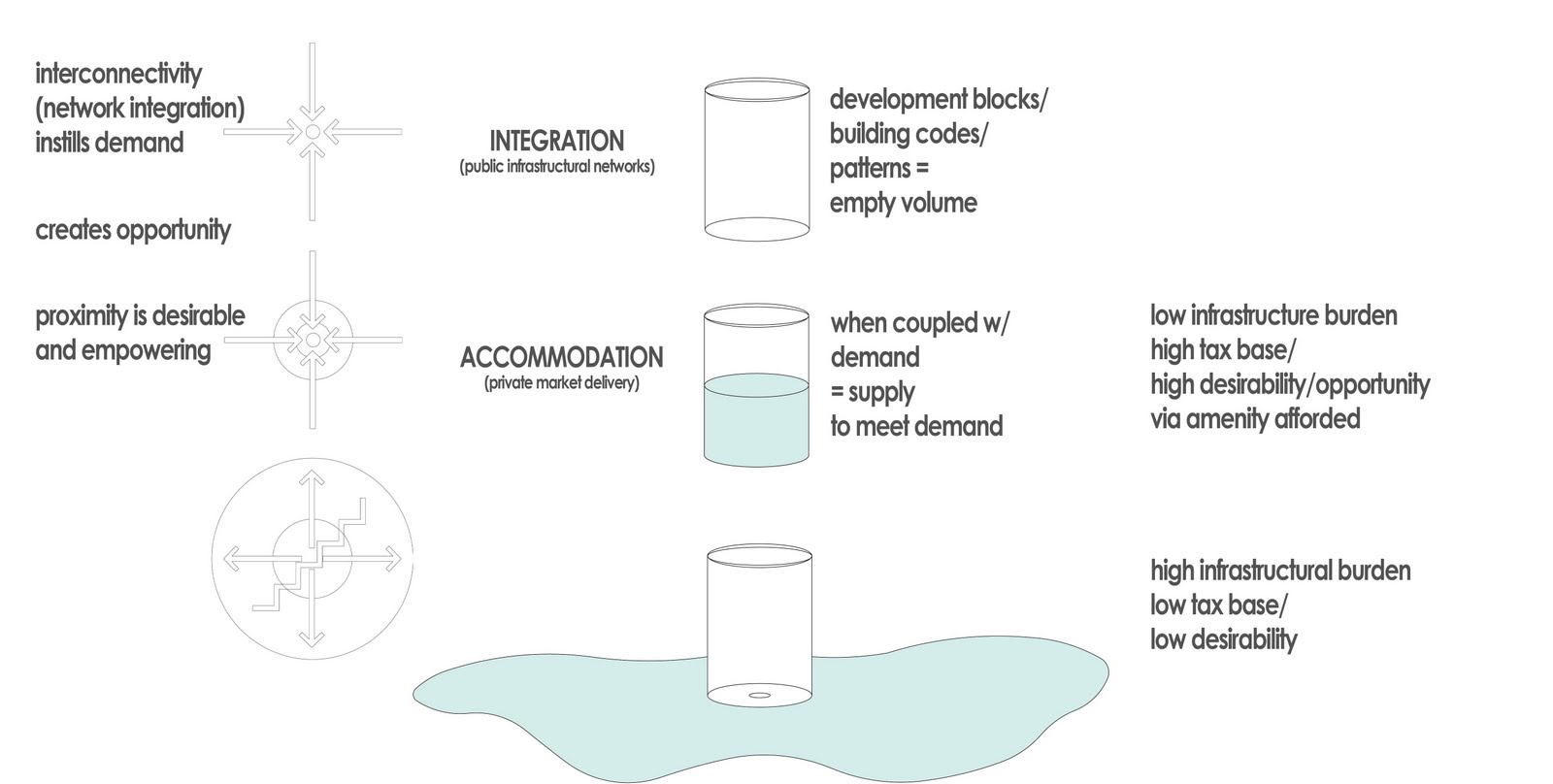

When you look to the right diagram, the glass is supply of building form. The demand is liquid. When you interrupt local connectivity and overall integration (often for the sake of global connectivity), you are essentially creating a hole in the glass. All of the demand spills outward. You get sprawl and an empty glass. Like downtown Dallas highrises.

Wednesday, July 7, 2010

Post Holiday Linkages

The New York Times finds that on average urban living costs 18% less than its suburban compadre:
But the one big caveat in all the calculations is private schooling. If the city dwellers decide to send their children to private school — say when their children hit middle-school age — that expense would instantly make the suburbs a bargain.
Which is then supplemented by a senior level person at a brokerage firm who really offers no real analysis or insight beyond application of their own preferences, which makes you wonder what value does this person bring:
“At some point, the benefits of the city are not worth the things you need to give up,” said Jessica Buchman, a senior vice president at Corcoran, a New York real estate brokerage, for instance, when five people have to share one bathroom, or there’s no outside space.
As I've said over and over, it is about choice and meeting market demand. Truly urban places cost high for two primary reasons, the shear economic vitality raising salaries and the demand to be near that energy. If somebody's job (such as Ms. Buchman's) is to hinder or skew market perception or its ability to meet demand, then these are people you should be wary.

Speechless, I type to reiterate. I'm always flabbergasted at real estate professionals and experts who say people want one thing when price as dictated by supply and demand contradicts everything they say. This statement is NOT brought to you by the National Association of Realtors who want to remind you NOW is the BEST time to BUY. Please! Pretty Please! They'll even toss in random sex acts.

---------------segue----------------
Relatedly, two things pulled from the Patrick.net housing bubble mailing list:

Low mortgage rates scream now is NOT the time to buy, and

Yahoo Finance thinks housing could have as much as 50% more to fall.

I've been expecting a double dip for a while now if for no other reason than historical consistency and the human response to bear markets to beat the rush back to bullishness. Once that first wave fails to inspire necessary confidence in the market, back down the well it goes.

This has real world logic to it as well. The first fall could be very well attributed to too much fake money floating around in the system. Less money = less buyers and lower values. The next dip, which we haven't fully seen a correction for yet is the over-abundance of supply in conjunction with being in the wrong areas.

As cities reposition inward, that has to cannibalize from somewhere. That somewhere will be at the edges and areas not well served by transit or of extremely high end homes that will be able to maintain the properties (if they choose to remain secluded -- which is entirely possible if perhaps not probable).

-------------------segue---------------
Wall Street Journal picks up on the market demand for walkability:
A walkable neighborhood doesn't necessarily have to be in the city center. And it doesn't have to be more expensive. Eric Fredericks decided in September that, with the housing tax credit, it made more sense to buy than to keep renting. Planning on kids, he and his wife wanted a three-bedroom house in Sacramento, Calif. "We never considered living in suburbia," he says. But they found a new development in a suburb called Rancho Cordova organized around a main street, with stores and restaurants. Their 2009 house is six inches away from the house next door and a couple of blocks from the town center. It cost $240,000, half what he says he would have paid for a comparable place downtown.
Included if only because I once worked on some strategic planning strategies for Rancho Cordova as a young pup shortly out of school.

The rest of the WSJ article is a kindergartner's guide to the flaws inherent to WalkScore's current valuation methodology. See here for much better analysis.

-----------------------segue------------------
And lastly, Blair Kamin says to keep an open mind about pedestrian malling urban streets:

Clearly, there’s a hunger out there for better public spaces, especially in the city’s neighborhoods. With his ubiquitous median planters Mayor Richard Daley has given us beautiful streets, but the commenters also want livable streets—places where they can gather, socialize, and catch a break from the relentless two-dimensionality of computer screens and mobile phones.

Two contrasting issues with this. Pedestrian malls failed horribly in this country once already. But, it should also be noted why:
  1. Suburbanization had already begun. Policies too numerous to count here shipped people out of cities by the tens of percent of population.
  2. Because of this, density was not high enough to support pedestrian only places
  3. In some cases they were overly ambitious, closing too much down at once
  4. In other cases, transportation policy ensured the pedestrian only areas were isolated by barrier streets of intense automobile movement.
  5. Modernist design was often overly brutal, hard edged, inhuman, and theoretical if not ideological and therefore disconnected from our biological needs, preferences, tendencies, and sensibilities.
With that said, we are moving back towards the cities and temporary closures are proving very successful around the country. We have to be very cautious however, in our implementation of street closings. They should be phased incrementally in conjunction with increasing density and decreasing road capacity for cars. They should also be in areas that are easily accessible and prominent, rather than out of sight, out of mind (which is how some traffic engineers would prefer it). These areas then become dark alleys or "dead cat space." Hardly revitalized.

Thursday, July 1, 2010

Where the Next Gold Rush Will Be

Cities and economies are always under the pressure of "growth," whether that be in economic activity, productivity, or physical expansion. The last of which is what twists the meaning and understanding of the inherent need for improvement. Perhaps "improvement" is the preferred terminology. Either way, it is first necessary to understand that this is the way we are wired. Second, we must put in some brain damage to minimize misteps

If we're to apply the colonization habits of the honey bee, it is that they are on constant lookout for new nectar, new manufacturing opportunities for their very specific industry. The workers look for new territory and return to the nest "marketing" their finds. Other bees follow in order to "test" these finds based on the prospector bee's marketing abilities.

Obviously, marketing can only get a colony so far, as the new lands actually have to prove productive, useful. The way of testing these new finds for their utility is the colony expands outward to the new finds much the way outward growth from a city does, testing the temporary value of the land to the needs of the day. As some prove more valuable than others, the shape and size of the colony follows the ability of the land to support it. Some expand, some recede.

With that, we are finding that much of our recent suburban growth (that of the last 20 years) is proving to lack resilience, importance, and usefulness. In fact, the things holding them up are largely due to temporary inertia based on population as it exists today, not in how it will exist in the future. For example, good schools are largely considered to be in the suburbs. But, as countless examples show, good schools follow population much the way a Whole Foods or a Target might.

Because of this constant testing and shape shifting, I wish to challenge the tautology of a few points of conventional wisdom and offer some ideas for underserved markets as to where the next areas of growth will be as we shift from an expansionist growth economy or an extroverted to an introverted one where we find value within our existing parameters.

I think each of these will be worth deeper introspection, but for now I'll just provide a brief synopsis. Following the internet rules of 3s and 5s for the attention deficit'd, I'll leave the list at three and provide pretty colors:

UNDERVALUED OPPORTUNITIES

In many ways, all of these are related. They represent markets or land that is less than its potential based on physical characteristics of constant urban dynamics, those being the patterns that are evident throughout the history of civilization but perhaps not today. The presumption being that because of rampant and often profligate change throughout the last fifty years disappearing such consistencies represents only a temporary one.

Arterials and Intersections

(Green represents improved multi-modal corridors, purple is commercial node, orange is neighborhood centers, yellow is neighborhood transition, and red is overvalued highway frontage)

This land is in contrast to the overvalued "highway frontage." Similar to strip style development (that also plagues arterials), highway frontage is 1) difficult to get to and 2) is impossible to build the critical mass around the sites to have a proper "ecology" of varying uses and frameworks holding together and providing resiliency.

Development always goes hand in hand with transportation design. Bad transportation design, in this case car-oriented concrete deserts (arterials) begets bad development. With the shift from car-only transportation, to one that allows and designs for choice, arterials have the opportunity to be redesigned as multi-modal corridors that attract people rather than repel them. This is merely a matter of design.

Furthermore, many are over-retailed (as is the entire country) because retail had to disperse in proportion to the residential population. What resulted was a landscape full of empty big boxes and derelict buildings as there was always some new store, or mall, or strip center where retail tried to appropriately cluster (but often has done so poorly).

Arterials are poised for economic development as they are redesigned to function as both conduit AND place. They carry the most traffic, but unlike highways can actually support people-friendly development with the right people-friendly design. Density of Movement + People-friendly design = Demand for Developmental Density.

Cities should be focusing on repositioning their arterials from linear strips of repulsion to points of attraction and Developers should be eyeing properties along them in coordination to maximize positive momentum. See this article about the densification of one strip retail intersection in North Dallas.

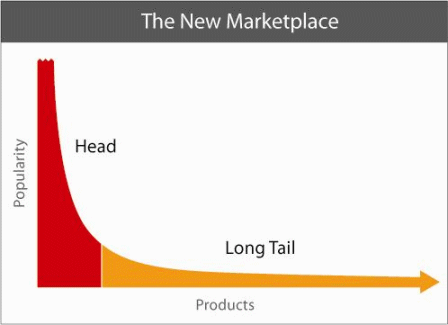
Affordably Long Tail of Housing

http://ffbsccn.files.wordpress.com/2009/11/long-tail-graph1.gif

I mentioned this the other day in my half-baked idea about mid- or high-rise cohousing or what might represent something similar to Single-Room Occupancy units. The fundamental issue is that we have to date provided very little choice in type or format of housing. Single family are nearly all the same, as are townhomes, as are multi-family buildings.

In order to meet the market that demands in-town walkable urban housing (supply of ~3%, demand of ~40%) while accounting for higher land costs, developments must maximize efficiency of space and development and find new prototypical niches to differentiate your project.

There are lots of ways to do all of the above, some of which have been done before in other cities, some have yet to be tried. The key is to understanding people, the market, and demographics, particularly the two biggest population bubbles in American history, retiring boomers and graduating Millennials.

Around Downtown


I came to the realization a few months ago after long discussions with a few colleagues and clients that the opportunity didn't lie in downtown so much as it did in the bombed out areas immediately around downtown, they became the moated wasteland around a 9-to-5 castle. What is now known as uptown was once this way as well twenty-plus years ago, but benefited from being within the "favored quarter" or the direction of initial expansion.

I came to the realization after studying Leinberger's favored quarter concept that it only applies in younger cities, ie American cities. As cities age, they eventually recenter around the primary center of gravity (those defined by transportation hubs or places of the greatest degree of convergence). These nearly always are downtowns. Eventually, investment begins to encircle downtown and North-South, East-West balance is restored as pioneers and investors seek cheap deals near to hubs of activity. Furthermore, more mature cities often relegate all industry or noxious uses aka LULUs (Locally Undesirable Land Uses) to a singular "quarter."

That brings me to downtown Dallas and its adjacent neighborhoods or once-were and soon-to-be neighborhoods. Already we are seeing signs of positive momentum in Bishop Arts, Deep Ellum, the Design District, and some parts of Ross/Live Oak (albeit chaotic here).

Applying the transect, these areas want to be of medium- to high-density similar to what uptown Dallas has become, but many of these have more history, more potential for unique character than uptown (ie Bishop Arts, Lakewood, Deep Ellum). However, some of these areas are more encumbered by barriers, ie highways than others. Cedars for example is an island whereas Near East connects all the way to East Dallas without interruption or break in the fabric until White Rock Lake.

Furthermore, all of these areas fall within the 1- to 3-mile radius of downtown that modern streetcar and bikes serve very well, two pieces of the transportation hierarchy rising in demand and cultural consciousness. Similar to the Arterials section, new kinds of transportation will yield new development by repositioning a barrier (the arterials) through design and repositioning the neighborhood through provision.

You might say, why streetcar and bikes? The answer is that to support the natural amount of density that the land and sites can support, there have to be alternative modes of transportation 1) to support a variety of market segments that may not want to have a car and 2) you can't provide infrastructure for high amounts of car use AND the framework for density, which should be nothing more than a product of desirability, uninhibited by barriers.

Lastly, the kind of density that is demanded in these areas (but held back by a number of reasons, some unique to each "quarter") will eventually result in increased vibrancy and that means drinking establishments. Do we really want all of our bars to be only served by car?

Furthermore, with that kind of density, parking requirements (which are nothing more than poor substitutes for mobility) are less necessary because the parking is replaced by nearby rooftops (where people can walk or bike to the store or office, etc.) and large supplies of parking often interrupt the latticework of interconnected walkable urbanism (not to mention are cost prohibitive).

By limiting parking and providing new hierarchy of transportation alternatives, areas adjacent to downtown offer the perfect setting for creative, affordable housing infill.