Showing posts with label car culture. Show all posts

Monday, March 7, 2011

George Will: Fashion Police

Automobiles go hither and yon, wherever and whenever the driver desires, without timetables. Automobiles encourage people to think they—unsupervised, untutored, and unscripted—are masters of their fates. The automobile encourages people in delusions of adequacy, which make them resistant to government by experts who know what choices people should make.
If not a different planet, perhaps just an alternate reality possibly aided by hardcore hallucinogens. The theory of individual automobility clearly sounds far more compelling to him than the reality of it.

Yes. We're all four-wheeling across the amber waves of grain. We're not at all dependent upon publicly built and maintained infrastructure, nor the daily variegated ebbs and flows of traffic as dependent upon the amount of other drivers clogging said roads. Clearly Will lives in a car commercial where no other cars exist and other people only exist in order to admire the metal cage you occupy. In a country where millions upon millions of cars are either discarded daily or sit idly upon a shipping port, something about there being more cars than people in this country upsets Will's ideological assumption equation a bit.

But, my other favorite part is Will's citation of this blog's favorite, Randal O'Toole. And by favorite, I mean punching bag:
Randal O’Toole of the Cato Institute notes that high-speed rail connects big-city downtowns, where only 7 percent of Americans work and 1 percent live. “The average intercity auto trip today uses less energy per passenger mile than the average Amtrak train.” And high speed will not displace enough cars to measurably reduce congestion. The Washington Post says China’s fast trains are priced beyond ordinary workers’ budgets, and that France, like Japan, has only one profitable line.
Point 1: So nobody works or lives in downtowns (except that those numbers are rising uniformly across the country), therefore we shouldn't invest in downtowns, the very bellweathers of social consciousness and iconoclastic representations of our cities, our homes, and how we identify ourselves.

Point 2: So we're going to use China's low wages as an example of the proportionally high cost per capita of transportation? Really? At the same time gas here is rounding $4/gallon and headed for $5?

Clearly, they would be against new roads out to exurban areas where previously nobody lived. Except they're not. That's freedom! Or something like it. They're all for that kind of public spending and even if they dissent, they'll suggest some private form of infrastructural investment which doesn't exist to "unlock the real estate potential at the edge." Unfortunately, for them the only place where value potential is greater than value existing is within the city in the areas abandoned as we slowly begin to remember all the benefits and inherent efficiencies of urbanism and spatial integration.

In that way, Will is a true conservative in that he wants nothing to change. Everything is perfectly fine as it is and he's willing to (post-)rationalize everything to make sense within that worldview. Getting around seems way more like freedom when things like cars, roads, parking, and gas are unnaturally subsidized and seem something like free. If car culture actually had to pay for itself in complete, maybe it wouldn't seem so much like market forces propelling it.

Welcome to Will's bizarro-world where you can't get anywhere without buying a car nor without filling said car with the unpredictably priced fuel that powers it. Call it a private tax on connectivity that in another, better world you could do for (virtually) free by walking (wherever, however, whenever to use his parlance) or bicycling or maybe even a train, but then you're completely beholden to 10- or 15- minute headways. The horror!

But remember, your individualism, according to Will, is completely and utterly defined by the gunmetal gray or forest green mass produced machine that everybody else also has. Not anything, ya know, like your actions, because you're not a beautiful and unique snowflake. You're stuck in that traffic jam just like everyone else. Plebeian loser.

It all reminds of Tyler Durden's misunderstood call for purpose (cuz hey Nazis had purpose too), "you are not your f'ing khakis." You're also not your BMW 3-series, but everyone else is of course.


Monday, February 7, 2011

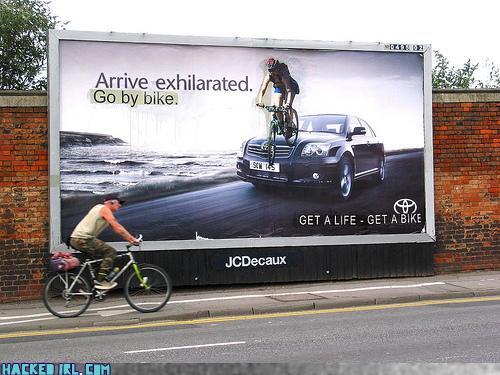
Bikes vs. Cars, A Generational Battle

culture jamming win
Image via failblog

I'm guessing just about every movement during the early stages of its gestation is considered merely a passing fad by the establishment. I suppose that once upon a time several monks in monasteries felt the reformation would pass and they could go on collecting tithes as payment for the sacred knowledge they and they alone held as to your post-mortem future. The recently emerging movement towards increased biking for enjoyment or short-commuting is not going away and city's like Dallas is doing with its Bike Plan would be wise to begin planning for it.

Furthermore, when it comes to forms of transportation within cities, competing forms can often take on an antagonistic, and occasionally violent, relationship as is detailed in Peter Norton's book Fighting Traffic: The Dawn of the Motor Age in the American City, as multiple forms compete for the same space. Either see the book or Mikael from Copenhagenize review at the above link describing the violent backlash against cars invading cities built primarily for pedestrians and horse-drawn carriages.

I can't tell you how many times I've heard drivers remark "how much they hate those damn bicyclists." When I've driven, I always sensed that every other driver was the competition and they treated me as such as well, trying to 'cut in' in front of you to beat you to the next traffic signal.

Perhaps the violence and competition really only comes from cars and their machine operators behind the wheel. As Tom Vanderbilt points out in his book from last year Traffic: Why We Drive the Way We Do and What It Says About Us, we lose our connection to humanity when we can no longer see people's eyes as is often the case behind the wheel. Ever felt more assured as a pedestrian when crossing the street once you make eye contact?

Perhaps there is even something competitive ingrained in us through years of television glamorizing the revving of engines and the starting line as if we're leather jacketed and greased up James Dean. Of course, television for better or worse is specifically catered to the zeitgeist or else it would fail as a business model. It has to appeal to markets, which are created by shared interests by a critical mass of people. Shared interests often are generational, as population bubbles are often defined by similar shared experiences.

The lure of the open road was profoundly influential on Baby Boomers. Cars symbolized freedom. There was still plenty of land and every new road was an open road. Only later did car culture become so overwhelmingly oppressive in its dominion over modern American daily life, because the chosen solution to the issue of competing forms of transportation was to eliminate the complexity. Conflict points were reduced, by doing what else? Getting rid of every other form of transportation by hook, crook, or happy accident.

Problem solved with an eraser. Unfortunately, cities aren't simple entities. They are as complex as the millions that occupy them. Every drastic decision will have drastic consequences. Freedom became oppression. Anakin became Vader.

Then along comes the echo boom of the Millennial generation. Just now beginning to fully express itself (see: social networking). Large population bubbles shape and reshape economies and therefore cities in their interest.

During the Millennial's formative years, the first generation to truly grow up in auto-oriented suburbia, the car and their home were traps. The only escape was often dependent upon somebody else, mom or dad to drive them to soccer practice or the school bus to take them to the daily children warehouse.

But then there was the bike. Oh, how every kid loved getting a new bike on christmas! Who doesn't remember their first days learning to ride? Or then riding everywhere and anywhere your spinning little legs could take you. You were now the master of your own destiny. The bicycle = freedom for an entirely new generation and the car was associated with something else, rarely as positive.

Now that we're all grown up, we want to ride our bikes again. But where to go? Cars are bigger and faster than ever as they race between stoplights. You can't go a mile without encountering some freeway to ford. The modern American city was not built for bicycling, but we need it to be. Therefore there is another looming backlash as depicted in the graffiti above. I hate to compare with the magnitude of what is happening in Egypt right now, but messy conflict is inevitable whenever there are identifiable forces restricting personal freedom, in our case, the ability to get to where we want to go, however we want to get there. Cities are built on this foundation of choice.

This also doesn't mean that the two forms can't co-exist. Many cities are showing they can (and not just European cities but New York, Philadelphia, and Vancouver have added extensive bike lanes throughout), but there must be specific provisions, infrastructure, and safety measures to ensure they can. As they should because multiple forms of transit also shouldn't be segregated. We've seen what happens when we segregate city functions. The result is "anti-city."

Proper urban form of functional, interesting, vibrant cities necessitates this concentration of movement. But concentration of anti-pedestrian modes of traffic creates a negative, repellent force. It undermines the effort to create a concentrated hierarchy of place. There is an indirect relationship between traffic and desirability. Non "anti-cities" have a direct relationship between desirability, density, value, and traffic (or movement).

Commerce that requires a physical presence (as opposed to e-commerce) is dependent on the predictability of traffic. This creates the backbone of predictable, resilient cities. That traffic MUST be pedestrian friendly as car-only traffic repels people. Pedestrian-friendly traffic then begets more people, as people attract people. More people means a market is created and local businesses can succeed rather than trying to scrape by in a failed 1960's strip center where no one wants to spend more than the absolute necessary amount of time to get in and out.

We have to make them get along, just like it makes no sense to allow for this generational divisiveness. But it's almost inevitable as auto-centricity must make some concessions.


Thursday, January 6, 2011

Reader Rant

Published with permission of the emailing author (emphasis in bold is mine). Warning potent levels of profundity herein:

Happy New Year!

Let me begin by saying I have been reading your blog for more than a year now, and found it very useful when preparing for my PhD qualifying exams. I've moved to Dallas a couple of years ago to begin my doctoral work in humanities. Of course, the lady who approved the student visa back in my home country could not help but smile when I told her I am focusing on aesthetic studies in Texas. Anyhow long story short after about 7 years of studying and working in the north-east including NY, Washington, Philly...I ended up here in Dallas. It's been about 2 years and a half since the day I landed.

I never had a car, I never owned a car. I've never had a license, not in the US, not back in Europe. I "survived" Dallas for two years commuting up and down from Plano to Downtown and Irving by bus, train, shuttle, etc. I "survived" the long transfer waiting periods between bus and train. Many times this waiting extended up to two hours in 110 degree heat, because one bus driver decided to talk a bit more on his cell. Other times the bus system seems to work according to what kind of cigarettes a driver smokes. 100s of course burn slower so pose the risk of the passenger not catching his/her connection, menthols however will take one to the transfer point in time. That new function on the DART website that tells you where your bus is makes me laugh in the light of all this. And of course I cannot help but bitterly smile and remember how annoyed I used to get back when I lived in Berlin...annoyed by their perfect public transportation knowing that if the clocks on a train platform would announce a 3.49 minute wait, then it would be 3.49 minute, no more nor less.

I have walked miles, hundreds I might honestly say all around DFW, the last long walk being last week from South Irving downtown. One of my weekly walks now is from White Rock Lake area to Mockingbird Station...plainly put, a distance greater than between Union and Times Square...a totally walkable distance in NY yet made more miserable by all the parking lots and non-spaces in between here in suburbia.
I learned a lot about this city just by walking. I feel I know it better than probably the born and raised here. I know the city because while others were driving by at 40 or 65 mph, I had the time to stop, and look around. I had the time to walk around a corner, a passage, etc. Hard to play the part of a flaneur in Dallas, when there are no people to watch.

I have tried biking around, but since I am not a pro I found it more dangerous than walking. On the other hand while walking for pleasure around White Rock I have encountered dozens of Lance Armstrongs who, with their $3000 bikes, disregard pedestrians completely. Walking around I have also pondered over the absurdity of some biking laws. Why do I have to ride my bike close to the curb, and not on the sidewalk in a residential area when most of the time those sidewalks are completely empty? Yet why around White Rock the mix use lane has turned into a race track, when there are more people walking around than on any street? (ed. note: this gets at my point that cyclists need adequate infrastructure within the street network)

So in the end it wasn't the walking through nowhere, heading nowhere, it wasn't the fact I was waiting in cold or dead heat for a bus that might never come, or the smells on these buses, it's not the fact DART is an expert when it comes to making transfers feel like time spent in limbo, In the end it was the people and their lack of public transportation education. The ones who have no clue how to make use of the whole train car, the ones who piss on the buses, the ones who will threaten to punch you in the face when you ask them to take a step or two forward in the middle of the car where there's plenty of space, etc. It was also the bikers who disregard the pedestrians, and cars alike. (ed. note: we're all animals in a zoo and we behave based on expectations and rules set forth for us, transportation included)

After ten years in the United States and two and a half in Dallas I called it quits. I received my license three weeks ago and am looking forward to close myself in a steel box on wheels to merrily speed up and down the highway. I am ready to feel the American freedom by becoming dependent on oil (ed. note: delicious use of irony). Every day heading to school I am going to repeat to myself that "spending $5000 on a clunker, spending another 2000 on insurance, and hundreds on gas..." (probably my entire scholarship) is part of the "merican dream, of the precious freedom that might be taken from me by officials who want to support public alternatives of transportation.
In other words I will begin playing the part of the mythological stubborn asshole American patriot for a few years until I can make it out of Dallas, until I can return to a city where pedestrians, cars, and bicyclists kinda work organically in peace. (ed. note: see why we're losing people? In car culture, you are not free. People, especially exceptional and talented people, like those getting PhD's want real freedom.)
Off the top of my head: New York since I've been living there. I will of course not begin comparing US cities to European ones.
Hopefully I will survive the car experience, as I will encounter other types of asshole bastards. But it is a new adventure. Yes I already hate driving, I hate not being able to read a book or work on my dissertation on the TRE, and I hate this feeling of emptiness that I was suddenly aware of going up I 75 (also my first time driving by myself on a freeway). I already miss the contact with people on the train, I miss being able to read their worries, or make up stories about them, but I don't miss the fear of potentially getting in an argument, or fight, along with different rotten smells. Here's a suggestion for the DART. Replace all the seats on the buses with plastic ones or thinly draped ones, just like in European buses or trams. Cushioned seats are sponges, they will contain the spit, piss, germs and crap of others. Replace the damn seats and people won't feel like traveling on an outhouse on wheels.

Anyhow I don't know where I am heading with this, oh yes driving. I am looking forward to drive to places I couldn't walk, to drive beyond the red, green, and blue lines. I will lock myself in a gas guzzler, a metal box and experience mindless driving until people here will learn what "public transportation" should be. I once again bitterly smile watching that new Green Line DART commercial on TV, a slice of wishful thinking, of diversity, mix use, happy faces, etc...utopia at its best. Beyond the station names shown, and the extremely fit people getting on the train, there is an emptiness, parking lots, kiss and ride stations, pedestrian ways going nowhere, spaces sometimes too large to be covered by foot and quite limited in attractions.

I'll miss you DART, I'll miss you nonexistent sidewalk, I'll miss you all, characters on the buses. Now I will be the one oddly watching pedestrians crossing the street. Now I will get even fatter. Now I will experience the 'merican dream with doors locked and A/C on. See you all on the freeway heading I guess to a deserted landscape reaching beyond the horizon.

Cheers!
C.
I'm going to focus my comments on the early bolded criticisms of DART from a truly seasoned transit rider.

Mass transit, perhaps like education, can be as good as we want it to be. The question is, do we?

Mass transit aids in creating and augments a functional city. We have a dysfunctional citywhere mass transit is ill-suited and therefore can look like a painful wasted investment... until the city adapts to its new bones, its infrastructure. Of course, those efforts are indeed wasted and undermined by continual propulsion of the insustainable, car culture. I don't mean that to say cars inherently are bad and nor do I declare war on them. I do however declare war on the misguided policies and subsidies that skew both argument and city.

Even with a city not built for mass transit, we could still better integrate bus lines and schedules with trains. Whether this is true or not, it seems there has been little thought put towards buses acting as a feeder/circulator system for DART in an orderly, hierarchical fashion. The argument is surely, "people don't like to transfer." Sometimes the answer is tough sh!t. People also don't like 1)buses and 2)bus systems that are incomprehensible and untimely.

A bus system that does not work in subordination to the train system works against the fixed-alignment rail system. Instead it does two things:
1) It exists and operates catering to a sparse, car-oriented environment. By doing so, just driving seems like a preferable alternative, and

2) because of this, only those that have no other choice but to ride the bus, do so, which carries a certain stigma, further limiting ridership.
I'm not saying make all bus routes circulators, but many should be. There ought to be a hierarchy of routes. The highest order should be BRT or BRT similar, along primary corridors in dedicated lanes that potentially could become placeholders for modern streetcar (or not if the BRT is successful. Caveat: buses must be replaced every 3-5 years. Trains can last decades and decades, defeating the cost effectiveness of buses, especially if the natural gas to power the buses is garnered by firing garbage into the groundwater.). The rest should serve as spokes feeding the train lines which from an urban perspective, can carry more passengers and exist as more important centers (of gravity) - meaning more value.

Making bus routes to function as circulators thereby increasing "convergence" at station areas, thereby making land around stations more valuable, thereby increasing density within walking distance of station areas, thereby increasing ridership. Or is that 1) too logical and 2) too long-term?

Back to my original statement, how useful (successful) do we want the mass transit system that we voted for and spent money on to be? I'm reminded of Seattle mistakenly lumping bond initiatives for transit along with highway expansion in one vote. It failed. I'm reminded of China, pretending to be green, making bicycles illegal and building 40-, 50-, 60- lane roads.

This morning I was reminded of a study where people preferred a 20-minute commute. No more, no less. Long enough to decompress and transition in mindsets between home/work. Short enough as to not be oppressive. I remembered something I said at the Arts District round table event, "we have too much cooperation between cities. We could use a little more competition." Meaning, competition to be more walkable, more enjoyable, more economically functional in the way that cities were invented to facilitate.

Major cities tie the noose around their own neck allowing freeways within their boundaries. Vancouver, once ridiculed as backwards, now revered, never did. Allowing highways within the city is like jamming a straw into your heart to make it easier for the leaches. Those lucky enough to live in some of the excellent North and NE Dallas neighborhoods can have a 20-minute car commute, or they could not. It is entirely dependent upon the state of the highways, choked with suburbanites commuting in. The street network is dendritic, meaning everything funnels to the highways and there is very little choice, option, or adaptability in the system. Every accident or traffic backup, is a stroke to the city's economy.

We want to have our cake and eat it too. We want to tickle our bellies and pretend that cars somehow still = freedom and we're willing to drive off economic (and environmental AND social) cliffs to do so. But this cake is injected with oil. It tastes awful, is probably toxic, costs a boatload, and is the only thing on the menu. Customers keep walking out of the restaurant.

They're heading to others where they have some choice and can eat healthy if they so choose or not. That's the beauty of it, there is choice. New York, Portland, Seattle, Chicago, Boston, D.C., all cities 1) still in U.S., thereby gas prices are still held artificially low, 2) destinations for many many talented individuals, and 3) where you can have a car... or not. It is your choice. And doesn't choice = freedom?


Monday, November 29, 2010

Curb Cuts: Cause and Effect

This is a post I have been mulling over for some time. It was not until witnessing a related incident that I decided it was time to crank it out.

As anybody familiar with downtown Dallas streets knows, you must tread lightly. Particularly, during rush hours as you are rushing to catch that train or wherever. Cars dart in and out of parking garage with little remorse, restraint, or caution. It can be even worse when out for a dog walk and the distance between dog and self become dangerous enough that you worry fido might get run over at every garage exit.

The event I witnessed is one that presumably happens every day. Except this one office tower parking garage has a police officer directing traffic for a parking garage exit onto a one-way, barely used street. You would think this wouldn't be necessary. I suppose like the presence of speed bumps, this is evidence of poor planning and design.

As I was walking up to this particular conflict point, I could foresee an issue arising. The police officer was having a distracted conversation with somebody while waving on cars that may or may not have been on their way up the exit ramp. From the opposite direction as myself, a woman was chatting on her cell phone.

Wouldn't you know it, but a car burst from the invisible ramp and nearly hit the woman on the cell phone. An argument between the woman and cop ensued before the cop lost patience and suggested she get a move on before cuffs came out.

Was there fault to go around? Surely, probably on all counts. The woman on the cell phone acted afterwards like she knew a car was coming out, the car had no reason to slow down or give caution as the cop was waving it on, the cop probably shouldn't be having random conversations when conducting traffic.

I'm left to wonder, what is a cop doing directing traffic from a private garage? Yes, yes, public safety and all that, but isn't there a safer system than cars shooting out of buildings like this (ed. note: mute this awful music):


Now, let's think about what ingress/egress/curb cuts/garage access points really are. They are no different than say, storefronts for pedestrians. They are the way a building interfaces with its transportation system.

I would argue that the best cities in the world are those where the building is accessed nearly universally by foot, except for a few transfer facilities such as bike parking, transit stations, and centralized parking facilities where stakeholders such as pedestrians and land owners have some sense, hey, I can expect to interact with cars around here. This also adds some measure of wayfinding for drivers, if they can find the clearly marked garages.

Like nearly all things in complex, interwoven systems like cities, curb cuts are both cause and effect, adding to or subtracting from the inertia of various processes. When blocks are carved up by curb cuts in order to deliver drivers directly to buildings, that is the effect. The by-product of a car-centric transportation system. The same one that shackles all of us willingly or unwillingly, affordably or unaffordably to participating in this system by owning and operating a car within it.

Curb cuts are a cause, inducing different actions, behaviors, and outcomes for a few reasons. One, I already mentioned, that it discourages pedestrian activity on the street by making it unsafe, and perhaps more detrimental, stressful. You can't focus on other things like window shopping or whatever because you're worried about Morpheus and his brand new Cadillac CTS to chop you off at your waist.

The other things all of these curb cuts do is takes up valuable square footage in buildings, 1) on the ground floor where you would typically like many different pedestrian access points to buildings, aka street friendly interfaces, and 2) these are obviously leading to either service docks, surface parking, or garage parking, ie even more space that is unsalable and costly to construct.

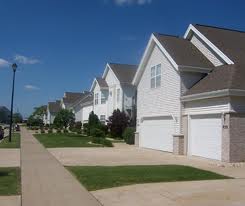
The resultant building or urban form is one that I would call self-interested, as in not enlightened self-interest. In anthropomorphic terms, this would be a selfish building block. It says, "I want my access to my garage, and I don't care what it does to other buildings," which is often a perfectly logical, and rational response. But, it isn't an enlightened response.

The best neighborhoods are those where the valuable is greater than the sum of parts. This only happens when building blocks (used as short-hand for urban blocks that may or may not have more than one building on them) reach out and relate to the public realm and buildings around them. One building improves the value of those around it and it receives the same in kind from the 3, 5, or 10 building blocks nearby. The more building blocks that amplify the neighborhood, the return on enlightenment increases factorially based on 1)quality or value and 2) proximity.
--------------------------------------

So I decided to map the curb cuts in downtown Dallas to see if any patterns emerged. Keep in mind that in the ideal city there would be very few 'car interfaces' as 1) transportation share is balanced better between modes (foot, bike, car, bus, train), and 2) parking would largely be relegated to on-street so there would be no curb cuts. Thus creating motive to develop real estate that is more valuable than housing cars, but in housing commerce and/or people. Pricing car storage out of downtown, parking is relegated to outside the city at transit facilities or pricey, centralized parking garages.


At first blush, they appear pretty balanced, spread across the city. Sparse only in two types of places, truly dead zones and truly alive zones. There is also an awful lot of them. Doubtful I'll ever have the time to map a similar sized area in other cities, but you can bet there is a direct relationship of car-dominance to amount of curb cuts.


Here, I mapped a few of the denser clusters as well as Main Street in green. The sparse areas around the edges of downtown are due to surface parking lots not requiring many access points that would cut into value, aka more spots, and giant dead areas like around the convention center. Other sparse areas, would include around Belo and what are nominally known as parks in the southwest portion of downtown.

The most eggregious areas seem to act as buffers around the successful little pulse of Main Street. If Main Street is our living and dining room, the two big red blobs are our two-car garage. Like a conventional suburban house, the pride of place goes to the garage, rather than the welcoming embrace of a front porch or stoop (the pedestrian interface).


The red areas tended not to be the worst only because of vehicular egress points but loading and unloading areas where sidewalks were negligible at best. This is another case of a building being selfish, allowing for loading and unloading based on convenience for the loader and unloader rather than to the benefit of street life.

In Copenhagen and Rome for example, two places I have spent a decent amount of time, loading and unloading happens in the street early in the morning when there is very little pedestrian or car traffic (where cars are allowed in those cities). This is enlightened self-interest because you use the public infrastructure for loading rather than building it yourself and then having a hostile street presence, shutting off the amplified powers of a city that engages rather than withdraws.

----------------------------------
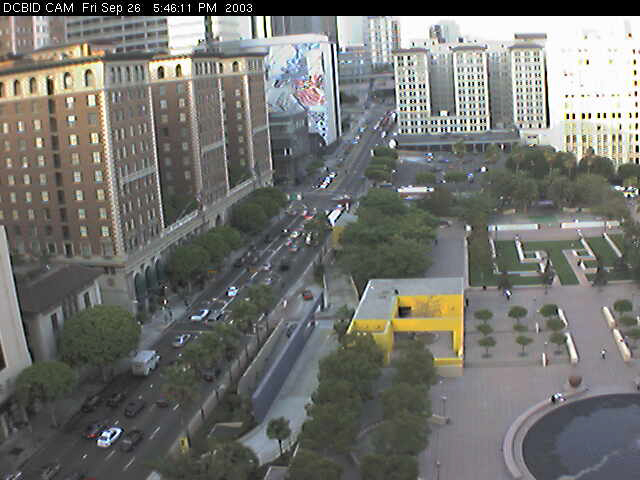
The concept applies to open space as well, as open space is no different in terms of access from 'closed' space except that it doesn't have a roof. It still needs an interface. Main Street Gardens was intended to have parking below it originally and thankfully an operator couldn't be found. We lucked out. Otherwise, we would have another Pershing Square in L.A. on our hands.

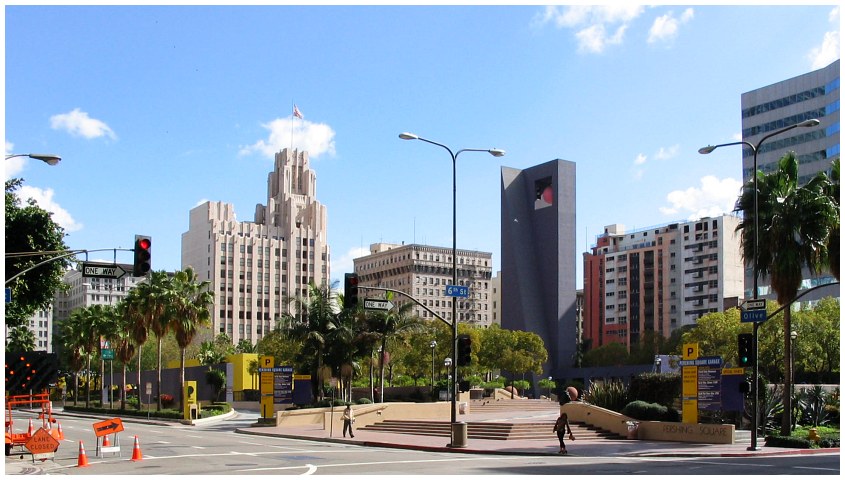
Here are a few pictures of Pershing Square. In the first two, notice the garage access ramps. These line all four sides.


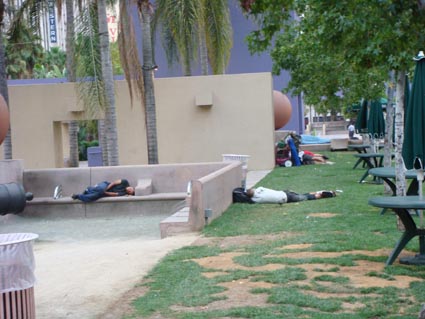
The result is a barrier to pedestrian activity and perhaps even worse a barrier to visibility. It creates places that can't be seen and when you do that, you get the kind of activity that likes to be in places that aren't seen. The best of which is sleeping.

--------------------------------

Now here are examples of pedestrian-oriented building interfaces at varying scales and intensities:


or, the alternative: