Showing posts with label Housing Market. Show all posts

Tuesday, January 4, 2011

Ask the CarLess Guy?

Received this thoughtful question today, and one I've thought about for a long, long time but haven't really written much about specifically or in detail, but the issues are all familiar:
Patrick,

I am a reader of your blog, https://carfreeinbigd.com, and enjoy it greatly. However, I was wondering if you have ever given any thought to, or written about, how modern Apartment complexes play into livability versus how they were constructed in the past.

It seems to me most modern apartment designs are done on a multi acre scale instead of the old style (early to mid 20th century) of a random building or two along a street, relying on that street for parking needs. Modern complexes, with the exception of the Tx Doughnut, seem to be an isolated retracted space shielding themselves from the surrounding neighborhood. Newer complexes like in Uptown seem to be bridging the gap between the classic one off building and the apt community.

In uptown at least this increased walkability and density happened in a positive manner. Larger complexes, aka the village, are more suburban in feel and function. Most folks despite the density in the complexes still use a car to travel to the City Center, from their apt, however, based on the density you would think it's more walkable.

Classic apartments, in Lakewood, or East Dallas, Oak Cliff, ect, provide a nice mixture of income level folks without becoming a "scary Section 8" complex since a building or two by its very nature is so small. It minimizes the potential "scariness "of buying a single family home next to an apt complex. Additionally, they provide a nice mixture of density, without becoming overwhelming the character of the neighborhood. In the long running allowing it to slowly become densier and more walkable.
Anyways, I have rambled with long enough. Thanks for your though provoking post.

Without writing 10,000 words in detail of every little nuance and reasoning for the observed by-product of economic inertia, I try to respond:


Glad to hear from you and you are 100% correct in your assessment of the different development form and format. The deeper question then to ask is why did this shift occur and how did it happen. Then the next step is to determine if some measure of return to that real estate delivery system is 1) feasible and 2) desirable. The reason for the shift has a number of origins: new building standards/codes, Euclidean zoning, as well as financial mechanisms behind what gets approval for loans and what doesn't - which is typically the tail that wags the dog - in that it is a byproduct of the above, but then dictates it thereafter, hence the inertia of the entire real estate delivery system and why we mistakenly think of suburbia as a market demand.

All of these were in some ways a form of market determinism, but the solutions were ham-handed. They went too far and undermined, well, complexity and interconnectedness (interconnectedness produces complexity) if all evidence and Space Syntax are to be believed, which I do. It was like treating cold symptoms with nerve gas. Not sure the details of this metaphor parallel reality, but the hyperbole is intended.

As my next column in D magazine (February issue) will cover, physicists are showing that as cities double in size, they produce efficiencies in outputs. More specifically, this means about 115% increase in output for every doubling in population size. Outputs are data elements. Things we can measure and they can be both good and bad. For example, cities are the greatest invention of wealth generation man has ever created. This is the very reason for their creation along with the increased efficiencies of inputs within cities. Inputs are things like infrastructure, roads, energy, etc etc. Cities use 15% less of these things for every 2x of population.

Wouldn't every business man like this equation? Less upfront cost, more returns (economically, socially, and environmentally profitable).

But along with the benefits of cities, they also produce negative outputs, such as crime, disease and waste/pollution. Industrialization made cities awful, dirty, crime-ridden, smelly, polluted, disease-infested places with plenty o' poverty as well. We failed to innovate in terms of addressing these negative outputs from economic production and in turn, cities became the stigmatized places we still live with today. These actions begot an equal an opposite reaction (and probably overreaction given the state we're at today). We erased the city to erase the negative outputs of city life and also lost all of its benefits. Cheap (and now subsidized) gas/oil prices have only exacerbated/accelerated the process and further entrenched how difficult it will be to shift market sentiment.

Those that studied cities and found the efficiency numbers above, found that Sun Belt cities such as Dallas underperform on both the front and back-end. We are wasteful with our inputs (in that we use a lot of energy and infrastructure per capita) and we get less positive outputs, but because negative outputs are determined by population size, we still have all of the negative issues/outputs, aka crime, disease, pollution. To summarize, Sun Belt cities get all the bad and none of the good of cities. The bad is determined by population size, the good is determined by urban form.

Getting back to the specifics of building form, the reasons for the bigger projects rather than smaller are entirely economic: bigger banks and bigger developers and bigger architecture firms, etc require bigger returns and to get those bigger returns they need big projects that can maximize efficiencies in building practices. At the end of the day however, this only works for short-term financial gain, which is how the financial system is rigged, rather than long-term, continual and sustainable value. ie if a building is built cheaply so that it falls apart and is unlovable in that we let it fall apart, it will just be cast aside in the future. This is the throw-away economy of the 20th century as applied to cities.
Side note: one of these days I want to address the short-term vs long-term economic engines by way of stakeholder vs. shareholder economies.
Waste is a cost (the air we breathe, cost of creating/having landfills, etc etc). Fundamentally, we constructed a broken system. In the natural world, there is no waste. It is all closed loop systems, cradle to cradle, where waste equals profit. We've created the opposite as if it were possible. These outputs, waste, get externalized, ie written off. Somebody else's problem. We're starting to just now bump into those debts the 20th century accrued. Cities become profitable when we don't throw them away every generation and start again. Every building, every stone is reused, repurposed.

Furthermore, since a building might be cheap and ugly, everything around it withdraws or "defends itself" against adjacent ugliness for lack of a better word. This includes streets and the transportation system. It is all connected. Build a great street, say the champs elysees, value and density gather around it, embrace it, and it is financially rewarding to interface directly with it. Therein lies the depth of all of these issues and the bureaucratic entities that defend the status quo (from both a public AND private side). The bigger the entity, the more resistent to change, aka necessary adaptation. From a global perspective, this is why I think there are two types of evolution (whether in design or in natural world): Drastic and painful due to unwillingness, or gradual, incremental, and constant.

I also agree with you that the old way was preferable in that it creates more authentic, true, walkable urbanism - or better yet, functional, efficient urbanism as a platform for human livelihood. It is inherently complex, since it is interconnected (also in the 4th dimension in that it is tied to history, or some tradition, ie years of decisions/thought put forth years and years before - modernism also suffocated all of this thought - a selfish mistake by modernists). Interconnectedness is the primary reason for many chicken/egg dilemmas of urbanism. Also, I think what we call authentic is that it was incremental and demand driven. Much of what we see built today is supply driven, ie the housing bubble/burst. There weren't real demographic shifts calling for an extra 25 million new households, but the financial system (and its mouthpieces) said there was money to be made, so build we did...bigger and bigger, more and more.

I also think that if we can apply modern materials and methods to this process while making it economically viable to do so is probably approaching necessary at this point. So what we have to do is drill deep into the real cavities, the systemic issues and mechanisms producing the cities that we see and feel, and that aren't working for us, change them, so there really is no choice, but to build great cities, buildings, and places. I prefer a system that doesn't outlaw the bad, but rather financially punishes the bad and rewards the good. To do so, we have to be honest with ourselves as to what those cavities are and honestly address them rather than adding some veneers and calling them world class.



Thursday, April 1, 2010

How Texas Mostly Dodged the Housing Bubble

At MoJo:

This is, you'll note, essentially a limit on leverage. In this case, though, it's not a limit on bank leverage, but on individual homeowner leverage. It's a good example of how leverage is shot through our entire financial system, and how reining it in at one level can have a big impact on every other level as well.

But there's more to Texas than just their regulation of HELOCs. State law also prohibits mortgage loans with prepayment penalties. And it prohibits negative amortization loans, where the principal you owe goes up over time because you're not required to make full interest payments. There are also limits on balloon payments and requirements that mortgage lenders take into account the borrower's ability to repay a loan. (Shocking, I know.)

Tuesday, March 16, 2010

Ask the Carless Guy, Volume Something or Other

http://content9.flixster.com/question/39/17/44/3917443_std.jpg
How many a-holes do we have on this ship?

I received this email from my college roommate today:
listening to public radio this morning they kept talking about a decline in the amount of new homes being built as a bad sign. isn't this going to happen eventually anyway since the amount of open land gets smaller with every house?
I didn't hear it myself. I'm wondering if this was national public radio, or a local DC show, so that I can look up who the interviewer/interviewees were. That always has to be the first question to ask yourself, "what is this guy's angle?" Without knowing that I can't pinpoint why he might be saying that lack of new housing starts is bad, because...well, what is bad?

Is it bad because he is in the real estate industry and knows no other way to operate his business than the status quo that has utterly failed and bankrupted us? Is it because he's an economist and worried about losing jobs in the housing construction industry? Was it bad that the horse and buggy industry is no longer a thriving job growth industry?

Cars have their place. Single family housing has its place. This is the common misconception of me, typically by those who don't know any better or are so mired in ideology or fear of altering their precious status quo. That I excoriate them because of my own preferences. First, that wouldn't be very professional. Second, and personally, I live by a simple rule: Live the way you want, as long as it doesn't negatively affect others and ensure that others have a similar choice to be able to live they way that they want without negatively affecting others.

Want to stop bailing out banks for bad loans on single family houses people couldn't afford? Want to stop wasting money on overextended infrastructure and unnecessary and poorly planned highways? WALKABILITY IS A TAX CUT.

Unfortunately, we built a structural inertia upon zoning, bank loans, tax incentives, and road construction that carried us WAYYYY past equilibrium for those industries. We are now experiencing the pain of this overshoot, like any druggie experiencing withdrawal. Any institutions we establish have to be flexible and adaptable enough to change when we change and learn as we learn, or else it becomes a starship in ludicrous speed with no breaks.

It is the cause of every recession. The severity of which is determined by how far we went off in one direction and how long it takes until we reverse the inertia. I've been howling about the impending housing doom since 2002, but that apparently was steering the Titanic with flippers and scuba gear whilst hanging onto the rudder. I was just too naive and broke having just graduated from school to know how to wager against it.

So no more housing starts may or may not be a bad thing, but we have to look deeper. Where are those housing starts occurring or not occurring? If they are no longer occurring at the edge, in exurbia, that is a good thing. We can't afford more single family homes at the edge nor the infrastructure to them. All the people who CAN afford to be out there, either already are or they choose not to be.

We KNOW we have at least a surplus of 4 million large lot single family homes. We're pretty sure that banks are sitting on x2 that number to inflate the prices on the previous 4 million. With the ARM resets about to happen this year and next, we might be looking at another x2. Some estimates have a surplus of 22 million by 2025.

Building new houses is insane, at least in the way we've been doing it, on land in exurbia that the highest and best use of is probably agricultural production or nature. The housing industry keeps trying to prop up the myth that everybody needs their single family house in BFE, as some sort of sign of independence or surge in middle class choice or prosperity. All marketing BS. They do so, because it is easy on them. Land is cheap, so they externalize transportation costs on the consumer.

Cities, particularly young cities that know no better are eager for the tax base. That is, until they get the bill to maintain that infrastructure at such a low density. But the unfortunate reality is that you can't unbundle transpo from housing without having a lot of poor people stuck in the middle of nowhere.

If it is because there is no new housing where we badly need it, where it is tied to cheap, effective, optional choice of transportation then it is a bad thing. And we need to loosen up the credit markets for locational efficient housing starts for rental, ownership, and affordable housing. This should be job one at the federal and state level.

The other key is utter and complete overhaul of all state and federal standards for transportation planning and design, land use and zoning, and affordable housing standards. Some of these are already happening. As I have said before, with all of the press that healthcare and bank bailout get, the best thing that any administration has done in thirty years is the effective merger of HUD, EPA, and DOT under one roof, with the exact right person in charge.

This will be the way out of this uber-recession. We just have to make sure we don't cement this particular direction so we can provide some steering or breaking at a later date. Railroads were once as corrupt if not more so than the highway industry is now. It is the nature of the beast.

Monday, November 30, 2009

Monday Linkages - Back Atcha

...whilst watching Cash Cab and realizing that I either need to move to NYC or die trying to bring a similar measure of urbanity to DFW. Is there anything more satisfying than the street shoutout working?? Speaking of:

Interesting interview of author Carlene Bauer, who discusses moving to NYC and the urbanity that helped her find herself:
Also, I seemed to have a predilection for the urban from birth. Apartments over storefronts on main streets—not a feature of the suburban cul-de-sacs I was raised in—were fascinating to me. Who lived in those lighted windows? I wanted a lighted window. I thought if you had a lighted window, rather than a whole big house, you were living an anonymous, autonomous life.
Hmmm...I think she touched upon a future Livability Indicator that I've been putting together.
------------------------------------------------
I may have linked this one before, but who cares. It's about a city removing a giant gash freeway from its connective tissue in order to increase revenue thru property value increases. In this case, it's Providence RI:

In a similar fashion, about 20 years ago the city uncovered the Woonasquatucket and Moshassuck Rivers, which were largely paved over in downtown Providence, and moved the point of their convergence for aesthetic purposes.

Next year, the old highway overpass will be demolished and the city will begin to create a new street grid, which will better connect surrounding neighborhoods to the waterfront, said Michael P. Lewis, director of the state Department of Transportation. This work will continue into 2011 and 2012, while the state prepares the surplus land for development.

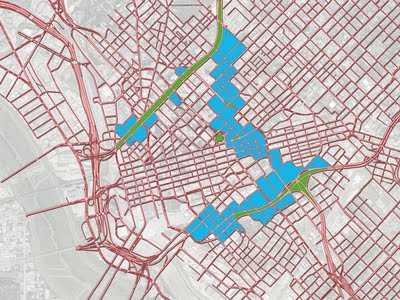
I created a diagram to show how many parcels would be affected by similar efforts in the Big D:

----------------------------------------------------------
Zoinks. Haven't talked Housing in some time, because I no longer need to convince people of the impending, nay, now imploded doom. But, Case-Shiller is suggesting another 48% fall.

More on housing, Wells Fargo's Chief Economist tells the awful truth, "there is no easy way out."
And there, hopefully, begins the long way road to recovery. There are no free lunches.
----------------------------------------------------------
Dubai. My favorite Vegas on Steroids. One of my personal fav oped guys, the man who brought to life such excellent insight and turn-of-phrase (also regarding Dubai),
When prices go up, buildings go up. When prices come down, buildings tend to stay up. Until recently visitors to Dubai returned gasping. This was truly a city designed from start to finish by autocrats and architects. It was the last word in iconic overkill, a festival of egotism with humanity denied. It was an architectural chorus line of towers, each shouting louder and kicking higher. People were ants.
Simon Jenkins, weighs in again:
I still have no doubt that Dubai will survive, despite its lack of oil or other natural resources. But it will do so as a benighted settlement on the Gulf shore, in hock to neighbouring and more cautious oil-rich states, such as Abu Dhabi. Its luxury apartments will become tenements to an ever shifting army of refugees from the torments of the Islamic world. Its towers will stand empty, unable to afford their energy-guzzling services. Its fantasy islands will be squatted or will rot and sink back into the sea. Where fresh water will come from, who knows?
It's fundamental problem is that it is entirely a product of the supply side thinking that created much of the economic catastrophe the world over. If you build it, they will not come. And if they do, they will then leave because noone else is there, like a tide rising, only to retreat back to the ocean. There has to be demand in the first place and demand comes from economic purpose, which typically comes in the form of natural resources, transportation, or increasingly, human capital.

Funny thing? There actually was a demand that they have managed to exploit which until further notice will be the economic foundation of Dubai. That, as the world's black market, for anything and everything that black markets exist for.

And, anybody that quotes PB Shelley in a newspaper article is always well worth the read. Expect the readers to come to your level, don't ever write down to theirs:
I met a traveller from an antique land
Who said: `Two vast and trunkless legs of stone
Stand in the desert. Near them, on the sand,
Half sunk, a shattered visage lies, whose frown,
And wrinkled lip, and sneer of cold command,
Tell that its sculptor well those passions read
Which yet survive, stamped on these lifeless things,
The hand that mocked them and the heart that fed.
And on the pedestal these words appear --
"My name is Ozymandias, king of kings:
Look on my works, ye Mighty, and despair!"
Nothing beside remains. Round the decay
Of that colossal wreck, boundless and bare
The lone and level sands stretch far away.'
-------------------------------------------
Park Slope CoHousing. The article is only strengthened by the presence of Alex Marshall.
Co-housing has yet to be tested anywhere as dense as New York City, but as Alex thought about it, he came to believe that, in fact, the city was perfect co-housing ground. Throw a bunch of organic leeks in Brooklyn right now and you will hit some kind of a communal-living situation—a vegan house in Bed-Stuy, a bunch of young renters in Clinton Hill who Craiglisted up to pursue like-minded goals. Surely he wasn’t the only middle-aged New Yorker who wished he had real relationships with his neighbors.
If you haven't read How Cities Work. You are missing out. See my post discussing the potential for high-rise cohousing:

This stems from the idea that any one person's community, the amount of people they can ever really "know" at one time is approximately 150. I probably need to track this back to source the info, but something tells me it was one of those tidbits that stuck with me from a psychology class in college. In this case, the vertical co-housing would be the person's "community." Whether they choose to know everybody within their building is beside the point, but the opportunity is there.

The vertical cohousing was based on the idea of eliminating excess inefficiencies of excess individual plumbing lines, savings on sharing of electricity and appliances, and all but elimating inefficient floor space, meaning, no hallways. The elevator opens directly into a shared kitchen/dining area that would be shared by 4 to 8 units per floor and potentiall two floors per kitchen area. This would be organized as a tenants "nuclear family."

The rest of the common amenities would be structured similarly based on the amount of people to use it. Meaning every four or so floors there is a common gathering area, be it a workout facility, a pool, game room, home theater, etc. These areas would be the "extended family."

The idea of which has been done with many high-rise towers in europe that create garden floors every fifteen or twenty floors in modern "green" office towers, ie creating social spaces for subsets within the larger unit. However, as I have said, to some extent this minimizes the person/place/thing interactions or feedback loops that create more intelligent places, ie rather than being 100 on the street, there might be 20 every 100 feet in elevation (although I imagine diminishing returns based on the exponential overlapping that occurs in these semi-lattice networks).

The base of the building, would have a community-wide amenity area. One building we worked on was supposed to have a wii station for resident use.

The last level of the hierarchy is the public, which is the street, or city at-large, and this is where the building would have its "third places"; how the building engages the street and the city. Here could be some overlap with the community-wide amenity area as I have seen in my building with the bar/grocery store as a popular hangout after work for building residents.

-------------------------------
Lastly, on Rio's Favelas, Gangs, Drugs, and Crime. If you haven't seen City of God you are missing out on the best movie of the last twenty years.

Wednesday, November 4, 2009

All Housing All the Time

B/c realtors are unaccomplished middle-men, sometimes they rig the game. It's the American way! Nope, this is in Canada, where the gub'mint is threatening to cap their fees.

With a membership of more than 96,000, Ottawa-based CREA is the largest real estate organization in Canada and represents the majority of the nation's realtors.

"The Bureau is concerned that CREA's rules have restricted consumer choice and limited the scope of alternative business models," says an internal memo by CREA president Dale Ripplinger. "Unfortunately, the Bureau seems to believe that CREA's rules ... create restrictions and barriers."

-------------------------------------

Housing is bankrupting families.

No matter how much money the government puts into the housing market to stimulate sales, a recovery won’t be on firm ground until people stop viewing homes as commodities, said Joe Carson, head of global economic research at AllianceBernstein LP in New York.
Say no more brother.

So let's work our way up from the bottom. Buyers whether ignorant or wreckless overbought. They were given loans by banks who shouldn't have been giving said loans because various regulatory agencies were either crippled or willfully ignorant. Bigger banks buy those crappy loans, bundle them with better loans for resale. Bond rating agencies take a look at them (not really) and grease the pig by giving them an A for effort. Bundles get sold, brokers skim off the top. Put that in the spin cycle about ten times for effect b/c once again regulating agencies weren't paying attention or couldn't. Prices spike b/c of the surplus of buyers. Who pays the piper?

----------------------
They haven't found their bottom yet.
-----------------------
And...it's still a "crisis."
“It’s just a very bad idea to expect home prices to bounce back and solve all these prices,” Emmons says. “There’s just no good reason to expect that.”
Because? They're disconnected from wages. Tadaaaaa.

Tuesday, July 7, 2009

The Future of Suburbia

Both existing and future. Gonna have to start growing yer own food. From NYT which lists it currently as amenity. But, someday it will ratchet up one notch to necessity:

At the 220-home Serenbe project near Atlanta’s airport, the cachet of local produce has been added to retiree-friendly businesses, including galleries, a bed-and-breakfast and three restaurants. Steve Nygren, an Atlanta restaurant impresario, started the project on his 900-acre farm.

The problem is that this is still in "niche market" phase serving a solitary demographic.

Thursday, May 21, 2009

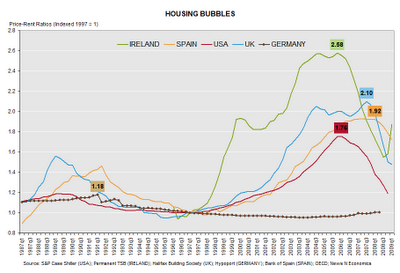
Housing Bubbles Around the World


Link here. Germany chugging along a-ok.

Speaking of Germany, the best news show on television devoted an entire episode last week to efforts the country has been making including their feed-in or buy back program where the government buys clean energy from the people at a premium rate. The two most significant points here are that clean energy is overtaking auto-manufacturing as the job leader in the country AND this program costs the citizens of Germany the equivalent of two dollars per month. Sign me up.

Other issues addressed in the episode include the Passivhaus in Freiburg and the CarFree district of Vauban in Freiburg. I was so moved by this, I decided to take phone shots of my television screen:


Wednesday, April 1, 2009

Latest Case Shiller Indices

From WSJ.

Dallas posts a 5% drop for the year. Some said Dallas was insulated from it and housing prices didn't spike like they did elsewhere. True. But, 5% in any other time would be quite hefty. There was simply too much imagined money floating around.

Monday, March 30, 2009

Surplus of Empty Houses and Record Numbers of Homeless

People-less Houses, Homeless People.

Thursday, March 19, 2009

Why Not To Get Excited About the Housing Starts

I mean, beside the fact that there is definitely at least 6 million empty homes on the market and that number is probably more like 12 million, from banks holding them to limit supply and try somewhat in vain to keep prices up. Valiant effort.

Monday, March 9, 2009

Quote for the Day


The necessary melt down of the 2oth century phony economic model of quantitative growth; of robbing peter to pay paul; of buying other debt, bundling it, repackaging it, charging a fee to do all that and calling that economic development; is making a house cleaning of the conventional, the generic, the suburban, and ultimately the worthless.
The roof, the roof, the roof is on fire. We don't need no water, let the mother fucker burn. Burn mother fucker. Burn.
Yes, it is painful. Yes, I am finally feeling the effects too. But mostly through others. I strongly recommend everybody reposition themselves for the future.

To quote another song, this time by TOOL:
This is necessary...

Friday, March 6, 2009

Friday Morning Links

Majority say Mortgage Plan Unfair.

Majority also didn't read nor understand the plan. Majority of journalists are lazy and under-qualified.

Freakanomics Blog: Planners and Architects weigh in on CarFree NYC
.

WTF. Okay, I can live with Sam Staley being included to provide a countervailing voice. But, Randal O'Toole? Has this guy been right on anything?! If you don't feel like reading it, O'Toole takes the patronizing tone that we should all be ready for businesses to fail. IN TIMES SQUARE!

They said the same thing about Copenhagen when they started closing roads. The density and activity is already there. This only enhances the pedestrian experience thus making it more amenable to businesses. Yes, pedestrian malls failed in the States, but only b/c when they were instituted in the 60s, the exodus had already begun.

Oh, and did I mention that O'Toole's backing comes from the money earned by car dominance?

When did the media decide that both voices should always be heard in equal parts no matter how asinine one side or how in the minority that side is? Perhaps we should have a debate like the survey from Flight of the Conchords: Are you Pro-AIDS or Anti-AIDS?


Millennial Survey. Take the time, help out a friend of a friend.

Dallas is 4th most congested city. But, to once again clarify (which this doesn't), there is good congestion and bad congestion. For example, NYC, Chicago, and DC surround Dallas.

Unsustainable Humanity? Does economic growth have to slow to prevent catastrophe? I disagree. The wrong kind of economic growth, based on land consumptive and/or destructive practices has to slow. Qualitative growth: energy efficiency, clean energy, and infill are the markets that can support new growth and expansion. As McDonough says, it's not about being "less bad," it is about building a world where being "more good" means more profit.

Monday, March 2, 2009

Once Again: Told You So

Robert Greenwald and his company Brave New Films is advertising his new documentary Fighting for our Homes. The email announcement I received in advance of this included this lit
"We were trained to mislead borrowers," says a mortgage broker in Orange County, California. "There were people who were club promoters or even drug dealers that found out it was more profitable to run a mortgage shop than to do whatever they were doing."
Ahh, the full manifestation of a society built on something for nothing. I mentioned this phenomenon from a personally anecdotal standpoint long ago on these here blog pages:

Realtors are to Drug Dealers as...

It has occurred to me that Mr. Greenwald and Greg Palast represent the future of investigative journalism since the mainstream press has let us all down with the censorship of corporate tyranny.

Thursday, February 19, 2009

Sullivan on the Housing Plan

Many liberals think that the plan is too small. Many conservatives and libertarians think it will prove wasteful, ultimately ineffective, and that we shouldn't be trying to prop up housing values anyway. And this is surely the fear behind the gist of what Obama has done so far: it avoids the brutal re-balancing of the right while lacking the full metal Krugmanism of the left. Maybe this is a pragmatic sweet spot. Or maybe it's falling into some kind of ghastly, protracted abyss. I do not pretend to know.
Amazingly, I tend to fall slightly to the right of Andrew here - if only because I was wary enough to steer clear of that nonsense (which reminds me to figure out where I was reading that too much home ownership (as seen in the states, 70%) is bad in a macro-sense on top of being illogical at the micro level, for a similar reason: that it is too much wealth AND people being illiquid). Housing prices have to fall back in line with fundamentals, otherwise they shall remain UNaffordable, and frankly NOT at market rate. We have to find the true value of homes to allow the homes/properties in the right places to survive, the rest? To whither.

My optimistic guess is that the Obama team is merely applying a parachute to the prices because it is economically wrong to improperly inflate the prices and amoral if not downright toxic to many neighborhoods/communities to toss people on the street.

Personally, I like the plan put forward by the woman interviewed on Dan Rather Reports the other night suggesting that if refinancing can't be achieved that home owners are given the option to rent the place at fair market rental value.

Monday, February 9, 2009

I See You Giiirrll, Lookin' at my Links

Derrick Jackson on Tax Rebates for New Cars:
Mikulski mustered all the Chicken Little she could. "My amendment is not about bailouts," she said in a prepared statement. "It's about jobs, jobs, jobs. Six million jobs are at stake in the American car industry . . . The only way to save the Big Three is to get people into showrooms, but 1,000 dealerships could close this year. That's 53,000 jobs that could be lost just at the dealerships."
Ugh..the stupidity of saving jobs of the 20th century at the expense of jobs of the 21st century.
-----------------------------------
On a day when the WSJ has an article that opens with, "It's tough to be green when money is tight," treehugger has an article on learning from the inherent sustainability from the world's poor (because it is actually easier, if not imperative to be more "green"):
...contains the attributes for environmentally and socially sustainable settlements for the world's increasingly urban population.... The district's use of local materials, its walkable neighbourhoods, and mix of employment and housing add up to "an underlying intuitive grammar of design that is totally absent from the faceless slab blocks that are still being built around the world to 'warehouse' the poor."
"I strongly believe that the west has much to learn from societies and places which, while sometimes poorer in material terms are infinitely richer in the ways in which they live and organise themselves as communities," Prince Charles said. "It may be the case that in a few years' time such communities will be perceived as best equipped to face the challenges that confront us because they have a built-in resilience and genuinely durable ways of living."
-----------------------------------
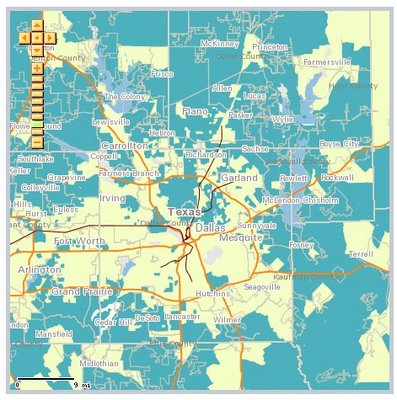
From the Center for Neighborhood Technology:

In turquoise, areas of the DFW metroplex where housing + transportation costs equal more than 48% of median household income:

-----------------------------------------

And finally, the best for last...Treehugger, which tends towards either of two extremes; the very granola low-tech or the super high-tech gadgetry, comes this article that ghasp, sustainability and tackling sprawl is about proper planning rather than new "eco-towns."
“Everyone gets seduced by the ‘green bling,’” Stephen Platt of Cambridge Architectural Research told me. “Making the houses energy-efficient is the easy bit. The key problem is making this a long-term socially acceptable place where people will want to live and prosper.”

Thursday, February 5, 2009

Homes for the Homeless

DMN: City of Dallas likely to build 500 homes for homeless.

If not on here, I know that I have discussed the idea of this at least privately (and half jokingly), but it certainly wasn't the construction of NEW housing. This country has a surplus of what, 20 million housing units? I'm certain Dallas has a few of those.