Showing posts with label Return on Investment. Show all posts

Wednesday, June 16, 2010

Faux Urbanism of the Vertical Cul-de-Sac

...or how many co-opted French words can I fit into a title.


(Old image, but I wanted to show its location and every rendering seems to conveniently ignore its context in favor of the shimmery skin.)

There are two pieces of news in this article at the DMN: first, is that like Frankenstein, the Museum Tower is ALIVE. IT'S ALIVE! And that it is funded by the respective pensions of the Dallas Police and Fire departments. The second bit is that the House by Starck and Yoo is a whopping 10% sold and the Ritz is full to the kind of ambiguity you expect from leasing/sales agents at 1/3rd of the units.
------------------------------------------
Side note: my guess is that very few are first homes for the buyers either. Some by foolish investors, others bought as 3rd, 5th, or 12th homes by the uber-rich to have a pad in Dallas. The problem of all of the above is that those "residents" add very little to the street scene and livelihood of the urban experience.
------------------------------------------
Let's start from the beginning shall we? Dallas (and downtown in particular) needs investment and residents; density and tax base in proper relation to infrastructure so, ya know, we can afford our City once again. As Mike Davis of Dallas Progress points out via tweet, Museum Tower can mean up to $7 million in tax base for the City of Dallas. All good right?

While that is good from a City perspective, I immediately turn and look at it from an investors perspective through the filter of knowledge and understanding of cities. I see product delivery, more supply and no demand. What we don't need is silly mindless investment ignorant of context and urbanism that is doomed to lose money and potentially scare away investment in downtown long into the future.

Investment in Downtown Dallas already missed the market once aiming for uptown level returns fueled by two things: a demand for walkable urbanism and an overheated housing/lending market. Barriers inherent in downtown Dallas required a lower level market (at least a mix), but land costs drove the market back up to the high end.

A few months back, sitting around a desk with some fellow financial and urban minds, we discussed the potential of pensions as an ideal source of investment for high quality urbanism because of the long-term and consistent returns of real estate that is part of an interconnected whole, aka urbanism.


Apparently, we're confusing location and density alone in a vacuum as somehow "urban" and a good investment. Which is why I get the feeling that someone is getting "took."

The same way we did with high end projects like the House (10% full) and the Ritz hovering slightly above that.

That 10% number apparently didn't scare away the developers or the investors for some reason. Why? My guess is that they are merely assuming this was another hum drum bubble and business as usual can begin after a couple years laying in the economic cut.

Eventually, all that leasable space will 1) magically be absorbed, 2) we time the market rebound with the grand opening (as if they're the only ones doing this suggesting they will "have the market to themselves." Every developer I've talked to is trying to time the exact same thing.), and 3) profit.

That's how it works kids.

And that would be fine if the only problem was timing a saturated high end condo market when we desire to add more to that supply.

Never mind the fundamental flaws in buildings/developments like the Ritz, Museum Tower, or all of Victory in that they provide no connection, participation, or interaction with their surroundings. They are anti-urban density, cul-de-sacs in the sky. And thus, the value is less than what went into the development, otherwise known as precisely the reason they aren't selling for what they are priced.

In a luxury condo, in a downtown urban setting, people are paying for the location, the vitality and activity of the area. Value is driven by what is outside the walls. Outside of the museum tower, what can you walk to?

You might say, "but that's not what they're paying for?" Oh yeah professor? Than why build it there? Build it in Allen and it will do just as well.

At first blush one might think the site demands high end: the Arts District, Woodall Rogers Park, etc. However, I would argue (for the time being) that unlike the Transformers there is far less than meets the eye. There is no urbanism, no relationship of buildings to streets and buildings to each other.

Those kinds of places quickly get boring and when the rich get bored, even they move out, often to areas colonized by artists and creative types who are busy pioneering into Deep Ellum and Bishop Arts, making them fun, safe, interesting, AND more valuable. When the wealthy move into those "hip" places, then everybody screams GENTRIFICATION! Welcome to how city's work.

Walkability means value. Not for some esoteric notion of holding hands and happily skipping down the street, but rather proximity. The distance to things you can walk to, the density, and mix creating synergies that drive the variety and real estate value of said destinations. The mix of all that creates the increased incremental value of urbanism where the whole is greater than the sum of parts rather than less.
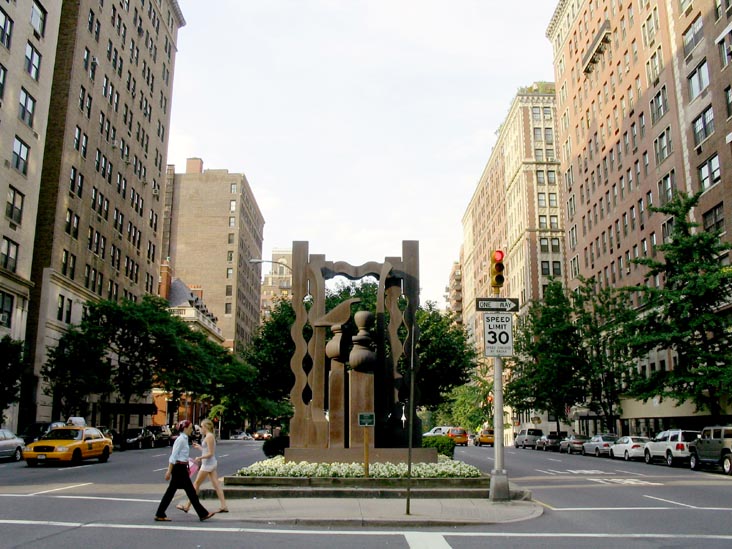
http://www.bridgeandtunnelclub.com/bigmap/manhattan/ues/nightpresenceiv/0307-16-07.jpg
(Here is a picture of the Upper East Side to drive home the point about necessary ingredients for determining valuable places. The height/density is a direct response or outgrowth of the demand to be in the area.)

The stuff inside of a building or unit, ie quality of counter tops and fixtures, etc are well and good, but those are the fine-grained adjustments to the real estate microscope. Location and proximity, or propinquity, is the big knob.


The problem of the Arts District is its clustering of the venues so tightly that any potential vitality is suffocated by an over abundance of simple boxes. Sure the architecture might be complex but that is only skin deep. Value is driven by complexity. And real complexity is created by the mixture of types, uses, buildings and the interconnection of a walkable urban fabric. The point of walkable urbanism is the value of having your daily destinations within a safe, pleasant walking distance.

This is still Henry Ford assembly line urbanism when we need the technology of the 21st century of smart, interconnected systems thinking with the ability to learn and adapt populating our approach to urbanism and development. Simplicity vs. Complexity.

It is the difference between Wrigley Field and Fenway Park being so loved and "stadium districts" getting, well, torn down every twenty or thirty years. Which was the smarter investment? I'll answer my own question, it is the development that is the cherry on top, the culmination of the messy mix of its urban neighborhood.

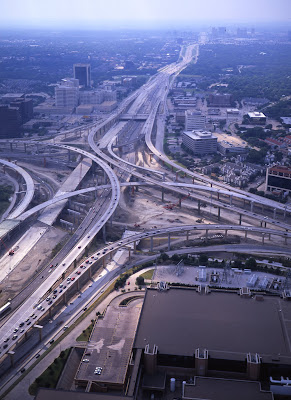
Of course, I just spent a thousand words talking about the investment going into the Museum Tower and the only real problem is the clover leaf strangulating it. If that was my pension money, I'd be putting a little extra into protecting my investment and getting rid of that thing so the tower and its residents actually can participate in the City around them.

Underestimate highway engineering's negative effect on real estate value at the peril of your investment.

Wednesday, April 7, 2010

Fort Worth to Proceed with Streetcar Study

Old news by now, but the vote was indeed unanimous. Major kudos to Fortworthology on this one, who instead of gloating wisely decided to bite their tongue (this time). See their post on the proceedings:
We’ll save the analysis, and the correcting of certain council members, for another time. For now, we’ll just say “thank you” to the supporters who spent a long night in council chambers and a “thank you” to all those in the public and private sectors who have worked to get us this far. All your support had a very real impact on how this vote went.
Now the real brain damage can start: how to pay for the construction of something that, like all transportation, rarely pays for itself, has high initial startup costs, and a return that is disconnected from its investment. Because it does generate returns for landowners near to lines, increased tax base for cities, development opportunities for private investment, and eventually increased mobility due to the associated high density development that accompanies new streetcar lines, we are confident that it will take creative public-private partnerships to see the vision through.

I look forward to tracking HDR's progress on this project.

Tuesday, April 6, 2010

Lessons from Charlotte and the Challenge Defining Livability

Excellent article at the NYT, "A Southern Success Story for Public Transportation Offers Lessons in Livability." With a laser scope and a round in the chamber, this fully automatic piece hits so many targets so forcefully, that it is well worth the read. It even includes a delicious quote from the head of a brilliantly named American Highway Users Alliance as well as some right-wing cannibalistic fear mongering by a washed up George Will.

A sampling of the remainder of the article, about a City that suffers similar maladies as does our own hometown here in the Big D: a choking inner ring highway around its downtown (what they call uptown - backwards, I know), areas of the city completely disconnected and isolated by freeways and railroad lines, overly wide streets with a preponderance of one-ways, over-scaled bank towers and their enormous supportive infrastructure and delivery systems, and surface parking in the downtown as far as the eye can see (once again proving that with all of those highways and roads, surface parking is the highest and best use):

Charlotte's vision:
In year four of a 25-year plan, the city is laying the tracks for an intermodal passenger system with a full menu of mass-transit options, complete with light-rail trains dropping off passengers in Uptown and at a central high-speed rail station, and streetcars running from center city to the international airport.

The ineffectual nature of buses:
The ridership numbers for the city's first light rail line help to make the case: More than 70 percent of the system's riders had previously never been regular passengers on Charlotte's bus service, according to the city.

The invisible hand is always attached to an invisible arm of gub'mint:
Leinberger likened transportation planning to "a rudder of a ship" that ultimately controls where and how private investment flows.

The challenge facing cities with no additional Federal funding support:
"With no additional revenue coming from the federal government, this is going to be up to local jurisdictions to raise the money," said Leinberger. "There's just not sufficient money coming out of the federal government."

Projected return on investment:
To that end, Charlotte's planners say the city is expecting $1.8 billion worth of investments to be made along the first line by 2011.

The question then becomes, how do you foot that big ol' bill when both the calculable and incalculable returns on investment are well documented locally and nationally? Does the city raise taxes to pay for it? Does it issue bond packages? Is there a way private investment can capitalize on the opportunity through development potential, considering the biggest winners will be land owners near proposed transit hubs, the public sector through increased tax base, and a citizenry no longer shackled to the cost and tyranny of automobile usership (usurp-ship?).

Considering streetcar lines were privately built to unlock the value of land outside the immediate downtown (what we now call "inner ring neighborhoods"), I am guessing that it will require some or all of the above in a cooperative public-private partnership, only made more difficult this time around with fractured, parcelized land ownership of the targeted and oft-faltering neighborhoods.

The planning and design part is easy. On the financial side, it is most certainly going to take some brain damage, but it will be well worth the effort.

Monday, October 12, 2009

Saving the Suburbs

"On a long enough time line, the survival rate for everything drops to zero."


A cautionary tale: no outlet in the fourth dimension.

The Radical Honesty? There is no saving them, but there is a future.

I know I've written about and cited studies of the trend towards increased crime in the suburbs, but alas I can't find those articles despite blogger's supposed search capabilities, so instead, today's article re: suburban decay du jour comes from MSN Real Estate, "Is Your Suburb the Next Slum?" (special bonus points for the title of the video on the sidebar "Has Housing Finally Turned" - no need for editorializing which way it's turning):
That's already happening in places such as Elk Grove, Calif., a community 15 minutes outside Sacramento. Here, builders rushed to build subdivision after subdivision — putting up 10,000 tract homes in just four years at the height of the boom — confident that buyers from all over the Bay Area would trade up to these larger homes.

They were wrong.
Succinct. I admire traits I lack.

I've probably written it before, I know I've spoke of it many times to friends, colleagues, clients, etc., but I'm always struck by the irony of the city's with the most laissez-faire attitude toward development (ie allowing sprawl) never fail to end up having some of the highest tax rates simply b/c they have to in order to pay for the amount of infrastructure per capita that is required for what the easiest possible development model entails.

Many suburban Dallas cities (and even the City itself) are feeling the pinch. Some b/c of the spread out nature, others due to the "drive til you qualify" nature of their outlying housing; in either case the tax base simply can't afford it. Paraphrasing a quote from Green Metropolis (the book is sitting next to me, but when I came across this quote I failed to dog ear the page nor highlight the passage as I typically do ruining all books I've ever owned), the author talked about the stigma of the countryside around times of the French Revolution where only Aristicrats and Rubes lived out there despite the City having undrinkable water, poor sanitation, and worse air.

The Aristocrats' (not the joke) streets were paved in gold, while the country bumpkins were dirt roads at best (b/c both had to pay for themselves in times where classical economics (read: sanity) still ruled the day). It is no different in today's times as we're seeing the bottom drop out of the American Dream and the Middle Class standard of living.

But, that standard of living can be molded. It can be shaped. I'm living proof that you can manipulate your costs to still live like a king. Of course, I don't have kids. But, the underlying point is that the suburban way of life is no longer the ideal model, particularly for the largest generation in American history that are rewriting the rules of the American Dream as they march thru their lives like Sherman from Atlanta to the Sea. Hopefully however, we will be rebuilding railroad tracks rather than mutilating them.

Suburbs are chosen these days for a variety of reasons, none of which are the same as when they were a new creation. They were strictly a reaction to the plagues of what Cities had become and were an embodiment of a democratic ideal that every man was his own king, in charge of his own life.

But, all of that is changing as suburbanites find themselves trapped in traffic jams, chained to their car keys (and the costs associated), stuck in Generica because for the most part there were no other choices. That is hardly free. Today, people leave the cities for schools (which I'm a firm believer that they can be as good as we want them to be once ideology is stripped from the conversation) and for the perception of crime or safety, whichever way you want to think about it.

Turns out that yeah, well, the school thing is still a major (nay, GARGANTUAN) issue not just for a return to urbanity, but for society and this country as well. But, as for the rest of suburbia, we are learning that it's not safe, it's not healthy, it's not sociable, it's not enjoyable, and it certainly isn't lovable. Hat tip to Steve Mouzon on this one, it's his point that for things to be sustainable, they must first be lovable, or they'll just get bulldozed for the next thing, whatever that might be.


The issue about safety is the indefensible nature of suburban design. For lack of a better word, they are unpoliceable. There is too much space.

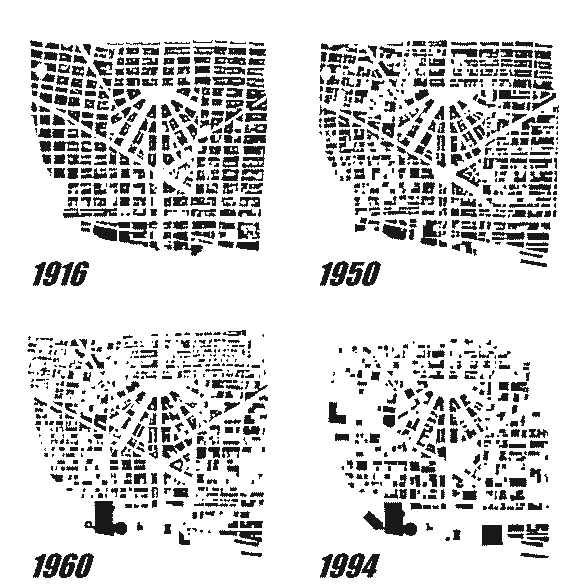
Watch the time lapse of Detroit's decay. Take a close look at the 1916 years and how little "white" space there is (black is buildings obviously). What this does is minimize the public realm, which means less space per capita, which means higher affordability for high quality spaces and less to maintain, a focus on convergence points forming key public gathering spaces, creating a natural hierarchy where important civic or public buildings can be placed celebrating accomplishments of art, culture, or self-governance.
http://www.buildingsrus.co.uk/detroit/figure_ground.gif

The beauty of good urban design is the focused nature of the open space...if illicit activity is happening in the privacy of a home, it doesn't affect the public realm unless it is so concentrated as to plague entire districts and overwhelm any efforts at policement and regulation. Furthermore, when Bill Lucy was speaking here, he pointed out data showing that when calculating per capita safety numbers and removing all violent crimes that are committed by friends or relatives, haphazard mortality rates are much higher in suburbs than cities.

The flip side of the ZOMG suburbs are awful commentary is that we've pushed all of our chips into the center of the table. We're pot committed vis a vis that shear amount of infrastructure that I've just been bitching about. So we have to work to save them, but how?

I see two choices and mentioned this in the Transect post from a while back that seems to have quickly become the most clicked post I've ever written. As the rough graphic shows we have an over supply of T2 - what we know as suburbia - and this has to either densify or de-densify.

[supply.jpg]

Jane Jacobs, in Dark Age Ahead, wrote:
Sprawl can become less wasteful only by being used still more intensively. If that happens, suburban sprawl will turn out to have been an interim stage, a transition between land in agricultural use and land densely enough occupied to support mass transit, to form functional and inclusive communities, to reduce car dependency, and to alleviate shortages of affordable housing.
We are already seeing densification occuring in strategic locations, Las Colinas, Addison Circle, Legacy Town Center, Downtown Plano, etc. in some cases these are defined by new transit lines, in other cases the density formed with the idea to be served by transit sometime in the future. This densification allows the outlying communities to become more dense, livable communities with a greater variety of housing product and affordability levels, as well as increased tax base, which we will need to support and fund schools.

Those that densify will have to have a reason for doing so, and will need a certain measure of a real, supportable economy themselves. This entails an infusion of new uses into all single use districts, whether they be retail strips, light industrial parks, suburban office campuses, or single family neighborhoods. But, for the most part, these communities still act as bedrooms for downtown and nearby workers, which is fine for the most part as it still allows for transit use, and the opportunity for choice.

But, what of the further outlying suburbs that will never have any forms of mass transit?

If we're not careful (or if we intentionally allow to do so for environmental reasons) some of the lesser positioned and poorly constructed neighborhoods may turn to dust, or reclaimed by nature as some killer shelters with two car garages and walk-in closets for whatever furry creatures decide on Mulberry Lane to raise their roost.

As Jacobs writes, the way for these areas to maintain themselves as productive members of their metropolitan area, is to intensify their use. And that means import replacement. The way to de-densify is either go back to nature (which for all it does with water and air, IS productive) or replacement of things we truck, pipe, train, ship, or wire in from further locations via local food and energy production.

With giant agribusiness depleting arable soil at an alarming rate, there may just be a plentiful amount of food giving earth still remaining in suburbs that were sold by small farmers, who cared for their land family's b/c their livelihood depended upon the perpetuation of its production value. Often, they were forced to sell their land to developers for a retirement nest egg as their children moved city-ward and/or plummeting commodity prices made it impossible to make a living and compete with said earth rapers corporate agri-business.

The other potential option is as energy production - solar or wind farms, or hell even nuclear - go here to see treehugger's debate on nukes, which might just be a necessary evil as we transition into a post-carbon world, allowing time for technology to fully take advantage of all the Sun's potential.

As I've said, the suburbs to have a future, must have an economy to do so, beyond being strictly bedroom communities, however many industries will learn that they need the synergies of urbanism and will move back to the city following the demographic shift center-ward (being near employees was one of the major reasons for the move of businesses out of cities). Suburban communities have two choices, and neither is the status quo: 1)Densify or 2) start thinking about what kind of imports they can replace with local production - I'm of the opinion that it's food or energy - or maybe it's even water as areas return to nature's natural cleansing ways.

Tuesday, June 30, 2009

Fun with Numbers/Dallas Budget

So in light of the City of Dallas experiencing a nearly $200 million dollar budget deficit, I thought I would have a little fun with numbers while we watch education, police, fire, and presumably every other necessary service get slashed while road maintenance and upkeep retain highest priority.

First of all, I should say that compared to many other cities that I have been to and worked in, Dallas is getting off light. The city is both lucky and unlucky given its defined boundaries. Many smaller cities are experiencing much more severe budgetary constraints. For example, one city of approximately 100,000 had a projected shortfall of $250,000,000 equalling $2,688 per person. And THAT number was strictly for infrastructural upkeep and maintenance (and upgrades. Can't forget upgrayddes. That's how I will spell it from now on whenever an engineer uses the term road improvements or upgrayddes because it is such a bastardization of terminology), meaning no new construction. Compare that number to $146 per person in Dallas. That's nearly 20x.

Building low density sprawl had come home to roost. We simply can't afford the level of infrastructure that sprawl expects. The primary issue is that logically and throughout history level of services and amenities increased with greater density. It makes sense, more people sharing burdens and costs, the more can be achieved with that pooled wealth. The countryside couldn't afford sewer and roads and power, etc.

This is why I state over and over that Deep Sustainability comes in two forms, self-sufficient and very sparse (the Jeffersonian Ideal) or the very dense cities (but I expect due to material constraints this means lower scaled, but still dense building in the model of Florence, for example). As we know, the very necessitation of human settlement patterns (and community) is shared common hardships and then, in turn, quality of life improvements through gains in standard of living brought about by the economics of sharing, trading, cooperation, markets, etc.

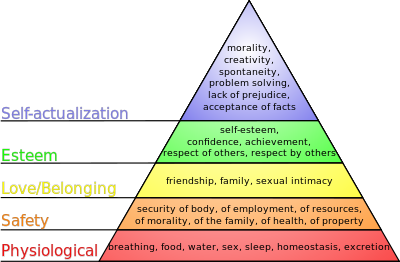
This pattern can be traced directly to Maslow's hierarchy of needs. Imagine ourselves as lonely neanderthals at the bottom of the pyramid, rising to the highest of levels during times such as the Renaissance, or the Enlightenment, or the even the technological revolution of today leading to increased levels of interconnectivity. And then crash back down to the yellow in our fractured and disconnected society via the car, the television, etc.


With out new found wealth and suburban explosion, we expected the best schools and similar level of infrastructural support to follow. For a time it worked, but upkeep has proven to be the problem. The infrastructure and population density are spread so thin that we put so much pressure on such brittle apparatus that it begins to collapse due to overuse often caused by our dendritic arterial system versus a more choice-laden, adaptable and dispersive grid network and underfunding.

So getting back to why the City of Dallas's budget shortfall is 20x less than that of smaller cities as discussed earlier, Dallas is lucky in that it is landlocked by its suburban neighbors. Dallas proper can do very little in the way of new growth, which has mostly happened in areas like Rockwall, Mansfield, and Frisco, meaning less no roads (despite everyone from the City to the State, to COG, and to TxDOT's best efforts). So we can ideally focus our efforts on QUALITATIVE over QUANTITATIVE growth.

This is unlike Houston which annexes all of its growth. The future of these two cities can go either way from this tipping point we have reached due to their nature. Houston could become much more responsible with its growth, spending, inertia, and annexation or Dallas could be more successful as it can focus on a much smaller land area.

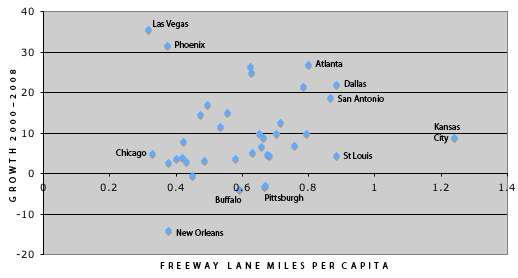
Where this bites Dallas in the butt, is that there are so many commuters coming in from Richardson, Plano, Arlington, Mesquite, et al., this means Dallas ends up with a very high freeway miles per capita number. Essentially because commuters' trips to Dallas are subsidized at the expense of state and federal taxpayers, but the real cost is the burden on the well-being of the City itself.


Often when the argument of mass transit comes up, I'm both dumbfounded and frustration by the simplicity of the dollar values and supposed wastefulness that is bandied about. Such things as revenue generation, long-term maintenance, real estate values, etc. are always ignored in favor of startup costs strictly against Mass Transit. Well, how about we take a look at how much embedded wealth we have sunk into all of our roads in Dallas.

**Disclaimer: Very rough numbers.

The chart above shows the City of Dallas at .88 freeway miles per 1,000. This chart from 1999 shows freeway equivalent miles at 1.291. I'll use this number because freeway equivalent sounds an awful lot like freeway. Call me crazy, but I'll assume it costs something similar. Also, note how many Texas cities in the top ten. And we wanna build another one as part of the Trinity River Project? Sounds like a good plan (or a racket).

So we know that we have the freeway equivalent of 1.291 lane miles per 1,000 people, approximately 1.3 million people at a density of 3,605 per square mile. And a land area of 385 total square miles. This suggests that 1 freeway lane mile in a congested urban area can cost upwards of a $100 million multiply that over the 1678 freeway lane miles in the city and we get a cost of $167 billion or a cost of $130,000 per person.

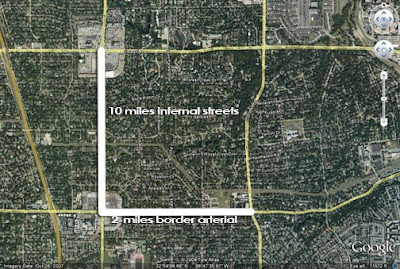
But, what about the other roads? Since Dallas was built on mile-square arterial grids we're going to apply this pattern to get a sense of how many overall road miles there are per capita in this city. As you can see in the graphic below, each super block is bound by 1 mile length arterials and further broken up into blocks by internal collectors or residential streets. The total perimeter equals four miles, but I'll go with half that or 2 miles because each arterial is shared by another 1-square mile super block.


Internal to this superblock, I will estimate approximately 10 miles worth of neighborhood streets cross this block. This is more difficult to get a sense for as each superblock is subdivided differently due to geography, density, or whim. But, to assume the equivalent of five N-S and five E-W streets is pretty conservative considering that leads to about 800' x 800' blocks, not unusual for the 'burbs.

At 3,605 people per square mile in the city that means that these blocks then have .00277 of residential street per capita (not unreasonable as that equals 14' of street frontage) and .00055 arterials per capita. I'll cost the residential streets and infrastructure at $5 million per mile (which assumes NOT a very nice streetscape) and $10 million per arterial.

If we are to extrapolate these superblock numbers over the entire city that means we have spent $7.2 billion on arterials, and $1.8 billion on residential streets and infrastructure. Add in the freeway equivalent costs and we are at $176 billion dollars JUST for construction, or $135,384.62 per Dallas resident. Did we realize we can't afford that?

Next time somebody complains about a transit line costing X amount of dollars throw some similar numbers like that at them. We already know the difference in quality of place the two create.

Maybe to save our budget and essential city services, we can stop building or "upgraydding" roads and start building for people, not for cars.
Better caption? Money Well Spent or Return THAT Investment?

Tuesday, April 14, 2009

"The Era of Bling is Coming to a Close"

From Christian Science Monitor:
Cooke & Co. was the Bear Stearns of its time, a pillar of national finance. If it could fail, anyone could, and the US stock market collapsed that awful autumn. The price of real estate, railroads, and other hard assets crashed, too. Banks fell like wheat before a reaper. Deprived of credit, Main Street commerce suffered. Unemployment reached 25 percent in big cities. The Panic of 1873 eventually led to 18,000 business bankruptcies. National production shrank for six years. Yet a new and stronger US economy emerged from the wreckage.
I have to say though, that I disagree with #10 - The Bust of the Boom Towns. As long as we are accepting "growth" as the axiom our society, economy, and standard of success is measured by, the Boom Towns still have the most work to do. Reason 1, why I am here in Texas.

Yes, they boomed. But that economy of growth was a false one in cities such as DFW, PHX, and Vegas. 99% of what was constructed was worthless. In the cities of the Northeast, not much growth is expected, if at all. What growth will occur will be simply putting people back to work with minor deviations in what they are actually doing.

Here, we have the most work ahead of us in terms of overall reorganization of both people AND economies. Much of the economic growth was in Real Estate and it played out on the land with exponential quantitative spatial growth vastly outpacing population growth.

If this City is smart they will get on the ball and set up a streamlined zoning, entitlement, and approval process for mixed-use, mid- to high-density development AT LEAST in set areas, such as Leinberger suggesting that Dallas needs ten 100-acre high density overlays. If they set up these overlays now, the planning work can get started and developers will be ready to build in ten months or two years, whenever the lending purse strings loosen again (or if again means never, then we need to find a new way to finance these things).

We know the market is there and the demand is there. As I wrote here, Millennials are the largest demographic group (aka "market") in American history and they are redefining the world around them through their shear mass, vitality, and collective directed vigor.

It will be a race for Sun Belt cities to not only be "cool" again to compete for talent in an ultra-competitive and mobile knowledge/creative economy (where real economic growth is created thru startups and innovation), but also in order to be relevant. If not for the Real Estate industry fixing its mistakes, I'm not sure what other markets are out there to pull the Sun Belt cities out of a certain prolonged recession.

Monday, March 16, 2009

Monday Morning and Weekend Links

Green-ness of Skyscrapers? including the prescient Dr.Seuss tale:
Over the protests of the environmentally sensitive Lorax, the Once-ler builds a great industrial town that despoils the environment, because he “had to grow bigger.” Eventually, the Once-ler overdoes it, and he chops down the last Truffula tree, destroying the source of his income. Chastened, Dr. Seuss’s industrialist turns green, urging a young listener to take the last Truffula seed and plant a new forest.
This tells me more about the cancer stage of capitalism than it does environmentalism: forever growth!...Now for the important calculations:
Matthew Kahn, a U.C.L.A. environmental economist, and I looked across America’s metropolitan areas and calculated the carbon emissions associated with a new home in different parts of the country. We estimated expected energy use from driving and public transportation, for a family of fixed size and income. We added in carbon emissions from home electricity and home heating. We didn’t try to take on the far thornier issues related to commercial or industrial energy use...

In almost every metropolitan area, we found the central city residents emitted less carbon than the suburban counterparts. In New York and San Francisco, the average urban family emits more than two tons less carbon annually because it drives less. In Nashville, the city-suburb carbon gap due to driving is more than three tons. After all, density is the defining characteristic of cities. All that closeness means that people need to travel shorter distances, and that shows up clearly in the data.
Here is the problem. This study takes the Amero-centric view that only through tall buildings can one achieve density. Skyscrapers are not a necessity for density. Paris, Florence, Madrid, Rome, Copenhagen, are wonderfully dense. Now, here are the potential CONS of skyscrapers:

1. Even if a platinum-certified tower is constructed, the building is still immensely energy intense in its construction phase.
2. They are materially intense, with materials typically travelling much farther than with low- and mid-rise buildings.
3. Skyscrapers privatize sunlight and views. Then, amazingly when another tower is built next door, the tenants of building 1 flip out that they lost their view...despite doing the exact same thing.
4. Tight-knit, often medieval form urban fabric generates protective microclimate from weather extremes. Skyscrapers often exacerbate the problem with the intensity of the wind shear and down draft created by the building.
5. Skyscrapers adversely affect the street aka the public realm by 1) removing people from the street and putting them in elevators and 2) overpowering the scale of the space created by the buildings.
6. These buildings tend to be glass and steel. Two energy intensive materials, often not created locally. I like the elegance of glass buildings, but then the issue becomes one of active vs. passive heating and cooling. AND, reflective glass is often pretty ugly.
7. COST. They are expensive to build.

In summary, I'm not saying that I'm against skyscrapers. I like the pyramidal form of skylines of cities, emblematic of the greater synergies driving up values in the center-city, and thus manifested by taller buildings, aka greater real estate and F.A.R. in those places as a natural result. But, simply calculating that more dense places are greener doesn't say a damn thing and it certainly doesn't necessitate skyscrapers.

Brookings on the economic engine and (should-be) haven for investment of cities:
Yet here is the problem: While America is more metropolitan than ever, the nation’s policies and structures rarely match economic reality. As a nation, we remain fixed in old arrangements, established decades ago and kept in place by bureaucratic inertia and entrenched political interests. Such a misunderstanding of contemporary urban structures inevitably leads to bad public policy decisions. Take as an example the nation’s crumbling infrastructure, now finally in the public eye. We should be spending money on metropolitan infrastructure, such as new transit lines or the maintenance and upgrade of existing roads and bridges, because it gives the best return on investment, the most bang for the buck. And yet the federal government sends the overwhelming bulk of national infrastructure funds to states, not metros. Given the vagaries of state politics, state departments of transportation in turn tend to scant metro investments in favor of building brand-new roads in far-flung places. Money that could be fueling the metro economic engine ends up widening a rural highway.
And lastly, a fascinating take on the death of newspapers as compared to the revolution that was the printing press:

Round and round this goes, with the people committed to saving newspapers demanding to know “If the old model is broken, what will work in its place?” To which the answer is: Nothing. Nothing will work. There is no general model for newspapers to replace the one the internet just broke.

With the old economics destroyed, organizational forms perfected for industrial production have to be replaced with structures optimized for digital data. It makes increasingly less sense even to talk about a publishing industry, because the core problem publishing solves — the incredible difficulty, complexity, and expense of making something available to the public — has stopped being a problem.

Wednesday, March 11, 2009

Prepare for Higher Taxes...

...or, if your community, town, borough, township, etc. out in Generica, i.e. suburbia lacks the will or ability to pass higher tax rates, prepare to get nickle and dimed on every little fee, registration, parking meters, wherever they can hide little costs to meet the overwhelming costs of overextended infrastructure.

I can't tell you how many typical "conservative" communities, i.e. the ones that allowed conventional suburban developers and strip centers run amok over their city, that I have worked in that are so under water just for upkeep and maintenance of their current infrastructure. These communities often, ironically, end up having some of the highest tax rates to accommodate the land raping that has been done.

Suburbs simply lack the density to pay for themselves and it's time to start paying the piper:

Florida prepares for higher taxes despite dropping property values:

Monday, March 9, 2009

Quote for the Day


The necessary melt down of the 2oth century phony economic model of quantitative growth; of robbing peter to pay paul; of buying other debt, bundling it, repackaging it, charging a fee to do all that and calling that economic development; is making a house cleaning of the conventional, the generic, the suburban, and ultimately the worthless.
The roof, the roof, the roof is on fire. We don't need no water, let the mother fucker burn. Burn mother fucker. Burn.
Yes, it is painful. Yes, I am finally feeling the effects too. But mostly through others. I strongly recommend everybody reposition themselves for the future.

To quote another song, this time by TOOL:
This is necessary...

Monday, February 23, 2009

Quote for the Day

A critic such as Frederick Ackerman in 1925 could dryly note that "a community with a stable population is now referred to as a dead one." Interestingly, this was in a paper titled "Our Stake in Urban Congestion," noting that contemporary proposals to "solve" urban congestion by building elevated and limited access highways would kill the golden goose, which is based on the ability to tax the increases in land value and specialized transactions that cities create.

Wednesday, February 18, 2009

Dovetailing Conversations

Unintentionally, I had a conversation with a reporter, a client, and ahem, myself I suppose while reading this take at HuffPuff: Can Obama get us to the Long View?

When do we start looking at life cycle costs? How can we get past looking at a day on Wall Street like reading our daily horoscope? How can we stop externalizing costs? How do we balance the need for budgeting up front costs with expected or even guaranteed ROIs?

Are these inevitable? Or merely stumbling blocks as we throw out the Rube Goldberg political and cultural apparati of the Baby Boom generation for the Bullet Train of Millennial progress.
----------------------

By the way, I was able to catch Dan Rather Reports on HDNet. It is clearly the best news program on television right now and has found a permanent place on my DVR rotation.
----------------------
Side note 2: I also recently watched the Behind the Scenes feature on the Wall-E dvd b/c I'm the type of nerd that watches movies with the director's commentary on. Whenever you sit and think just how competent these movie makers might be when viewing the end product - thinking "wow, this is something that I just CAN NOT do," and you get to see some of the work in progress, you no longer feel so inadequate. Holy crap the initial story was utter shite compared to where it finished. More like a bad episode of an otherwise mediocre show, Futurama.

Especially when they mention that if it was the end result of one artist working around the clock, it would take that person 400 years to finish the movie. And the finished product is the better for that collective effort, once again undermining Ayn Rand's notion of the solitary genius.

This is exactly the same reason that I discuss Placemaking as places being greater than merely the sum of the parts. A building is a postcard, a snap shot. A real place is drama.

TreeHugger Touts Rail Investment

Link.

But, how far will $8 billion get us? Let's say a typical high speed rail line costs $80M per mile. Throw in another $20 for gubmint waste (or just to make nice round numbers). That is 80 miles. WooHoo, high speed rail to Waco!

Or at least it's enough to get started on planning and design throughout the country. Oh well.