Showing posts with label Inhumane Roads. Show all posts

Wednesday, February 8, 2012

Single White Vampire Seeks New Infrastructure

North Texas Tollway Authority has a press release out. Hat tip to Big Jon Daniel for forwarding this along. It is rather comical in that my first impression was to confuse it for a personal ad placed in the singles section of what used to be newspapers (which I suppose is now Craig's List(?)) by a vampire.
NTTA roadways “may be greater economic drivers than ever before because transportation access is so important in terms of residential choice and the choices businesses make in terms of where they want to locate,” Weinstein said. “You don’t have to be an economist to notice this. I’ve lived here 36 years and watched the expansion of these roadways and seen the type of development that occurs along or close to them.”
"I want to whisper sweet nothings in your ear...then I want to bite your neck. Just a little nibble. I promise."

And that promise is economic development. Sounds like a pretty sweet deal right. Yes, infrastructural spending invariably leads to investment. But what kind? And for how long?

I think we already know the answer that bad infrastructure begets bad, short-term "economic development" which quickly turns into disinvestment. But as long as we are able to move the goalposts and only measure short-term investment leveraged, it still sounds like a pretty siren's song.

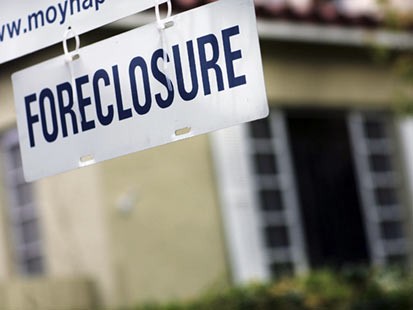
But then again, "housing won't go anywhere but UP!" Sounded pretty good too.

And I should add, I'm in favor of tolling highways. Just not building new ones to do so. That is a racket. Fundamentally, the toll is designed to help roads and drivers pay their own way (not even above and beyond to cover potential externalized costs such as pollution, etc. Rather, the toll merely covers the gap in funding leftover by the gas tax which only covers about 50%).

By offering what seems like a free good, free access to roads, badly distorts everyday transportation decisions. By more accurately pricing this "good," you would inevitably reduce demand. If you're reducing demand, why then do you need more roads?

Oh, because your business is building roads. Who cares if you're effing over the city in the long-term. But really, isn't that what the vampires in the want ads want to do anyway?

Monday, January 23, 2012

2012 Report: Rankings for Walking/Biking

Alliance for Biking & Walking has published their 2012 report ranking American States and Cities. Their words:

This report comes at a critical moment, as Congress takes up the imminent passage of the next federal transportation bill, which dictates how billions of tax dollars will be spent over coming years. The Benchmarking Report reveals that, in nearly every city and state, pedestrians and bicyclists are disproportionately at risk of being killed, and currently receive less than a fair share of transportation dollars. While 12 percent of trips in the U.S. are by bike or foot, 14 percent of traffic fatalities are bicyclists and pedestrians. Pedestrian and bicycle projects receive less than 2 percent of federal transportation dollars.

“The Benchmarking Report shows that biking and walking are smart solutions to many of our country’s most pressing challenges when it comes to transportation, job creation and health,” Jeffrey Miller, Alliance President/CEO, says.

The report compiles persuasive evidence that bicycle and pedestrian projects create more jobs than highway projects, and provide at least three dollars of benefit for every dollar invested. The report also highlights the health benefits of active transportation, showing that states with the highest rates of bicycling and walking are also among those with the lowest rates of obesity, diabetes, and high blood pressure. “The data points to one conclusion: Investing in biking and walking projects creates jobs, leads to more people biking and walking, and improves safety and public health,” Miller says.

John Pucher, a professor at Rutgers University, emphasizes: “The wide range of environmental, social, and economic benefits of walking and bicycling, so clearly documented in this report, justify greatly increased investment in facilities and programs to encourage more walking and cycling, and to improve the safety of these most sustainable of all transportation modes.”

If you just download the media fact sheet, you'll find where Dallas and Fort Worth stand amongst the 51 cities included in the rankings.

For overall levels of walking/biking:

Dallas 49th of 51
FW 51st of 51
OKC is 50th

That's the bottom three. As for the top three: Boston, DC, San Fran in that order.

For fatality rates of pedestrians/bicyclists:

Dallas 49th of 51
FW 51st of 51
Jacksonville is 50th

As for the top 3: Boston, Minneapolis, Omaha in that order

When I have more time, I'll dig into the methodology.

Monday, January 16, 2012

We Can Do a Lot of Things, But We Can't Do That

If you hadn't heard, a bicyclist riding on the Jefferson Street viaduct was struck by a car riding from Oak Cliff to downtown this Saturday. The collision broke his neck. As the news report rightly points out, this is one of the streets suggested for initial restriping of bike lanes. Dallas has no on-street bike lanes at present. Meanwhile, cities around the country are adding them left and right.

It should also be noted that there isn't one safe connection across the Trinity River for pedestrians and/or cyclists at present. Jefferson and Houston Street viaducts, the two primary connections to/fro Oak Cliff are literal nightmares. I've ridden them several times. Yet the irony is that there is so little vehicle traffic to warrant the excess vehicular travel lanes on them. Google Earth Pro tells me that previous traffic studies suggest an average of about 8,000 vehicles per day on each. They're both 4 lanes. 8 lanes in total. The sidewalk for bicyclists and pedestrians abruptly stops. Meanwhile, Main Street in downtown moves 9,000 vehicles per day. It is one lane in each direction.

The Lance Armstrongs as I call them, those that think just some good edjumucation is in order to get ridership and safety up, want riders to co-exist with vehicles on the travel lanes. Cars routinely drive 55 mph on those two bridges. Can you pedal that fast? Can a child? Cars drive as fast as the road design allows them. They haven't a clue as this post points out, which is why they've been saying the same thing with no results for decades. They appeal only to the 1%. Not that 1%, but the 1% identified by Roger Geller that is "strong and fearless."

It is the 60% of the population which is the untapped market that is "interested but concerned." I.e. not batshit crazy enough to try and compete for roadway space with drivers conditioned by a highly competitive traffic environment to drive aggressively. I was in conversation with a woman at one of Chef Nicole's underground dinners a few nights ago. She lamented why does everybody in Dallas have a giant SUV?

The answer, beyond the various tax breaks and artificially deflated gasoline prices for hyper-inflated internal combustion vehicles, is precisely that competition. Every other driver on the road is your enemy? Why? Because the optimum condition of a road is no other drivers. This is the failed logic of the transportation planner/engineer. They're in your way. They cut you off. They slow you down. They tailgate you. It is competitively advantageous to desire a bigger vehicle. In contrast, in European cities, it is competitively advantageous to have a smaller vehicle because space is at a premium, both parking and drive lanes.

Meanwhile, in a safer pedestrian-oriented environment, each other "commuter," whilst on foot, improves the overall experience. And as I tweeted the other day, city form is commonly based on the primary transportation technology of the day. However, foot power is the only transportation technology that transcends time. Therefore, the only truly timeless cities, durable cities, that will surely last long past peak oil (unless we all kill ourselves and each other on the roads first) is the pedestrian-oriented city.

Fortunately, Dallas Torres survived the crash. Or unfortunately? Did I really just say that? In other words, he won't be a martyr for change, since that is apparently what it takes to get the city to do its primary job: ensure public safety. If the city disagrees, thinking that public safety should take a backseat to economic development, there is also the fact that investment and spending along the Magnolia Avenue bike lane in Fort Worth is up over 500%. In one year. The actions of the city make it appear that they don't understand economic development and don't care about public safety. They do however think paying $10 million to Calatrava for a redesign of a physical connection THAT ALREADY EXISTS is a good investment. Maybe he'll just pull a design off the shelf again.

If words like these offend, perhaps they should offend. While the city looks for excuses not to make any changes, will it take a death to begin making changes?


Perhaps we need to give a call to the Bobs to ask, "what exactly do you do here?"

Monday, December 6, 2010

Conversing w/ a Traffic Engineer

"We can't have obstacles in the clear zone."

"What is the clear zone?"

"A zone that must be clear of obstacles on either side of the street so that cars don't run off the street and hit anything."

"How wide is this clear zone?"

"Twenty-five feet."

"That is my entire front yard. My kids play in the yard."

"I would not recommend that."


"What is the total project cost?"

"The project cost is $9 million."

- from Chuck Marohn at StrongTowns.org

Wednesday, September 29, 2010

Fort Worth's Diet Plan

Good news from Fort Worth. West 7th, the overly wide road connecting downtown Fort Worth to the Cultural District, but dividing everything along the way, will go on a diet. From FortWorthology:
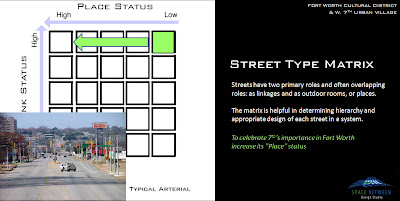
Since they’re re-topping the pavement anyway, the city is going to re-stripe to narrow 7th Street from six lanes + turn to four lanes + turn, and add on-street parking and bike lanes. The intent is to slow down traffic on the over-engineered high-speed street and make it more hospitable to pedestrians and cyclists, as well as safer for all users by slowing traffic. In essence, trying to turn the street from being a “link” to being a “place,” to go hand-in-hand with the new walkable/bikeable mixed-use development that’s occurring along it.
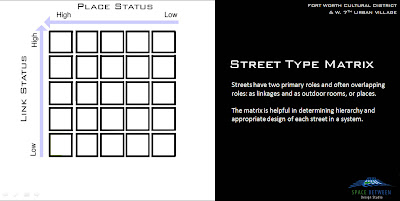
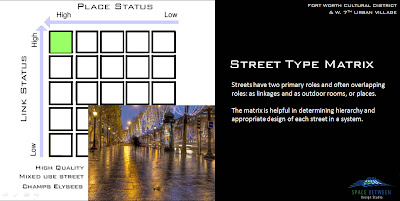
Vindication! Two things: You may recall me writing about W. 7th and the potential in the area that was held back by the current street function and design. Find that piece here. I have it on good authority that that piece was sent all the way up to State Senator Wendy Davis by local property owners. Furthermore, around that same time, I gave a presentation in Fort Worth that used those exact words, "link" and "place," so I'm glad those seeds have sprouted out west. Here are the slides for you to see and understand the concept as well:


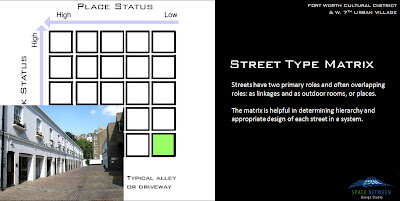
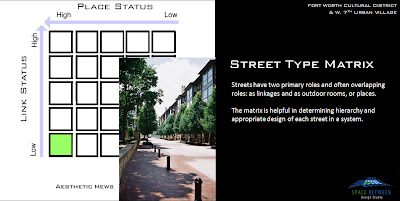
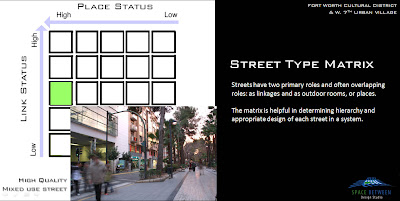
Here is the matrix, borrowed from British traffic engineer Peter Jones.


Link/Place: Low/Low - alley


Link/Place: Low/High - Designed Mews


Link/Place: Med/High - Predominantly Pedestrianized Mixed-Use Street


Link/Place: High/High - Preeminent, Champs Elysees. High design, moves all forms of transportation. Still amenable to street life and pedestrians with adequate +/- 50% of spatial envelope.


Link/Place: High/Low. West 7th currently, and nearly all other arterials in the Metroplex. With public coffers crippled by low sales tax receipts, the city is unable to transition directly from Low to High "place" value, it can incrementally do so by first transitioning the function of the street.

In many ways, this is better as it becomes in essence a pilot project for the city since people tend to reject change until they see it can work. Once it works functionally, and becomes more amenable to street life as pedestrians and bicycles, investment will surely follow. With a little bit of paint they are able to change the psychology of the area. This is strategically no different than what the Better Block is doing in Oak Cliff, what Janette Sadik-Khan is doing in NYC, or what the City of Plano did fifteen years ago narrowing K Ave through downtown Plano.

The key to this, is that the new, eventual investment will then leverage the upgrading of the aesthetics of the street to then match the quality of the development that happens. Baby steps people, baby steps, but we're at least stepping the right direction for once.

Peter Jones, your legacy will be felt in probably the last place you would ever expect it.

Friday, June 11, 2010

Only Quasi-Guerrilla Urbanism

But, taking back the streets nonetheless. A first class version of the paint and cones preferred by the rabble for taking lanes back from streets in favor of increased people space on our public streets:

Walklet


More imagery at the San Francisco Museum of Modern Art's blog.

As the best works of art are always representative of the human struggle of a particular time period (or endless struggle against our own barbaric nature which lies only a shallow cut beneath the surface of culture and community), if this isn't a great form of expression for modern art, I don't know what is.

This actually accomplishes something, a positive step in our quest for a return to humanity, toward interaction, rescuing us from our wheeled-steel traps. This is the very opposite of some lights under an overpass. This is King Crimson vs. a lip-syncing Britney Spears. But art, culture, and community is hard work.

Wednesday, May 26, 2010

GUEST POST: Bicycling in Dallas


Go ahead, drivers. Make my day.

These are fun. Why? Because I don't have to provide all the written content. Thursday afternoon, 5 to 8 pm, at City Hall in downtown Dallas is the Bike Plan open house. Will anything substantive come of this particular session, probably not. But, it is a chance to commiserate with your like-minded peers...and there'll be punch and pie!

------------------------------------
Putting My Hard Hat On and Going to Work.

Yes, I ride my bike. Or, should I say I am the pimple that the city of Dallas drivers can’t seem to rid themselves. I may be a speck in the grand scheme of a City where commuting is an antagonistic affair, but I am certainly the most annoying of all opponents delaying you from that rat race.

It might actually seem feasible to reach a downtown job by bicycle for a resident of the yuppie village region of Uptown Dallas, not more than two miles away. Too long to walk, the trolley is as reliable as its century old parts, and driving just seems ostentatious. It ought to be the perfect distance for what should be a safe, enjoyable ride if in a City that accommodated it.

Well, in the City of Dallas, it isn’t. With the luxury of great weather year round, I began commuting by bike three months ago. The trek is not far. I can see my building from my apartment, but the absurdity of navigating the region on two wheels is far too intimidating for most. As a safe, energy efficient endeavor, it shouldn't be. Alas, we've entitled those pointing and pedaling the much more deadly machines.

People comfortably ride bikes around White Rock Lake and on the Katy Trail, but hardly anyone rides on the street. Why? Because you can’t. Sure, you can physically ride on the street, but good luck. Without a bike lane to be found you are head-to-head with impatient motorists not interested in your safety, but rather, reaching their destination as expediently as the law does or does not allow.


My commute is unable to take the logical, direct route: McKinney Ave, or snake through some side streets that might be more pedestrian friendly. No, my commute begins on the sidewalk to get to the intersection of Hall and Cole, or shall I say, the intersection of bicycle death. After I turn onto Hall, I then weave through a drive-thru bank (without making a deposit or withdrawal mind you) to get to the Katy Trail. Alas, I made it….alive. This is the only enjoyable portion of the commute. The Katy Trail is beautiful to ride alongside other bicyclists, people out for their morning jog, and experience some of the most beautiful green spaces in the city.


ed: Ryan's route vs. the more direct one.

On the roads forget about common courtesy or patience from drivers. Usually the best strategy at intersections is to let every car go first, hoping that the next wave of motorists realizes your turn, but this is risky business. Look out for Sally Sorority in daddy's beamer on her cell phone willing to make you part of the street, or her vehicles grill. Three separate times I have been nearly killed as I perform a basic left turn onto Hall Street, with the right-of-way. Common theme: cell phones. All three motorists have been on their cell phones not paying attention. I could have been a biker, a walker, or a double-decker bus in London. It would matter not. A wreck or manslaughter is in their future. No worries. Daddy will cover it.

Once this portion of the commute is over, the real journey begins as I navigate a sea of parking lots in order to avoid Mark Martin, Tony Stewart, and the late Dale Earnhardt on their way to work. Crossing the highway is always the next obstacle where I stare death straight into its steely grate. Surprisingly, it is not too bad. With a preponderance of lanes, motorists provide bicyclists the right-hand lane. However, I do not doubt for a second that I would be run down for the next changing traffic light.

When my day is up, back to the Texas Motor Speedway we go. The return trip always follows the same route because the only safe section is the Katy Trail no matter how far out of my way it is, which in the afternoon with the sun out is even more enjoyable. There are no safe streets for a bicyclist. Of course not. You are a second class citizen. Perhaps soon we will have to drink out of separate water fountains.

The commuting back and forth is not nearly as bad as the first time one tries it. Like anything else, you get used to it, all of it. You have to accept that this City, not just its inhabitants, its drivers have cast you out. You are undesirable. Even dressed in office attire, as might be the case in any other City in the world, you are lumped into the small niche crowd of hardcore enthusiasts in spandex when all you want to do is get to work.


I suppose it actually is my fault foolishly thinking that biking to work, since it is such a short distance, was a good idea. I mean that bro honking and glaring at me from his Hummer because I properly turned left at the four-way stop, with the right-of-way, is clearly right. Look how important he is, he’s in a car. Duh!

A city shouldn’t have to “get used” to alternative, healthy forms of transportation. This city needs bike lines, a plan for nearby residents to commute safely to downtown, and a real conscience about promoting healthy commuting for a city known for the opposite. I am not Lance Armstrong, but I also don’t want to be that dead squirrel on the pavement.

----------------------------------------
Ryan DiRaimo is a local architect. He wants you to know that he's 6-5, 240 and plays in the NHL, but not for the Stars. Those endeavors might lead you to believe that he would be too busy to maintain a sports blog, a twitter account, AND be a favorite of the lovely ladies of Dallas-Fort Worth Metroplex. He does all of the above. Except for some.

Wednesday, August 19, 2009

Back.

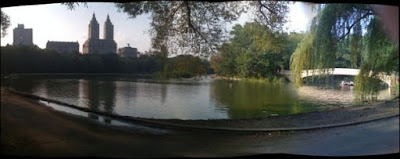
Sorry for the absence. I was in New York, state then city. Where I walked to Central Park, checked out the road closing at Times Square, used a NYC subway restroom, and ate at Bobby Flay's Bar Americain. /becoming a Food Network junkie.

More pictures to come, but for now, here is a Panorama from Central Park:
Now, I've been to NYC a dozen times for work trips and various other purposes, but this was my first time ever to Central Park and I was literally amazed how many people occupy every acre of that park. There are probably more people in that park at any one given time than have EVER been in downtown Dallas at once.
I'll write more as I get back into the swing of things, but until then, I'll stop at these walkable/clickable links:
Boston Globe: Roads that are designed to kill.

Most people think we are doing all that can be done to keep our roads safe. They are wrong. Road traffic injuries kill more than a million people a year worldwide, including 40,000 a year in the United States. We will continue to have drivers who are too young or too old, too distracted, or too bold, but we can change our roads so they help protect both drivers and pedestrians.
CEOs for Cities on new report regarding increased home values tracking with increased walkability. Walkscore strikes again.

"There are a number of trends that are reshaping the American Dream," said Coletta, "and the value home buyers now place on living close to more daily destinations is one of the most important. Now, planning, zoning and development decisions have to catch up to consumers."