Showing posts with label Pet Peaves. Show all posts

Thursday, July 8, 2010

The Problem w/ Dog Poop: People

http://www.demimonde.com/wp-content/uploads/2009/10/dog-toilet-paper-main_Full-225x300.jpg

I've written about Dog Shit extensively before and the dilemma it poses. Obviously, nobody wants it laying around, but at the very least, it means people are living there. Step 1 accomplished. Step 2 is getting people to clean up after them, which alludes to something deeper, actually caring for and tending to the neighborhood, participating as active stewards in your home (where your loft becomes your bedroom and your neighborhood, your living room, and its restaurants, your kitchen).

Virginia Postrel makes the leap to conclude that the presence of doggie doo doo means an area in decline. Writing for D in 2003, she concluded that uptown must be on its way to decline because a neighborhood that replaced crack vials and used needles from 15 years prior with dog poop must be trending the wrong direction. Lesson, she's an idiot. Apparently, she hasn't been to Paris or New York or London or Rome who have been waging this battle for eons.

There are two certainties regarding people and cities: we like our dogs and there's always an a-hole. The key is to shame the offending jerkstore into behaving like a socially responsible steward like the rest of us.

Eventually Paris had enough and now essentially subsidizes city sponsored clean up after doing the very French thing of surrendering, this time to its own people. Not the ideal solution, but one they felt was necessary after exhausting all other solutions. Lesson: Paris is full of a-holes.

Downtown Dallas Inc. has raised the issue before as well. To which I responded, that it is awfully hard to ensure responsibility is taken by everyone when the City provides dispensers for baggies, but never fills them. I'll give them credit, since I wrote that there have been baggies available at Main Street Garden nearly every single day, but I think one (from memory).

Still to this day however, I save all my plastic grocery bags (not paper?! or reusable burlap?! how very ungreen! off with his head) to carry with me to clean up after my dogs, just in case. Of course, there is always the occasional accident where I might be rushing and forget to grab an extra plastic bag or two from the drawer. Main Street Gardens is typically the only place where I can reliably find a plastic bag if necessary, which is why I'm writing this:

Today, I witnessed something that pissed me off to the Nth degree. A woman with a stroller and no dog walked over to the dispenser on the far side of the park from where I was, and I heard a noise like a tug at the plastic baggie dispenser. And there she was yanking tens of feet off at a time, like a toddler that just discovered the mechanics of the toilet paper roll and wanted to see if there was a pot of gold at the end of the rainbow. She then proceeded to neatly fold up what must have been at least 20 feet of plastic baggies and discreetly tuck the folded baggies under her baby.

Part of being an active steward in your neighborhood is understanding and participating in the unwritten social contract between neighbors, between businesses and residents, and between residents, businesses, and the city. We expect the City to live up to its promise of providing bags, we expect people to pick up after their dogs, and only take one bag at a time. What is the sense of hording them? Then we all end up with poop on our hands...or feet.

If there is excess dog shit all over downtown Dallas tomorrow, now you'll know why.

Wednesday, September 23, 2009

Pet Peaves


My earlier post inspired me (and missing the trolley) to walk back downtown. To wit, I came across one of my all-time most irritating details. In this case we're in uptown, but it's the insistence upon TREE LAWNS in downtown locations. The sidewalk is four feet wide, runs parallel with a building with no "perforation" or pedestrian "porosity," and is a maintenance (ie cost) drain. Notice the seeds, which if we're "lucky" will eventually need to be mowed.

The American reflex to plant grass everywhere comes from the European Bourgeoisie use of space as a indicator of power and wealth to define nobility from those in the cities. Writ large, it became the American ideal that every man was his own king of his little sodded castle.

Native grasses can be lovely, drought tolerant, and maintenance free, but turf, or manicured lawn, has two appropriate and practical uses, in the present day: fields of play (whether organized or informal) and places serving double duty as gathering places and a design device to accentuate scale. Think: DC Mall.

Pet peave #2:


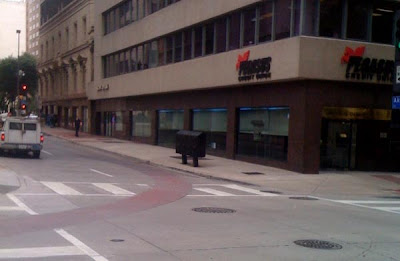
Over simplicity. Sometimes genius is found in subtlety. Sometimes things are just ham-handed. On the corner here, is one of the new centralized newspaper vending stands replacing the messy(?), individualized by media outlet ones that are found on every city street corner ever (or just ones that often have people (customers) standing and waiting at intersections).

Intelligent design, and I don't mean the State of Kentucky's curriculum, is driven by the maximum amount of feedback possible. In this case I am not referring to public process feedback, which can either drive or muddy planning processes, but the collection of design factors that are or can be taken into account. The more factors addressed in one coherent and elegant solution is the definition of smart design.

In the every day urban world, feedback includes eye contact between a driver and a pedestrian crossing the street at a four-way stop, the body language of passersby, the tone a mother takes scolding her child for running into the street or the way a building engages or takes a defensive posture with regards to a street depending upon the street's design and characteristics. All manners making the everyday hum along. It is communication of all things to all things.

The design challenge here seems to be limited strictly to, "clean up all those damned paper vending stands." The solution doesn't reach out and create a dialog with the adjacent connections, the dynamic, the visible, and invisible things that create said feedback and further informing design, in the way that all things in nature are reactions to actions. Such potential informative factors include the building/use adjacent, local weather patterns, the opposite street corner, etc. This forgets to be visible from two sides. It forgets to be located in a place where people linger, as a form creating space itself. The more design "connections" the more something looks as if it belongs, integrating completely into its environment. This looks out of place.

Oh, and it forgets to be elegant...but, that isn't always necessary, as how many of these interesting, messy little nuances are elegant in NYC? But, it could be.

Things can always be better.