Showing posts with label Highways Make for Bankrupt Cities. Show all posts

Wednesday, June 2, 2010

Highways Didn't Kill Small Towns. People Did.


I came across a tweet yesterday by Richardson blogger Mark Steger that I want to address because it is both right and wrong. And because it displays a common misconception of the conventional wisdom. Here is the tweet that may or may not have been in response to one of my twitter rants:
Travel old Route 66 today and see all the towns that died when the Interstate bypassed them. Then you'll know why cities don't cut the cord.
I shouldn't complain that blaming highway bypasses for the death of small towns because for a long time I believed the same thing...until I started to think about it yesterday. Mark is right that the highway bypass killed those small towns, but wrong that it is still relevant today, at least to big cities.

I would argue that the highway bypasses didn't kill towns as much as they were probably already doomed to some extent. Our remorse is little more than nostalgia.

The old highways, before the super highways, were the single lifeline of a 20th century small town. Each turned into the "Main Street" as it passed through town. Before that towns sprung up all over the country along railroad lines linking the country from coast to coast. This dates back to antiquity where trading posts emerged at cross roads between settlements.

The difference between then and now is that the world is different. It is hyper mobile and getting moreso every day. We are no longer connected by one umbilical cord whether it be a railroad or an interstate. It is the human urge to connect and technology is making it possible to do so in a dozen ways including via (see what I did there?) the internet, they way you are reading these very words.

The internet also hasn't proven to be the death of cities or human interaction as many once feared. In fact, the opposite has occurred where we have shaped the internet into web 2.0 or social media making human interactions and community building all the more efficient. We've created cities and we've created the web to facilitate human interaction and INTRA-city highways are a barrier to that. Unless of course this is your kind of human interaction:


I say INTRAcity highways because INTERcity highways DO serve an important function in linking regional economies, ie Dallas to Houston. But, they also should just provide an option, much like you can fly or hopefully in the future take high speed rail from downtown Dallas to downtown Houston. We like that idea because it facilitates connections from where people are and commerce happens, the cores of cities. However, highways within cities tear apart the urban fabric, are a centrifugal force of entropy, and damage local economies.

A certain segment of the population wants human interaction, wants to be near other people. Highways prevent that and only serve those that don't. As I tweeted, they are the lifeline of the suburbs and ironically, removing them would be the best thing for brittle suburban communities dependent upon them as they leech from the core. In order to survive the next century, suburban communities will have to be able to stand alone.

Those small towns don't compare to today's modern megalopolitan economies. Today's cities are highly interconnected, highly mobile places where freeways actually make it more difficult to make our daily face to face interactions that comprise cities.

The blame we lay upon the bypasses is that they killed Main Street. Main street businesses packed up shop and moved out to the interchange in the form of big box. But people had already left. Retail follows rooftops and everybody moved outside of the towns or the cities because of debt-fueled, tax incentivized policies towards consumption of new land, new houses.

Except all of that is as ephemeral as the leaves on the trees. We have 6x as much retail per capita as does the most heavily retailed European country. All of that excess retail is going to fade away and re-cluster around population centers in order to survive. All of those homes and buildings built to last twenty years and made of little more than paper mache are going to turn to dust. We won't be replacing them with more of the same. The sun belt cities you see today, will never be seen again. We can no longer afford them and we're seeing the effect.

Our intra-city highways are a giant land bank that broke states and broke cities are sitting upon. Irony = that which bankrupted us is the biggest asset we have in restoring our wealth and prosperity.

This won't happen all at once. It would be too traumatic. Humans adapt, but we can only do so at our pace, which is why it is necessary to slowly, but incrementally implement change for the betterment of cities and the facilitation of human interaction and human need. The same much of Copenhagen didn't go car-free overnight, we will start with easy wins, narrowing highways and their interchanges. Replacing cloverleaves with development opportunities.

People will likely be fearful of the idea. In Copenhagen, local businesses yelped when change began. Businesses, as well as people, are conditioned by their context. They generally hate change. Status quo is comfortable. We're used to it.

But we need real mobility, a choice of mobility. Highways dominate our life. You can't get anywhere without them, which is precisely why losing them seems frightening. We need to replace our highway commute to work with a train ride where we CAN text or email without endangering lives. Our drive to the store with walk down a peaceful, tree-lined street; the school bus system that bankrupts our schools with an empowering bike ride.

Cities are built upon connections and the great ones have the quickest, the most expedient, the most efficient, and the most nourishing, the healthiest. Intra-city highways are the opposite of all of those.

Don't be scared. In fact, be a leader.

Friday, April 23, 2010

This Month's D


I encourage you all to go out and buy this month's issue of D Magazine. They have to pay for their fancy new digs in walkable downtown Dallas.

So don't go to this link about the development at Park Lane Place where I am quoted thusly:
He says a development like this one needs to do two things to succeed. “It has to be so well-designed, so lovable that the citizenry will always care for it and ensure that it endures,” he says. “The other is, it has to tie into the rest of the city, the adjacent properties, neighborhoods, street network, and transportation framework so that the improvement, stewardship, and resilience are mutually ensured. I’m not sure Park Lane successfully accomplishes either. I think the underlying logic defining Park Lane—that of convenience—undermines certainly the latter and possibly the former, as the experience is ultimately degraded by the disconnection, no matter the level of detailed design.”
And especially go buy it because of the Op-Ed by publisher Wick Allison at this link you don't want to click where Wick hops on the bandwagon to demand Mr. Leppert, Tear Down This Freeway:
Those neighborhoods—and Fair Park—are too valuable to neglect any longer. The city’s next bond election should include the funds necessary to tear down about 3 miles of I-30, from its interchange with Central Expressway to Samuell Boulevard. HNTB estimated the costs at about $200 million. The benefits are incalculable but real. These neighborhoods now contribute a disproportionately low rate to the city’s tax rolls. By restoring East Dallas as a middle-class community and by stimulating the return of the black middle class to Fair Park, the city will see a huge return on a relatively small investment of $20 million a year for 10 years. The pressure is there. People want to move into the city, close to downtown. All Dallas needs to do is remove the single biggest impediment to its own urban growth.
Exactly. As we shift from expansion to contraction, "growth" will be found in the qualitative improvement within the City. In this age of what I call "urban introspection." Since the highways are a barrier to that effort, they are therefore a hindrance on economic growth. Do we really want that as we dig out from under a recession?

The $200 million number seems like a lot. But, like any responsible investor (as the City should be with its infrastructure and urban "acupuncture" or in some cases neighborhood difibrillator), we should demand a return on investment. Trinity River Plan is nice. The Woodall Rogers Deck Park is as well. But nothing, and I mean NOTHING, will generate the return on investment as tearing out freeways. Whether it is I-30 or the downtown loop, there is billions in private investment pent up by the Dallas intra-city highways.

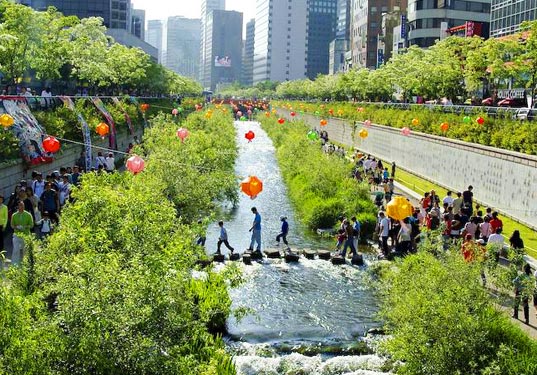
Just look what Seoul, South Korea did with $200 million. Before. After.


What I like about this picture is that bodies of water, like highways, can also act as barriers, as edges. The design shows how it can be a seam, stitching the City back together. It represents the repair of a long and degraded history for this particular body of water that was once, quite literally, used as Seoul's sewer. The first logical solution of course, was to cap and cover it with a freeway, an express lane into a modern economy.

Fortunately, they have since realized how cities and economies really work. Oh, and it has been so successful that the Mayor who was elected ON this idea, executed it, and then became so popular as to become President of South Korea. I know I feel better that the lunatic to the North is balanced by the intelligence of his southern counterpart.

Economic Development is Urban Design. Urban Design is Economic Development.

I don't mean to be harsh, but if you are in the profession of economic development, you either need to be thinking about removing intracity highways (with a CAN DO attitude!) or find yourself a new job...because my beer mug is going to need a fillin'.

-30- and I'm out. Peace.

/drops mic
-------------------
Post Script: For everything I've ever written on taking out freeways, peep this link.

Thursday, April 22, 2010

Highway Dependence Begets Auto-Dependence, What's the Cost?


Well in NYC, the City and its residents save $19 billion annually.

The $19 billion number is a quick, conservative estimate that almost surely understates the savings New Yorkers reap by not driving. The study estimates that, per capita, New Yorkers drive nine miles per day. It then multiplies that figure by the national average cost of operating a vehicle, 40 cents per mile. Compare that total -- how much New Yorkers spend on driving, per capita -- to the national average, and you get $19 billion in savings.

Here's why that's a conservative estimate. The study calculated average VMT rates in New York City by distributing the average daily distance driven in the entire metropolitan region according to the city's vehicle ownership rates. If New York City car owners drive less often than their Suffolk County counterparts, or drive shorter distances when they do -- both reasonable assumptions -- then nine miles per day overshoots the mark. Moreover, the cost of driving is almost certainly higher in New York than it is nationally, due to elevated costs for parking, insurance, and gasoline. In other words, it's likely that New Yorkers save much more than $19 billion.

Cities (and larger entities) spend money on transportation and its infrastructure every single year, no matter the form. If you spend it on the kind that supports high quality dense, urban living that puts more money in the pockets of your citizenry who can then spend their savings how they choose.

You want to know why housing is more expensive there? Reason 1: the Car has less impact on livability, and Reason 2: those savings can then be spent on better housing closer to activity centers, which are always in high demand no matter the age. If economics are driven by emotion, we WANT to be near other people.

Activity hubs are where fame, fortune, and females can be found, which is why Bill Shakespeare moved to the squalor of 16th century London, hardly the paragon of livability compared to modern city standards. Due to advances in industry and sanitation our cities are no longer disease ridden, filthy mires. Imagine how valuable the land will be when we remove all of the other barriers to livability, such as intra-city highways.

I tweeted about this yesterday when reading about some American Dream Coalition. These are the kind of people so intellectually bankrupt that they apparently think the American Revolution, Civil War, and World Wars were fought for the single family home and two-car garage. Of course, none of those things existed.

What they don't understand is that the American Dream is about opportunity which is defined by and had only through CHOICE, fundamental to market economies and capitalism, no? The American Dream Coalition wants to shackle everyone to home mortgages and car payments. Why? Well, because they are made up of car companies, oil and gas companies, the dinosaurs of the real estate industry (ReMAX and Century 21s of the world) and the highway lobby.

In their world, you are coppertop. They want to suck the life out of you and every city they can touch.

I'm going to start the horse and buggy coalition. WE NEED TO BAIL OUT THE HORSE AND BUGGY INDUSTRY! What will happen to those jobs?! Oh sweet despair and dismay! I can't live without you.

Perhaps someday we too can get out of the stone ages of stupidity and begin competing with the global cities who understand a thing about real economic development.