Showing posts with label bike culture. Show all posts

Monday, January 16, 2012

We Can Do a Lot of Things, But We Can't Do That

If you hadn't heard, a bicyclist riding on the Jefferson Street viaduct was struck by a car riding from Oak Cliff to downtown this Saturday. The collision broke his neck. As the news report rightly points out, this is one of the streets suggested for initial restriping of bike lanes. Dallas has no on-street bike lanes at present. Meanwhile, cities around the country are adding them left and right.

It should also be noted that there isn't one safe connection across the Trinity River for pedestrians and/or cyclists at present. Jefferson and Houston Street viaducts, the two primary connections to/fro Oak Cliff are literal nightmares. I've ridden them several times. Yet the irony is that there is so little vehicle traffic to warrant the excess vehicular travel lanes on them. Google Earth Pro tells me that previous traffic studies suggest an average of about 8,000 vehicles per day on each. They're both 4 lanes. 8 lanes in total. The sidewalk for bicyclists and pedestrians abruptly stops. Meanwhile, Main Street in downtown moves 9,000 vehicles per day. It is one lane in each direction.

The Lance Armstrongs as I call them, those that think just some good edjumucation is in order to get ridership and safety up, want riders to co-exist with vehicles on the travel lanes. Cars routinely drive 55 mph on those two bridges. Can you pedal that fast? Can a child? Cars drive as fast as the road design allows them. They haven't a clue as this post points out, which is why they've been saying the same thing with no results for decades. They appeal only to the 1%. Not that 1%, but the 1% identified by Roger Geller that is "strong and fearless."

It is the 60% of the population which is the untapped market that is "interested but concerned." I.e. not batshit crazy enough to try and compete for roadway space with drivers conditioned by a highly competitive traffic environment to drive aggressively. I was in conversation with a woman at one of Chef Nicole's underground dinners a few nights ago. She lamented why does everybody in Dallas have a giant SUV?

The answer, beyond the various tax breaks and artificially deflated gasoline prices for hyper-inflated internal combustion vehicles, is precisely that competition. Every other driver on the road is your enemy? Why? Because the optimum condition of a road is no other drivers. This is the failed logic of the transportation planner/engineer. They're in your way. They cut you off. They slow you down. They tailgate you. It is competitively advantageous to desire a bigger vehicle. In contrast, in European cities, it is competitively advantageous to have a smaller vehicle because space is at a premium, both parking and drive lanes.

Meanwhile, in a safer pedestrian-oriented environment, each other "commuter," whilst on foot, improves the overall experience. And as I tweeted the other day, city form is commonly based on the primary transportation technology of the day. However, foot power is the only transportation technology that transcends time. Therefore, the only truly timeless cities, durable cities, that will surely last long past peak oil (unless we all kill ourselves and each other on the roads first) is the pedestrian-oriented city.

Fortunately, Dallas Torres survived the crash. Or unfortunately? Did I really just say that? In other words, he won't be a martyr for change, since that is apparently what it takes to get the city to do its primary job: ensure public safety. If the city disagrees, thinking that public safety should take a backseat to economic development, there is also the fact that investment and spending along the Magnolia Avenue bike lane in Fort Worth is up over 500%. In one year. The actions of the city make it appear that they don't understand economic development and don't care about public safety. They do however think paying $10 million to Calatrava for a redesign of a physical connection THAT ALREADY EXISTS is a good investment. Maybe he'll just pull a design off the shelf again.

If words like these offend, perhaps they should offend. While the city looks for excuses not to make any changes, will it take a death to begin making changes?


Perhaps we need to give a call to the Bobs to ask, "what exactly do you do here?"

Monday, February 7, 2011

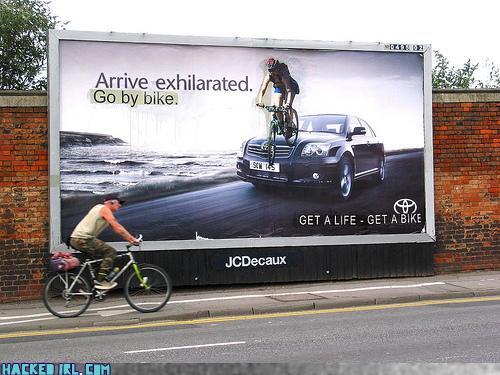
Bikes vs. Cars, A Generational Battle

culture jamming win
Image via failblog

I'm guessing just about every movement during the early stages of its gestation is considered merely a passing fad by the establishment. I suppose that once upon a time several monks in monasteries felt the reformation would pass and they could go on collecting tithes as payment for the sacred knowledge they and they alone held as to your post-mortem future. The recently emerging movement towards increased biking for enjoyment or short-commuting is not going away and city's like Dallas is doing with its Bike Plan would be wise to begin planning for it.

Furthermore, when it comes to forms of transportation within cities, competing forms can often take on an antagonistic, and occasionally violent, relationship as is detailed in Peter Norton's book Fighting Traffic: The Dawn of the Motor Age in the American City, as multiple forms compete for the same space. Either see the book or Mikael from Copenhagenize review at the above link describing the violent backlash against cars invading cities built primarily for pedestrians and horse-drawn carriages.

I can't tell you how many times I've heard drivers remark "how much they hate those damn bicyclists." When I've driven, I always sensed that every other driver was the competition and they treated me as such as well, trying to 'cut in' in front of you to beat you to the next traffic signal.

Perhaps the violence and competition really only comes from cars and their machine operators behind the wheel. As Tom Vanderbilt points out in his book from last year Traffic: Why We Drive the Way We Do and What It Says About Us, we lose our connection to humanity when we can no longer see people's eyes as is often the case behind the wheel. Ever felt more assured as a pedestrian when crossing the street once you make eye contact?

Perhaps there is even something competitive ingrained in us through years of television glamorizing the revving of engines and the starting line as if we're leather jacketed and greased up James Dean. Of course, television for better or worse is specifically catered to the zeitgeist or else it would fail as a business model. It has to appeal to markets, which are created by shared interests by a critical mass of people. Shared interests often are generational, as population bubbles are often defined by similar shared experiences.

The lure of the open road was profoundly influential on Baby Boomers. Cars symbolized freedom. There was still plenty of land and every new road was an open road. Only later did car culture become so overwhelmingly oppressive in its dominion over modern American daily life, because the chosen solution to the issue of competing forms of transportation was to eliminate the complexity. Conflict points were reduced, by doing what else? Getting rid of every other form of transportation by hook, crook, or happy accident.

Problem solved with an eraser. Unfortunately, cities aren't simple entities. They are as complex as the millions that occupy them. Every drastic decision will have drastic consequences. Freedom became oppression. Anakin became Vader.

Then along comes the echo boom of the Millennial generation. Just now beginning to fully express itself (see: social networking). Large population bubbles shape and reshape economies and therefore cities in their interest.

During the Millennial's formative years, the first generation to truly grow up in auto-oriented suburbia, the car and their home were traps. The only escape was often dependent upon somebody else, mom or dad to drive them to soccer practice or the school bus to take them to the daily children warehouse.

But then there was the bike. Oh, how every kid loved getting a new bike on christmas! Who doesn't remember their first days learning to ride? Or then riding everywhere and anywhere your spinning little legs could take you. You were now the master of your own destiny. The bicycle = freedom for an entirely new generation and the car was associated with something else, rarely as positive.

Now that we're all grown up, we want to ride our bikes again. But where to go? Cars are bigger and faster than ever as they race between stoplights. You can't go a mile without encountering some freeway to ford. The modern American city was not built for bicycling, but we need it to be. Therefore there is another looming backlash as depicted in the graffiti above. I hate to compare with the magnitude of what is happening in Egypt right now, but messy conflict is inevitable whenever there are identifiable forces restricting personal freedom, in our case, the ability to get to where we want to go, however we want to get there. Cities are built on this foundation of choice.

This also doesn't mean that the two forms can't co-exist. Many cities are showing they can (and not just European cities but New York, Philadelphia, and Vancouver have added extensive bike lanes throughout), but there must be specific provisions, infrastructure, and safety measures to ensure they can. As they should because multiple forms of transit also shouldn't be segregated. We've seen what happens when we segregate city functions. The result is "anti-city."

Proper urban form of functional, interesting, vibrant cities necessitates this concentration of movement. But concentration of anti-pedestrian modes of traffic creates a negative, repellent force. It undermines the effort to create a concentrated hierarchy of place. There is an indirect relationship between traffic and desirability. Non "anti-cities" have a direct relationship between desirability, density, value, and traffic (or movement).

Commerce that requires a physical presence (as opposed to e-commerce) is dependent on the predictability of traffic. This creates the backbone of predictable, resilient cities. That traffic MUST be pedestrian friendly as car-only traffic repels people. Pedestrian-friendly traffic then begets more people, as people attract people. More people means a market is created and local businesses can succeed rather than trying to scrape by in a failed 1960's strip center where no one wants to spend more than the absolute necessary amount of time to get in and out.

We have to make them get along, just like it makes no sense to allow for this generational divisiveness. But it's almost inevitable as auto-centricity must make some concessions.


Monday, July 19, 2010

Dallas Bike Helmet Law

Over the weekend, I was issued a citation for bicycling without a helmet. It is a law in the great City of Dallas, apparently. I never really knew. I thought it might be, but never really saw or heard of it being enforced. To mitigate the risk of getting a ticket myself, I always wore one while knowing full well that it could only prevent injury in minor accidents. I had to become a Lance Armstrong* if I wanted to bike around Dallas.

The policy legislates bicyclists, presumably in order to protect them from cars. In a City built strictly for the car, that is like requiring everybody to carry a gun to "be safe" and then ticketing somebody for not wearing a bulletproof vest. In practice, the law itself undermines the goals we have set forth as a City and even the current pursuits such as the bike plan, while raising inconsistencies that threaten trust and legitimacy in the representative government itself.


*I use the term "Lance Armstrong" because Dallas cycling culture is kept to only hardcore enthusiasts. Perhaps, this is our effort at safety. Keep cyclists off the road so they won't get hurt. By doing so we create a far less safe environment where more people die each year due to traffic collisions than by gunshots. Mission Accomplished, indeed.

Backstory:
On Bastille Day, my girlfriend and I met Brandon Castillo, organizer of the Deep Ellum market which was to occur for the first time on Saturday, the 20th. We decided to bike there. My girlfriend just got a bike in order to accompany me on the occasional joy ride and had not yet picked up a helmet. Having seen several other cyclists around town without helmets, I figured, "what the hell? I won't either so as to not draw attention to her for not having one."

From downtown to Malcolm X Blvd in Deep Ellum is probably less than a mile. It was also the weekend, where you might as well see tumbleweed blowing across the empty streets. There are often more vespas on the street than cars. We had no problems getting to the market and checking it out before returning downtown to get something to eat.

On our ride back, a bike patrol officer in a car pulled alongside and asked, "do you have ID?" He went about giving us a citation in the "just doing his job" fashion one might expect of somebody just following orders. He went on to explain that since it was our first offense, all we had to do was take the citation and a helmet to the courthouse and the charge would be waived with a minor court processing fee.

I will do this. I have no problem with DPD. They have always been fair and professional in my personal encounters and interactions with them. We'll ignore the fact that four cyclists then road past as the officer was writing the ticket, two of whom didn't have helmets either, my point of contention goes higher.

The City is currently undergoing a bike plan. If it comes off successfully, in the future we should have miles and miles of bike lanes added to Dallas City streets. The intention is to slim down, pollute less, get cars off the road to reduce congestion and the inherent money/productivity wasted in it, and well... die less. All good things.

With bike culture paddling towards the mainstream, we need choice in transportation modes to increase mobility and the infrastructure in which to avail that choice. We also need consistency of policies in support of the movement towards a safe, more sustainable city.

Then we have the little thing with a bike helmet law, which seems like a minor little thing. But, in practice it becomes a much larger barrier to cycling than imagined. All of a sudden we have to wear helmets and spandex and get toe-clips and all this stuff when all I want to do is stick a baseball card in my spokes and explore my 'hood much the way I provided myself mobility and adventure as an driver's license-less under-16 year old. I was clearly much more responsible once I turned 16, fo sho. Or far more capable of damage, one or the other.

Any City has the responsibility upon it to create and foster a sense of safety for its citizens. One component of any city, of which we all take part, is its transportation system. In the very best case scenario, we are being overly paternalistic in requiring all cyclists to wear helmets (except on private land with a public access easement like Katy Trail. Just ride to Katy Trail with your helmet and then take it off to ride on the trail...make sense?!).

In doing so however, we prevent bike ridership, which increases the ownership share and dominance the automobile exerts over the road, making it less safe. Any place with more cyclists or more pedestrians is infinitely safer than a street dominated by the car. Oh, it is also more attractive to commerce and higher real estate values, takes on less infrastructural burden, and generates greater tax revenue than properties reacting appropriately to car-only access.

Look at every city where biking has taken hold. Not a helmet to be found, because cycling is perfectly safe:


These cities score higher in livability rankings. Why? Because they're safe enough to ride without a helmet for one.

Requiring a helmet ensures cycling remaines in the realm of Lance Armstrongs and that intimidates the people we want to be riding. The ones who are thinking about it, but are deterred by maniacal 4-wheel drive vehicles and pulling on a pair of spandex.
This guy needs a helmet.

The policy at its worst hints at something deeper, however. There is no law requiring a motorcyclist to wear a helmet. Motorcyclists can go on highways. Motorcycles can move at speeds that kill. I would rather not speculate, but my hunch is that there are far bigger moneyed interests lobbying to preserve that status quo. Not helmetless riders, but the burning of gasoline on expansive roadways.

When what amounts to little more than a petty, nanny-state policy, from a broke City, one has to wonder, are we just fundraising here? Is this how we want to pay for our decades of incompetence and the slow rot of poor city building? By shaking down the citizens when real mixed-use development that needs walkability, bikability, and transit pays its bill?

When the mind wanders down these likely deadends, it is no wonder why there is so much frustration and distrust directed towards City Hall. Inconsistencies in policy and pursuit of inappropriate or failed ones point towards illegitimacy. One begins to wonder if they really represent us or are petty, purposeless, and inconsistent policies like the bike helmet law little more than the extraneous apparatus of a Rube-Goldberg City of no guiding direction beyond the momentum of what inertia is leftover from failed 20th century policies.

I'm quite certain it is the latter.

http://clackhi.nclack.k12.or.us/physics/projects/experiments/2000/Rube%20Goldberg/rube_napkin.gif

Thursday, June 24, 2010

Cycling Reconnects w/ Nature, Lifts the Spirit, and Exercises Your Brain

Via Mind Hacks comes this conclusion from an 1890 journal for mental health on the appeal of cycling:
For most of us the exquisite loveliness and delight of a fine summer's day have a special charm. The very life is luxury. The air is full of sound and sunshine, of the song of birds, and the murmur of insects; the meadows gleam with golden buttercups, we almost fancy we can see the grass grow and the buds open; the bees hum for very joy; there are a thou sand scents, above all, perhaps, that of new-mown hay.

There are doubtless many patients before whom "all the glories of heaven and earth may pass in daily succession without touching their hearts or elevating their minds," but, in time, it is possible even these would, by means of cycling, have their love of Nature, which had been frozen or crushed out, restored. Thus all Nature, which is full of beauties, would not only be a never-failing source of pleasure and interest, but lift them above the petty troubles and sorrows of their daily life.
Riding a bike home the other day, it struck me just how alert one has to be on a bike. While you can effectively shut your brain off and drive on auto-pilot as car traffic patterns have been engineered for the lowest common denominator, day dream whilst walking down the block, or complete work on mass transit as some other faculty provides the effort, on a bike one must maintain a constant state of awareness. This also reminds of the dangerous irony of very poor drivers operating very deadly machinery populating our roadways while one must be near expert to navigate the roads by bike, the simpler, safer, and cheaper method.

While it is nice to let the mind turn off every once in a while, like any muscle it provides a nice reward to exercise our strongest one. A good pain.

Reconnect with the place where you live.

Wednesday, June 23, 2010

One Billion Bikes

"I cycle to work. I cycle from work. I cycle to University. I cycle pretty much everywhere." Dressed stylishly while casually acknowledging cycling use without shame. And without helmet or fear of personal safety, I might add as well.

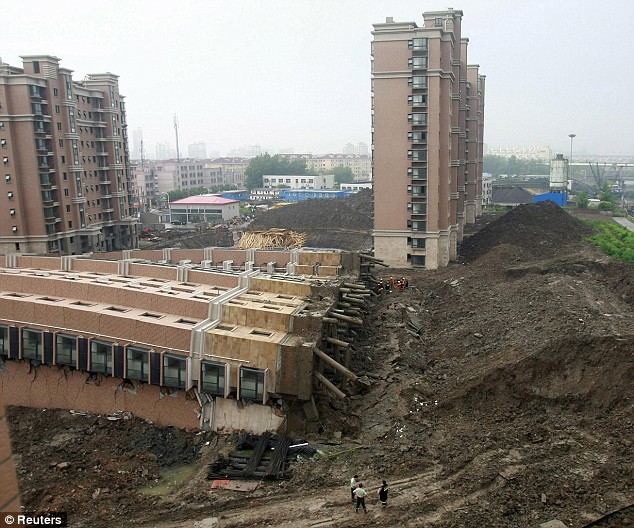
And not in China. Because they're busy widening roads and going "green" by widening highways and forcibly moving peasants from their agrarian lifestyles into well-constructed filing cabinets like this one:

http://i.dailymail.co.uk/i/pix/2009/06/28/article-0-05815B1E000005DC-497_634x528.jpg

Oopsy Daisy. Perhaps some oversight and the nasty time for professional accreditation is worthwhile after all.

No, I'm talking about this. Ignore the dreadful cameo to begin the video if you please...unless you like gargantuan d-bags that look uncomfortable using their cheated to gain fame to promote whatever:


These bikes are powered by one billion power bars, and Oh Gawd the amount of air that fill those tires... They're taking all our good air!!!!!1111!!!