Showing posts with label Designing for Humanity. Show all posts

Wednesday, July 8, 2009

Nothing Costs More than Free

A lot of info to digest from both the book Free by Chris Anderson, editor of Wired, which appropriately the book is offered here at the linked site for a similar rate, and this review in the New Yorker of the ideas by Malcolm Gladwell of Blink, Tipping Point, and Outliers fame.

Now, I have to say that I feel like I always disagree with Gladwell's assertions. Something about his logic and my logic just never seem to align. Given those titles mentioned above alludes to the quasi-statistical basis that seems to captivate Gladwell. I see him as a bit of a Bizarro Freakanomics guy, who have a much deeper background in solid statistics.

But, the point is to relate Anderson's message to what it might mean for Cities, and more specifically the organization of cities which are always defined by the transportation systems. Gladwell writes, paraphrasing from Anderson's book (my emphasis in bold):

Since the falling costs of digital technology let you make as much stuff as you want, Anderson argues, and the magic of the word “free” creates instant demand among consumers, then Free (Anderson honors it with a capital) represents an enormous business opportunity. Companies ought to be able to make huge amounts of money “around” the thing being given away—as Google gives away its search and e-mail and makes its money on advertising.
If we were to create Fare Free Mass Transit (as MATA Trolley is now is are, and more significantly, car travel) what would be the benefits?

First of all, the amount of revenue mass transit systems bring in barely cover the costs of operating their own fare collection systems and certainly not their operating budgets. What some cities around the globe have found that the value generated by writing off the cost of fare travel is actually recovered by the overall value that transit creates "around" the system.

A city's job is to create and maintain an environment suitable for commerce and improved quality of life for its citizens. Both original motivations for the creation of cities due to the clustering of people.

If transit becomes easier and more convenient (and cheaper) to use than car transportation and its auto-oriented development counterpart, the city and people within the city begin to reorganize around the new, dominant form of transportation. Transportation decisions are made by government. We've just been duped into making all the wrong ones in the name of "progress," as generations of individuals grew up with the idea of the Corbusien City, impacted greatly by moments like the New York World's Fair:
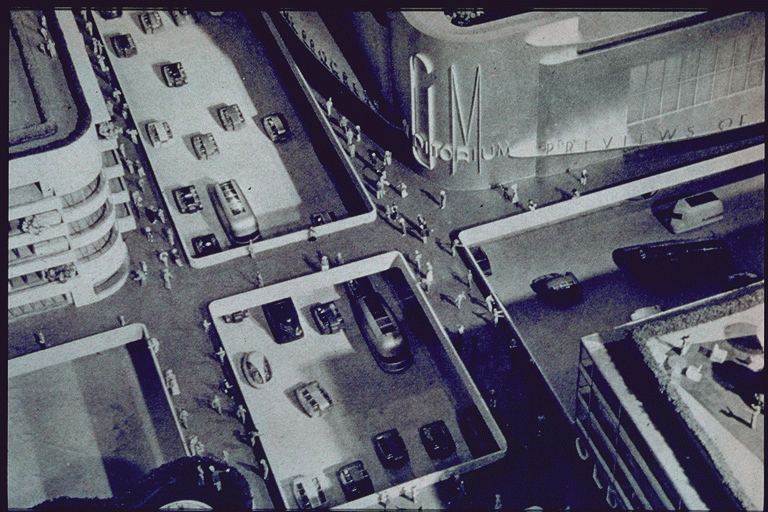


Because the car was technology and technology meant progress, we leapt into a rabbit hole unaware of the repercussions.

If somebody gives you the "that is social engineering" line, respond that all forms of transportation define how cities structure themselves because cities, while we think of them as timeless, are actually rather fluid. The only things that are timeless are those things/places that we love and wish to maintain as "timeless."

Free Transit (and by free I may just mean convenient - as itunes has proven cheap may not be necessary, but EASY absolutely is) would immediately increase ridership which means mobility. And mobility is what lubricates markets, i.e. commerce as well as access to labor/talent and vice versa jobs.

Cars create mobility as well you might argue. The difference is the spatial arrangements of the two. Cars dislocate people while transit concentrates people which is necessary for the "movement economy". The predictability of a certain number of people passing by your business in a given timeframe.

As we have discussed previously, this is the future of retail, locating in areas where the most people pass by. Currently, these are where highways meet arterials, but the public realm is a disaster and effectively is sociofugal. Whereas transit oriented development encourages more pedestrian friendly environments, clustering development into spatial arrangements that encourage vitality, safety, and synergy. All necessities.

Frankly, utilizing "the blink" method, I'm guessing that financially a City would get MORE back from increases real estate value, development and property taxes, as well as the increase in sales tax revenue from this reorganized city.

I'm not trying to take your car away or practice spooky "social engineering" but rather attempting to rearrange and balance our transportation systems for a positive social, environmental, and commercial outcome; so that the private form that is currently a necessity becomes the luxury and vice versa.

We've taken to the car like a junky to a new drug, creating a period of dislocation and isolationism. It's time to enter rehab.

Wednesday, July 1, 2009

Victory: Defeat. A Potemkin Village


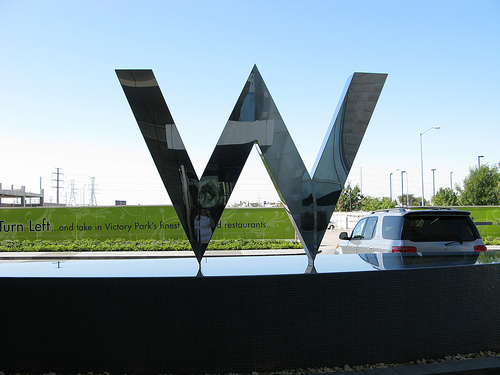
My unit in Victory. When should we mention that every unit in the W tower is owned by men?

Ok. I have had an empty link at the side of this page for about a year now with the promise of analyzing (at the time) why Victory would fail. Failing is such a harsh word, but it has in many ways thus far, particularly when compared to the promise and hype. Ultimately, given the amount of investment it will get rolled back into the city fabric it tried to avoid like a little kid squirming away from something icky to prevent catching cooties from...what? Authenticity?

Well, we still haven't created that part yet either. Hopefully, it will begin spreading from very true urbanism, embodied by State Thomas. A place I have long called the best piece of reinvigorated authentic urbanity. We'll come back to this neighborhood when the author of the article does.

Thanks to Lindsey who forwarded me this article from D Magazine:

The Failure of Victory Park.
"It is sleek, chic, and modernist. Translated,
that means it is cold, barren, and unfriendly."
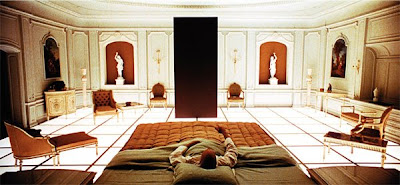
The writer Wick Allison hits on all the points I've caught hell for in places like on Dallas Metropolypse, suggesting the architecture belongs in somewhere in the antiseptic third act of the 2001: A Space Odyssey. When the W was still a 2-dimensional imagination, I had this to say:
"looks like Kubrick's vision of a dystopic future."
Clearly, I need new movies to reference. Next time I discuss Millennials, I will reference Juno. I promise.

God forbid I dare critique ANY new development because ALL development is good development. I guess this City has fallen so far that we ARE desperate for something, anything. Even if deep in our bones we know the flaws embedded in the work, usually stemming from compromises made with engineers or 80's style developers set in their ways.

That wasn't the case with Victory, however. From the outset of design, mistakes were made. First of all, the designer of American Airlines Arena, and Fort Worth hero David Schwarz sited the venue oddly. "Let's cant it. Ya know, to be different." Forcing every block around it to accommodate oddly configured shapes and patterns forming a mish mash of grids, former grids, and irregularities.

Next, most importantly and by design, the City was excluded. Presumably, a developer led decision, they chose NOT to be a part of the City, by re-routing roads and proposed DART alignments to avoid Victory as much as possible. Lesson: You can't be exclusive in the 21st century city, isolating yourself as a development prevents it from ever becoming a neighborhood, which all known and successful places are at their root. You might as well cut off your own hand and plant it in the ground hoping for it to sprout a body.
Now take a look at State Thomas. Say what you will about what happened to the historic neighborhood, but the destruction was from Office speculation in the 80's that ripped apart the largely African-American neighborhood that was there. The current development was about curing the destruction.
"To see Jacob's ideas at work in Dallas, go to the corner of Allen and State in Uptown, and walk down either street. You will see buildings constructed on a human scale, out of natural materials, with narrow side streets."
It's not coincidental that the writer picked the same intersection that I often describe as the best part of the City. Re-investment brought about by the first TIF in Texas saved this portion of Dallas when there WAS no "uptown". It created uptown. Now that it has been colonized by yuppies is time to create more supply of urbanism.

Back to Victory. There are other flaws, but ultimately they all come back to that decision to disconnect although it is hard to blame them. There was very little TO connect to nearby. The transportation network was/IS a disaster, LoMac in particular. So they had to create a neighborhood all to themself and frankly that is typical of Dallas area development.

The roads are SO bad (meaning hostile and inhumane) that you have to play defense. You have to create a destination so great to literally pull people into your site off those bad streets. In a future post I have outlined, I will write about how "We Will Never have a Fifth Ave., Champs Elysees, or Michigan Ave." With that said, transportation always comes first and building and development are a reaction. If you don't get it right, you fail.

To create their destination they relied strictly on what was inside the walls, events at AAC, Ghost Bar, the now defunct n9ne, not the space between the walls, which is what people remember, where the return to, and what really creates "place." It is (near?) impossible to create a lasting and true place this way. At the very least, Victory teaches us lessons.

So what else went wrong? Let's count the ways shall we...

1. Road Alignment - Have you noticed that the most prominent open space, AT&T Plaza terminates Field St. Houston St., the one that Victory essentially uses as a service drive. This is one of the bad roads Victory has to pull people from, except the back feels more like the front and the retail is in the back, which is actually the front... I'm confused. Exactly.


2. Block Size - The blocks are too narrow to create efficient buildings. Don't get me wrong efficiency should never be the mark by which anything is judged, but it's probably still wise to be cost effective. The buildings are about 140-145' wide. A garage is 120' minimum width, leaving barely, and I mean BARELY enough to get some liner use there. This is particularly important if they are going to be completely crazy and try to park each building individually in an area with thousands of empty parking spaces. So it means that everybody has to be pulled way up on top of the garages and away from the streetscapes.

3. Phasing - They built everything on one side of the street. Retail more than any other use needs more of itself nearby. Mall designers and retailers have very specific dimensions to make retail cross shop and create spin-off business, aka synergy. It's the one good things malls have done for us beyond nostalgia for Gen-Xers. Not unexpectedly, the retail tenants move out and/or close down one by one.

The built form created by the W and its in-line brethren act more like a curtain of urbanity, a facade of "cool". Don't pay attention to the man behind the curtain however. In fact, this seems a lot like Dallas' reputation anyway. So it DOES work in a Koolhaasian nihilistic sort of way. If this was meant, it would be a genius work of art. I'm guessing this was actually a happy little accident.

4. Retail Programming/Branding - Too much testosterone. Even the developers admit it. And yes, all men bought in the W.

5. Lifeless Architecture - Stale, antiseptic, lifeless. You choose the descriptor. The D Mag article covers this.


6. Streetscape - Doesn't soften the hard edges of the buildings enough. I'm willing to reserve judgment until the rest is built here.

7. Park - Here I'm referring to the little dog-shitting venue in front of the House by Stark and Yoo. Now I have talked up the virtues of dogshit on this blog previously. No, seriously. This doesn't feel like a public park. There is a wall and grade change disconnecting it from the street. And no street in front of the buildings it serves makes it feel like theirs...which, in fact, it is. That's the point. Ours, not yours. Stay away from our happy little retail development you tens of thousands of daily visitors to AAC.

Someday when I get more time perhaps I can put together some sketches of the areas around Victory in attempt to pull it off its island.


Monday, April 13, 2009


GOOD Mag on Streets of the Future. And that future is complete.

But, where is the on-street parking? And why the one-way roads? Not to sound like a street-design fundamentalist myself, but the storefront businesses AND the pedestrians need that on-street parking. We also know (via studies + empirical evidence) that one-way roads kill business, not to mention make it difficult to get around in cities.

All roads need to go everywhere...and not everywhere. Everything in moderation, even moderation.

HT: CoolTown Studios.

Tuesday, March 10, 2009

End of the Auto

...and all of those commercials where everybody is so happy driving their new hummer around. Not so coincidentally my own mother was just hit at a light by some maniac going 60 mph. Fortunately, she was ok. But, is this what life is? Sitting around in metal boxes, playing bumper cars, if only to have some human to human contact.

Harvey Wasserman on the end of the era of the automobile:
But the larger transition is epic and global, based on a simple structural reality: the passenger car is obsolete. Auto sales have plummeted not merely because of a bad economy, but because the technology no longer makes sense.

Franklin Roosevelt took GM over in 1943-5 to make the hardware to beat the Nazis. Barack Obama should now do the same to beat climate chaos.

Make streetcars, not passenger cars.

Hybrids are too little, too late, with problems of their own. Solar-powered electric cars will help phase out the gas guzzlers.

But in the long run, the automobile itself needs to be dismantled and re-cycled, not retooled or rebuilt.
The fact of the matter is that Car companies are broke because they can't run their business profitably, cities are broke because they over extended infrastructure and the costs to support car culture, people spend roughly 20% of their income to operate and maintain this machinery to get us around, and urban development is crippled by the cost of constructing parking. All barriers to progress.

And all of this BEFORE energy costs really start to cripple this energy-absurdly intense economy. Just wait to some real disruptions in the energy markets. How about we just rid ourselves of these burdens now???

Time Machine with Guy Pearce was a pretty shitty movie, but to this day I still have with me the scene from the near future in NYC where everyone is moving around via bicycle.

More from Wasserman:
We need to dig up roads, not build more. We need rails and coaches, bio-diesel buses and self-propelled trolleys, Solartopian super-trains and in-town people movers, not to mention windmills, solar panels, wave generators and geothermal piping.

In America's corporate-conceived “love affair with the automobile,” our first spouse---mass transit---was murdered. Now the unsustainable obsolescence of the private passenger car is collapsing a global financial system built on the illusion of its constant growth.

If the automobile and its attendant freeways continue to metastasize in India, China and Africa as they did in the 20th Century United States, we are doomed.