Showing posts with label faux urbanism. Show all posts

Thursday, April 19, 2012

So Much Win. So Much Loss.

Welcome to the wild west of city building.

The win is all in the long form column by D editor Tim Rogers about the solar radiation, reflection, and heat gain spilling off the shimmering glass Museum Tower (who knew glass towers would be a bad idea in a hot sunny climate?!) and into the Nasher Sculpture center. I want to quote so much of it, but go and read it yourself. It's the must read of the week.

A few of the key points:
  • 16 of the 100+ units have been sold. Though I'm sure the sales people will somehow work this into being 85% under contract. Every building ever is 85% full according to leasing, real estate people. A mathematical anomaly.
  • On a cloudy, 78-degree day in March the solar gain via reflective glass from the tower on the Museum raised ambient temperatures in the lawn to 103 degrees. Yikes. Can't wait until another month long 110-degree August rolls around.
  • The Museum Tower report either wittingly or unwittingly (neither is flattering) plugged the wrong type of glass into their model.
  • Tim suggested architects Scott Johnson and Renzo Piano settle the dispute via walk-off. (Ok, I'm suggesting that).
  • The Dallas police and fire pension has only spent $100,000 on the project yet is on the hook if it goes belly up. Somebody piece together those dots for me. This is a weird deal in every aspect.
  • Oh, and there is still a cloverleaf highway exit ramp circumnavigating the property. Cul-de-sac in the sky. And you wonder why there are only 16 buyers.
About two years ago I wrote about what a crazy investment Museum Tower was for the Police and Fire Pension Fund. If I were a cop or fire fighter, I'd be thinking about protest and overthrow of the board (which apparently includes 4 city council members(!)).

I hate being right about these things, kind of like when I predicted that the Hunt Hill Bridge would be a safety hazard/speed trap before it even opened due to the road being designed for highway speeds yet signed for 35 mph (! x 2 = !!). Hey, maybe DPD can recoup their losses by ticketing everybody on the Hunt Hill Bridge.

Last summer, I also tried pitching the column idea to D Magazine about why reflective glass towers were in fact a terrible idea for Dallas, wrecking the public realm. Except, we couldn't find the right/specific angle without good data. Tim's column has that data via the on-going fight between the Tower and the actual Museum, as quoted above.

This fight is so going to court. And I expect it will go to very high levels of court since there are undefined issues of property rights going at hand, combined with deep, entrenched pockets on both sides. In a way, this is sort of like the mostest Dallas thing ever. Like Belo building a park in front of a condo building then throwing up a 12-foot wall between them. We get the urbanism all wrong and everybody throws middle fingers up on all sides. Maybe we can just build another wall around all of the above? That seems to solve all of these problems, right? Right?

Perhaps someday, just maybe, we'll stop acting like little children and realize that urbanism is about actual value rather than some superficial novelty item to wrap bad financial investments up in.

Integration begets accommodation. Drive demand, get supply. This is the number 1 rule of city building. And it is inalienable, despite our best efforts.

Wednesday, January 25, 2012

The Resilience Quotient and Malls in Drag

A developer with his "mixed-use town center."

New Yorker architecture critic has a new article up on the American Scholar about his last visit with Jane Jacobs in 2004. It is well worth the read, particularly my favorite bit:
Not the least of the price we pay for having so many of Jacobs’s views become the common wisdom is the extent to which they are now co-opted by real-estate developers and politicians. They have realized that there is money to be made in shopping centers created as fake villages with pedestrian “streets” leading to “town squares,” and in “festival marketplaces” that are little more than shopping malls in drag. Developers proclaim these places to be like real cities, as if they were a natural outgrowth of Jacobs’s ideas. The term mixed use, which started as a sharp-eyed writer’s observation of what underlies an organic urban fabric, has become a developer’s mantra.
A few years ago I was consulting for a city in Nevada. They had such bad experience with past new urbanists and moreso the developers behind the new urbanists, that I wasn't allowed to use any number of buzzwords in the realm of sustainability and urbanism. They had been promised so much before in order to get entitlements, but then what was delivered was little different than the sprawl they were used to. They were tired of being lied to.

Everybody is using words like "mixed-use" as a sort of panacea. I disdain this kind of talk. In a D Magazine column, I derided developments like the malls in drag masquerading as urbanism as baking a cake with all of the ingredients but not following any of the actual instructions. All you end up with is a vat of goo. A checklist of buzzwords like "mixed-use," "live above the shop," "garage parking," "main street," etc. etc. are all bull shit. At least how the majority of urban design consultants use them. We think of these buzzwords, these superficialities as causes, goals, when in actuality these are effects. They are symptoms, by-products of something deeper (the emotional impulse towards real urbanism that I often write about. This results in form that is conducive to encouraging social and economic exchange. The result is the physical form that we call "urban."). And with all the promises of cake, they are they end up building goo.

It is my contention that there are various metrics emerging allowing us to understand the demand and resiliency of a place. As I pointed out in my last article for D Magazine, one of these metrics is intersection density. I'm currently working with a software developer in exploring whether we can tap into open source mapping data to turn this into a program, much like walkscore. For the time being, I am counting intersections effectively by hand.

In the linked D article, I included calculations of two of the premier examples of infill urban redevelopment: State-Thomas uptown Dallas and the Pearl District in Portland, OR. The baseline as figured by UConn Prof. Norman Garrick is about 225 intersections per square mile. State-Thomas has 250+ and Pearl District has well over 400.

Obviously there are limitations. You can't have a million intersections per square mile because then there would be no room for development. It would be nothing but roads, which seems to be the plan for downtown Dallas. Snark snark.

Furthermore, I've begun creating tiers for which these should be measured and then proportioned to the square mile metric. For example, since neighborhoods are by nature radial, organized around a center (even if the road network is rectilinear), centrality prevails. So instead of using an actual square, I've begun using circles. A circle with a radius of 2,979 feet equals a square mile in area. But, when using the ten-minute walk of about .45 linear miles to the center of the neighborhood, this equates to .63 of a square mile. This would be the neighborhood scale resiliency metric.

Ultimately, I want to be able to qualitatively categorize intersections into a hierarchy of values. Also, it needs a contextual metric as well. For example, Fair Park may have a strong historical grid (which it actually doesn't - but roll with me) within the .45 mi. radius, but if it is circumnavigated by a highway, or several highways and rail lines, fragmented from its surroundings, its neighborhood score could be high. Therefore, it needs a contextual resilience metric as well to tell the tale.

There is also the caveat that this is not a tell all. It must be done within the context of other analyses. For example, California required masterplanned developments in the Valley to build all of their roads upfront. Today, many of these developments exist almost like deserted towns, entire road networks, but only a smattering of houses. Who cares what the intersection density is here, because it was built with entirely artificial demand bubbling up over a boiling lending market.

For now, we'll stick with neighborhood score to look at a few malls in drag or Potemkin Villages. Note: each is mapped with a .45 mi radius from the approximate center of the "neighborhood."

First, Victory - which I wrote about how to save it for D.


Total intersections: 96
Intersections per sq.mi. (x/.63): 152
Resilience quotient (y/225): 67%

Note: State Thomas resilience quotient would be over 100%. It is also in high demand, occupancy rates are high and every little sliver of land is slowly, but surely being developed. There are a few ways to look at this number. One, is to see an area that has a high quotient, but low level of development and see opportunity. The next step would be to examine its context to see where the breakdown occurs. Second, is to look at an area like Victory and see a deficient quotient and then begin looking to its surroundings to what can be fixed to up the quotient in the neighborhood.

Looking at the map we see the breakdowns come on both sides of Victory, from the highway and the effectual super block that is the Jefferson Apartments (or whatever they're called these days). It's not actually a terrible score, but considering the amount of density built in Victory, the score needs to be higher. I expect this is partially to blame for the poor performance of the development compared to expectations. Looking deeper however, there are a number of intersections in the LoMac, or Lower McKinney, area. Given what we know about how horrid this spaghetti of intersections is, the score for this area is inflated. So we're missing a qualitative component which helps demerit this area for how truly unsafe and disruptive the street and intersection design is in this area, given that nobody walks the short .25 miles through it to the American Airlines Center.

Next: The shops at Allen and Fairview, which I wrote something here about and received a good bit of hate mail from nearby residents so proud of their new development:


Total intersections: 46
Intersections per sq.mi. (x/.63): 73
Resilience quotient (y/225): 32.4%

Verdict: Mall in Drag. You can see the breakdown comes from the poor connection to its surroundings, the highway on one side and the neighborhoods on the other that are completely ignored. It exists in a bubble, surrounded by a sea of parking, in other words, a mall without a roof. And malls are failing precisely because of their poor connections to their surroundings.

This development could likely be salvaged if the number of intersections is doubled since the density is not terribly high, I'm not sure it needs to get up to 100%. However, if it begins to struggle will the demand ever exist to instill the impetus for such infrastructural reconnections?

Next:
Park Lane Place, which I was interviewed about here and said the following:
Whether the development will flourish is something we’ll have to wait to find out. But there is reason to question Barnett’s assumption about the need to “internalize” the development. Patrick Kennedy, an urban planner and designer, has spent some time walking around Park Lane. He says a development like this one needs to do two things to succeed. “It has to be so well-designed, so lovable that the citizenry will always care for it and ensure that it endures,” he says. “The other is, it has to tie into the rest of the city, the adjacent properties, neighborhoods, street network, and transportation framework so that the improvement, stewardship, and resilience are mutually ensured. I’m not sure Park Lane successfully accomplishes either. I think the underlying logic defining Park Lane—that of convenience—undermines certainly the latter and possibly the former, as the experience is ultimately degraded by the disconnection, no matter the level of detailed design.”

Total intersections: 37
Intersections per sq.mi.: 58.7
Resilience quotient: 26%

Verdict: Ayeeeeeeeeee! Run for the hills! It has the North Park Mall on one-side and even the mall has more intersections. That isn't really why North Park is still succeeding why all other malls are failing. Instead, it is succeeding partially because of its location and partially because it exists as THE mall in the region. Any region can only support a handful of malls at best. If I were to take a stab at a ratio, it might be a 1:1 ratio of square feet per population. Meaning a 1 million square foot mall per 1 million population. And even North Park is slowly but surely repositioning itself. I expect its surface parking lots to infill eventually.

The real breakdown with Park Lane Place is not just the poor connection to its surroundings but the design on-site itself. There are very few actual blocks and convergence points created. This is further exacerbated by the changes in plane, Whole Foods and other stores are a few stories above the street level, accessed by an elevated parking garage, disconnected from everything else.

My guess is that PLP could have done a bit better if a legitimate street and block structure was created on site. However, even if it had done so, it would have been limited by its poor connections outward. Given that it has a roughly equal amount of density as Victory yet half the resilience quotient, it is pretty easy to see how this development has failed and will continue to flounder long after Victory rights the ship.

Let's contrast these with a successful development: Legacy Town Center, aka Shops at Legacy

Total intersections: 80
Intersections per sq.mi.: 127
Resilience quotient: 56%

Verdict: It's quotient is lower than Victory's but higher than the others. Which makes some sense as the density delivered is also much lower. However, with closer examination and when looking strictly at the approximately .26 square miles that the development consists of, this number jumps to 308 intersections per sq.mi. or 137% resilience quotient. It's breakdown comes with the corporate campus sites which have few roads.

You could say this is an isolated development, much like a mall without a roof. I've heard and read of a number of critics, professional and otherwise use this criticism. Similarly, it is a cut and paste criticism of my objective critiques above clumsily and inappropriately applied. Just like when creating "mixed-use" in all the wrong places and without the proper foundation.

This is the case for two distinct reasons:

1) This development has a better housing to retail/jobs ratio than do typical "town center malls in drag" which are nearly entirely retail. And more importantly,

2) The connections to the highway and surroundings are still quite good. And furthermore, these corporate campuses can be eventually infilled as there is already thought of doing so. It makes perfect sense. Many of these corporate office parks have excess land while trying to reposition themselves and their businesses. One of their major assets is land. Legacy, rather than being a disconnected, isolated entity, will actually be the catalyst for expansion and interconnection as its urbanism spreads outward.

Wednesday, September 14, 2011

Pioneers Get the Arrows, Also Spread Small-Pox

Sylvan:Thirty and the West Dallas Plan

There is an old saying in real estate development, "pioneers get the arrows, the settlers get the land." Most urban planning, as we know it, is an attempt to get out in front of those inevitable conflicts between past, present, and future. We like to think all places are permanent. We are naturally resistant to change, particularly that which happens right before our eyes. We live day to day. Cities live generation to generation.

It appears a dawn is rising on West Dallas as the citybuilders, the busy bees, look for new areas to colonize where opportunity and potential exists at an increment high enough above existing (land costs) to allow for profitable investment. This is how all city building is done within a market economy. Sometimes the city, our representatives, as gentle nudges to the market. Sometimes zoning plans are enacted to get out in front of the market and guide investment and development towards a desirable end.

Sounds good. Only this playbook is still in Dallas, where zoning is a mere suggestion. We're actually far closer to Houston than we are Portland or Vancouver or wherever we are trying to mimic (and in many ways, rightly so). Zoning is a placeholder here until a deal is made and then zoning is amended via PDDs (which is customized zoning) or amendments. Often this is an entirely political process. It is also one that can take up to two years of negotiations. And, if you know anything about legal fees, you know that is a pretty hefty barrier. Both in terms of cost and time.


The question then becomes, why would anyone want to invest in such a climate? Part of a necessary planning process is to streamline development that is headed towards your desired end. If it isn't, it should be hard to do bad work, easy to do good work.

In nearly any case such as this where a developer is investing in an area not quite ready for it, that requires city participation, subsidy, beyond typical street and block infrastructure. It is often a deal we're willing to make, in order to up the tax base/density of areas lagging. And hopefully into something long-term and meaningful that will be cared about, "owned," and stewarded by the citizens themselves (that for the most part, don't currently exist on site -- another issue of the public planning process, but that is neither here nor there).

Since it requires subsidy, the financial gap is really one of demand. The developers are supplying more square footage (density) than the area currently warrants. The deeper issue is that this investment is out in front of the West Dallas Plan, whose primary goal must be, to drive demand. Demand is created primarily through spurring spatial integration, locally and globally. Density is a by-product of desirability. Desirability stems from a few things: access, mobility, safety, and quality of surroundings to name a few.

Not coincidentally, these are all components to spatial integration. For example, downtowns typically have the tallest buildings because they are the easiest places to get to (theoretically) and to collaborate and interact with others, because others are also there making similarly rational decisions. There are positive feedback loops interconnected and intertwined creating this self-organized complexity. The intensity of these feedback loops should be matched by the greatest density (often emblematic by building height), merely a supply to meet demand.

--------------------------------------
The West Dallas area already has regional connectivity, being right on I-30. West Dallas is also getting the Hunt Hill Bridge to extend Woodall Rogers freeway into it, amplifying broader, regional scale connectivity. However, the area is in its current state of disrepair and disinvestment because of a lack of local connectivity. And in some cases the lack of local connectivity is due to said regional connections (including the railroad trestle) interrupting complex local networks. This is on the City and the West Dallas Plan to create.

The proposed Sylvan:Thirty development ignores these things and the West Dallas Plan nor whatever public money might help the project go vertical hasn't convinced the developers to do what is in everybody's interest (the neighborhood, the city, AND the developer). The West Dallas Plan, the "urban structure" plan is showing itself to have no real point, like many of the other plans created around the city. The West Dallas Masterplan shows the Sylvan:Thirty project as is (and with few changes has been for about two years), not as it should be. The key to planning in a place like Dallas is to either have some real teeth and stick to them (with big fat healthy carrots to go with that stick) or to find developers that are willing to buy-in and adhere to the vision.

So what should have been done? Or, could still be done?

First, let's review the existing plan:
(click to enhugen)

When I first look at this plan, I see what everybody else sees: buildings brought out to the street edge. I can't say whether this is a misunderstanding of urbanism, a cynical attempt to fool people into thinking it is urbanism, or simply a rational response to bad zoning that doesn't quite understand its point. And this is a point I always try to make: form-based code is not an end to itself.

In fact, to get urbanism right, it should be a rational response to site conditions. Buildings out to the street, "live above the shop," "mixed-use," density, etc. are all a by-product of something else: the desirability of proximity and the proximity to desirability. The ends, that we should be striving for, is actually highly interconnected places and therein is the failing of this and the West Dallas plan for allowing it.

The local resistance to the plan is that this is a hybridized version between suburban "convenience" (whatever the hell that is in a highly inconvenient context where everyone must drive everywhere) and the visual trappings of urbanism, which is why we end up with form-based codes and plans like this that line some buildings around a block, and arbitrary labels on buildings like "this here building is MIXED-USE."

The city is insisting on a traffic light on Sylvan in order to create access to the site, to the private parking lot, which becomes a clusterF of parking, amenities, "public spaces," storefronts, and loading zones all sort of just tossed into the center of the site in hopes Pinocchio can somehow become a real boy some day.


The "mixed-use building" is an absurd 800 foot long "bar building" (meaning single, straight shot corridor) with 5 levels of residential sat on top of 3 levels of parking garage. I can understand the neighborhood's stance that it is too tall. Those fights happen all the time all around the country. But frankly, I don't care either way about height in this case.

What I can't see is the designer nor developer's motivation to draw such a monstrosity. Would you buy (or rent) a unit that looks upon a parking lot in one direction (the west) or a truck depot (to the east)? I understand they're trying to sell a view of downtown, but the postcard view lasts a day and wears off. Life happens on the street level (if there were streets). You buy a townhome for the town. Or in this case, you move into a mixed-use building to be part of an integral mixed-use neighborhood.

I imagine the building was designed this way as a barricade to the adjacent properties: the truck depot and the USPS property. And therein lies the deeper problem. There is no vision for properties further integrating and interconnecting

The thing is, I don't really blame the developers one bit. Their physical response is a mostly rational one given the site, the lack of a highly interconnected street-block infrastructural system, and the overly scaled Sylvan and Fort Worth Avenues which move between 10 and 15,000 cars per day. In other words, the same amount as Main Street in downtown Dallas which is one lane each way.

The traffic model surely says they have to be this way so engineers and road building companies can keep cashing checks and property values can keep plummeting and the city can get further into budgetary holes as tax base flees for more desirable locales, safer for their kids to play than in the middle of Fort Worth Avenue. To some extent, the city is cash strapped. But there are tools and money available to do what is necessary: to ready sites for development by creating an interconnected street, block, and public space structure.

So if the city is participating financially, then the city has some leverage. As in, "if we're going to make this profitable for you, it has to be profitable for US." And by US, I mean what it does to catalyze redevelopment and reinvestment throughout the West Dallas Area. But maybe rather than bridging the financial gap for Lake Flato architectural fees and hill country doo-dads tacked onto a donkey of a building, we actually do what is necessary to create a livable neighborhood, the platform of desirability for new investment.

Below is a sketch I did in ten minutes. It only loosely follows the exact program of the site (since I don't know it fully), but adheres to one-garage, and a desire for surface parking (which is cheaper). I moved the garage over along I-30 frontage road to 1) improve access into it and 2) buffer the more pedestrian experience from I-30. The primary entry to the 1st phase of development is again at the proposed traffic light on Sylvan:

(click image to enmassive-a-size)

The green zone is the Sylvan:Thirty property. The yellow zone creates a second phase on the adjacent property. To be developed by? Who cares, as long as it creates for parcels that are now interconnected and create some synergies between adjacencies. The rights to this development might make a nice carrot to the Sylvan:Thirty developers to actually do the right thing on their property.

The last, or longer-term, phase is outlined by the red dashes to suggest future building frontages, organized around a new public space/center of gravity for a neighborhood that has none. A neighborhood without a center of gravity is not a neighborhood. It has no definable place.

Where the new traffic light is proposed on Sylvan, would turn onto a public road that extends through the site, unlocking the potential value of the adjacent property rather than burying it. This allows for the two-sided "main-street" retail experience so may developments try to create. I haven't taken the time to calculate the development capacity of the plan, but from eyeballing it (and drawing thousands of these in my lifetime), it looks much more efficient than the current plan. I would bet there is more leasable floor area potential in this plan AND lower development costs.

Furthermore, the new public street system would actually create further site efficiencies allowing the right-of-way to be excised from property ownership and land taxes.

This is the fundamental failing of the West Dallas Plan. It didn't successfully engage the developers to steer them into a plan that creates longer term success for both this particular site/developer over the long-term as well as the adjacent properties. Any long-term area-wide vision will only be as good as the first development out of the gate, the one that sets the tone for everything else to live up to. Otherwise, public planning and subsidy is wasted.

By creating developments (or allowing them) that are by nature disconnected from the adjacent properties or create a situation where new connections and interrelationship are impossible is inherently suburban. This is what fails over the long-term. There aren't relationships that hold property levels up and create places that people care for. As somebody super cool said about the Park Lane Place development:
...a development like this one needs to do two things to succeed. “It has to be so well-designed, so lovable that the citizenry will always care for it and ensure that it endures,” he says. “The other is, it has to tie into the rest of the city, the adjacent properties, neighborhoods, street network, and transportation framework so that the improvement, stewardship, and resilience are mutually ensured. I’m not sure Park Lane successfully accomplishes either. I think the underlying logic defining Park Lane—that of convenience—undermines certainly the latter and possibly the former, as the experience is ultimately degraded by the disconnection, no matter the level of detailed design.”
Neither does this plan, super awesome, handsome, and intelligent bro.

And when I said, "I'm not sure." I actually meant, "I'm a bazillion percent certain," which has proven correct. As I am for Sylvan:Thirty development.

How about we start working towards some win-win-wins, rather than lose-lose-loses, eh?


Friday, July 15, 2011

Puppet Show

A while back I decided to give up the increasingly popular term "pop-up urbanism." I did and continue to do so as the nomenclature misses its mark for actual and true meaning. Locally, in terms of the DIY movement which sought to take some power back (rightly) towards community building from the public sector that was negligent and the private sector that was more interested in, well areas that the public sector was also focusing on. Funny how the invisible hand is always guided by an invisible arm.

But as we head to a larger scale, the term "pop-up" still applies but you can't "DIY" at massive citywide scales. This is essentially what has been occurring in China and the Middle East as entire cities emerge out of the ground as if from a newly opened picture book.

Well, I say city, but I really mean "city." The most astute observation in Ed Glaeser's book is that a city is not the physical manifestation, the buildings, but the invisible connections between things. In that way, none of these are cities, as the people rarely are keen to abandon all of the intimate, interconnected networks that comprise the community where they currently live no matter the squalor. Glaeser's insight here is particularly profound and I'm guessing will stand the test of time longer than any of his other theses.


It should be noted that these "pop-up cities" are steroided versions of the masterplanned community from the States, which were generic representations of the original garden cities of England. They had to learn it somewhere right?

It doesn't bode well for these masterplanned communities either. Each tried to jump the gun and create place where there was none, nor was there reason. This was a finance fueled world where "location, location, location" no longer mattered, replaced by "if you build it, they will come." And predictably supply outstripped demand many times over. More often than not, they don't come. And if they did, chances are they'll leave eventually, because that intimate and complex interconnectivity that comprises real community doesn't emerge.

This bonding is what Jane Jacobs identified with the local butcher or other sort of local businessperson was also part steward of the neighborhood and its children, even if they didn't directly belong to them. This fails in "pop-up" places 1) often because of time and 2) because proper urban design enables and nurtures this.

If you think about a bacteria culture, it has to have a life source. Food essentially. And it will continue to grow until it exhausts that resource then it will begin to die off. Since we're smarter than bacteria (we think), we ought to be able to think about how to maintain colonies as well as the sources of life to support said colonies without a mindset of pure growth until it exhausts all life supporting resources.

For places to exist, they need to occupy a crossroads. An intersection, which could be between various modes of transportation as well. This is how all cities were formed (i.e. railroad crossroads or farm to market road intersecting with a shipping channel, etc.) and continue to exist. They are at strategic points and continue to endure as long as their usefulness does.

-----------------------------------

So the term pop-up fails because it is far too broad. But DIY still applies as does "tactical" urbanism. Or even vigilante (if it isn't officially sanctioned). Or defibrillation (which has no chance of catching on, but is precisely how it works) providing a jumpstart to dying places or those clinging to life. The key is that they're still alive or have a chance of surviving.

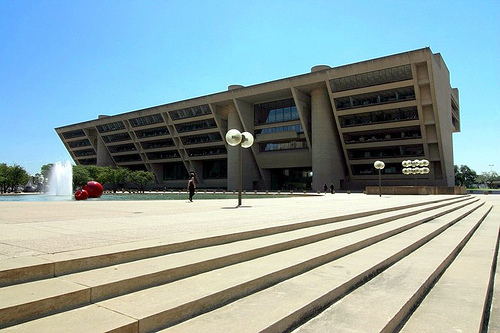
Which brings me to "The Living Plaza" creation at City Hall, which the astute and intuitive press seems to have realized is no longer worth much space or attention besides a half-hearted press release echo. Once a month, massive amounts of marketing and organization goes into bringing various food trucks and games and other forms of programming to a dead space in attempt to lure people to a part of town they would otherwise never go (and similarly, those food trucks would never locate there on their own nor would they make money there without said luring).

As I feared, in the wrong hands, the tactical, incremental approach has quickly turned to yet another magic bullet, above all of the other tools in the tool belt. The screwdriver is best left to turn screws, not hammer nails.

On a typical day.

But during/after the Living Plaza, you notice that the pictures that come out of the event are framed appropriately to make the fifty or so curious souls look a crowd that would make Pravda proud. When idealism replaces realism, a movement is destined to fail, which is my real concern, because it has its role. It's just a question of how long you wish to perpetuate it until reality smacks you back in the face, which it always does. And that smack gets more and more violent the longer and further disconnected you get from it.

As I wrote yesterday, a place must be integrated first and than it can be accommodated. The Living Plaza is yet another version of "build it and they will come," faux-urbanism and shows a fundamental misunderstanding of the incremental processes that create or conversely erode "place." Places that are desirable. That people populate, congregate, and in turn, attract more people. A real center of gravity. City Hall Plaza and the entire area around it needs to be repositioned. This is outside of the realm of pop-up, DIY, or any other name's potential.

The Davis Street Better Block worked because of the "pedestrian logic" underlying the fundamentals of the place as well as the interested, engaged residential base nearby that was aching for a center of gravity, of community that was torn apart by a hideous street. The original better block's initiative was simple interventions to restitch an existing community that had a tear through the center of it. With City Hall Plaza it has tried to bite off more than it can chew.

I find it particularly pernicious in that this sort of effort has value but only when applied appropriately. Otherwise, it might sink the entire movement of tactical, strategic, PROPERLY TARGETED interventions to jump start certain areas.

This is not to say that City Hall Plaza should be left for dead, just that we have no found the outer limits of what such efforts can do. The problems underlying the Plaza are far deeper and far more profound than simple programming and marketing can fix. It will take serious public and private intervention to rework the entire area and its place within the city.

The foundation for places to exist is spatial integration. Think of it like the energy grid. To be energized, a place has to be plugged in. Once you start getting further afield, the infrastructure, the grid gets over-stretched and you start to have brown outs in areas, which are no longer energized. A dead zone like the Gulf of Mexico off the coast of Houston.

We think and act and pretend that the Living Plaza is some form of incremental urbanism, but the only thing incremental is the amount of effort it takes to maintain the vegetable on life support suggesting a false incrementalism.

The reality is that a cadaver, a long dead and gone place, like City Hall Plaza and the near vicinity can't be resuscitated. We have to start life over again from scratch. To reconceive it as the defibrillators just aren't working.

We're pretending it is this, alive, dressed up but ugly as can be:
But in reality, the Living Plaza is this:

A cadaver puppet, we're parading around, pretending it is still alive. That's not urban design, nor urbanism. Let's quit pretending it is.

---------------------------
The Living Plaza is accommodation without integration and that is just dressing up a dead corpse. You must MUST have integration first. Once it is energized, the energy brought by people converging builds demand for steadily increasing accommodation.

Let's take a look at the example of Pegasus Plaza on Main Street in downtown Dallas.
Pegasus Plaza is at the intersection of Main Street and Akard is essentially the extension of the North Dallas Tollway/Harry Hines entrance into downtown. Effectively, this is the "main and main" intersection, the heart of downtown Dallas. Ground zero where two major connectors converge.

Where convergence is high, accommodation must match or lest it underperform below the potential afforded by the interconnectivity. One form of accommodation is the creation of public space at such a convergence point. This is usually publicly driven as a form of public infrastructure.

Furthermore, a recently implemented "tactic" was to add movable tables and chairs in the plaza. Which get used, but the level of integration of the "main and main" crossroads still demands more. I'd like to assume the Downtown 360 plan was this sophisticated with its proposal for "glass box" retail to replace the dog poop zone/back of house of the Magnolia Hotel that fronts the plaza, but I doubt it. I think they were just filling a blank since they proposed the same thing in several other places.

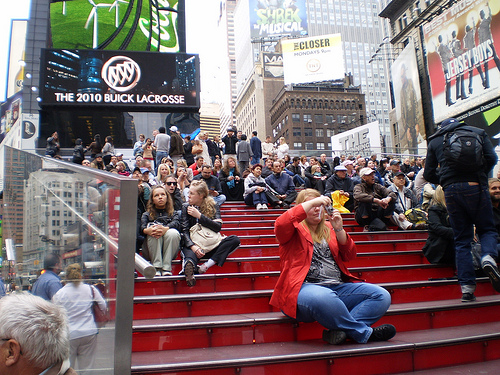
Another, cheap, tactical idea, would be to just take some of the bleacher seating that is often laid out onto Commerce Street for Parades and place the bleachers up against the Magnolia, facing the plaza in the way that Times Square added bleacher seating:


In fact, I think this would be a better solution as a temporary fix until the "glass box" retail can be occupied and staffed profitably without direct subsidy. Instead, the subsidy is the platform that builds the market in a certain place, the interconnectivity. It is the invisible arm, appropriately manipulated and the invisible hand will take care of the rest.

Instead of parading cadaver puppets around, let's get serious about building lively places in dead zones such as city hall, which takes real long-term strategy and reworking of the physical interconnections of the place, which means investment as well as honest/open assessment and addressing of all the barriers to private investment that exist currently (those barriers are listed here).

And let's focus the tactical implementation to places that are already living but are just in need of minor improvements and tweaks. Remember, integration, then accommodation.