Showing posts with label Carbon Footprint. Show all posts

Thursday, April 16, 2009

Thirsty Links

"No more taking off your shoes..."

The President's address on high speed rail today (link to video)
There are those that say this is too small. This is just the first step to a long-term effort.
Good to hear. He also mentions that the first allocation is strictly towards upgrading existing lines.

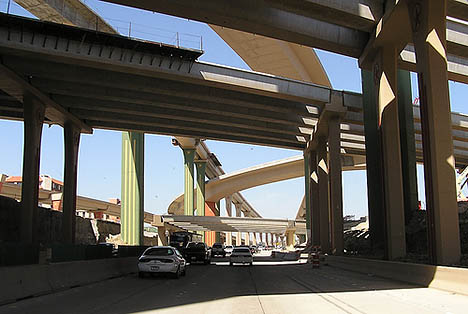
TreeHugger on Carbon Emissions Do Not Equal Happiness. Apparently, their collapsed economy doesn't have Ireland and Iceland feeling the blues. Perhaps also they don't derive their happiness from a daily stock report as if it were their daily horoscope...ewww 1-star day. Also, I love the contrasting pictures:

Copenhagen:


Dallas. Yay, we're famous!

And lastly, a fascinating map on job losses per county monthly over the last two years, at Slate. Texas is getting off easy thus far. 230,000 jobs lost in LA county alone. How much longer til the full-on backlash against Hollywood extravagance I wonder?

Lastly, on a happier note, WorldChanging on the 20-minute city, using Seattle as a template describing the City where every need is met within a 20-minute walk. Step 1 to a high-quality neighborhood:
When it comes to getting around Ballard, alternative transportation seems to be king. Driving a car to this neighborhood will cost you time and money. Luckily, you don't have to. From downtown Ballard, almost everything you need is a quick hop, skip and jump away.

Friday, April 10, 2009

Pro Sports and Carbon Footprints

This line says it all right here doesn't it?
The energy required to operate a sports venue is fairly minor compared with the energy that fans expend in simply getting to a game...
From Slate.

Now let's compare (I would use some Google Earth mapping, but apparently that program is having a hissy fit today):

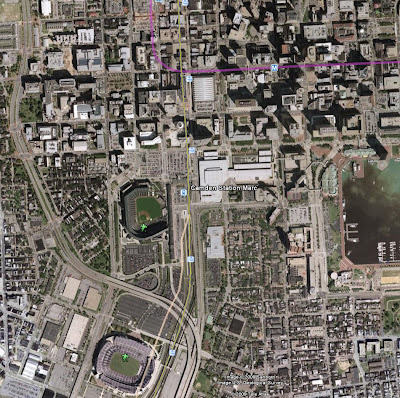
Oriole Park at Camden Yards, embedded in the heart of downtown Baltimore near the Inner Harbor, and you can walk to, bus to, or train to...


or...

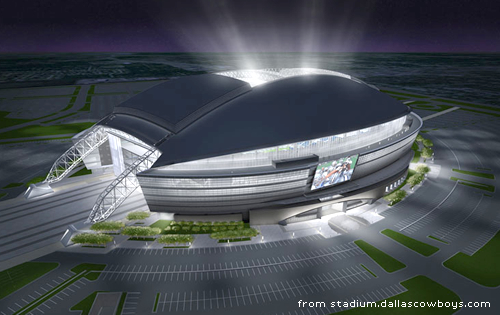
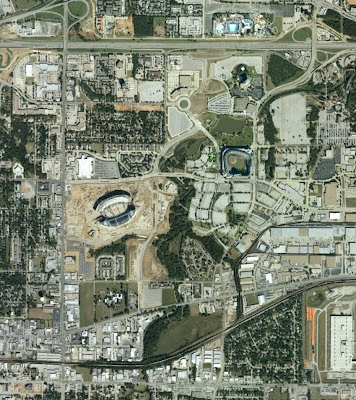
Shiny, happy Jerry World set in beeeeeyooooteeeful Arlington, Texas, home to the largest city in the country with no, ZERO, mass transit. Good luck hosting the Super Bowl, the NBA all-star game, and the Final Four in coming years while everybody stays in Dallas or Fort Worth without any way for these people to get to the venue.


Now, let's say the average fan is traveling the 20 miles from Dallas to the game, for 8 games a year, but we'll say 9 b/c the Cowboys are good at making it to one playoff game, and seats 80,000 people per game (assuming 80,000 people are willing to travel that far, pay for gas, and whatever Jerry Jones is charging for the upper level seats (cuz you ain't getting the lower level ones my friend). 80,000 people travelling each travelling 20 miles, 9x/year = approximately 720,000 gallons of gas.

I know, I know. Not every single fan will be driving solo, but yet again this is Dallas.

Somebody plz tell me how Arlington, and in turn, Dallas will NOT be laughing stocks like Houston and Jacksonville or Jacksonville again when the Super Bowl comes to town?

If you don't feel like clicking the links, here is the criteria ESPN's sports guy used to describe the ideal super bowl setting:

Does this mean Houston should be hosting a Super Bowl? Of course not. It's ridiculous. There should be five trademarks for every Super Bowl experience. This is not negotiable. Here are the five:
  1. Warm weather.
  2. Serviceable stadium.
  3. A downtown that's easy to get around.
  4. Fun things to do at night.
  5. A city that gives you that "Wow, what a city!" feeling.
If you're scoring at home, for Arlington that is: yes, presumably, no, no, GAWD no.

Tuesday, March 24, 2009

Reduce yer Carbon Emissions

Move to the City, and then get rid of your car.
"There are density-related advantages for both travel and heating," says Dodman. "When you have a critical mass of people like in London or New York, public transport becomes a feasible option for many, while people in more rural areas rely more on cars. And a flat that is surrounded by others is more efficient to heat than a free-standing house."
DC is dirty, but still only 82% of the American average.

Monday, March 16, 2009

Monday Morning and Weekend Links

Green-ness of Skyscrapers? including the prescient Dr.Seuss tale:
Over the protests of the environmentally sensitive Lorax, the Once-ler builds a great industrial town that despoils the environment, because he “had to grow bigger.” Eventually, the Once-ler overdoes it, and he chops down the last Truffula tree, destroying the source of his income. Chastened, Dr. Seuss’s industrialist turns green, urging a young listener to take the last Truffula seed and plant a new forest.
This tells me more about the cancer stage of capitalism than it does environmentalism: forever growth!...Now for the important calculations:
Matthew Kahn, a U.C.L.A. environmental economist, and I looked across America’s metropolitan areas and calculated the carbon emissions associated with a new home in different parts of the country. We estimated expected energy use from driving and public transportation, for a family of fixed size and income. We added in carbon emissions from home electricity and home heating. We didn’t try to take on the far thornier issues related to commercial or industrial energy use...

In almost every metropolitan area, we found the central city residents emitted less carbon than the suburban counterparts. In New York and San Francisco, the average urban family emits more than two tons less carbon annually because it drives less. In Nashville, the city-suburb carbon gap due to driving is more than three tons. After all, density is the defining characteristic of cities. All that closeness means that people need to travel shorter distances, and that shows up clearly in the data.
Here is the problem. This study takes the Amero-centric view that only through tall buildings can one achieve density. Skyscrapers are not a necessity for density. Paris, Florence, Madrid, Rome, Copenhagen, are wonderfully dense. Now, here are the potential CONS of skyscrapers:

1. Even if a platinum-certified tower is constructed, the building is still immensely energy intense in its construction phase.
2. They are materially intense, with materials typically travelling much farther than with low- and mid-rise buildings.
3. Skyscrapers privatize sunlight and views. Then, amazingly when another tower is built next door, the tenants of building 1 flip out that they lost their view...despite doing the exact same thing.
4. Tight-knit, often medieval form urban fabric generates protective microclimate from weather extremes. Skyscrapers often exacerbate the problem with the intensity of the wind shear and down draft created by the building.
5. Skyscrapers adversely affect the street aka the public realm by 1) removing people from the street and putting them in elevators and 2) overpowering the scale of the space created by the buildings.
6. These buildings tend to be glass and steel. Two energy intensive materials, often not created locally. I like the elegance of glass buildings, but then the issue becomes one of active vs. passive heating and cooling. AND, reflective glass is often pretty ugly.
7. COST. They are expensive to build.

In summary, I'm not saying that I'm against skyscrapers. I like the pyramidal form of skylines of cities, emblematic of the greater synergies driving up values in the center-city, and thus manifested by taller buildings, aka greater real estate and F.A.R. in those places as a natural result. But, simply calculating that more dense places are greener doesn't say a damn thing and it certainly doesn't necessitate skyscrapers.

Brookings on the economic engine and (should-be) haven for investment of cities:
Yet here is the problem: While America is more metropolitan than ever, the nation’s policies and structures rarely match economic reality. As a nation, we remain fixed in old arrangements, established decades ago and kept in place by bureaucratic inertia and entrenched political interests. Such a misunderstanding of contemporary urban structures inevitably leads to bad public policy decisions. Take as an example the nation’s crumbling infrastructure, now finally in the public eye. We should be spending money on metropolitan infrastructure, such as new transit lines or the maintenance and upgrade of existing roads and bridges, because it gives the best return on investment, the most bang for the buck. And yet the federal government sends the overwhelming bulk of national infrastructure funds to states, not metros. Given the vagaries of state politics, state departments of transportation in turn tend to scant metro investments in favor of building brand-new roads in far-flung places. Money that could be fueling the metro economic engine ends up widening a rural highway.
And lastly, a fascinating take on the death of newspapers as compared to the revolution that was the printing press:

Round and round this goes, with the people committed to saving newspapers demanding to know “If the old model is broken, what will work in its place?” To which the answer is: Nothing. Nothing will work. There is no general model for newspapers to replace the one the internet just broke.

With the old economics destroyed, organizational forms perfected for industrial production have to be replaced with structures optimized for digital data. It makes increasingly less sense even to talk about a publishing industry, because the core problem publishing solves — the incredible difficulty, complexity, and expense of making something available to the public — has stopped being a problem.

Friday, February 20, 2009

LaHood to Consider VMT Tax

In my younger and more disconnected from reality days of yore, I would have supported this (link):
Transportation Secretary Ray LaHood says he wants to consider taxing motorists based on how many miles they drive rather than how much gasoline they burn — an idea that has angered drivers in some states where it has been proposed.
However, in a world of "drive til you qualify" which has forced moderate and low income families far into the nether reaches of sprawling cities, we would be once again forcing them to foot the bill for the mistakes of the power brokers and decision makers.

This can work in Portland, NYC, DC, San Fran as a means to disincentivize living at the edge. However, not many of those cities are exactly affordable inside the loops or near transit, exactly the types of places the lower and moderate income need to be to save on transpo costs.

In Dallas, everybody drives (except me!). Do we want to punish them for the world they didn't create? Or should we focus our efforts (spurred by cash flow from toll roads - which I do support for similar but less drastic measures than the VMT tax) on qualitative growth, infill around transit stations, new modern streetcar lines, and making the city more livable - thus creating a better option for people to choose.

Matthew Iglesias at ThinkProgress also questions the logic:
So I’m not sold. When it comes to pricing driving-related activities, it makes sense to charge people from things that actually impose costs on others—burning gasoline, and taking up space on crowded roads—not the mere act of driving.
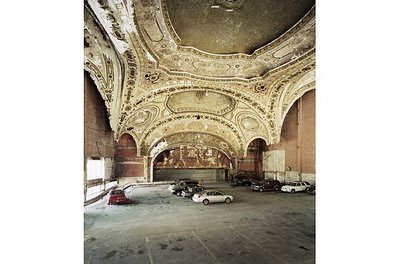
Or, we could be like Detroit:


Which we tried...but fortunately, we saved our current office space, the Republic Bank building from being turned into a parking garage itself: