Showing posts with label New Economy. Show all posts

Wednesday, July 21, 2010

Dallas: The Digital City?

Last night, due to the wondrous interconnective powers of these here interwebs, I was graciously invited by Kevin Walker to take part in The CultureLab's informal round table discussion on Dallas and its ability or lack thereof to become or be considered a Creative Class city; and what might be the necessary barriers, hurdles, or next steps towards that end. The event was hosted in Southside on Lamar, which I must admit, I haven't spent enough time down there, and is pretty cool -- if potentially overscaled and overly internalized as a building.


As the invite shows, the special guest was a gentleman named Micheal (Mike) Pratt, a man who was involved in starting Digital DUMBO and who I didn't know (or think I knew from Adam). I walked in, we immediately recognized each other and pointed, "didn't...I...just..." Yes, in fact, we had just met the past Wednesday at D Magazine/TEDx's "What Are You Working On?" social event.

As it turns out, he's a pretty important dude and now due to familial obligations, he is now ours based here in Dallas. If I was to put a finger on one standout trait of Pratt's, it is that he sees opportunity in chaos, in creating order out of that chaos by way of instilling and then organizing a culture of community. Community (in the very real or more abstract digital notion) is essential for fostering creativity. Collaboration comes from the space between me and you. WE is always smarter than ME.

DUMBO
First, some background on DUMBO. Like many hip urban areas where the name comes from the common shortening of names for people and places (J-Lo, T-Mac, LoDo, SoHo, etc), it is an acronym for Down Under Manhattan Bridge Overpass.

Because it sits in a V beneath the Manhattan and Brooklyn Bridges, it was what the real estate community would consider useless land: under elevated freeways, on the third side and at-grade freeway, and the fourth waterfront. But, this was the East River, long considered the outfall for 19th and 20th century dirty industry's effluent. It also had terrible access. How do you get there, parachute out of a moving vehicle from the bridge above?

All of its built-in undesirability made for cheap land with an existing urban fabric, some old warehouse space. This is New York City where incredible demand can make any and all land valuable. It also had a subway station at its periphery.

In it, creative start-ups found first, cheap space. Presumably through various previous associations that cheap space was then broadcast to creative acquaintances looking for similar, funky loft-type space. Eventually, as they began to agglomerate still under the radar, digital DUMBO came along and provided a digital center of gravity to go with the emerging physical one.

The digital version brought these businesses and the individuals behind them together. People who would otherwise just pass each other on the street or stand nearby waiting for the next F train, were now meeting at events organized by Digital DUMBO, sharing ideas, sharing business cards, and small startups began pooling skills, collaborating on projects that otherwise might have been too big for one or the other.


From a physical standpoint, the urban morphology nerd in me, loves the way it appears to exist on an island growing from a singular epicenter.


Although much of our dialogue last night revolved around digital media, design and creativity comes in many forms. Type in design into google earth and a number of companies pop-up including building architecture and digital architecture. This isn't the last time I will make that parallel.
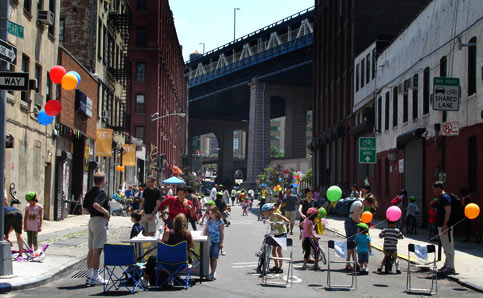
http://susty.com/image/brooklyn-summer-celebration-for-kids-dumbo-wide-shot-pearl-street-triangle-lawn-chairs-balloons-bikes-children-adults-photo.jpg
DUMBO: the physical, made possible by the organizing power of the digital version.

Now on the map, DUMBO like many new hip spots in any city, was first pioneered by creatives looking for little more than cheap space, then colonized by peers, and once a critical mass was apparent, then organized and marketed outwards. Now, even the big firms want to be a part of the digital organization and physically open up shops there.

In a way, it is gentrifying, both the digital and physical community. And that isn't a bad thing. The pain of gentrification stems from our biologically-wired resistance towards rapid change. At its basic level, gentrification means investment. It is only not ok when there is a clean sweep of the old in favor of the new.

Over the course of the history of all cities, every area has at one time "gentrified." Any place that becomes exclusive or static, eventually becomes boring. To resist investment or inclusion of "the other," means to stagnate and ensure a slow strangulated death. On the other hand through gentrification, exclusivity also comes at an increase in price point.

What happens however, is that those original pioneering creatives rise in class as their creation, their collective organization, their neighborhood rises. They can then move on and focus their energies on creating new places or investing in the next generation of young creatives looking for cheap, cool space and the culture of community to match. They're now experienced in How-to and capitalized, ensuring the uplift of various other portions of the city.

In order to retain the spirit of places, places need organizations and leaders as stewards. Physically, they also need protection once an area rises to what we might consider its ultimate, highest and best use. In DUMBOs case it was to become designated a historic place on the national registry in 2007. It is now protected from getting scraped clean in favor of all glimmering waterfront condo high-rises (which may very well form the connection between DUMBO and the rest of Brooklyn ultimately, as DUMBO-driven demand creates the need for more residential space nearby). The demand driver, the sense of place remains.

DALLAS
Dallas is often considered by the Joel Kotkin's of the world as the epitome of the "polycentric city." Last night, creative acquaintances of Kevin's in town from Chicago, NYC, and Tokyo pointed out that they left Dallas because of a lack of livability. Their words, I promise you. A UTD grad student pointed out that you have to be from Dallas to know where to go for virtually anything, there are no centers of gravity with a sense of place, an understood identity, that registers beyond a local level.

The truth of the matter is that Dallas isn't polycentric as much as it is non-centric, it is the placeless anti-city that Mumford warned about with the rise of personal automobility and the extensive infrastructure to support it. While Bishop Arts, Lower Greenville, uptown, Lakewood, Oak Cliff, X+, Deep Ellum, Design District, Cedars, Expo, Fair Park, etc. may register to us locals, what do those names mean to a recent graduate from Stanford, Columbia, or NYU (which surpassed Princeton for the first time ever in applications last year).

These local Dallas spots are all still neighborhood centers. DUMBO now registers nationally. For the City to compete on the national and global scale that it wants to, these are the areas that have to rise to regional and national prominence. They have to start small. They have to find leaders. They have to build communities online that are self-organized, like-minded, and motivated to parallel with the physical communities they want to live in. But, they also have to welcome an increase in density to accommodate the desire to be a part of these clusters.

DO-IT YOURSELF CITY
Dallas is too busy worrying about how to attract creatives when it needs to focus on keeping them first. I'm always amazed by how much talent this city exports, hands over in exchange for nothing, to other cities, considered more interesting, more livable, more amenable to their creative endeavors and desired quality of life.

For a business or a city to compete in the 21st century (or any time period really), it isn't enough to simply do something the best or be the biggest, but best embody the spirit of the times. The 21st century will be known as the anthropocene, or era where people and quality of life come first. Portland and Copenhagen are generating the attention they are because they are not so much winning but the first out of the gate. We have the potential and ambition to surpass them.

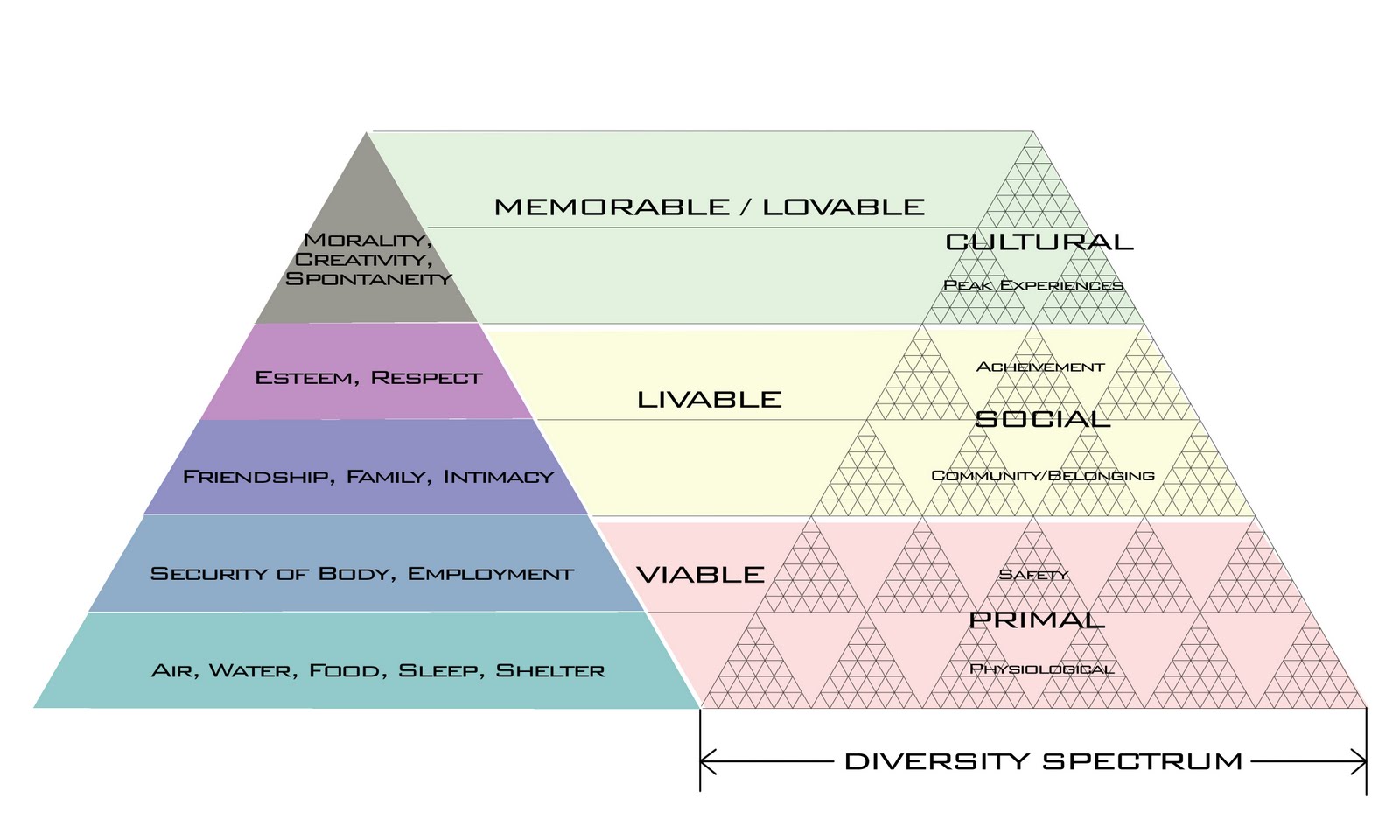
What the Non-centric City of Dallas is struggling with from a physical and economic standpoint, is its parallel problem of form and function. Form helps foster function. Dallas is for the most part formless. If the city was the web, imagine an internet with no websites, ways to access them, or everything was pay-walled.

The city and the web are both human constructs, both perhaps modeled after the way our own interconnected brain and bodies work. The City and the internet are two parallel geographies and quite possibly the two greatest advances in human civilization.

They are both facilitators of connections, between people, goods, capital, and ideas. They have the potential to allow us to achieve all of our needs and wants, the emotions that make us human and drive the economy.
http://2.bp.blogspot.com/_D5kx0bUGx_c/S_v4YDHga8I/AAAAAAAACfc/lLwt_qvXz5Q/s1600/city+pyramid+-+hierarchy+-+diversity.jpg
There is a reason why there is probably far more to learn about cities from Stephen Wolfram than Frank Gehry. One is a true architect just in a digital world, creating communities and facilitating connections, advancing true human possibility, while the other sculpts platinum (a purpose perhaps, but its true transformative value is limited). The parallels don't end there.

Both have hubs, ports, and linkages. Websites are like buildings. The use of the building is like a website's content and they must interface with the stream of movement, the digital transportation between points and destinations. For websites, traffic is critical and they must create clouds of interconnectivity. Buildings must interface with the various forms of transportation and facilitate ease of use.

Both have "sites" that get "developed" according to "codes." Coding which is becoming increasingly open-source, meaning more individual customization and local empowerment. However, our codes for physical cities lags behind. It is still written for the 20th century economy. It is not ever changing and adaptable, but static and antiquated. Imagine if the web was written and interfaced in DOS.


The internet as designed by conventional city code. Your city has you.

From similar simple terminology to the actual read/write nature evolving in both, the 21st century economy will be increasingly defined by 21st century industry, which means 21st century principles, of mass customization, collaboration, and transparency.

The digital geography is the physical geography. The more the lines blur, the better.

Currently the City and many of its future industries are in chaos, scattered all over the City with little interrelationship, or mutual dependence. The City and its potential new industries therefore are less than the sum of its parts. Through organization, clustering, and collaborating they can become more than the sum as many industries that need and want to grow as a driving force of the 21st century economy, one of creativity, collaboration, synergy...of empowerment, are looking for the physical neighborhood mirror.

While the internet was once feared to breed a generation of shut-ins, the opposite has happened. We still yearn for social contact and the internet has become the tool to not only collaborate from distance, but to organize physically and provide the catalyst for change of urban neighborhoods.

Any area of the city needs both a digital and a physical interface, a way to empower the citizens to be a part of a community, to be stewards. It is the cities, the neighborhood organizations, and the leaders (or those that are yet to emerge) that have to facilitate this, that look to organize and recruit the scattered small creative businesses into their potential cluster. To compete in the 21st century, we must foster centers of gravity, of intellectual foment, digitally and geographically.

In many ways, this is exactly what is going on with GoOakCliff, a parallel geography of internet awareness, marketing, and then organizing and empowerment, associated with a specific place, fostering a sense of collective care about neighborhood, about home. These various neighborhood areas have to accept change, and alternative forms of transportation like streetcars in order to support the density that is sure to come, to fulfill the exploding demand for authentic, interesting, vibrant urban locales.

Since many of these organizations don't yet exist, therein lies the opportunity for creative energy. If you're creative, don't leave. Customize your world. Focus your energy here, make a culture of community from scratch, both digitally and physically. Create order out of chaos, form out of the formless, place out of the placeless.

Dallas can't be a great digital mecca without associated great neighborhoods. The people we want to attract aren't ready to flock to Dallas yet. Fortunately, we can create those places, those clusters of innovative activity and expansion of the possible. But business as usual won't get us there.

Like DUMBO, make the city/your neighborhood your creative outlet. This is the self-designed century of collaborative, mass-customization. Take control. Let the Dallas be your canvas.

File:The Squirrels 0017.jpg
DUMBO's self-made pocket park

Monday, July 19, 2010

Monday Morning Linkages

Today's links may not have a particular theme, beyond being as diverse in their complexity and range of issues as urbanism itself. Two things that I often focus on are governance/democracy and its various permutations and the transition between old capitalism and new capitalism, as any economy is the single most important dynamic affecting the form and function of our cities.

On to the show:

Derek Powazek citing Yochai Bentler on the revolutionary democratizing agent of the internet and its lamentations:
You know who’s sad about the gatekeepers losing control of the media? Nobody except the gatekeepers. If you care about democracy, thank your lucky stars for the internet, the most open forum for the free exchange of ideas ever invented.

I say: Let’s dance on the graves of the gatekeepers. Let’s build things never before possible. Let’s show what a giant network of brains can really do.

The internet as a single entity and a voice for the rabble isn't the only way this is happening. It's an empowering agent that fosters self-organization and self-customized connections, where we can eliminate the useless and cut out middle men of any economic transaction. There are gatekeepers in all industries and to some extent they are necessary. Language, for example. See the late David Foster Wallace's internal debate* regarding the issue of laissez-faire language evolution and the protectors of a true (potentially arbitrary) protocol of syntax.

Similarly, while gatekeepers can be right or wrong for a field, usually depends on their own abilities, often undermined by the foundations of capitalism as we know (knew?) it. Those same useless, wasteful, or stalling agents in the name of progress. One example, is the music industry, controlled by a few major record labels increasingly turns out more noise and less art, setting up barriers against real talent reaching a broader audience.

While occasionally, against the tide, some musical acts can rise to the top, but they typically need a martyr within that very industry to fall on a sword to give them a chance. The reason the music industry prevents talent from rising as it is naturally wont to do, is that talent can typically write. And writing music means royalties. And royalties mean on-going and perpetual revenue stream.

By cross-platforming between music and television with TV shows like American Idol, the music industry, largely engulfed by gigantic publicly traded companies, is able to build an audience by marketing to the willing masses. The show gives the audience a "stake" in the game by each having their favorite individual, the most popular gets ahead. The most popular will sell the most records because we** feel we have some level of personal connection to that person winning.

The industry, with staff writers on salary and under contract as to not receive royalties, then produces some factory-produced, focus-grouped modern-day elevator music for the all-singing, all-dancing puppet to perform.

It's also all that is wrong with capitalism. More usury and pyramid scheme than facility for talent to garner its true worth.

* Warning: You have to be an uber-nerd to dive into DFW's text.

**Author has never watched a single show of American Idol.

-----------------------------------

While we're on the topic of changing economies, I've recently come across a fellow tweeter (twitterer? twit?) by the name of Umair Haque, who incidentally happens to write for the Harvard Business Review. I was struck first by Haque's tweets which always seem to mirror my own with regards to a profound generational, perceptual, and functional shift in the fundamental operational underpinnings of the economy (like in a good way).

Eventually I started reading his writings at the HBR, including this one on Apple. There are times when you think you can write and then there are times when you have similar thoughts in your head as to the author but only wish you could convey them as clearly and concisely as he does here:

Apple, when you think about it, is a microcosm of the global economy; a tiny but striking representation of both its strengths and its weaknesses. Apple mass produces "product" (with a smattering of services on top), mega-markets it (across mass media), and sells it in your local mall, mostly to developed-world "consumers."

Here are just a few of the downsides: The raw materials Apple uses are toxic to the environment; Apple's Chinese subcontractors have endured a spate of recent suicides; Apple takes advantage of a questionable Chinese exchange rate regime that effectively exports unemployment to the developed world (and subverts the very notion of "free trade"). And it does all this at a lightspeed pace of "innovation," which results in spirals of obsolescence; last year's junk heads, often, to the landfill. Finally, it's questionable whether Apple's products, as beautiful as they are, offer meaningful benefits to people. Are they just the technological equivalent of Jimmy Choos, the kind of stuff that underpins the consumption addiction at the heart of the global economic crisis in the first place?

Apple, to its great credit, strives mightily to minimize each and every one of these downsides. Yet, that it must do so is the very point. How different, as a linchpin of the economy, is Apple from the Ford of 1930, the GM of 1950, the P&G of 1980, or the GE of 1990? In economic terms, not so much: all are built on the same set of institutions: mass production, mega-marketing, "profit," hierarchy, opacity, "innovation." You know the score — and by now, you might just ask yourself: "isn't it time to move past the industrial age already?"

Just shut up and let it breathe, Patrick...

--------------------------------

Der Spiegel interviews Albert Speer, Jr. Yes, but no. Not the Albert Speer known for his overly scaled representations of Romanesque forms for Nazi Germany but his son who has become an accomplished architect himself and says that the slums of the 21st century are being built in Dubai (to which I completely agree, of course for reasons I will get to):

The highlights:

So, fundamentally, buildings such as the Burj Khalifa aren't inventions of the 21st century. Such plans existed earlier, it was just that they weren't feasible technically. Today, we have the means to build such towers. However that doesn't mean it's sensible to build them. It's purely a vanity project.

Overscaled product of dying economy: check.

Perhaps there are enough people in the world who would consider an apartment in such a building to be the cherry on top of their luxurious lifestyle. But this has nothing to do with normalcy or a sustainable lifestyle. When one builds a city -- at least I think so, as a German -- one builds it for the next 200 years rather than the next 10. Take the German city of Freiburg, for example -- the layout of the city is the same as it was in the year 1000. But in Dubai, it is likely that the majority of the buildings there will have to be torn down again before too long

Product of supply-side thinking rather than outgrowth of demand: check.

I am convinced that the slums of the 21st century are, to a certain extent, being built there. Dubai has two sides. On the one hand, it's the Gulf state that doesn't possess any oil but which has nevertheless managed to get its name on the world map within the space of 20 years... Many buildings were built quickly and on the cheap by speculators and are now standing empty.

No foundation for an economy to exist there, other than the epicenter for the black market of the world: check. Eventually, it will become far too seedy for the wealthy that are needed to fill those condos to want to even be there.

One builds cities for people... I believe that Dubai got intoxicated with the idea that everything is possible. The collapse of that system demonstrates that it wasn't the right way to go.

One predictive measure of whether the system of built form and how people interact with it will succeed or fail is Space Syntax, a career's worth of work by a British Professor in the name of adding objective regularities or constants to urban planning and architecture: city building. It is heavy stuff if you want to dive into it, but you can be sure that Dubai and the new portions of car-orientation lack the form where people can predictably and comfortably use the space. In the place of order, Dubai represents an application of American oppulance and profligacy.

We were once wealthy and powerful. Wealth and power then gets associated with the "right way to do things" rather than the actual reasons of that accumulation of wealth and power. Dubai and China are copying what we did wrong and painting a rosy picture of the future economy on top.

Their/Our mistake was in thinking that simply by pending money and siphoning off the circulation of that money somehow created wealth and prosperity. Only through creating and adding value creates wealth and prosperity. Copying the copyers is no way to rebuild our economy.

----------------------------------

And lastly, speaking of pyramid scheme real estate economies, while this only deals with property tax revenue, mixed-use development far and away outpaces single-use suburban development, much of which hasn't fully paid for the infrastructure it requires before it is torn down and land repurposed:

Next, Katz showed the results from retail properties. Here comes surprise No. 1.: Big box stores such as WalMart and Sam’s Club, when analyzed for county property tax revenue per acre, produce barely more than a single family house; maybe $150 to $200 more a year, Katz said. (Think of all those acres of parking lots.) “That hardly seems worth all the heat that elected officials take when they approve such development,” he noted in a related, written presentation.

Among retail properties, the biggest per-acre property tax revenue in his county, almost $22,000 per acre, comes from Southgate Mall, the county’s highest-end commercial property with Macy’s, Dillards and Saks Fifth Avenue department stores. That’s not so surprising.

But here’s the shocker: On a horizontal bar chart Katz showed, you see that zooming to the far right side, outpacing all the retail offerings, even the regional shopping mall, is the revenue from a high-rise mixed-use project in downtown Sarasota. It sits on less than an acre and contributes a hefty $800,000 in tax per acre. (Add in city property taxes and it’s $1.2 million.) “It takes a lot of WalMarts to equal the contribution of that one mixed-use building,” Katz noted.

If not just questioning our development product and form, this should also having us more closely examining our tax policies at a fundamental and philosophical level.


Thursday, July 1, 2010

Where the Next Gold Rush Will Be

Cities and economies are always under the pressure of "growth," whether that be in economic activity, productivity, or physical expansion. The last of which is what twists the meaning and understanding of the inherent need for improvement. Perhaps "improvement" is the preferred terminology. Either way, it is first necessary to understand that this is the way we are wired. Second, we must put in some brain damage to minimize misteps

If we're to apply the colonization habits of the honey bee, it is that they are on constant lookout for new nectar, new manufacturing opportunities for their very specific industry. The workers look for new territory and return to the nest "marketing" their finds. Other bees follow in order to "test" these finds based on the prospector bee's marketing abilities.

Obviously, marketing can only get a colony so far, as the new lands actually have to prove productive, useful. The way of testing these new finds for their utility is the colony expands outward to the new finds much the way outward growth from a city does, testing the temporary value of the land to the needs of the day. As some prove more valuable than others, the shape and size of the colony follows the ability of the land to support it. Some expand, some recede.

With that, we are finding that much of our recent suburban growth (that of the last 20 years) is proving to lack resilience, importance, and usefulness. In fact, the things holding them up are largely due to temporary inertia based on population as it exists today, not in how it will exist in the future. For example, good schools are largely considered to be in the suburbs. But, as countless examples show, good schools follow population much the way a Whole Foods or a Target might.

Because of this constant testing and shape shifting, I wish to challenge the tautology of a few points of conventional wisdom and offer some ideas for underserved markets as to where the next areas of growth will be as we shift from an expansionist growth economy or an extroverted to an introverted one where we find value within our existing parameters.

I think each of these will be worth deeper introspection, but for now I'll just provide a brief synopsis. Following the internet rules of 3s and 5s for the attention deficit'd, I'll leave the list at three and provide pretty colors:

UNDERVALUED OPPORTUNITIES

In many ways, all of these are related. They represent markets or land that is less than its potential based on physical characteristics of constant urban dynamics, those being the patterns that are evident throughout the history of civilization but perhaps not today. The presumption being that because of rampant and often profligate change throughout the last fifty years disappearing such consistencies represents only a temporary one.

Arterials and Intersections

(Green represents improved multi-modal corridors, purple is commercial node, orange is neighborhood centers, yellow is neighborhood transition, and red is overvalued highway frontage)

This land is in contrast to the overvalued "highway frontage." Similar to strip style development (that also plagues arterials), highway frontage is 1) difficult to get to and 2) is impossible to build the critical mass around the sites to have a proper "ecology" of varying uses and frameworks holding together and providing resiliency.

Development always goes hand in hand with transportation design. Bad transportation design, in this case car-oriented concrete deserts (arterials) begets bad development. With the shift from car-only transportation, to one that allows and designs for choice, arterials have the opportunity to be redesigned as multi-modal corridors that attract people rather than repel them. This is merely a matter of design.

Furthermore, many are over-retailed (as is the entire country) because retail had to disperse in proportion to the residential population. What resulted was a landscape full of empty big boxes and derelict buildings as there was always some new store, or mall, or strip center where retail tried to appropriately cluster (but often has done so poorly).

Arterials are poised for economic development as they are redesigned to function as both conduit AND place. They carry the most traffic, but unlike highways can actually support people-friendly development with the right people-friendly design. Density of Movement + People-friendly design = Demand for Developmental Density.

Cities should be focusing on repositioning their arterials from linear strips of repulsion to points of attraction and Developers should be eyeing properties along them in coordination to maximize positive momentum. See this article about the densification of one strip retail intersection in North Dallas.

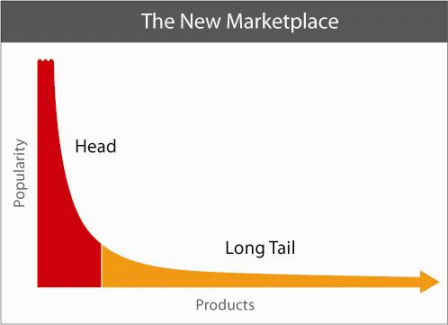
Affordably Long Tail of Housing

http://ffbsccn.files.wordpress.com/2009/11/long-tail-graph1.gif

I mentioned this the other day in my half-baked idea about mid- or high-rise cohousing or what might represent something similar to Single-Room Occupancy units. The fundamental issue is that we have to date provided very little choice in type or format of housing. Single family are nearly all the same, as are townhomes, as are multi-family buildings.

In order to meet the market that demands in-town walkable urban housing (supply of ~3%, demand of ~40%) while accounting for higher land costs, developments must maximize efficiency of space and development and find new prototypical niches to differentiate your project.

There are lots of ways to do all of the above, some of which have been done before in other cities, some have yet to be tried. The key is to understanding people, the market, and demographics, particularly the two biggest population bubbles in American history, retiring boomers and graduating Millennials.

Around Downtown


I came to the realization a few months ago after long discussions with a few colleagues and clients that the opportunity didn't lie in downtown so much as it did in the bombed out areas immediately around downtown, they became the moated wasteland around a 9-to-5 castle. What is now known as uptown was once this way as well twenty-plus years ago, but benefited from being within the "favored quarter" or the direction of initial expansion.

I came to the realization after studying Leinberger's favored quarter concept that it only applies in younger cities, ie American cities. As cities age, they eventually recenter around the primary center of gravity (those defined by transportation hubs or places of the greatest degree of convergence). These nearly always are downtowns. Eventually, investment begins to encircle downtown and North-South, East-West balance is restored as pioneers and investors seek cheap deals near to hubs of activity. Furthermore, more mature cities often relegate all industry or noxious uses aka LULUs (Locally Undesirable Land Uses) to a singular "quarter."

That brings me to downtown Dallas and its adjacent neighborhoods or once-were and soon-to-be neighborhoods. Already we are seeing signs of positive momentum in Bishop Arts, Deep Ellum, the Design District, and some parts of Ross/Live Oak (albeit chaotic here).

Applying the transect, these areas want to be of medium- to high-density similar to what uptown Dallas has become, but many of these have more history, more potential for unique character than uptown (ie Bishop Arts, Lakewood, Deep Ellum). However, some of these areas are more encumbered by barriers, ie highways than others. Cedars for example is an island whereas Near East connects all the way to East Dallas without interruption or break in the fabric until White Rock Lake.

Furthermore, all of these areas fall within the 1- to 3-mile radius of downtown that modern streetcar and bikes serve very well, two pieces of the transportation hierarchy rising in demand and cultural consciousness. Similar to the Arterials section, new kinds of transportation will yield new development by repositioning a barrier (the arterials) through design and repositioning the neighborhood through provision.

You might say, why streetcar and bikes? The answer is that to support the natural amount of density that the land and sites can support, there have to be alternative modes of transportation 1) to support a variety of market segments that may not want to have a car and 2) you can't provide infrastructure for high amounts of car use AND the framework for density, which should be nothing more than a product of desirability, uninhibited by barriers.

Lastly, the kind of density that is demanded in these areas (but held back by a number of reasons, some unique to each "quarter") will eventually result in increased vibrancy and that means drinking establishments. Do we really want all of our bars to be only served by car?

Furthermore, with that kind of density, parking requirements (which are nothing more than poor substitutes for mobility) are less necessary because the parking is replaced by nearby rooftops (where people can walk or bike to the store or office, etc.) and large supplies of parking often interrupt the latticework of interconnected walkable urbanism (not to mention are cost prohibitive).

By limiting parking and providing new hierarchy of transportation alternatives, areas adjacent to downtown offer the perfect setting for creative, affordable housing infill.

Tuesday, February 23, 2010

Is Dallas Synthetic?

Russ Sikes, local businessman, and president of the local chapter of the Congress of New Urbanism (CNU-NTX) writes when the spirit moves him unlike myself who witheringly taps away at the keyboard like I've had a heavy dose of mental fiber. Each time he does, it is timely and appropriate. In this latest iteration of knowledge-dropping, he manages to craft a love note skillfully masquerading as an excoriation of DFW citizenry.

In "Dallas: Syn City", he asks, "is Dallas a "synthetic city?" I want to react to the general query along with this key statement:
“Sustainability” is said to be key to our future survival, and as Herman Daly explains, true sustainability requires shifting our consumption from finite stocks of resources to self-renewing flows in our midst. This conversion will necessarily involve various synthetic processes. Chief among them is photosynthesis, which makes virtually all other life possible, and provides not only our food, but increasingly our fuel too. Since nearly all of our energy derives ultimately from the sun, some form of photosynthetic bio-mimicry or novel synthetic processes are sure to provide the fulcrum on which a sustainable future rests.
This alludes to what we will find to be profitable in the next wave of growth, the "new economy," or at least the next economy until we must reinvent it again. The irony is that the profitability will be found in the very things we deemed to be the thief of profitability: waste. That is right, waste = food. It is natures way.

The city (meant generally as "all or any city") is a metabolic creature. Nutrients go into cities which are the physical emodiment of local economies in the form of human capital, natural resources, etc. it is processed by skill or talent which then produces goods and services deemed of use. These processes all have waste.

Natural systems are all highly evolved closed-loop systems in which all waste is food for other interconnected processes. The city as we have constructed it is an open loop by virtue of neo-classical economic ideologies and policies that support and in fact encourage business actions that "externalize" waste.

The equivalent of this might be if human and animal waste didn't fertilize plant life that then produces oxygen, food, or both. Our cities are cavemen smearing each other and drawing on the walls with R. Kelly's doo doo butter. That doo doo butter being the externalized costs of pollution, waste, etc. that are eventual costs that we will all have to deal with eventually.

Smart businesses and cities will monetize their waste and begin to think of the economies of cities as metabolic loops. This will most definitely require a close examination of all/any materials flowing through these loops to determine their potential in the new economy. This is all cradle-to-cradle 101 and it is contains infinitely more profit potential than the economy we are shedding.

As for what is derided as "synthetic," in my opinion, are those retreating remnants having surpassed their useful livelihood. These are the dead leaves, damp and dirty, lying on the ground waiting to be swept into piles and jumped into; all things we essentially relate to North Dallas, fairly or unfairly.

It is the conspicuous consumption spread across the landscape in the form of what we know as wasteful auto-oriented sprawl; a form of gambling in essence. Turns out the financial mechanisms behind it rigged the game, to avoid the losses: the returns had to be faster than the testing mechanism to properly assess the real value. That way the lenders could get out before the floor dropped out, i.e., test of time revealed the true value behind the forever growth mythology fueling the housing market boom. (All the more reason to valuate real estate based on long-term, and more consistent returns.)

This is, of course, not to say there weren't successes. All eras of expansion are marked by overshoot, a spreading out period to test apples to apples, in order to find what areas will endure. The whole point of the expansive growth was to find those places. The marked recklessness, however is what creates for such drastic swoons: the further the expansion, the more intense the contraction, the rougher the recession, which is simply an economic term for a evolutionary biological concept - repurposing.

We have the places that we will now begin the period of contraction to (re)organize around, ie densify. These are both old (found to be useful in previous gambles of expansion) and new (found in the most recent round of expansion).

These are the areas that we plug back in, closing the "economic" nutrient loops as we realize or remember the value in them. They are the areas we often define as "authentic," including places ripe for reinvigoration: Lakewood, Deep Ellum, Near East Dallas/Ross Ave, North Oak Cliff, etc. etc. (I could go on and on, but those are the freshest in my mind after the streetcar post.)

Unfortunately, many are ill-equipped to identify the more permanent elements from the recent high tide of expansion. Some erroneously lump those that will prevail in the long-term with all that will fail as one large regretful flood of wastefulness (haven't we learned that in all waste is potential for profit?). Others incorrectly presume everything we've built in the latest go 'round of boom/bust expansion as permanent inexorables of modern life. These are the Bruegmann and Kotkin's of the world.

What is "synthetic" is that which has lost or is losing its purpose in the new city phenotype, fallen leaves from trees. And, we all serve our biological purpose rightfully deriding its various permutations. That which we define as "authentic," provides the "green shoots" of the new city as it re-adapts, yet again. These are the fruits of the loom? boom and bust, carrying seeds as lessons.

How much will we learn? And,

can you decipher which is which?

Wednesday, February 10, 2010

Transportation Choice and City Building to Accommodate It

It's the dolla dolla bills y'all. First, a semi- book review:
--------------------------------
Last week, I destroyed Game Change in about three days, which does read occasionally like the hysterics of equally happy and jilted junior staffers aimed at their either current or former bosses. One thing that struck the biggest nerve with yours truly, was the level at which the old guard didn't or couldn't grasp the irresistible force that was the Obama Express '08, next stop White House.

This was particularly mentioned with regards to the Clintons and in a specific case with his eventual running mate, Joe Biden, with regards to Obama's proposed tax policy. Biden exclaimed, "that's it?! THAT is your tax policy?!" with pronounced bewilderment toward the seeming simplicity of it (the book didn't go into any explanation with regards to the two men's policy differences). To Biden, it seemed like nothing more than hollow rhetoric.

This is something that I've seen at every level of government throughout the country, and IMO why we see so much backlash towards bureaucracy and the unnecessary complexities of government. Each particular level of government at the leadership level was too involved in the minutiae, when they really should be up at the proverbial 10,000 foot level offering direction, but little in the way of detailed policy.

This is particularly true when it comes to planning, zoning, review boards, and city councils. Too many city councils are worried about every detail of every property, when they should really be focusing on simplifying and streamlining their own zoning documents. If you don't think the overwhelming complexity of city planning and zoning is a deterrent to real estate development, check your local 500- to 1000-page zoning document.

Set the goals, let your departments worry about administration, and focus on steering the ship.

At some level, I believe Obama gets that. His policies don't have the depth that lifetime policy-makers and wonks expect, because they...well, don't. Nor should they. This is the kind of simplified, tangled bureaucracy-cutting directive that this country needs, and all levels of government should take heed.

The lifers don't get it simply because Obama is the leader of an entirely new generation; a new phenotype if Howard Bloom is to believed. Millennials think differently than the previous world changing generation that has preceded them, the Baby Boomers. It is no coincidence that Millennials went 66-31 for Obama and that they made up much of his campaign staff, including his still executive speech writer.
------------------------------------

Like government bureaucracy, mathematics can be similarly complicated and confounding. Especially when you consider that our lives for the past fifty plus years have been defined and controlled by equations that are incomplete. By this, I'm referring to all those things that were determined to be too subjective to appropriately assess the value of, so they were in turn, left out. Who needs clean water, clean air, quality of life, etc.

Before such hysterical rationality dictated our lives, a politician once declared that the citizens of his city demand two things: Justice and Beauty. This is what we call, a pattern. A simple guiding principle, establishing a hierarchical decision-making process that empowers each level of the chain.

--------------------------------

Cities are often also thought to be complex. Perhaps this is only so, because no mathematical equation has been able to accurately assess or predict a city, other than to simplify a city into its component processes. What if rather than looking for more complex equations, we start thinking simpler? The water bodies of the planet are infinitely complex in their physical permutations, but the defining equation is that all water seeks to find its own level, and gravity does the rest.

My recent post last week took recent examples of theft in downtown Dallas and extrapolated it to a larger issue, the requirement of all to own and maintain a car in order to participate in what we call civilized society. I suggested that some incremental measure of crime and despair is driven by the lack of mobility or choice in transportation. If we had a similar directive to assess problems and affect decision-making like "Justice and Beauty," how much better off could we be (this makes the assumption that available lifestyle choice, in particular mobility, is a form of justice).

In the previous post, I referenced a study showing that more walkable cities can have car ownership per household rates at or near 50%, whereas Dallas finds itself at 10%. A new study referenced by the New Republic and conducted by Universities of Alabama and Florida (who knew they could cooperate?), states that residents of walkable communities save 16% of their income compared to those in non-walkable environs. Residents in walkable communities have a choice: they can have a care, if they so choose. The report goes on to suggest that this costs the nation trillions of dollars spent because of a lack of walkable communities providing adequate choice.

We know Dallas would look much differently if it were to approach a 50% car ownership rate, but how would it affect the local economy? Applying that % of $ savings number to two hypothetical cities of 1 million people, we will calculate the implications.

First, in order to compare apples to apples we need to define our variables and controls. The variable will be the rate of car-ownership per household, city A will be 90% and city B will be 50%. While these car-ownership rates would likely have drastic effect on spatial organization and, in turn, real estate values, we will for the time being ignore those differences (ahhh, too complex!!!).

The controls will consist of population size of 1 million, household size we will use 4, meaning # of households is 250,000, median income of 50,000 per household (if for no other reason than being a round number), while the report mentioned above used 16% as savings for walkable vs. sprawl, we will use 20% because that report makes no distinction for car-free which then averages and dilutes the savings.

Oh, and one last control: people are people. If you are the type of person that says, "shutup we love our cars u no good yella nazi hippie commie jerk." I am applying a system where choice is part of the equation. You are transferring your personal preferences onto everyone else in that system.

If everyone felt like you, the car ownership rate wouldn't vary so much and so predictably based on city form. City form is driven by transportation expenditures. Car ownership is a by-product of that, one whose machinations were too big and unwieldy to appropriately apply the breaks to a downhill-rolling snowball. So give up the phony-libertarianism. Your lifestyle is exceptionally defined by top down measures.

Now that I got that off of my chest, onto the back of the envelope (literally) calculations:

City A: 1,000,000 people
Households: 250,000
Car Ownership Rate: 50% (walkable city rate)
Households w/ Cars: 125,000
Households w/o Cars: 125,000
Median income: 50,000
w/Cars adjusted income minus transpo costs: 30,000
w/o Cars adjusted income minus transpo costs: 40,000
w/ Cars aggregate income: $3.75 billion
w/o Cars aggregate income: $5 billion
That is a total of $8.75 billion in income, transportation adjusted, assuming that excess transpo costs largely leave the local community by way of oil, gas, car, etc.

City B: 1,000,000 people
Households: 250,000
Car Ownership Rate: 90% (Dallas rate)
Households w/ Cars: 225,000
Households w/o Cars: 25,000
Median income: 50,000
w/Cars adjusted income minus transpo costs: 30,000
w/o Cars adjusted income minus transpo costs: 40,000
w/ Cars aggregate income: $6.75 billion
w/o Cars aggregate income: $1 billion
That is a total of $7.75 billion in income, transportation adjusted, assuming that excess transpo costs largely leave the local community by way of oil, gas, car, etc.

The difference between the two is that the more walkable city maintains $1 billion per year within the local community. Because it is local and largely discretionary, it often translates into housing costs, which is why you see higher housing costs in each of the more walkable cities shown in the study referenced. This directly counters Joel Kotkin's assertion that cities should be measured on affordability.
---------------------------------------
Furthermore, cities built around the car have to provide greater infrastructure to support the excess stress cars place on the city. Ahh, the multiplier effect. Here is where the numbers really get crazy:

City A population: 1,000,000
City A freeway miles per 1,000 people: .564
Freeway lane miles: 564

City B population: 1,000,000
City B freeway miles per 1,000 people: 1.291
Freeway lane miles: 1,291

With land acquisition, design, and construction, an inner city freeway can cost upwards of $100,000,000 /mile.

City A freeway cost: $56.4 Billion
City B freeway cost: $129.1 Billion
-----------------------------------------
How about all that parking. If we take the required parking for a car-oriented city like LA and that of San Francisco, we can begin to calculate the cost of parking on a city. Taking Professor Donald Shoup at his word, each car in America has at least 4 parking spots provided for it. Also, he has stated that San Francisco's required parking rate is 50x less than LAs. Let's also assume that each home that chooses to have a car has 2 and that the average parking spot costs $5,000 (not including spatial dislocation costs).

City A households: 250,000
City A households w/ cars: 125,000
City A cars: 250,000

City B households: 250,000
City B households w/ cars: 225,000
City B cars: 450,000

Even though the walkable city will typically have a lower parking ratio, to keep things somewhat similar, let's just assume both provide 4/car.

City A parking spaces: 1,000,000
City B parking spaces: 1,800,000
City A cost for parking: $5,000,000
City B cost for parking: $9,000,000

Total cost savings in walkable city of 1,000,000:

Income multiplied over earning period of 40 years:
$40 Billion

Highway savings:
$72.7 Billion

Parking savings:
$4 Billion

I just identified $116.7 billion in savings for a local community that chooses walkability to define its future. Now THAT is green. Of course, this doesn't even begin to scratch what Harvard economics professor Ed Glaeser has defined as the role of cities in the future economy:
"the economy is different now. It no longer revolves around simply making and moving things. Instead, it depends on generating and transporting ideas. The places that thrive today are those with the highest velocity of ideas, the highest density of talented and creative people, the highest rate of metabolism. Velocity and density are not words that many people use when describing the suburbs. The economy is driven by key urban areas; a different geography is required."
Density. Density can only be made livable through walkable design. Cars and their infrastructure are an unnecessary and costly barrier, a tax, to the free exchange of ideas in the new economy.


Monday, December 7, 2009

The Life Raft

CoolTown Studios has an excellent post up describe the critical components of what many of our cities need, sun belt cities primarily, in the worst way.
Local, independent businesses on the ground floor. Not only do local businesses have four times the economic impact over nationals, but the entrepreneurs who run them are a key source for job growth. The ideal business in this building would be a third place restaurant/cafe/coffeehouse/lounge.
I've described something similar at this post:
we are working to develop a multi-family prototype geared to the needs of Millennials. It generally consists of smaller units, but more embellished common areas and amenities to accommodate their highly social nature and attract talented college graduates to Dallas.

A focus on urban infill housing and creating a more livable city will provide the foundation for getting out of this rut. The will is there, even if it is subcutaneous, but we also need leadership to guide us there through the darkness.

Tuesday, August 25, 2009

DPZ: NU or Starchitect in Sheep's Clothing

I found this interesting, at Planetizen: The Quest for a Contemporary Urban Pattern. I haven't deciphered yet as to whether the vainglorious nature of the title comes from the author of the article or DPZ themselves. If it the former, I apologize to DPZ for the remainder of this article and the writer would be not much of a journalist, but of course, he isn't. In fact, he comes across more as a cheerleader.

At worst, I find it wishful of the sort that proposes some roof gardens and windmills will make a skyscraper green somehow, if not whimsical, which is the same accusation we like to hurl at guys like Rem. Perhaps, this is why I rarely give a shit about a particular "style" of a building. It's little more than window dressing. Styles come and styles go, but quality lasts forever. If architects are no more than fashion designers how will we make the difference we claim.

Personally, I find this neverending "quest" rather shallow and arbitrary. It is much the same trap contemporary architects find themselves. Any and every work must be different in some, nay, any manner and the designers heralded for such creativity by their sycophants when underneath the trappings it is really all just more of the same.

In fact, the term "quest" itself really undermines the significant nature of the changes in the mainstream development pattern that need to occur by the underwhelming nature of the "changes" proposed. So, it's for drainage. Say that. It is by no means some radical new form of city that will save they day. In fact, these things aren't concocted. Changes in city form are natural outgrowths of the needs (or wants when abundant wealth makes people act rashly and stupidly) of the day.

So as the city is an outgrowth or the physical manifestation of economies and/or human needs twisting a grid a little bit is preposterously superficial (in juxtaposition to the pompous claims) unless fundamental shifts in the economy occur, coordinated with organized and focused needs and desires of communities.

I understand perfectly well the role as architects and designers we must play in shaping the city and steering this ship in some direction, but as I said, such artificial claims of substantial change without the necessary fundamental shifts diminish the cause. Perhaps, this is why Duany himself, despite all of his fame or notoriety in the city planning world has never broken thru to the real powers that be or designed anything that altered a city's internal functionality in some paradigmatic way despite his incredible rhetorical skills.

Appropriately, out comes Nouriel Roubini warning of a "double dip" recession once the gas (the stimulus) gets put back into the same clunker (the 20th century economy). Commentary by FreeExchange at the Economist (my emphasis in bold):
That may mean that no matter what governments do, oil prices will act as a governor on the world's (or at least America's) economic engine. Growth above a certain rate will be sufficient to boost oil demand and prices up, dampening consumer spending and slowing expansion—potentially keeping the American economy from growing at a rate sufficient to decrease unemployment. That will be the dynamic until dependence on oil is sufficiently wrung out of the economy, which could take some time. This is yet another point arguing in favour of a prolonged and shallow recovery for the American economy.
Every aspect of our economy, and in turn, our cities (and vice versa) are defined by the cheap oil of the 20th century. Cities have lasted so long as the primary organization of human civilizations for so long because they are so inherently durable due to their diversity. A homogenous economy/city defined by one potentially volatile element in the equation is foolhardy. Just ask Detroit.

Kunstler adds, in his exclamation Financial Crisis Called Off!:
They seem to think this mass exercise in pretend will resurrect the great march to the WalMarts, to the new car showrooms, and the cul-de-sac model houses, reignite another round of furious sprawl-building...
Or as the Daily Reckoning adds the words to my worries over the last five years pre-dating the collapse, (once again, my emphasis in bold):

The process of de-leveraging will be slow. Maybe five years. Maybe 15. Maybe 25. It will go up and down…with high unemployment (businesses will cut their wage costs as sales fail to recover)…low prices (at least in real terms)…low profits…and slow growth, or none at all.

Is that bad? No, not at all. It’s good. Economies need to adjust to the new realities of the post-credit bubble world. It will take time. And with the world’s financial authorities fighting it every step of the way…it could take a LONG time.
So I'll end with the oft cited, and over-represented Churchill quote:
We shape our buildings, thereafter they shape us.
As I stated previously, however, in reality we shape policy, which shapes economies, which then shapes our cities, which then shape us. And that shape is globular and slovenly.

Tuesday, April 14, 2009

"The Era of Bling is Coming to a Close"

From Christian Science Monitor:
Cooke & Co. was the Bear Stearns of its time, a pillar of national finance. If it could fail, anyone could, and the US stock market collapsed that awful autumn. The price of real estate, railroads, and other hard assets crashed, too. Banks fell like wheat before a reaper. Deprived of credit, Main Street commerce suffered. Unemployment reached 25 percent in big cities. The Panic of 1873 eventually led to 18,000 business bankruptcies. National production shrank for six years. Yet a new and stronger US economy emerged from the wreckage.
I have to say though, that I disagree with #10 - The Bust of the Boom Towns. As long as we are accepting "growth" as the axiom our society, economy, and standard of success is measured by, the Boom Towns still have the most work to do. Reason 1, why I am here in Texas.

Yes, they boomed. But that economy of growth was a false one in cities such as DFW, PHX, and Vegas. 99% of what was constructed was worthless. In the cities of the Northeast, not much growth is expected, if at all. What growth will occur will be simply putting people back to work with minor deviations in what they are actually doing.

Here, we have the most work ahead of us in terms of overall reorganization of both people AND economies. Much of the economic growth was in Real Estate and it played out on the land with exponential quantitative spatial growth vastly outpacing population growth.

If this City is smart they will get on the ball and set up a streamlined zoning, entitlement, and approval process for mixed-use, mid- to high-density development AT LEAST in set areas, such as Leinberger suggesting that Dallas needs ten 100-acre high density overlays. If they set up these overlays now, the planning work can get started and developers will be ready to build in ten months or two years, whenever the lending purse strings loosen again (or if again means never, then we need to find a new way to finance these things).

We know the market is there and the demand is there. As I wrote here, Millennials are the largest demographic group (aka "market") in American history and they are redefining the world around them through their shear mass, vitality, and collective directed vigor.

It will be a race for Sun Belt cities to not only be "cool" again to compete for talent in an ultra-competitive and mobile knowledge/creative economy (where real economic growth is created thru startups and innovation), but also in order to be relevant. If not for the Real Estate industry fixing its mistakes, I'm not sure what other markets are out there to pull the Sun Belt cities out of a certain prolonged recession.

Wednesday, April 1, 2009

You Talkin' to Me?

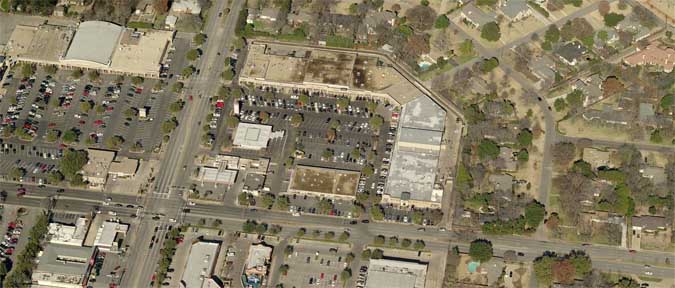
Well, this writer from the local Dallas magazine The Advocate interviewed me regarding what to do with a typical Dallas neighborhood center, particularly in this case the Preston-Royal intersection:
In Kennedy’s vision, you won’t need a car because you’ll live in the center or nearby. And if you don’t need a car, the center won’t need as much parking, not only lowering construction costs, but making room for amenities like parks. And if people spend time on the street — walking, window shopping, eating lunch in the park — the center becomes a more desirable place to live.
Hey, that's me! And below is an aerial bird's eye of the site, although I approached the interview as hypothetical as the exercise was:


To clarify, that doesn't mean the car is a thing of the past. What it means is densifying these neighborhood centers that are fast becoming obsolete, improving the experience of the retail and the quality of life for the neighborhoods adjacent that this center now provides all of the life support systems for.

After skimming the article, it doesn't appear that any of my talk of transit made the dialog. The first thing I mentioned in the interview, was that with $100 mill and entitlements to this site, I would take half of the loot and then run a two-mile modern street car along Royal Lane between the tollway and 75/DART red line station at either Walnut Hill or Lovers Lane. Which is sort of a prerequisite before ditching the car entirely, making the entire above statement sound stupid without.

I still prefer what I wrote about it retail and this site here in Rise and Shine Old Retail:
This exact same phenomenon is occurring currently with malls. The biggest and best are densifying with residential and office uses, accessing public transit, and adding amenitized, outdoor public spaces. They are becoming both more people friendly AND more business friendly. Those less fortunate (if you happen to sympathize with the plight of a particular mall) are finding life as something else, if not being scraped altogether.

This "pruning" will leave blighted "gray fields." In Dallas, this pretty much means the retail clusters that are organized on the original 1-mile super-grid, with single family neighborhoods in between will have to find a new manner of existence.

Tuesday, March 17, 2009

A Friendly Reminder

From Andrew Sullivan's "View from Your Recession,"

...sad to say, but this is no bubble. Industries will not bounce back like nothing ever happened as in previous recessions. The confluence of so many enormous issues, breakdowns, and turning points suggests nothing less than an epochal shift. Some industries will disappear completely; others will reemerge vastly different and/or much smaller than before. The road building industry, as written of here, is one of those.

So when we are thinking about bailouts of this and bailouts of that, let's first ask, "what is this industry's role in the 21st century's cleaner, greener, and ultimately more profitable economy?"

Thursday, March 12, 2009

Today's Treat: Guest Post

I'm hoping guest posts on a variety of topics that I am incapable of commenting on can become a regular feature of this blog...

With the recent spate of community gardens and the movement away from the English-derived, petty bourgeois need for manicured lawns towards something more useful, I've enlisted a friend and colleague who has started his own garden in the front yard of his young families inner-ring Dallas house:

Take it away Juan Munoz...


Primer:

http://www.eattheview.org/
What's a Garden Worth?

I originally started my garden as a native, albeit urban prairie. I reintroduced native species without the use of chemicals and pesitcides as an antidote to the manicured, unsustainable water hogging turf lawn decorated with imported flowers that feel more at home in England or some rainy European climate. They won't grow here in Texas without a major helping hand from homo sapiens and some petro-chemical based inputs.

Man cannot defeat nature. It's been around a whole hell of a lot longer than us. So I chose to work with it.

Once that was done and the Laissez-faire method of natural lawn decoration reaped its wild and unexpected rewards, what else was there to do? Answer: Grow my own vegetables. My mom did it. My grandmother did it. I want my kid to do it. I want my kid to learn where food really comes from and to learn skills that too many of have us have lost with advanced technology.

I was sick of bland, commercially grown veggies that had no flavor. They come from who knows where. I can't really afford to eat organic veggies because, frankly, they are too expensive. We had a few scares from salmonella outbreaks in tomatoes, spinach and jalepenos. How in the hell am I going to make salsa without tomatoes? Plus, there is a deep satisfaction of growing something you eat. You can taste the love you put into it.

From the native garden, I moved to a container garden of tomatoes and peppers, and the containers proved to be a little dicey in the heat of Texas summers. The pots dried out to quickly and the yield was low. But what little we got from the containers tasted so damn good I was hooked.

It was time to expand and actually build a raised bed garden where my front lawn stood. Part political statement and part necessity due to the sun orientation of my lot, the front yard was where it was going. (I used the orientation part to convince my wife that the front yard was the only place it could go.) She finally warmed up to it once the Romaine lettuce started sprouting up. She will love it more when the tomatoes ripen.

Since the soil in North Texas is generally clay, the initial cost outlay is more than I imagined, though not exceedingly expensive. Instead of digging into the dirt and planting random veggies, I was forced to build raised beds and amend the soil with compost.

Soil is the key. Healthy soil, healthy happy plants. I make my own compost, but the amount I am able to produce and the amount required to start the beds were not even close. Add in the wood to build the raised beds with the cost of the compost/mulches and seeds and some starter plants, I am at around $250. Next year the costs will be substantially lower since I will be starting from seeds mostly and the soil will improve each year with minimal amounts of homemade compost added to the beds .

The garden is only around 75-80SF(It’s at 50 SF as of today)but it is designed to maximize every square foot of space using the block style method of planting. See link here: http://cmg.colostate.edu/gardennotes/713.pdf

For example, in a 3’x3’ space in the bed, I can yield 144 carrots, 36 onions, or 16 heads of lettuce. Using succession planting, i.e., sowings seeds every two weeks, I should have a steady supply of fresh kitchen veggies until the first frost. The initial 250 dollar outlay is comparable to a week and a half’s worth of groceries for me, the wife, and baby Jack. I think it is money well spent, and it’s cheaper than therapy. We will see where it goes, and how much we really get out of the garden.


Tuesday, January 20, 2009

A New Era of Responsibility

"...the stale political arguments that have consumed us for so long no longer apply. The question we ask today is not whether our government is too big or too small, but whether it works - whether it helps families find jobs at a decent wage, care they can afford, a retirement that is dignified. Where the answer is yes, we intend to move forward.

Where the answer is no, programs will end. And those of us who manage the public's dollars will be held to account - to spend wisely, reform bad habits, and do our business in the light of day - because only then can we restore the vital trust between a people and their government. "
Now President Obama dancing with both sides of the aisle during his inaugural address before landing on an entirely higher plane than the petty discourse of the previous generation of politics. This is his power.

See the full transcript, here.