Showing posts with label Transit Oriented Development. Show all posts

Monday, October 18, 2010

TOD Galore

A new massive database has been assembled and released at large by the Center for Neighborhood Technology and the affiliated Center for Transit-Oriented Development (TOD). The direct link to Dallas is here, we'll see if that works for you, since you have to be a registered user to access it.

Below is a sample where they map all existing and proposed transit stations and with a click will return population, # of jobs, and median income within a 1/2 mile radius. Let's see if you can guess my one issue with it:


Get this far? Well, my one and only problem is inherent to such massive assemblies of data. Each of these TOD zones requires specific attention to detail. This gets at a broader problem preventing TOD planning from becoming smarter, and that is the ubiquitous 1/2-mile walk circle.

The issue with the 1/2-mile circle, intended to simulate a 10-minute walk or a popularly accepted distance to travel by foot to transit stations is that not all 10-minute walks are the same. What is the road network like within that 1/2-mile generic circle? How many roads must be crossed? How direct is the route (yielding a more radial pattern emanating from a center of gravity or attractor - in this case the transit station)? Are there highways to be traversed? How long is the wait to cross at crosswalks, etc. etc.?

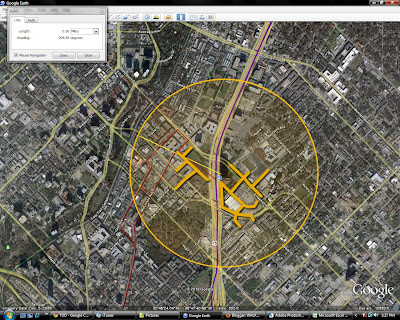
This is the type of thing that can really only be field tested and I apologize for not doing that here. Instead, I did a quick estimate based on distances and first-hand experience of riding DART to the CityPlace station and walking to various destinations (Target/West Village) several times. Below is a quick map of that.


Click to get a closer look.

As you can see, what actually constitutes an acceptable walking distance is FAR, FAR smaller than the 1/2-mile circle, because it takes a similar amount of time. In the case of CityPlace station, being 20,000 leagues beneath the sea of traffic on North Central Expressway is its problem as surfacing from the subway station can take at least 5-minutes unless you're in the mood for 2-minute thighs and feel like running up the monumental stairwells that are only missing the monument.

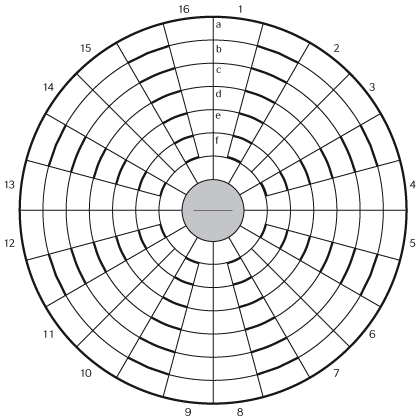
Other areas of the city would actually come far closer to the actual perimeter of this circle. To do so, would require a tightly-knit grid of smaller, easily crossable, pedestrian-oriented streets, preferrably in a more radial pattern than perfectly squared gridiron. The reason for this is that it creates more direct routes based on desire lines (if the transit-station is the most desirable destination in the area). Obviously, this exists only in a perfect world which over time balances the competing desire lines to other destinations.


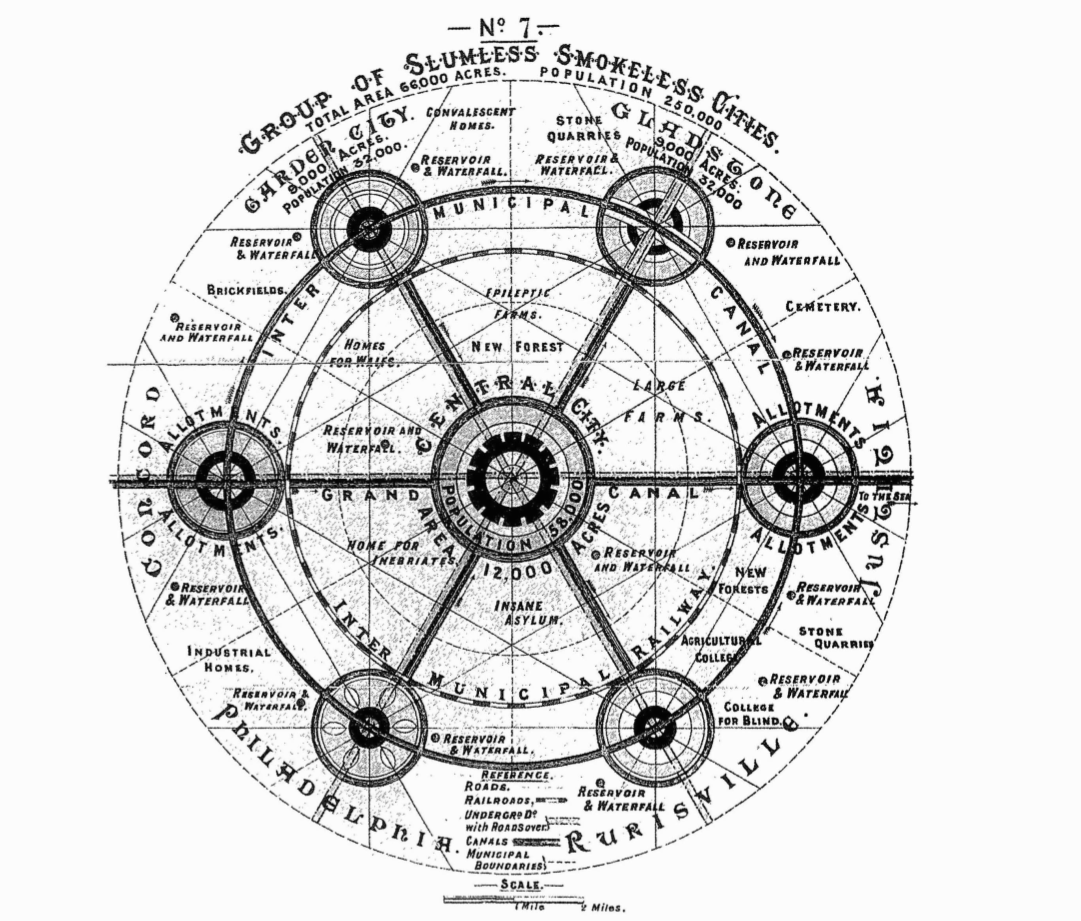
Example of a "pure" radial grid. Many of the garden cities, which were little more than purely theoretical exercises, exercised in exurban greenfield locations (much like the pop-up "sustainable cities" of the Middle East and China that are super awesome theoretically, just lack a reason for being in the first place besides 'can do?' not 'should do?'), display similar features. Both promised utopia.


While I would never espouse a pure geometric form since no place is perfectly flat or so singular in its hierarchy of desire lines, I do prefer an overlay of radial and gridded much like Paris or DC or Papal Roman Trivia or Broadway, because it creates natural points of convergence and responds to this hierarchy and instills a logical and predictable order unto the real estate market. I should add that I'm also not a rigid adherent to the importance of straight lines and the divergence of road centerline axes leads to decay or reduced value that the Space Syntax crowd preaches. But order created by building form certainly is necessary.

Here is an image of how desire lines and changing demands shape cities over time (Rome during the empire and Rome closer to today) creating a natural order of smaller blocks, system of streets and open spaces.


For more information, see my previous posts on convergence and intersection density analysis:

https://carfreeinbigd.com/2010/06/intersection-density-and-convergence.html

https://carfreeinbigd.com/2010/01/w-7th-in-fort-worth-and-retail-as-place.html

Thursday, July 8, 2010

Toot Toot!

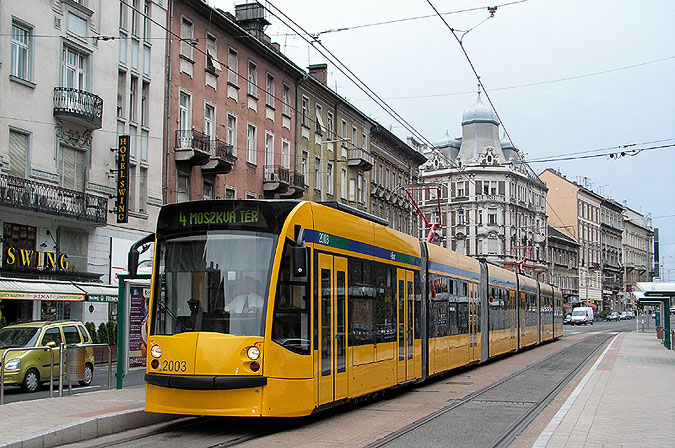
http://cincystreetcar.files.wordpress.com/2009/01/modern-european-streetcar.jpg

It looks like Fort Worth is one of the big winners for more hot stinky federal cash money for new transit lines. From the FTA announcement website:

Project: Fort Worth Streetcar Loop (Urban Circulator)
Sponsor: The City of Fort Worth and the Fort Worth Transportation Authority
Amount: $24,990,000

The City of Fort Worth and the Fort Worth Transportation Authority will construct a 2.5-mile one-way streetcar loop with between 20 and 25 stops and three vehicles to connect a Trinity Railway Express commuter rail station and Intermodal Transportation Center with the central business district. This will be the hub of a planned streetcar network connecting six designated “urban villages” targeted for redevelopment to the city’s major employment centers, such as downtown and the Near Southside Medical District. Ultimately, the streetcar system will connect residents in four economically disadvantaged areas to job opportunities in major employment centers, while stimulating the redevelopment of walkable urban neighborhoods with a variety of housing choices.

Dallas also gets a hand in the pocket to extend the MATA to St. Paul DART station and loop back on Olive:

Project: Olive/St. Paul Street Loop (Urban Circulator)
Sponsor: Dallas Area Rapid Transit Authority (DART)
Amount: $4,900,000

The Dallas Area Rapid Transit Authority (DART) will build a 0.65-mile urban streetcar track extension to an existing system. This project would link the current McKinney Trolley to the existing DART light rail St. Paul Station and to the McKinney Trolley Olive Street Extension in the heart of Downtown Dallas. The connection to the Olive Street extension would form an entire reversing loop for the trolley, making operations safer and more efficient, while connecting downtown destinations such as the Dallas Museum of Art and the Nasher Sculpture Center to Uptown Dallas.

That is about it for Texas projects except for some chump change to Brownsville. Just kidding. Brownsville is probably doing backflips over a $4 million grant for intermodal station. But the question is, what the heck are Austin and Houston up to???

Friday, June 25, 2010

The Things that Happen in Train Stations

Like advertising on any website (more on that in a bit) or businesses seeking to locate on the busiest of streets, one needs to find its audience. In a city organized along highways and dreadful arterials, we are assaulted with billboards and pole signs. Ugly begets ugly.

Street musicians locate in the populated public parks of cities around the world, much the way pigeons do looking for another crumb with the machine like persistence of a shark at sea. Even those with the most pedestrian of abilities still add something to the urban experience of people clustered in walkable urban places.

But, what if that street musician wasn't someone down on their luck but one of the most famous and celebrated in the world? This article is a few years old now, but the Washington Post did just that. My favorite excerpt:

AS METRO STATIONS GO, L'ENFANT PLAZA IS MORE PLEBEIAN THAN MOST. Even before you arrive, it gets no respect. Metro conductors never seem to get it right: "Leh-fahn." "Layfont." "El'phant."

At the top of the escalators are a shoeshine stand and a busy kiosk that sells newspapers, lottery tickets and a wallfull of magazines with titles such as Mammazons and Girls of Barely Legal. The skin mags move, but it's that lottery ticket dispenser that stays the busiest, with customers queuing up for Daily 6 lotto and Powerball and the ultimate suckers' bait, those pamphlets that sell random number combinations purporting to be "hot." They sell briskly. There's also a quick-check machine to slide in your lotto ticket, post-drawing, to see if you've won. Beneath it is a forlorn pile of crumpled slips.

On Friday, January 12, the people waiting in the lottery line looking for a long shot would get a lucky break -- a free, close-up ticket to a concert by one of the world's most famous musicians -- but only if they were of a mind to take note.

And the video:


You'll notice at the very end, a fan who recognized him adding, "this is one of those things that could only happen in D.C." Clearly, pleased with her idea to locate to such a city.

Tuesday, May 4, 2010

How To: Fail? Temporarily, At Least


Given the notoriety local mega projects around the Metroplex have garnered, and rightly so in many instances (see: here, here, and here), I found a recent article on the perceived failings of a project in almighty Portland to be particularly interesting. Portland has been working on this thing we call "new urbanism" aka old urbanism but ideally without the freeways and more ideally without the phony, nostalgic architecture for much longer than we have. So they tend to get things right more often than Dallas has, but only through trial, error, and a better (or more willful) understanding of transportation policy/planning's implicit effect on urbanism.

To link to it once again, the article is We Built This City in the Portland Mercury about the South Waterfront in Portland, Oregon. The south waterfront sits somewhat isolated on a peninsula like sliver between the Willamette River and I-5, not unlike Delaware exists in relation to its downtown of Philadelphia.


If the article doesn't get at the primary issue within its body, it at least alludes to it in the title. No, it wasn't built on rock n' roll, but it was built on the faulty logic "that if you build it, they will come" that often torpedoes the best (and most ambitious) of intentions. It was a movie. It makes for a great soundbite, but as far as real estate strategy, if it isn't demand driven, it is likely doomed. Like in Field of Dreams, they built it and only ghosts came.

I like ambition as much as the next guy, but if it isn't tempered either by a deep understanding of urban dynamics (the kind of thing most in real estate either get only by intuition or luck) or extremely patient money, it is doomed to be considered a failure.

However, much like Las Colinas, the fundamental flaw with the South Portland waterfront is only one of timing and possibly ambition, not in fundamental (or unmanageable) failings in the vision or planning. Unlike Victory and Park Lane Place locally, the South Portland Waterfront got pretty much everything right. It just delivered too much product, too soon, to an overly narrow market segment. It has transit service, a grid of streets, and nigh flawless architecture (from an urban design perspective) that engages the public realm.


From a design perspective, its failings are of the nitpicking sort: the trees planted were mere saplings, some of the retail spaces are too withdrawn behind thick columns hindering visibility, but most importantly, many of the buildings are overscaled. Not just for the street, but for the market.

On this project in Portland, despite the architects' best efforts to accommodate the density in an engaging, urbane manner, the density and mass still overwhelms. High end "urbanism" often ends up being anything but urban. It is defensive. It doesn't interact with the street. It looks and feels exclusive, which when solated is fine, but when it dominates then it undermines the participatory interaction of urbanity. Portland is more of a middle class city, with middle class sensibility and middle class urbanism.

Its perceived failings are only that it was too ambitious. Market and timing are the flaws. So now it sits empty. But, it won't for long. The plan delivered a supply of only high end condos when that market was saturated. How many rich people are there in the world? Not everybody can purchase a $1 million condo. Other classes want the amenities of urbanism as well, but where is there product choice. The City does have plans for affordable housing in and around the development, none of which has yet to be delivered.

There is a worry of no retail and no grocery stores, but those are both eggs moreso than chickens within urbanism. They will come. As will more chickens, once land, housing, and construction prices find their right value. Particularly if a broader demographic range of residential fills in the blanks, which it will. The developer(s) just went for too much too soon. The scale of development is more befitting of Canary Wharf in London than it is Portland. However, Portland is still a desirable City, particularly for recent and soon-to-be graduates.

The worry now might only be that the intensity of development overvalues the rest of the land when the remaining development probably wants to be low- to mid-rise. See the remaining voids surrounding the initial phase of development below.


Eventually, it will be successful. Somebody will have to take the loss for when the high end condos get marked down, chopped up, or auctioned off to find where the market really is without the voodoo of a funny money housing bubble world.

To examine another worry, aka barrier, I want to step back for a moment to the contextual map. See how the South Waterfront has little to no context. It is in effect a cul-de-sac. In fact, the streetcar line even terminates and turns around within the development.

Healthy cities are represented by a typical conical shape to their skylines. They build up to something in the center. The point of highest interaction and desirability. The point(s) with the greatest metabolism in the exchange of goods, services, needs, wants, desires, laughs, and love. Yes, there can (and should) be multiple centers probably within the imposed hierarchy of a locally applied Zipf's law. Centers don't want to be at the end of the road.

The Pearl District, in aqua, is considered a huge success. Of course, it beat the bursting bubble to the punch and has largely been built out. But it also was right next to downtown and infilled with an appropriate scale. It had more to build upon.


Pearl District.

Just below is the South Waterfront, zoomed in. You can see how it is isolated. There is a possibility that because of the lack of context that it will never fulfill its promise, or saturate its supply (especially not at the prices pro forma'd). But, part of me still thinks that like Las Colinas, 20, 30, or 40 years down the road, its barriers will be removed as values change and as the City grows to a point that it needs Vancouver-style development within its geographic restraints. Cities like Vancouver, Seattle, Portland, Manhattan, and Hong Kong have nowhere to go but up.


The other issue is the scale of the development across the highway. It is all low-scale, 2- and 3-story single family homes, duplexes, townhomes, and small apartments. There is a disconnect between the two sides of the highway (beyond what the highway already does), that is of scale.

Two adjacent areas so at odds in scale and density are often incompatible. While they can be designed in a way to not negatively affect one another, the lower-scaled area rarely has the density to support the rents and retailers that the high density developers expect. Once again, the purpose of graduated density. Density is attracted to activity. In abstract, activity doesn't happen at the end of virtual cul-de-sacs, it occurs at intersections, at crossroads.


Will Portland's desirability and livability ensure that its population might double? Will the neighborhoods adjacent experience the pressure towards more density? Will I-5 be rerouted in order to stitch the neighborhood with the waterfront? Or at the very least be lowered much like it is through downtown? The only thing for certain is that proper urbanism and a flexible framework will allow such changes and the desirability of Portland will ensure that this particular area achieves livability if not lovability eventually.

Conclusion:
Timing aside, it is probably more density than the site wants to hold, which probably only means losses in the short-term for the investors of those specific buildings. In a much less exaggerated way, it is like me saying I want to build Vancouver in Italy, Texas. I could make it as "livable" as I like, but it has to be viable first. That isn't to say that Portland won't see the kind of influx of population to build that kind of demand, but it may just take a few decades.

In the shorter-term, there is certainly value in the remaining parcels for low- and mid-rise residential for middle income housing and below if the land prices can allow it. I think I would probably also recommend that the ground floor of the remaining buildings be "flex" at most, to allow the retail to properly fill in where it now sits empty and to ensure a concentration of retail as the new neighborhood matures.

Wednesday, April 28, 2010

The Role Governments Play

So we have two recent reports out, one from the Harvard Business Journal showing just how timely they are in the article: Smart Money is Moving Back to the City. They seem so proud. So prescient.

In the second article, Kaid Benfield from NRDC writes in the Washingtonian that it is already happening.

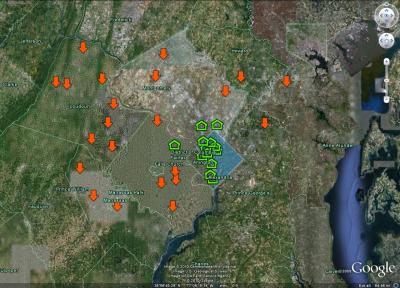
Need a more striking graphic:


Orange arrows mean a local drop in housing prices of 25% or greater. Green monopoly house graphic means the opposite. Hmmmm, Harvard. I think the smart money was in long ago. Glad to have you at the table.

This however does raise a few issues. Obviously, in our country, in our time, the private market makes the cities. However, to ignore government agencies roles in doing so is to not understand our system in the first place. The invisible hand is attached the invisible arm. And if the invisible hand is wandering aimlessly around the countryside, it ends up leaving behind the wastes of its explorations.

Well, on the bright side, it tested the value of exurban land, and found that it is far less than the value of the similarly isolated single family house now sitting on it.

So what does that mean for us here in DFW, real estate, new urbanism, and just plain old urbanism. I often point out that probably the most serious of all issues creating sprawl and underperforming urban environments is the disconnection between transportation planning and design and its counterpart of placemaking or city building.

What I find most interesting about the "new urbanism" of the past two decades, is that even the best projects occurred in all the wrong places. At best they were road side attractions. At worst they were positioned at the end of a virtual cul-de-sac. Take Addison Circle for example. It was only built where it was because of the availability of land. Urban forces however, if they weren't at odds, would want that kind of development along Belt Line Road. Addison Circle is the center of community, but off-center.

Because of the failings of DOTs, City, and State policies, the real estate industry stomps around cluelessly hoping to squeeze value out of any and all piece of land that they can get their hands on cheaply. It is a process built on wish and prayer. "We're gonna develop this property and hope people come." It is supply side rather than demand driven. Creating well-designed points of convergence is city building, it is also economic development. It removes the barriers to delivering supply to a pent-up demand wanting to be near movement, near activity, at the heart of places. It makes the real estate industry smart and productive rather than the enemy of NIMBYism.

Commerce needs activity, it needs movement and predictability of location. Commerce is driven by emotional need. Here is where it is important to point out that consumerism by nature isn't bad. It is the material waste inherent in open-loop systems that is particularly insidious. Commerce is the exchange of goods, services, ideas, and genes. It has to happen. It is biologically wired into us.

However, our transportation planning and road design has undermined this. "High Streets," "Main Streets," and markets always occurred at crossroads, at intersection points, at points of convergence. Density wants to be at these convergence points, which is exactly what downtowns are/were until we gutted them with highways.

The real estate market needs predictability to infuse intelligence into the price and value of land. Otherwise, we end up with a supply of development in the middle of nowhere with no demand to match. Las Colinas once fit this bill and it has taken at least two generations to slowly ingratiate it with the rest of the City. Hence, it was a financial flop for the longest time until the introduction of DART to provide some level of convergence, of predictability, of movement.

Our highways and arterial system are repulsive forces. Nobody wants to be on them nor near them. But, we have no choice. They are unsafe and inhumane. The very nature of their planning and design violates the nature of convergence and how cities function (and their economies). Our points of convergence, the intersections of our busiest streets have to the be most pleasantly designed. The most enjoyable to be on or otherwise, our local economies will continue to leak oil, literally.

Complete Streets, Context-Sensitive Design, and incentive-laden TODs are all steps in the right direction. All of which would allow the private market (the hand) adapt the City to and work cohesively with the transportation network established by government agencies (the arm). So why do we keep widening roads when we have some of the worst traffic in the country:

John Horsley, Executive Director of the American Association of State Highway and Transportation Officials, relayed the information during a news conference Monday at the National Association of County Engineers' annual conference.

The AASHTO's report, Transportation Reboot: Unlocking Gridlock, is the first in a series aimed at boosting transportation capacity.

It identifies what the agency considered needed projects across the country, including in Texas.

The study says bottlenecks cause 40% of all congestion, and the gridlock costs Americans time and money.

The solutions presented Monday include using millions of dollars to build new highways.

Texas, however, does not have the funding.

Hey John. You know what costs Americans time and money. Your industry. IntraCity highways are a drain. The cause, not the solution. How many studies do we need to undermine this nonsensical thinking?

Here is where it is important to remind of the corruption that once plagued streetcars, then railroads, and now highways. Too many are dependent upon that breast milk. We're like an 18-year old still living in the basement with an Oedipus Complex.

A monopoly is never good for markets, but particularly in transportation it becomes exceptional corrosive. If for no other reason, we need a range of transportation choices just to undermine the corruption that occurs within any one dominant form. History doesn't repeat but it rhymes.

Tuesday, April 20, 2010

A Clockwork Orange Line

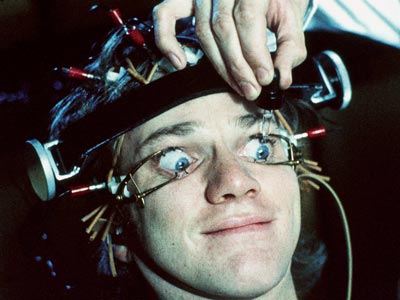
Something to accompany your steaky-wakes and eggy-weggs this morning:

http://entertainment.ie/images_content/ClockworkPic.jpg
Eye-opening ideas.

With funding problems a plenty for not just the orange line, but virtually all planned transit lines the DMN Transpo blog has an excellent idea up from the awesomely Texan-named Garl Boyd Latham.

What we are learning is that we actually can't have our steaky-wakes AND eggy-weggs AND eath them too all at the same time despite knowing full well that transit capacity and hierarchy of service is necessary for the city's and region's long-term viability. The world is no longer made of funny money...and this is a good thing. Funny money makes for incredibly (and sometimes indelibly) stupid and short-sighted city planning. It gives us time to pause...and prioritize. What is most important?

Latham's idea is to finish the Orange Line to the airport and I agree with him that connecting downtown to the airport(s) should be a priority, representing a carfree link to the global economy. If your city doesn't have that, good luck in the competition of cities of the 21st century.

One issue with the Orange Line as currently planned is that once complete, it will create a logjam of trains on the existing downtown line along with the Red, Blue, and Green all converging along the same corridor of limited capacity and inherent (in)efficiency to move them all through the City. Hence the reason for D2. The thought was that D2 would run through the southern portion of downtown, alleviate pressure on the current line and leverage private investment in the neglected areas of town.

Sounds pretty good right. Of course, there are also financial realities. One D2 alignment costs approximately $300 million. That's the cheapest. The City's preferred alignment, to the new "bricks and mortar" project, the convention center hotel, costs approximately $600 million (jaw ->floor).

Oooooooh-Kay. Time to rethink. Rather than run a second line through downtown, Latham suggests running the Orange line directly to Union Station, eschewing the train traffic snarl on the current line.

A direct link from airport to Union Station immediately increases Union Station's significance within the city. Currently, it is an afterthought. If that becomes the single place for businessmen (and women) to catch their ride to the airport, it once again becomes a hub of activity. Furthermore, it is only two blocks from the Convention Center Hotel and provides the opportunity to leverage the value of land around Belo into functional urban fabric.

His other idea is to effectively replace D2 with streetcar. I like this idea for several reasons:
  • Streetcar is cheaper than DART lines which are much closer to heavy rail than they are light rail. Streetcar can cost around $20mil/mile where DART lines could be anywhere from $80mil/mile or in downtown or subway type conditions upwards of $200mill/mile.
  • Streetcars run on the street and help to calm traffic making downtown roads more walkable, which is necessary for urban investment and development.
  • DART hasn't shown the ability to leverage much in the way of retail activity. My guess is the reasons are two-fold: it serves a much larger area meaning that, like highways, it serves macro-destination to macro-destination: 'burb to job center (downtown) whereas streetcar is much more fine-grained. Second, it hasn't shown the ability to "mingle" with cars and pedestrians alike the way streetcar can.
  • The geometries of a heavier rail like DART make it difficult to turn and corner within the confines of downtown urban fabric. We end up with more spaghetti under in and around the freeway spaghetti which act as barriers, further disconnecting downtown from its foundations, the neighborhoods adjacent.
  • Streetcar is best at leveraging investment in areas immediately adjacent to downtowns, which I'm slowly but surely leaning to the opinion that Downtown is so constrained that if you don't remove the freeways, you have to build up the value around downtown in order to make downtown viable.
  • Because streetcar is more pedestrian friendly AND cheaper, it generates more bang for the buck by way of private investment, which means...
...take whatever money is alotted for D2 and:

1) Run streetcar from Union Station to Oak Cliff as is currently planned.

2) Run streetcar from Union Station down Canton/Young into Deep Ellum.

3) Do NOT move MATA off of St. Paul and extend it past Main Street Gardens to intersect with the new Canton/Young line with plans to eventually run it to the Cedars.


Everything is linked into Union Station, and if we ever plan on having High Speed Rail, Union becomes a true multi-modal facility serving the various necessary hierarchies of transportation in order to properly link downtown with the local, metropolitan, regional, state, national, and international economies and returning "pride of place" back to Union Station as downtown Dallas's front door to the world.

Thumbs up.

Friday, April 16, 2010

Ode to Texas Stadium, Was Road to Texas Stadium

Greg Lindsay at Fast Company profiles the demise of Texas Stadium and the City of Irving's desire to replace it with TOD. If you follow either of us on twitter, you might have seen the 140-character interaction we had on the subject last Friday.

I worked on the initial "dreaming" scenarios some time ago (linked here where the only remnants are the little watercolor icons to the right of the page), before the recent computer-generated renderings were produced. I'll admit. I didn't know what I was doing back then as a young whipper snapper. Because of my early involvement though, I felt the need to be as impartial and objective (and unfortunately non-colorful) as possible with my responses.

The salient 'graphs from his piece, which is quite good (except that I wouldn't say downtown Dallas is the most walkable in the region, but rather uptown Dallas):
Before a single plot of land was sold, he ordered the dredging of lakes and canals, stocked them with gondolas, and ran a monorail overhead. "It is Disney World for the affluent," Texas Monthly reported in the 1980s. "In fact, when executives from Disney World visited the development a few years ago, one of them commented that it was a shame ol’ Walt couldn’t have lived to see the real thing." Las Colinas is what you get when you let CEOs and their site selection committees design a city. (ed: Have truer words ever hit the interwebs?)

What’s most interesting about Irving’s plans to added density in its last undeveloped corner is the tacit admission that Las Colinas’s gold-plated office parks and single-family homes are no longer enough. "The piece that has always been missing from Las Colinas is the human density that’s missing on weekends and at nights," says Gast. The reason for adding that piece is an eminently practical one -- it’s what those corporate tenants, their workers and developers all want. Irving is embracing transit-oriented development because it thinks it can make money doing it.

And therein lies the complications...Not helping is the possibility of major funding cutbacks at DART, including the possibility the Orange line won’t run all the way to the airport anytime soon. And the final bit of potentially wishful thinking is the notion that a stadium site at the convergence of three freeways - the so-called “Diamond Interchange” - can ever be converted into a Millennium Park, especially when TxDOT is leasing the site for 10 years to carry out freeway expansion.

I'll leave that for you dear reader. Have a great weekend all.

Wednesday, April 14, 2010

Maverick Feels the Need for Speed (and a new HQ?)

[edit: I went down to check out the site today and discovered that "Wonderview" is actually the name of a dead end street and a park. At least it has some contextual backing.]

Now that Car-(over)Dependent life has 'jumped the shark', the exploratory search engine of cities (comprised of the worker bee triumvirate of investors, developers, and planners) have begun to look for value in other places. That value would be defined as opportunity for profit (economical, social, environmental) found in the increment between current value and potential future value.

The skill for investors/developers/planners is to properly assess the risk and ensure all is done to find the maximum possible sustainable, durable, and resilient value. For example, now that the value at the edges of the city has now either overshot its value or reached saturation of utility (aka current value = proposed value), many of those properties will either revert to nature or agricultural production, lesser value. The land has undergone the test of time and the value of the cul-de-sac was a tragic misstep where some homeowner won't be able to derive their retirement.

This applies to all that invest in property, whether it be homeowners or developers. The homeowner (ideally) should be searching for value based on their own needs (are they raising a family? How are the schools? Are the streets safe? Does it provide the creature comforts for families? etc.) Both are searching for more value than they pay for the property. Capitalism 101 at work. If you have a comfortable abode, that is plenty enough value for you to make a home for life if your goal isn't to catch the upswing of the city evolutionary search engine qualitatively uplifting the particular area.

The more risk averse property developers are beginning to tip toe across 75 into the previous uncharted territory between 75 and Greenville. New homeowners are buying East of White Rock Lake. The more daring are heading towards South Dallas, more specifically (and currently) Oak Cliff*. Often the most daring can be rewarded handsomely as long as their timing is right to coincide with the inertia of incremental increase in certain areas. Now, the most maverick-y of the Mavericks is daring to cross the Trinity himself as a proposal to expand a Transit-Oriented Tax Increment Financing Zone to new property on Kiest Boulevard goes in front of City Council today.

TIFs are a creative form of public-private partnership. The beauty is that they don't really put the City on the hook the way a Bond package might, like a loan. A TIF allows the investor/developer to front the necessary infrastructural improvements to make a site more viable and then get paid back by the taxes generated by the qualitative improvement of the property. When they are successful in bringing nectar back to the hive, we are all richer for it.

State-Thomas was the first TIF in the state of Texas and it paid off handsomely, adding potentially as much as $2 billion in investment and improvements to the area. Of course, the City is also littered with bad TIFs like crack vials on the street as the City thought it found its new wonder drug. Like many pharmaceuticals or narcotics, they can be helpful in appropriate and measured dosage and usages. Or they can be toxic.

As this City, like many throughout the country, shifts from expansion to contraction mode within the evolutionary search engine timeline, it is critical to tie public-private partnerships such as TIFs to something that has a measure of permanence and stability to help manage the risk inherent in pioneering, searching for new value. This is why it is critical to tie TIFs to TODs aka areas with multi-modal transportation available. It is also why fixed rail alignments of trains and streetcars are vital to a City. They don't move and the City adapts to them, unlike non-fixed forms like buses. This adds another measure of stability and durability.

Because of this, Cuban Enterprises et al are wise to cover their risk with a public-private partnership such as the expansion of the TIF. The issue however is that TOD is generally considered to be area within walking distance of a public transit line or roughly 1/2 mile. The property in question is about 1.3 miles as the Grackle flies from the Illinois Blue Line DART station. Unfortunately, Grackles don't ride trains. They multiply and cackle.

Fortunately, a more robust hierarchy of mass transportation comes to the rescue. Right now, the most viable forms of transportation are car and DART train (until the City passes its awkward, gangly teenager form of urbanism, I won't consider buses as legitimate). And currently, very few areas in this City can be considered walkable or bikable.

This is where it makes a lot of sense to establish an "urban circulator" and fund it through the TIF and Federal Programs of a similar name and loop it from Illinois Station to the new development. Bam, TOD. These can be streetcars, jitneys, or buses, and their purpose is to bridge the gap between safe and comfortable walkable distances (very short in unwalkable locations) and the larger catchment area of a station (often .5 to 3 miles depending upon density and proximity of other stations).

Another reason to expand the TIF boundary is that between the fragmented ownership and fragmented parcelization due to the suburban-style road network near Illinois Station creates unnecessary and difficult to overcome barriers to investment. Otherwise, with the TIF in place, we would have seen more incremental and profound changes already.

Thinking long-term and looking at the broader context, Kiest Blvd has the potential for streetcar. Obviously, I am a big believer in the power of streetcars to revitalize areas within five miles of downtown. As all infrastructure unlocks value in new areas to some extent (at least the testing of value), streetcars were the catalyst for the now inner ring areas in the first place. They will again be the agents of change as we focus our contraction phase efforts (qualitative improvement of existing development aka infill) around transit, walkability, and infill.

Think about this, Kiest Blvd heading North merges with Cedar Crest Blvd before crossing the Trinity and becoming Martin Luther King Jr Blvd, which then runs directly to Fair Park. It might take 20, 30, or 50 years, but I would rename the entire portion of Kiest/Cedar Crest as MLK, start planning a streetcar linking Fair Park, Trinity River, and this new development (even to Kiest Station possibly) and be done with it.

We can start by converting the street section into a complete street as well. There is plenty of width between the unnecessary drive lanes and wide median to support space for cars, transit, bikes, and pedestrians. Where better for the City to show that they are committed to 1) South Dallas and 2) recapturing the potential human and economic value of streets from car dominance.

All of that however, is still long-term when in actuality we are still in the placeholder stage of generic water color imagery while the deal gets worked out. I will hold off on much comment on the masterplan because much of it is a placeholder (it isn't bad, but I also don't think it is the most sophisticated of plans -- which reminds that it is early and of the plan's ephemeral infancy).

What tends toward some measure of permanence and definition is the phasing strategy for the infrastructure. If the City goes in on a deal, they typically don't like a bunch of things shifting around. While many people will be drawn to the renderings, the plans below are where more critical attention needs paid (sic: PA colloquialism for a Carnegie Mellon grad).


Since architects are so often loathe to work in the unfortunately necessary world of context, I'll add the plan to an aerial for you to get a better sense of the plan and the challenges (ie lack of positive inertia and negative adjacencies such as an automobile graveyard -- fitting no?) facing the site.


The plan is rather internalized (notice the tray of parking as buffer between Heist and the first buildings). But without improvement of Kiest, the plan is unfortunately forced to be a roadside attraction, turning its back on an inhumane road (that's exactly the word I meant) rather than a transportation system and development that is fully integrated, allowing it to reach the full potential of its value. (I would strongly recommend some deeper thought goes into this to which I have ideas but I won't reveal any unless contacted. I provide a lot of content/ideas for free, but I ain't that cheap.)

The tragedy of 20th century city planning is the task of the 21st.

The project is big. It's bold (although I believe there is more value in being even bolder in some regards). I like the initiative. I like the Southerly investment. However, it is not without several challenges; not the least of which is the status as being the pioneer and proving the market up. To underplay or (willfully or otherwise) ignore those challenges is to ensure failure.

There is a HUGE unmet market for high quality urbanism, but will this particular area prove to be a coalescent points of the urban contraction? Of course, Mark Cuban is no stranger to being the explorer himself, having made his wealth pioneering another territory, these here interwebs. First in, can pay off handsomely no?

While to the Northwest in the Bishop Arts and X+ vicinities, qualitative improvement is happening from the bottom-up through self-organizing urbanism and shared needs and wants amongst a burgeoning community. Therein lies its strength and future stability. Lacking these, they are also the challenges faced here, lacking inertia and stable adjacencies.

Perhaps without waiting for the expansion of that success, this is the right time and place for a large, top-down development (the kind that tend towards awful names that won't stick). I once told somebody there are two things a developer must do to ensure the long-term value of a project (ideally both). Create a place that is so special people will love it and care for it in perpetuity OR forge meaningful connections to any and all adjacencies to ensure mutual interconnected fates, shared responsibility for stewardship and value maintenance of an area.

This area currently lacks those connections (other than a surprisingly good/cheap golf course). This project can be the anchor to which other investment moors its boat (the kind that makes it too valuable for auto-graveyards close to downtown), which is exactly why, if Cuban plans on putting his HQ here (necessary 1st phase - attractor - employment center), we (the City) should be supportive and expand the TIF boundary with a linking circulator.
------------------------------------------
*note: I am lumping Oak Cliff and South Dallas together as I am of the professional opinion that South Dallas will see its resurgence from the edges. Growing the renewed interest in Oak Cliff southward and building upon UNT's plans for a new campus northward. Because cities and properties are inherently interconnected, it is far easier to build off points of inertia than to completely overhaul areas from scratch without momentum.

-------------------------------------------

Tuesday, April 6, 2010

Lessons from Charlotte and the Challenge Defining Livability

Excellent article at the NYT, "A Southern Success Story for Public Transportation Offers Lessons in Livability." With a laser scope and a round in the chamber, this fully automatic piece hits so many targets so forcefully, that it is well worth the read. It even includes a delicious quote from the head of a brilliantly named American Highway Users Alliance as well as some right-wing cannibalistic fear mongering by a washed up George Will.

A sampling of the remainder of the article, about a City that suffers similar maladies as does our own hometown here in the Big D: a choking inner ring highway around its downtown (what they call uptown - backwards, I know), areas of the city completely disconnected and isolated by freeways and railroad lines, overly wide streets with a preponderance of one-ways, over-scaled bank towers and their enormous supportive infrastructure and delivery systems, and surface parking in the downtown as far as the eye can see (once again proving that with all of those highways and roads, surface parking is the highest and best use):

Charlotte's vision:
In year four of a 25-year plan, the city is laying the tracks for an intermodal passenger system with a full menu of mass-transit options, complete with light-rail trains dropping off passengers in Uptown and at a central high-speed rail station, and streetcars running from center city to the international airport.

The ineffectual nature of buses:
The ridership numbers for the city's first light rail line help to make the case: More than 70 percent of the system's riders had previously never been regular passengers on Charlotte's bus service, according to the city.

The invisible hand is always attached to an invisible arm of gub'mint:
Leinberger likened transportation planning to "a rudder of a ship" that ultimately controls where and how private investment flows.

The challenge facing cities with no additional Federal funding support:
"With no additional revenue coming from the federal government, this is going to be up to local jurisdictions to raise the money," said Leinberger. "There's just not sufficient money coming out of the federal government."

Projected return on investment:
To that end, Charlotte's planners say the city is expecting $1.8 billion worth of investments to be made along the first line by 2011.

The question then becomes, how do you foot that big ol' bill when both the calculable and incalculable returns on investment are well documented locally and nationally? Does the city raise taxes to pay for it? Does it issue bond packages? Is there a way private investment can capitalize on the opportunity through development potential, considering the biggest winners will be land owners near proposed transit hubs, the public sector through increased tax base, and a citizenry no longer shackled to the cost and tyranny of automobile usership (usurp-ship?).

Considering streetcar lines were privately built to unlock the value of land outside the immediate downtown (what we now call "inner ring neighborhoods"), I am guessing that it will require some or all of the above in a cooperative public-private partnership, only made more difficult this time around with fractured, parcelized land ownership of the targeted and oft-faltering neighborhoods.

The planning and design part is easy. On the financial side, it is most certainly going to take some brain damage, but it will be well worth the effort.

Tuesday, March 30, 2010

Latest Happenings - Midtown Park

Recently, I had a chance to walk around the construction zone at a development called Midtown Park. The project is in Dallas and it can be found just East of 75, bound by Royal Lane, Royal Oaks Country Club and Walnut Hill Lane, but bisected by Manderville Lane, the DART Red Line (N-S) and Meadow Road (E-W). While the real estate climate has temporarily slowed vertical development to a halt throughout much of the metroplex including here, earthwork and sorely needed public infrastructure improvements have continued unabated. While I didn't have a camera on me at the time, I have since had the following pictures emailed to me updating the progress.

One thing that inspires the most confidence is that the its continuation is showing a commitment by developers in the potential East of North Central Expressway, long considered a Maginot line for investment. Fortunately, like the Maginot Line, its purposes as demarcating boundary were clearly overstated, again and again and again. I say this with the proud French-German heritage of the Alsace-Lorraine-WeDon'tKnowWhichCountryWeBelongToAnymore region.

Below is an aerial taken in Dec. '09 where you can see the realigned Manderville and faintly make out the staked off areas of new parks and some new streetscape improvements.


Along with some new public streets, parks are being built so that each development block has a neighborhood park to address from, as well as these new monuments marking the primary entries into the emerging area. The inner lights, up-lights, and stone bases are still remaining to be added.

One of the driving design principles of the overall neighborhood plan (and hopefully conveyed in these monuments) is a successful merger of mature, refined and earthen timelessness with an elegant, contemporary, almost antiseptic modernism in a way that doesn't look like a clumsy postmodern amalgam.

These two characteristics are intended to represent the merger of what has unfortunately and unnecessarily become odd bedfellows: resilient residential neighborhoods successfully coexisting with hospital/medical districts. There is clearly a mutual demand for the other in an integrated walkable urban environment and this development will represent a step in the right direction.


Note: all buildings in background are existing structures.

Thursday, February 18, 2010

One if by Car, Two if by Streetcar

Streetcar is coming. Streetcar is coming!

I'm sure most of the regular readers of this site have heard the good news. Dallas won a federal TIGER (transportation initiative) grant for $23 million to start design and construction of the proposed 1st phase of the modern street car line. The second piece of good news, is that it is actually going to be one of benefit rather than the tourist trap downtown loop initally proposed. The flip side of this story, is that while the application was pursued in concert with Fort Worth, the federal government took it upon themselves to extricate Fort Worth from the receipt.

There has been some speculation that red Tarrant county was victim of some partisan politics from the Feds. First, whenever I see the victim card played, typically red flags go up in my head. Before we start getting all conspiracy theory, let's remember that between the high speed rail and TIGER grants, that some of the biggest winners have been states with Republican governors. So without cynicism, perhaps we might find other reasons for Fort Worth being left out...like the feds might have some concern that Fort Worth is double-dipping with multiple applications (ie the New Starts Grant later this year)? That is just a guess, but one that I think might be a little more logical.

It is a setback, but ultimately one more of timing and inconvenience than anything else. The shame of it is, that in my opinion the area of Fort Worth due to get the early phase streetcar is more lined up for immediate real estate investment. This is where the real value of streetcar is found, ROI. I'll have more on this later, but first think about the kind of returns via private investment Portland ($2.5 billion) and Tampa ($900 million) talk about with their streetcar lines. And Tampa did virtually everything wrong!

So maybe there is hope for us when we begin to get off the rails (pun rather intentional)...
--------------------------

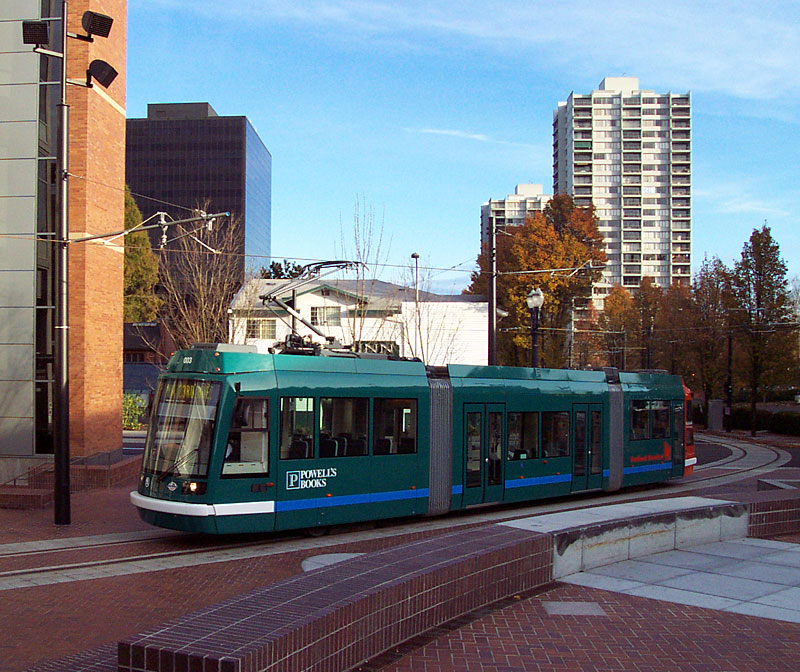
For the uninitiated, the first question one might ask is, "more streetcars?! Like that old-timey trolley thingy on McKinney Avenue? In fact, no. These will be sleek, quiet, comfortable low-floor, accessibly loading modern streetcars. And, I'm told that they will be purchased domestically from a company in Portland (rather than the Siemens cars), so I don't have to spend time belly-aching about bailing out Ford to build more stuff that we don't need rather than overhauling plants to build that which we will.

As freeways were the way to the future for the baby boomer generation, making the streetcar "of its time." Anything resembling nostalgia will limit its potential and reach towards the new population bubble, the Millennials.

Beyond style or preference, I find that the contemporary if not almost futurisitc look is an important indicator of progress to the public at-large. It is a subtle, but important message for building support that the City of Dallas is serious about building a great city rather than any feeble attempts at freezing people in time like a ride at Disney. This isn't about tourists, it is inclusive, but primarily for residents (the significance of which I will explain in a bit).

I expect them to look more like these Portland cars...
http://www.dogcaught.com/rfimg/0605/streetcar-psu.jpg

But, it is fun to check out what some other cities have:

Lyon
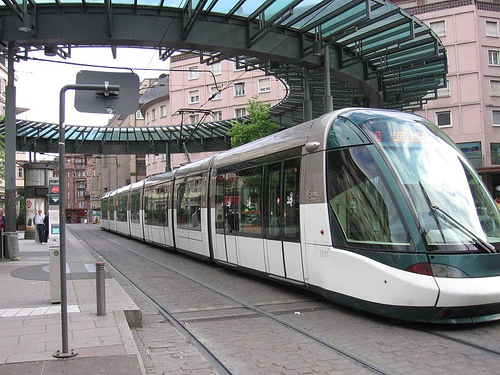
http://www.ecocompactcity.org/Eco-public-transport/big/Tram-big-Strasbourg.jpg
Strasbourg

Your second question might be, "what can this possibly do for me?" First, why turn your nose up at $23 million dollars from the Federal government that isn't going towards highway expansion (although as part of the TIGER grants, somehow something called "innovative highways" [guffaw] received funding including a highway expansion in Dallas. I guess being second in highway lanes per mile just isn't good enough. Kansas City, don't you know everything MUST be bigger in Texas, for better or worse - we make no qualitative distinction, or lest we consider ourselves failures and frankly, we just can't live with that.).

Public transportation can often be a lightning rod because of its relatively high upfront costs and seemingly low revenue generation. It is important to remember that no form of transportation on the history of the planet was ever "profitable" in and of itself. Even for me to ride a bike to the new bowling alley bar in Deep Ellum this Summer requires 1) cost to buy the bike, and 2) energy, ie calories. I have to eat a powerbar to expend the energy to get to my destination. Yet, it seems free, just like it does to hop on the highway and drive to Walmart. The true costs have been "unbundled," so the average person has no idea how much they've been screwed over by the automobile monoculture.

The primary purpose of transportation is to facilitate the functions of city (the transaction of human needs/wants), as Mumford states, "to concentrate the greatest variety of goods and people within that limited area, in order to widen the possibility of choice without making it necessary to travel. A good transportation system minimizes unnecessary transportation; and in any event, it offers change of speed and mode to fit a diversity of human purposes."

Car monoculture dislocates these operational efficiencies and have since, as predicted, proven a failure fiscally, environmentally, economically, socially, and medically.

Second, is that streetcars by nature encourage density (eek density! Arm yourselves with crosses and garlic!) and density pays the bills; it requires less infrastructure per capita lessening the tax burden on everyone. This is the ROI that I spoke of regarding streetcars and transportation in general.

Here is where I say, "this is how transportation should always be thought of, but never is." Except that I am not too naive to understand that it is FAR too easy to externalize certain factors/costs, and convince people that a new highway is actually a good expenditure. The question you have to ask people then really comes down to, how do you want to live, how do you want your city to look?

Third, the streetcars will help to lessen the burden on downtown parking for workers, as streetcar is best suited for short- to intermediate-range commuters. Less demand, with all that supply (OMG ALL THAT SUPPLY) could mean lower costs for parking for commuters into downtown. Though, that is a very slippery slope into circularity of argument.

Fourth, streetcars help lead to safe, interesting, vibrant areas - with unique restaurants and experiences. Note that I didn't say "will." The implication being that streetcars are some magic bullet for livable cities. They are one in a kit of parts. As I've said before, if it isn't part of a chicken/egg dilemma, you probably aren't on the right track toward building more livable cities.

See McKinney Avenue. It took the state's first TIF, will of city leadership/stewardship, and private developers willing to take a monumental risk so big that they had to go oversees to find lending for projects in what was one of the worst areas of the City 20-30 years ago. Now we have things like Crooked Tree coffeehouse, the prototypical third place/hole in the wall, offering character while indicating a mature, resilient, complete neighborhood. (Yes, I shamelessly plug my favorite spots in the City: those that are local, embedded in their community, friendly staff, and full of character.)

---------------------------------------

Historically, streetcars were largely private investment tools for new neighborhood creation. They were a scaled-down version of the common mass transit at the time, trains, and served a scaled-down catchment and service area. In this case, they unlocked the value of land immediately adjacent to very compact downtowns, as developers sought to capitalize on the demand to get out of cities that had become polluted/corrupted by industrialization.

These were the first suburbs and you still see the vestigial remnants of the emergent city forms in Lakewood and Bishop Arts. The underlying forces dictating these efforts were not unlike what continued to happen building further suburbia. The difference however, is that the streetcar suburb was still walkable, it still had a functional urban form, and a workable and predictable hierarchy imposed by the permanence of a fixed-line transportation element where the singular dominance of the automobile and its infrastructure diffused people, spaces, and buildings into "anti-city" where each component not only no longer communicated with the other elements of the urban equation, it now ignored them. Anti-city meant anti-economy.

Dallas, feeling its supposed raison d'etre went nuts with the new fangled contraption building over 200 miles and one of, if not, THE most extensive networks in the country, which coincided with a wave of building that made Dallas arguably one of the most beautiful cities in the country. You know the rest of the story.

Not coincidentally, streetcars are logically seen as one of the items to help restore the areas they helped to create one hundred years ago. In the modern megalopolis, each region of the city needs to have the appropriate scales of transportation to serve it in relation to its context. Streetcars typically serve areas within 1/2 and 3 miles of the primary convergence point, core or destination, typically a job center, ie downtown. These are the areas that have become blighted and desolate for the most part, and now have the potential to go from 0 to 60 as fast if not faster than did uptown Dallas because they will be swimming with the tide rather than against what is considered "conventional."

I'm not going to spend much time on the original downtown loop plan since I spent a couple of thousand words on it already, the methodology based on the form of transit and its purpose/history was so fundamentally flawed (or ignored) that it really isn't worth revisiting, but here it is linked if you want to check it out. The right decision was made in the end, I'd like to give the proper credit to those that helped make that decision, so the comments section is wide open for you. I know OCTA had a lot to do with it, but somebody above them had to make that call.

While I think a case can be made for Ross Avenue or Deep Ellum to get the first line, I think it is 1) important politically to address South Dallas and 2) Oak Cliff already has a more robust and defined character that makes the area ripe for success. The goal will be to allow that almost Austin-like [ducks] funkiness to remain under the extreme pressure of investment and new development. Some might call this gentrification, others investment. Either way, it is another engine that must be harnassed to maximize value (of all kinds).

---------------------------------

If we are to look at what this grant means to Dallas, Oak Cliff, and the future of the City, the first challenge at hand, is as always, dollars. The sum of federal spending that Dallas will receive, like many of the proposals, is half of what it had asked for. Can the entire line be built after the hat is passed around, or will the first phase be drastically cut short, especially considering that a good portion of the cost will be allocated to a the long Houston Street bridge that will obviously have no private investment immediately adjacent? Are there creative ways to cut costs?

The plan, as stated in the TIGER award, starts at Main Street Garden at Harwood and Main, head west down Main Street to the West End, hang a left on Houston to Union Station, where it will then cross the Trinity into Oak Cliff. The summarized submission then gets a bit vague stating that it will stop at Methodist Hospital before servicing several neighborhoods. I'm guessing if there will be budget cuts, these neighborhoods are what get expanded to at a later date.

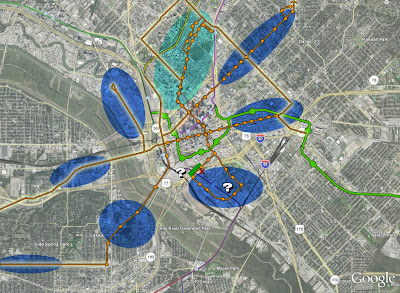
Looking conceptually at how streetcars can strategically reposition areas of Dallas, it helps to establish goals. Mine would be to catalyze reinvestment in the form of high quality walkable urbanism in the districts/corridors shown below. These would all be immediately adjacent to downtown, would create for the kind of urban housing that is proving difficult in downtown, and thus be mutually supportive of downtown Dallas. If I were to prioritize these areas based on need of immediate investment (desperation), readiness (somewhat subjective), and potential for future buildout (or what is the ceiling/highest and best use for this area?), it would be as follows:

1. Oak Cliff (between Bishop Arts and the Trinity)
2. Deep Ellum
2b. Ross Avenue to Lower Greenville
3. Cedars
4. Fort Worth Ave
5. Industrial Ave/Design District
6. Davis Street
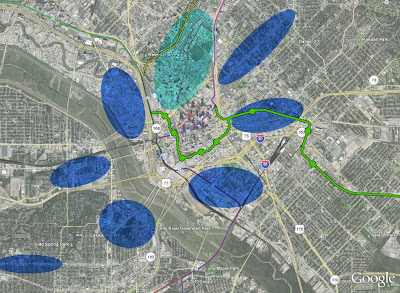

New/Future DART Line in green. Katy Trail in yellow. Uptown area served by MATA in aqua.

So if we add in the new phase, and stop it at Zang and Davis to save approximately $20 million/mile while still serving Methodist Area and being a 1/4-mile within Bishop Arts, I think this would be logical. There might be some desire to loop it back on Beckley, but as I'll get into, I would avoid "loops" in favor of Y- or T-turnarounds in a parking lot if the rights can be had.

(click to embiggen)
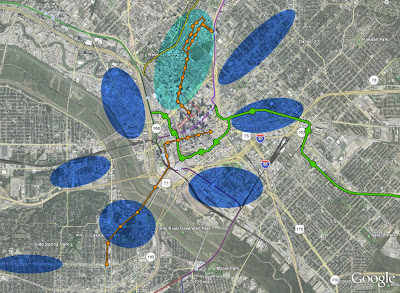

Rather than building loops, the next couple phases should focus on extending lines through downtown to the other areas in need of transportation alternatives and private investment. This would minimize transfer between lines to (typically) one at most. If I'm on Lower Greenville and decide I want to pizza at Eno's in Bishop Arts, if lines criss-cross, I can more predictably navigate my way on two lines max, rather than riding into downtown, catching the downtown circulator to some stop that I might not be sure of to catch the car heading towards Oak Cliff. Amount of transfers can be a mental barrier and should not be underestimated in terms of how it effects ridership.

This expansion consists of probably three phases. The first that I would execute would be to extend the MATA to Main Street meeting the new line, which would simultaneously be extended into Deep Ellum, thus directly linking Bishop Arts and Deep Ellum on one line. The next phase would take a radius line from the Arts District on Ross to Lower Greenville.
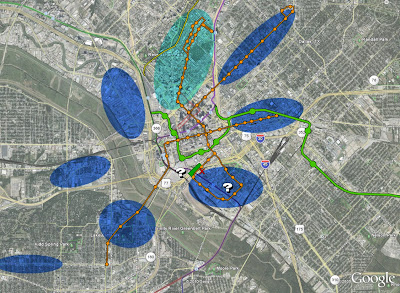

Eventually, the MATA/uptown line that is now extended to Main Street would continue down St. Paul to Old City Park and into the Cedars. If you look closely (or click to embiggen) I included several graphics along with this line. The first that I would like to discuss is the questionmark within the Cedars loop. As I said earlier I don't care for one-way loops. Maintaining both directions within one right-of-way creates for more predictability and "convergence," which is necessary for commercial or mixed-use areas. This also allows for movement all on one-track with switch points at stopping areas for cars in different directions to pass. This can be cheaper but difficult to design.

Also, one-way loops makes permanent one-way roads. We may not be ready for them now, but we might some day. And, in fact I would call it a priority to start thinking of all downtown roads as places rather than escape routes (link to highway as agent of disinvestment) and begin converting them to two-way streets. If you know me, you know that I often stress flexibility and adaptability, as none of us is clairvoyant enough to design for 2050 issues, but we can allow for the ability of those who are living in them.

The Cedars however, and areas like it that exist essentially as peninsulas, it will be primarily residential with some smaller scaled-neighborhood support type functions rather than any kind of high intensity mixed-use or commercial that you might see along Ross, Davis, or in Downtown.

Furthermore, in residential areas, you want to get as close to the residents (in this case even the hypothetical ones) as possible. With streetcar, the catchment area may only be 1/4-mile and with the dimension of the Cedars it makes sense to loop the track on Corinth, Lamar, and then Cadiz back to St.Paul (as shown). This would reposition the maximum amount of city blocks for redevelopment/improvement.

At Woodall Rogers, you will see a red "X" and a green blob. The red X would represent the cleaning up or "context-sensitizing" of R L Thornton through downtown. Cloverleafs are a property value killer and highly inefficient use of land that should be much too valuable for a spacious on/off ramp. These should be cleaned up. The green blob would be a new deck park (ya know, provided any/all of these highways go away as they should) over the freeway. This repositions the south side of the convention center (to help alleviate the gigantic barrier that the CC is) as potentially new office development and the North side of the Cedars as higher density residential/mixed-use on the park. This part of the street car phase then would complete a loop between Main Street Garden, Old City Park, and a new deck park.

Long-term:
Obviously highly conceptual.

Wednesday, October 14, 2009

Roger Rabbit 2: Battle for ToonTown

Or, just about the Streetcar.

So, before the parallel has been made to the death of street cars and the cities around them as told by the venerable Roger Rabbit, well perhaps the sequel can be told as streetcars make their way back to cities as useful instruments of urban life and revitalization. We've known the need, but now it's gaining steam. Here, too even!

This week, Downtown has gotten much of my attention and others as Blog Buddy Dallas Progress has discussed in his Myths and Conceptions post, but what should get yours is the progress of news that will have a much greater impact on redevelopment in and around Downtown.

First, something I whole-heartily agree with regarding downtown that deserves special mention (as it's one of those things you almost have to see in print to fully conceptualize and get over previous potential prejudices), he has this to say:
Yes, there are homeless people in Downtown Dallas. Unfortunately, there are going to be homeless people in every downtown in every major city. A good friend of mine in real estate made an interesting statement about the homeless, which was "if you had more people downtown, you wouldn't notice the homeless because they would blend in with everyone else."
Couldn't agree more. More importantly:
The people that don't travel downtown because of the homeless folks probably will never come downtown anyway.
But, back to the Streetcar proposal, the subject at hand. First, there are several articles written this week, from the empty, to the boring, to the stupid silly:
Then Davis asked if the trolleys will be on tracks or on rubber when the trolleys leave downtown and go out into the neighborhoods. The answer: "Tracks."

We see her point. Otherwise we're going to be in a hell of a mess with all those steel-wheeled cars chewing up neighborhood streets. Bet they'd be hard to steer. No, wait. The real point of her question? She says DART should be in charge of the whole thing because "they know a lot about tracks."

True. They're really good about building them out to the suburbs.

I don't even know where to begin with this, and frankly, I'm not sure why I'm quoting it. First, steering? Streetcars steer themselves. Hear of many runaway streetcars careening into pedestrian like that old head into a farmer's market recently? Second, DART also built the Transit Mall thru downtown. While it may not have been the best idea to go transit only on those streets, it is well executed from a built standpoint. Suburbs, in town, let the designers and engineers figure that out.

So what was the point of wasting space in the article, if the real issue was only glanced at, which is who is in control? Dallas or DART? A few of those clashes going around these days. Some alter the course of careers.

The other real issue is alignment and phasing. While there are phases suggesting future connections outward from Downtown (see map below), the first phase will be only in downtown as shown by the purple route. It will link with MATA at the Deck Park (which has the most bizarre of taglines btw, "city meets country?" Farms on McKinney these days? You getta WTF?!)


I'll allow Dallas Progress to take the first crack and I'll elaborate afterwards:
I also disagree with the current alignment of the downtown streetcar. In my opinion, the route completely cuts off Deep Ellum from the rest of downtown. It's a great route for the Arts district, but not for anywhere else.

I know that Deep Ellum is listed as a "potential extension," but there are great businesses there now. The main streets have multiple lanes that would be conducive to a streetcar. How cool would it be to leave your office during lunch, hop the streetcar down to Twisted Root or Lemongrass or St. Pete's, and get lunch? It also would show out-of-town Arts District patrons about this great alternative retail and restaurant scene right in the middle of our city. Maybe just throw Deep Ellum a bone by having the train stretch to Good Latimer and Commerce, circle back to Main and then continue north at Harwood Street. (ed. Go Phils!)
The issue he touches upon is broadly, "what is the point?" Or, with any piece of transportation infrastructure, "what two (or more) things is it linking?"

**Side note: Reader beware the term linkage or linking. It can mean something when breaking down barriers, but often in the wrong hands it can be wielded as a blunt, but powerless, instrument.

A streetcar line that starts downtown and stays downtown, becomes yet another tourist attraction rather than for residents. Redevelopment MUST be focused on current and future (or even past ones that bolted and may/or may not be stuck unhappily in Generica). Tourist attractions come and go, but a permanent and dependable residential base is there 24/7. An influx of new people invigorate places that then take on a life of their own. They then, establish places as destinations because the commercial (social adhesive?) in the appropriate locations won't fail and will form magnets of activity.

What the currently proposed alignment does, is actually very little in the short term, which is to only link current pet projects, the Arts District and the Convention Center Hotel. Well, a lot of money is being spent in those two locations. I guess we're going all in on the tourism industry saving Downtown Dallas. How, '80s of us.
"Hey, theoretical visitors. Come ride the streetcar from the Convention Center Hotel to the Wyly Theater! Hey, downtown BizMen! Come ride up to the Arts District and I don't know, pretend you're in prison while visiting the Wyly for stashing cash with UBS.
The problem that I'm guessing no one wants to acknowledge is that any leveraged development incented by the streetcar in Downtown (of which I'm guessing there will be very little since they are couching the investment in current people/development served) will lag. It will begin to look like a bad investment to build on Streetcar lines in future phases. When phased properly there is a tremendous return on investment.

A 2006 study by Reconnecting America, a nonprofit group that promotes mass transit, reported that Portland, Ore., saw a 1,795 percent private return on the city’s 2001 $55 million public investment in a 4.8-mile streetcar line. Portland boasts 12,000 daily riders.

The study also said Tampa got a 1,970 percent return on the $48 million it spent to install a 2.3-mile line in 2003 - even though its line isn’t meant for commuters and has poor ridership. (ed. note: Keep in mind that a different development climate exists today than the one in Tampa in '03 to '08. We shall see which can continue to support itself. I know Portland's will.)

It isn't a build it and ROI will magically appear situation. Given the alignment and phasing, I'm skeptical it will be the case here and I fear it may be the death (or severe delay) of necessary expansion.

http://upload.wikimedia.org/wikipedia/en/d/dd/Grove_trolley.jpg
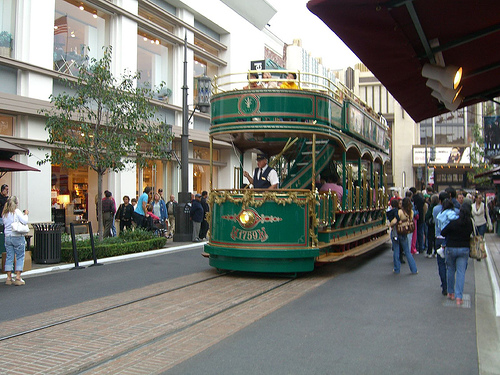
(The Grove in LA. No, it won't be faux historic, but it will still be the disneyfied, Potemkin Village version if it just runs tourists back and forth.

Rather we should be utilizing streetcar transit as a revitalization tool for the immediate areas around Downtown. Historically, Streetcars linked Central Business Areas with the early "streetcar suburbs," like Lakewood. We should be linking downtown outward, not inward, and allowing it to be a transportation alternative for those that already live in Dallas (and pay taxes) and those that WANT to live closer.

Once you build up the adjacent areas much like MATA helped with in Uptown and State Thomas, you can begin building off the synergies of what Downtown currently is (an office park an employment center) and revitalized (choose: Deep Ellum, Ross Corridor, Cedars, Oak Cliff, etc.). These areas are begging for it. Build up to a crescendo and allow downtown to feed off the adjacent successes (all while working on what really ails Downtown, of course).

Streetcars will have a much greater impact on revitalization for the struggling areas adjacent to downtown b/c ultimately these places will be more residentially driven (currently and in their evolution) than Downtown (although it's necessary there as well). Therefore streetcars won't have the same positive effect on redevelopment IN downtown as it will immediately outside. Fundamental change to the road network is necessary in Downtown.


Now for the picky details.

I like that they aren't messing with Main Street. I too would propose a loop adjacent to Main Street. Main Street is fine in its current design and function . Elm and Commerce are those in most need of rehabilitation and the Streetcar can and SHOULD be used as a transformational tool for those streets to become sociopetal rather than sociofugal elements of the City.

Also, rather than connecting the West End to the Arts District (which DART already does -- if it weren't for the 8 miles of surface parking and garages b/w the Pearl Station and Ross Ave, turning a two block walk into a lifetime of expected muggers and assorted anxieties) in Phase 1, there might not be a particular need to make it just one line or even connect them at this point, for that matter.

Personally, I would extend the MATA line down St. Paul to Main Street Gardens and create a loop around the park, in front of the Merc, the Grand/Statler, the Courthouse, and 1900 Elm, the Titche-Goettinger building.


Take the remainder of the cost and run the parallel Elm/Commerce loop into Deep Ellum with an expectation of this loop connecting Deep Ellum w/ Union Station/West End.

The goal of the next phase would be to start a line that would eventually run from Lower Greenville down Ross (which OMG needs it or a surgical strike), past the Arts District to the West End where it would hang a Luey and head into Oak Cliff/Zang Triangle area.