Showing posts with label Dallas Issues. Show all posts

Monday, April 23, 2012

Tell'em Angela

Councilperson Angela Hunt was interviewed by DMN transportation reporter Michael Lindenberger where she dropped this dime:

She was asked: If we don't expand highways, how are we going to reduce traffic in downtown?

"That to me is the most important question we can be asking ourselves," she said. "No one involved in transportation in a governmental sense, as far as I can tell, is asking the question or is interested in the answer to the question. But do we want to differentiate Dallas and help it grow into the future or not? We've expanded lots of lanes of road over past decade and yet our city did not grow in the last Census. I think that is significant. That is what we got for our highway money. We've allowed people to move further and further away.

And that is the real question. Why does every single person in transportation governance in DFW mistakenly think that they can build their way out of congestion through additional capacity? It's either incompetence or corruption of the highest order. Here is part of the reason, my piece on the four blind spots of transportation planning that inevitably leads them to supply-side solutions, as in additional supply, more roads, in the folly-fueled pursuit of free-flowing movement.

Know where I was most mobile in the last year? When I visited London and Barcelona. I could get anywhere and everywhere in those cities very cheaply and efficiently. Pedestrians and trains are always free-flowing, even when they're "congested." Because, like cholesterol, there is a good kind and a bad kind of "congestion." Pedestrian congestion nourishes real estate value and quality of place. It fosters authentic places by empowering the citizenry. It ensures long-term health, vitality, and resilience of a place long into an uncertain future of fluctuating gas prices and infrastructural upkeep. Ask Detroit how monotony of car-culture is working out.

While Lindenberger is right to pose the question, the answer really isn't that difficult. Building for regional transportation movement (to the point that it physically encumbers local movement and the value of proximity -- despite gas, operations, and maintenance costs to the private user that cripple the local economy) skews the real estate market towards car-based and regional development, ie sprawl. As cities are highly complex, adaptive systems, we have to understand that people (and in turn the real estate markets) adapt to changing transportation networks.

The real answer is replacing the highways downtown with developable real estate. Condemn them if you have to given the high degree of danger associated with them. The Right of Way (which is significant) can be converted into high quality, livable, walkable urbanism. As we've shown before, the inner city freeways are a drain on population and tax base. In the 245 acres around I-345 in downtown, the city generates only $3 million in tax revenue. When it could generate $100 million per year.

In other words, enough to build a modern streetcar line down Ross Avenue from West End to Lowest Greenville. The 20,000 new residents could walk, bike, and trolley to places of need. Because the value of proximity is restored. Or they could drive. The key factor is choice is restored and intelligence is built into the system via the users. They can choose the most appropriate and desirable form of transportation for their given needs for any given trip. Thus, less vehicle miles traveled and reduced demand. Meaning less cars on the street, less load on crippled, failing infrastructure, more free-flowing traffic (of all forms), and increased efficiency through propinquity.

The reason is that the highest and best use of land is for surface parking...or nothing at all. Vacant. The highways skew the housing and real estate market to favor shipping tax base outside of the city's boundaries while the city bears the infrastructural burden for a region of 6 million. Its rapid growth itself is indicative not of strength in the market, but fragility. It can go away just as fast.

If we're serious about revitalizing downtown, the answer isn't more highways. It's less. I was interviewed late last week by a writer in Baltimore covering the impending tearout of the JFX, I-83, which splits Baltimore in two, west and east, right down the middle. He was very interested in Fort Worth's relocation of I-30. I told him the effect of doing so was negligible and likely would remain so.

Sure, it enlarged downtown some, but it does little to change the movement patterns and demand levels built into the real estate market via transportation network. Capacity remained the same. The effort to move cars freely and easily is what makes it cheaper and easier to live outside the city (with your tax dollars) and commute into the city. It isn't a healthy interdependent relationship cities have with their suburbs (say, like Valencia Sp has), but rather a dependent one of host organism and parasite, sapping the host of its life. Slowly. And surely.

Thursday, April 19, 2012

So Much Win. So Much Loss.

Welcome to the wild west of city building.

The win is all in the long form column by D editor Tim Rogers about the solar radiation, reflection, and heat gain spilling off the shimmering glass Museum Tower (who knew glass towers would be a bad idea in a hot sunny climate?!) and into the Nasher Sculpture center. I want to quote so much of it, but go and read it yourself. It's the must read of the week.

A few of the key points:
  • 16 of the 100+ units have been sold. Though I'm sure the sales people will somehow work this into being 85% under contract. Every building ever is 85% full according to leasing, real estate people. A mathematical anomaly.
  • On a cloudy, 78-degree day in March the solar gain via reflective glass from the tower on the Museum raised ambient temperatures in the lawn to 103 degrees. Yikes. Can't wait until another month long 110-degree August rolls around.
  • The Museum Tower report either wittingly or unwittingly (neither is flattering) plugged the wrong type of glass into their model.
  • Tim suggested architects Scott Johnson and Renzo Piano settle the dispute via walk-off. (Ok, I'm suggesting that).
  • The Dallas police and fire pension has only spent $100,000 on the project yet is on the hook if it goes belly up. Somebody piece together those dots for me. This is a weird deal in every aspect.
  • Oh, and there is still a cloverleaf highway exit ramp circumnavigating the property. Cul-de-sac in the sky. And you wonder why there are only 16 buyers.
About two years ago I wrote about what a crazy investment Museum Tower was for the Police and Fire Pension Fund. If I were a cop or fire fighter, I'd be thinking about protest and overthrow of the board (which apparently includes 4 city council members(!)).

I hate being right about these things, kind of like when I predicted that the Hunt Hill Bridge would be a safety hazard/speed trap before it even opened due to the road being designed for highway speeds yet signed for 35 mph (! x 2 = !!). Hey, maybe DPD can recoup their losses by ticketing everybody on the Hunt Hill Bridge.

Last summer, I also tried pitching the column idea to D Magazine about why reflective glass towers were in fact a terrible idea for Dallas, wrecking the public realm. Except, we couldn't find the right/specific angle without good data. Tim's column has that data via the on-going fight between the Tower and the actual Museum, as quoted above.

This fight is so going to court. And I expect it will go to very high levels of court since there are undefined issues of property rights going at hand, combined with deep, entrenched pockets on both sides. In a way, this is sort of like the mostest Dallas thing ever. Like Belo building a park in front of a condo building then throwing up a 12-foot wall between them. We get the urbanism all wrong and everybody throws middle fingers up on all sides. Maybe we can just build another wall around all of the above? That seems to solve all of these problems, right? Right?

Perhaps someday, just maybe, we'll stop acting like little children and realize that urbanism is about actual value rather than some superficial novelty item to wrap bad financial investments up in.

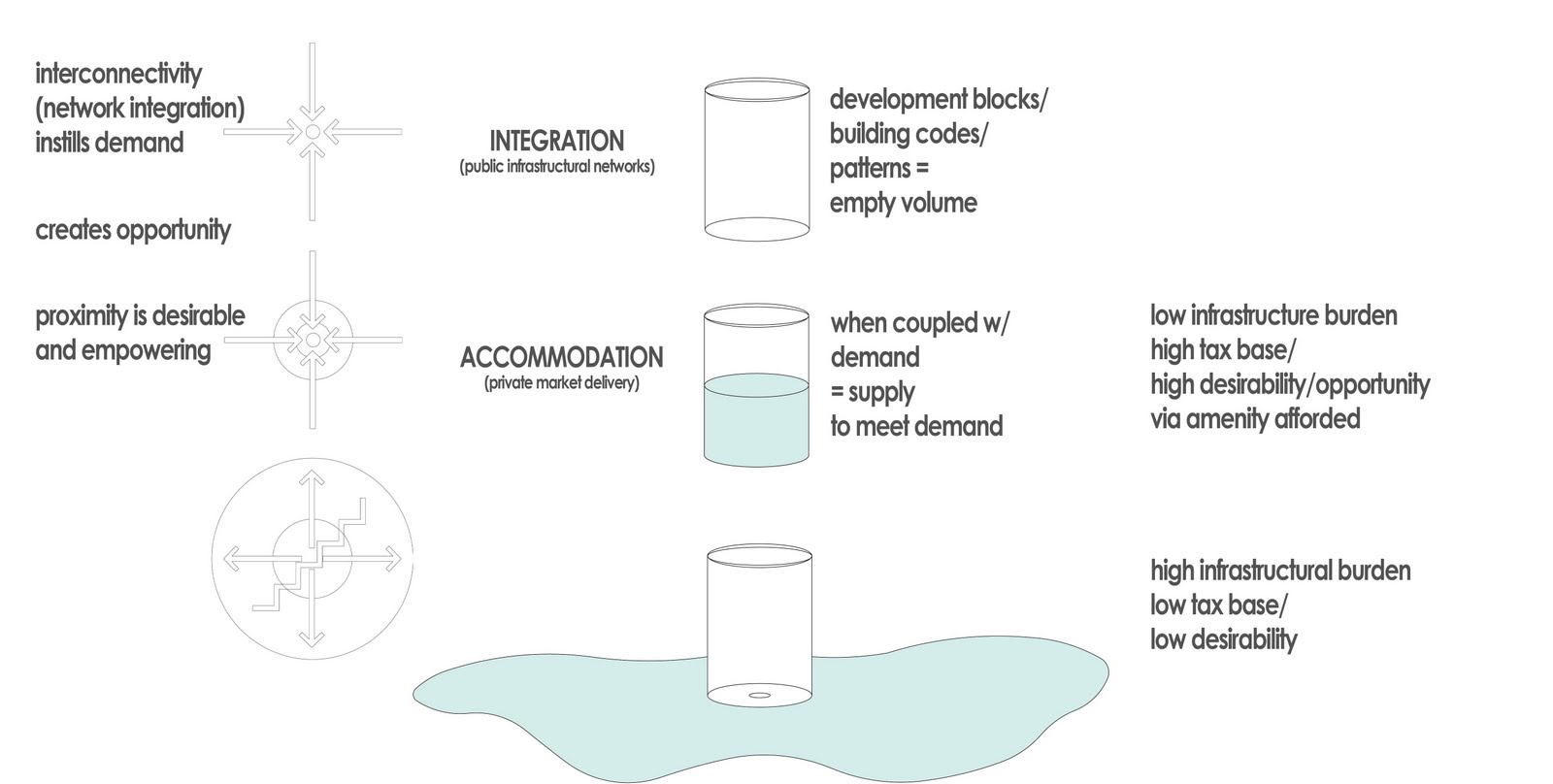
Integration begets accommodation. Drive demand, get supply. This is the number 1 rule of city building. And it is inalienable, despite our best efforts.

Trinity Toll Road

There's a Facebook group up and running. If you're so inclined, it will be the place to find news about the Trinity Toll Road project. I'm with councilman Scott Griggs who rightly said a new highway doesn't alleviate demand for traffic, but adds to it. Instead, we need to be reducing car-based transportation demand. Meanwhile, TxDOT shows their ignorance via supply-side thinking:

The Horseshoe bridges will help some, but the capacity is still a problem, said TxDOT district engineer Bill Hale.

Unfortunately, "capacity" is not a sexy sales slogan. Neither is "we need lanes."

Perhaps we should sympathize with TxDOT transportation planners/engineers. They're like drug warriors, fighting a crusade that cannot be won. At least, not the way they're fighting it. Another tragedy/folly of our time. What's the definition of insanity again?

Besides simply being wrong, there is the bigger issue about funding. And that is where details become a little more hazy and hard to come by. The way I understand it, NTTA identified a funding gap, in that the projected tolls won't pay for the road (nor, of course, the long-term upkeep and maintenance). Which says to me, either they're not pricing the road in order to do so (which should give us 1) a clue to the real cost of roads and 2) there isn't the demand for the road in the first place).

And that the city has to decide how to cover the funding gap, likely through additional bond packages and/or various other concoctions of public-private partnerships. Though, I am utterly clueless where any private investors would think they're going to get a return if NTTA doesn't think they'll get their part. It certainly won't be in property valuations.

If we really wanted to "right-price" roads so that they can pay for themselves, while appropriately leavening the demand side of the equation, we'd toll the existing highways before adding more capacity. By ratcheting down the dial of demand on automobile use and public infrastructure we reposition real estate markets to favor proximity, and thereby density. By favoring density and proximity (and restoring the logic to the fundamental impulse of cities), we create a real engine for qualitative development of property, ie investment. This is where the real gains are if you have any stake in Dallas property.

From a conservative/libertarian perspective, you should be against the reckless public spending.

From a liberal perspective, you should be against more road capacity and the environmental implications.

From a local Dallasite perspective and want the city to fulfill its potential as a "world class" city, you should favor reducing road capacity and empowering increased local interconnectivity and the resultant densification.

From a property/investor/stakeholder perspective with a stake in Dallas real estate, you should oppose it for all of the above reasons, primarily the shift in the demand of real estate market to relocalize, recentered on Dallas driving up property values and therefore densification, instead of neverending sprawl.

From a taxpayer standpoint, you should be appalled at the city taking on more infrastructure burden while exasperating the diminishing tax base that favors the dependent suburbs instead of the host city.

As a HUMAN, you ought to support legitimate choice in transportation mode and route, rather than coercion into cars and onto freeways. As I've said before, and Gil Penalosa echoed in his ppt to City Hall, equitable transportation is a human rights issue. Crazy coincidence, since it costs $7,500 per year to own and operate a car, the majority of which leaves the local economy, it's also an economic development issue.

There are, of course other aspects and implications to the issue. The first is what it does to the Trinity River Park Plan. As I've mentioned a million times, the quality and success of a park is only as good as the connections to it. When those connections become barriers (as regional infrastructure invariably does), it undermines the investment in the park in the first place. When the Trinity River Park was pitched to the city (perhaps under the guise of highway spending), it was compared to Central Park. Central Park is also not divided from the city by a highway.

There is also the issue (which everyone is focusing on, we, without fail, also always seem to focus on the least relevant issue at hand) is alignment. The new Federal Highway Admin report added a fifth option to the other four route alignments, that of no new highway at all. And that should be the real debate, whether to build it at all or not. Alignment is irrelevant. Why? Because the Dallas side of the Trinity is already a lost cause. Despite all of the Trinity Trust and CityDesign Studio's efforts, the Dallas side of the Trinity will never be worth anything. The Design District has potential, but its value derives from proximity to Oak Lawn, Parkland, and the Trinity Strand.

At least we've abandoned the idea, of running each direction down each side of the Trinity. West Dallas and Oak Lawn can be spared, perhaps even with a promenade along the Trinity and direct interface with the park.

This fight can be our Jane Jacobs vs. Robert Moses moment. The issue isn't specific, because as I said, the Dallas side of the Trinity is lost. The real issue is the culture and (maybe) corruption that believes government spending on evermore road capacity does anything positive beyond gut the tax base of the city of Dallas while adding increased burden upon the city of Dallas in favor of a parasitic form of regionalism.

We have to halt and reverse the inertia and entropy inherent in building infrastructure that scatters and instead build networks of choice, that empower people and infuse intelligence into the system. That bring people together rather than divide. This is the time where we have to remember (or learn for the first time) what cities are for, improving quality of life and opportunity for all, via social and economic exchange. And thereafter, once we define purpose we have a guiding light for building the interconnections towards that purpose.

What is the purpose of our city? Well, it seems it is nothing more than moving cars. With little other higher regard. We should be moving towards increased independence and interdependence of the many municipalities of the DFW metroplex. Not increased dependence. By doing so, we are effectively choking the host organism, slowly but surely sapping the life-giving property of desirability from it, and eventually killing it.

Thursday, April 5, 2012

Asking the Difficult Question

Last night I was part of the Dallas Press Club panel talking about West Dallas. I wasn't exactly sure what to expect of the audience, who was going to attend, but it turned out to be another neighborhood meeting essentially. One of the many and on-going with the La Bajada neighborhood about the future of West Dallas. And that's to be expected. Aside from investors, they have the most at stake: their homes and 'hood.

And it's understandable that the planning process has to and needs to be sensitive to them. We, as American urbanists, have about 80 years of thoughtless, insensitive "planning" to atone for. And by "planning," I mean clear the way new stuff is coming in (rarely for the better).

However, there is a very difficult question I haven't seen asked nor addressed. One that I wanted to pose, but last night wasn't the time. Let's say, that the West Dallas plan does catalyze the amount of investment it says it will, $3 billion (for now, we won't critically dig in to this number, but I suspect it will be lucky to get 1/3rd of that. Rather than high-rise condos and super high end development imagery shown in the book, I expect more 1-story retail with 2- and 3-story affordable housing being the dominant product typology. To simply draw a full build-out, calculate it, and put a dollar value on that is to belie both planning and economics of cities/development, ie invoke magic. This is why so much planning is ridiculed as paper planning.). With the proposed neighborhood preservation overlay limiting height to 27 feet, what will ultimately happen to La Bajada?

Despite the aside, the CityDesign Studio has the unenviable task of trying to make things work, incent development in areas that reject it. Not so much politically, but infrastructurally. The areas are fractured, fragmented, and disconnected. Such disconnections have led to disinvestment and decay. As I said last night, integration begets investment, disintegration begets disinvestment. I've never seen this published as the xxth rule of urbanism, but it might as well be.

Point being, investment and density will want to happen in the best areas. It wants to build on momentum. It wants to be in highly connected areas. In other words, if you love your neighborhood, there is a very good chance, density wants what you have. This may not necessarily be West Dallas. This is more of a broader statement pointed at a 3-mile radius around downtown. We're already seeing evidence of conflict between the onsetting approach of regional residents wanting to be a part of Greenville Ave., Henderson Ave., and Bishop Arts area. The battles over parking are just the start.

Next it will be about height restrictions and density, if they haven't already. So, to cater to the present, rather than the next generation, we politically have to placate neighborhoods. We'll find density in places where the market isn't quite ready for it, and thus the challenge.

In other words, to paraphrase Nedd Stark, change is coming.

But back to La Bajada in specific, let's say that $3 billion does happen. It will inevitably significantly raise the property values of homes in La Bajada. And even though in Texas property valuations for taxing purposes can only go up 10% per year legally, you can bet this will catch up eventually.

The rise in property values would do a few things. The increased property taxes might force many residents out, to sell. However, since the market value will outpace the assessment in this hypothetical scenario, it likely wouldn't make sense to the buyer's market to maintain low density. Because of the height restrictions, more density isn't really possible to make the land viable at higher land costs. I suspect this means a slow bleed out of La Bajada over the next few decades until not much is left.

However, I am ambivalent to this. I have no stake in it beyond wanting Dallas on the whole to be a more livable, lovable, resilient place that can withstand rising gas prices, that empowers its citizens, that provides choice in housing and transportation, and by doing so is a more latent, intelligent city. Since the users aren't forced into certain transportation modes or housing types, but can make the rational choices based on their own wants and needs. In other words, a truly self-organizing city is a resilient city.

Places either get better or get worse. Even those that stay the same have to achieve a certain maturity before they're calcified via historic districts. And these are generally only 1) possible and 2) ideal, when not just the local neighborhood loves their hood, but the entire city as well. Because it takes money to reinvest, just to preserve something in time. As generations pass, if the rest of the city doesn't find it equally as lovable and suitable as the present it will decay. It is inevitable. This is why the arrondissements of Paris, whenever under assault by the next obnoxiously brazen starchitect with grand visions for wiping out the the millennia of care, love, stewardship, and thought into crafting highly livable, incredibly user-friendly.

I worry that by calcifying La Bajada as it is today, ultimately means the last generation of La Bajada as we know it. If choice is what we want, choice to sell should also be instilled. To cash in on having a great location near to downtown. I worry that it's being dishonest to say anyplace will stay as it is now and forever. That isn't true any place on earth let alone a very young, highly malleable city like Dallas.

By setting this height restriction, are we embedding disinvestment? And will that disinvestment limit the potential of the West Dallas plan? Will we have to wait until the area is completely eroded when we'll have to go through another zoning process just to undo the height restrictions in 20 or 30 years? Such is the challenge of modern zoning. It just takes a guess at what the market wants and tries to steer the market into other places...as it should. However, when the steering doesn't match the market, when it doesn't match the infrastructure, is when that steering veers off a cliff.

This is why gentrification is such a touchy and awful word. It has too many meanings. To one person it means moving them out of house and home (though they very well might get a handsome payday out of it and it wouldn't be coerced as feared, but an option, a choice). To another person, it means chain stores and restaurants, generitopia rather than small, local businesses (even though sometimes it takes the chains to make the local businesses work). To yet another person, gentrification means investment. And without investment, without care and stewardship, all places suffer a slow and painful death (or at best a zombie-like state of undead).

I'm sure somebody will try to speak confidently to assuage these worries (such is politics), but nobody knows the answer. Cities are highly complex, unpredictable organisms. And they are especially cruel places to those adverse to change. We can make a best guess, no matter how experienced or how trained the eye. It is always just a best guess and only time will tell.


Wednesday, April 4, 2012

Wednesday Linkages

This will be the last post until next week. I hop a plane to London tomorrow. Until then, you can catch me tonight as part of the Dallas Morning News Future of West Dallas panel at KERA's studios. Or if you can't make that, give a listen to the latest Urbanology podcast, which you can find on iTunes.

Before I get to the linkages, I got the full tour of Thanks-Giving Square yesterday, which was fun and interesting. They do have a worthy purpose and mission, to bring people of all race and creed together. Unfortunately, problematic design inside and outside of the property have combined to diminish the square's stature, utilization, and ultimately its ability to operate as a gathering point for more than smokers (cigarettes by day, crack at night) and doggy doo.

That's right. As we were on tour looking at all the good things within the Square (including its underlying mission), you couldn't help but notice all the ironwork (railings and drain inlets) that had been stolen for whatever meager change could be garnered for them. Enough to get a hit of crack I suppose. The circle of life was evident as the maintenance man Rick, the guy I dubbed Sisyphus for his tireless work shoving slumping liquid rock back up the hill each day, pointed out a crack pipe along our walk.

The lesson is that illicit activity tends to occur in dark places. Shine the light and it scatters. However, I'm using the word light metaphorically, as in human activity. Visual and physical porosity. Thanksgiving square is dark during the day. You can't very well see in and there isn't much reason to go there unless your dog needs to satisfy its bowel movements and you, the office worker, needs to satisfy your nicotine cravings and your building won't let you smoke anymore by the entrance. But it's darker at night.

I'll be writing much more seriously about Thank-Giving Square in the upcoming weeks. This is a place worth saving. At least, its purpose and its place as what used to be a central crossroads of the city if nothing else.
----------------------
Three pretty fascinating articles which are thought provoking for various reasons and by themselves weave a narrative of three different cities in three different allegoric places headed in three different directions:

First, Medellin, Colombia. You remember it, right? That's where all the drug kingpins took over in the 80's. It's still a warzone, right?

Huh, investing in public transport and public education. Who'da thunk that would work. Empowering the mobility of its citizenry in two distinct but powerful ways. Sounds like cockamie.
----------------------
This is more like it. Baghdad by Starchitect in the 1950's. That'll "save" it. Call up Zaha Hadid.
----------------------
Now, far more interesting is this piece by the NYT on Berlin's airports new and old. Really thought provoking stuff on the nature of Berlin, security, and the modern airport experience. The retired urban planner's quotes are particularly poignant at the end.

"...A city surrounded by storks and wolves..." Sounds almost mythical. As if it belongs in Westeros, or something.

The planner told of the need to build bridges to the outside world. And he's right, that is if Berlin wants to "grow." And if that's what they decide politically, more power to them. And this will have consequences. Such as the replacing of the old beloved airport with a new "shopping mall with some planes attached."

Therein lies two modern and divergent issues: one of security and one of experience. The old airport emphasized convenience but was 1/3rd of the determined necessary size. People could go from home to gate in minutes, conveniently. DFW is not unlike this (just further away).

The new airport wants to funnel you through singular security checkpoints. These are awful (ever been through BWI?). They also want you to spend time there ("live, work, shop, play?"). So they build 5-acre shopping malls inside replete with dreadful food courts.

You know where I'd rather shop and eat and play and live and spend time? Either the city I'm leaving or my destination city. I understand the need to make layover time less intolerable, but give us free wifi and we'd sit on hot coals while plugged into colostomy bags if we have to.

I may rant about the need for relocalization, but airports and plane travel isn't going away. Nor would it be a good thing if it did (though it does badly need to reposition itself). But rather than trying to shake every last coin out of the captive market (is that a pat down or are you taking my wallet?), perhaps it would be a more sustainable business model for airlines and cities to get people to their destination cities as quickly and conveniently as possible.

Ahh, yes. But there isn't a business model within the fractured, fragmented, and broken value-extract institutions. There's no room for value-add on this flight.


Monday, April 2, 2012

Of Glass Boxes and Glass Slippers

One of the tragic things working in Dallas is the amount of people and effort trying to make things work, make the city more urban, ultimately giving it a longer shelf life, is that there are many smart people trying to make little changes within a fundamentally broken ship. Sardonically, we might call this rearranging deck chairs on the Titanic. However, we tide ourselves over with the comforting thought that a million (or only a dozen) small actions can lead to a tidal wave of change. The big changes to the underlying DNA of a place are just too difficult, too politically charged to even bother with, instead we'll just set the table, the linen, the silver, and the china on this one little dining table. So what the boat is headed for the iceberg of inevitability?

Perhaps neatly and accidentally summing this up is the news from the weekend that the City of Dallas, and in particular the parks department, is going to update the downtown parks masterplan. Buried within the subtext is a brief mention of two high-rises that are coming down to make room for new parks? New something. Probably not buildings. And if they are, they likely won't make money. Such is the state of downtown Dallas. Things happen by charity and subsidy because the transportation framework is stacked against downtown.
The glass is empty, so throw out the glass. Sure, the numbers don't work to fill that glass, but that isn't necessarily the fault of the glass, but the infrastructural network creating the hole in it instead.

I've been saying this for a while now, but the highest and best use for downtown land is nothing. Sad to say and sorry to challenge your world view, but this is inevitable within the broken system. Thus, within that system, we rationally think that nothing or a park is better than a building. That building is empty, so take it down, of course! Demand is too low to make anything work within that building. So instead of instilling demand, we reduce supply.

I forwarded this story to someone over the weekend who responded derisively, "let's just tear down all the buildings and make a wildlife safari." Or maybe move the zoo and let jungle cats roam the streets. Highest and best use: parks and parking. Perhaps it is time to admit we're doing it wrong and systemic reform is necessary to how we think about our city, cities in general, and the underlying processes behind urbanization (or in this case, anti-urbanization).

-------------

Along these lines, Robert Wilonsky, formerly of the Observer and now mainstream at the DMN -- but still working 24/7, sent along the news that the city is seeking an operator for their first 'glass box' retail space. The glass box semi-'popup' retail space is something born of the downtown 360 plan. It creates retail space in places that currently lack it. In essence, it is giving an interface to blank walls. However, there is a catch. There must be demand before supply.

It's not a terrible idea. In fact, it is a good one. But there is a slippery slope. Again. And that is if they are used willy nilly, then they are supply side urbanism and thus doomed to fail. For the city to erect these glass box buildings is good in a few ways: (1) it eliminates some startup costs (and barriers) for a small, local business to locate in downtown Dallas. (2) It provides an interface for a buildings currently lacking one, ie a front door engaging the public realm where currently there is none, a blank wall.

It is potentially bad if these are established in places where they won't succeed, in areas of low spatial integration. Spatial integration = demand = greater chance of success, the quick wins the city and the downtown 360 plan are looking for.

So, if we're looking for a quick win for the idea of the "glass box" in micro and downtown success in macro, you'd think we'd locate the first glass box in the location where it has the highest chance of success. Since there are several potential locations for the idea of laminated retail space on a current building facade, we have to pick the place that has the highest spatial integration value. Unfortunately, that isn't Browder Plaza. Yes, it needs it, but making this phase one is the right place at the wrong time. Or wrong place at the right time. Both suffice.


BrowderStreetPlaza.JPG
I too love theoretical people in renderings. But where do they keep their wallets? Is this how we visualize tourists? As apparitions, floating amongst us, the real and true Downtowners?

These people have to come from somewhere and that somewhere is through spatial integration. As I wrote about the McKinney Avenue Trolley last week, through movement is not nearly as important as cross movement because the people that cross the street are from the neighborhood, the street serves the neighborhood, and those are the people that populate the sidewalk and thus patronize businesses that interface with the street. Furthermore, these are return customers who keep businesses afloat.

I don't know all the decisions behind establishing the first glass box on Browder Street, a pedestrian plaza closed to car traffic, linking Elm and Jackson Streets. It very well could be that the city is trying to make retail work on Elm Street since it hasn't on its own. But that is part of the problem. It works on Main Street for a reason. There is a higher degree of integration on Main Street. Where Main and Akard meet at Pegasus Plaza is the crossroads of downtown. It is the single point of highest integration in all of downtown, its "Main & Main" corner.

There just so happens to be a perfect place on Pegasus Plaza as well:


As you can see above, the back of the Magnolia hotel fronts on Pegasus Plaza. Currently, this is a doggie dumping ground. I believe this is even a location picked out by the downtown 360 plan for retail lamination. Placing phase 1 here would build on the success already of Main Street rather than trying to expand that success beyond its natural boundaries. Those boundaries are Elm, Commerce, Field, and Ervay currently.

I'm the first to say we have to build outwards upon Main's success, but that can't be done without addressing Elm and Commerce's natural barrier effect. Much like rivers can't be crossed without fords or bridges, a river of cars is also a barrier to crossing, thus decreasing spatial integration. Meaning less pedestrians, less value.

City has added brick to the sidewalks on Commerce, but has spent nor done anything to actually change the functionality, the integration, of the street. The street is not narrowed, calmed, nor slowed. A center of gravity is not made. It is simply an aesthetic treatment, ie the least important thing you can do if you're really, really trying to catalyze change. Along those lines with the RFQ, the city is spending $500K to pretty up the concrete heavy Browder Plaza. Again, as with all superficial treatments, without first upping the degree of integration, cost significantly outweighs returns.

Now it could be that Commerce is ready for something there, but it is a gamble. Not the sure thing, nor quick win it is being espoused as. This may be a timing issue in conjunction with Forest City delivering more units further down Commerce, however the gravitational pull will remain Main Street as long as Elm and Commerce exist as they do, as escape routes. Places to save time rather than spend time.

The second problem here, is that there is a good chance this is the city picking and choosing winners. I'm no fundamentalist libertarian, but it is rarely a good thing. The public agency is better off focusing on instilling demand through the establishment of a transportation network that is about clustering. That is about demand, rather than about moving people out. Rather than instilling demand, the city is adding supply of new restaurants by funding the startup costs in essence within an area that is likely maxed out on restaurant/entertainment/retail space.

I have no data, just experience living in downtown, but I get the sense that the integration increment DART added to downtown has maxed out. Downtown is what it is now, rather than what it was nearly dead in 2000, because of DART. If we are indeed maxed out, new retail space cannibalizes from existing retail space. From living and being in downtown every day, and experiencing the evolution, it certainly seems like what is happening. One new place opens, another closes.

All of these issues, point towards an economic development program that is better aligned with urban design, and vice versa. I get the sense that they are aligned, just misguided currently. Integration begets accommodation (and decoration). Merely adding accommodation (and decoration) via a variety of incentive packages is spending to get minor successes. The solution is right in many ways, but the superficiality, the supply-sidedness of it, undermines the effort towards quick wins.

Alas, the glass slipper is still just a pumpkin.

Post Script:

Big Jon Daniel asked on twitter if this is a shot by the city "across the bow of food trucks." I don't think that is it at all. In fact, one of the food truck operators would probably be an ideal operator for the first (or any subsequent) glass boxes. Food trucks started because of the reduced startup costs in conjunction with the poor locational efficiency of the majority of the city. Simply put, entrepreneurs couldn't locate in the appropriate spots due to a variety of cost barriers, both real estate and operational.

Speaking for the food trucks, I would expect some would like to grow and expand their business. Many would like to grow up and have ambitions of a permanent establishment. If one of the food trucks moved in to the glass box, that would allow the laminated retail space to operate as a supply depot for the truck. At night, it could even park adjacent along the street and create a little cluster effect between the restaurant and the truck (particularly if the two filled separate culinary niches). Of course, that would mean parking on Commerce Street, altering its traffic flow patterns (God forbid!) and thus, another good idea dies a premature death.


Tuesday, March 13, 2012

The Urbanology Show

We've finally gone and done it. Kevin Buchanon of FortWorthology and I have started a podcast. The first episode is here and as Kevin describes it:
Episode 1′s topics include: designing streets for people vs. designing them for traffic movement, a brief introduction to Fort Worth’s Near Southside revitalization district, how the Internet and social media is affecting urban revitalization, the polycentric nature of cities, lack of transportation choice, building lighting, demand-driven urbanism vs. supply-driven urbanism, Deconstructivism, the revitalization of Bilbao, Woody Allen, the Enlightenment, and inappropriate Winston Churchill quotes.
Kevin has podcasted before so for me I suppose it was about getting the hang of it. We had been getting together about once a month over beers to talk about the very same things so we decided to start recording and putting those convos on blast, y'all. Though we both tangent trip by nature, the wide variety of topics listed above was surely caffeine induced, as the show was recorded at Avoca Coffee in the Near Southside area of Fort Worth. Next time, it will be over beers, meaning it may be more jovial and/or sanguine.

Tuesday, February 7, 2012

DMN's Sprawl Series, Part 1

I'm going to use this space to respond to various aspects of the series the Dallas Morning News is running on sprawl. I don't know exactly where it will lead since I haven't yet read parts 2 or 3, but after reading part 1, there were so many inaccuracies and lazy assumptions that rebuttal is necessary.

Note: All of this is behind the DMN's paywall. I will not do a full fisking, which would require cross-posting the entirety of their content. So I will limit what I post to the most critical strikes and gutters.

And to be frank, I'm having other people feed me this content since the DMN doesn't seem to have an itunes inspired pay per column idea and I can't convince the capitalist in me to spend above and beyond what I perceive to be the value of the content. This series does nothing to dissuade that opinion.

Apologies beforehand if anything herein hurts anybody's feelings, but I care about two things: the city I live in and the profession I work in. So yes, I get angry. Without proper understanding of the issues and dynamics at hand, both of those two things are badly weakened.

If the DMN wishes, I will replace quotations with paraphrases, but some information and debate needs to be in the public realm.

My words in a nice claret red.

---------------------

At current growth rates, the North Texas suburbs will reach the Red River someday.

I see their going for rhetorical bombast in their lede. It won't. One, you can't make the same mistake economists make far too often. Trendlines don't extend to infinity. Only timelines do. Cities are inherently restricted by transportation technology and the time humans are willing to spend making the connections necessary in their daily lives. This is why cities throughout history are an hour wide (and here I'm referring to cities in the sense that they are the physical manifestation of interconnected local economies, ie the amorphous, contiguous body you see in satellite imagery). So unless teleportation technology is invented or the planet's carrying capacity somehow manages to increase exponentially this will not happen. And as for the assumption that the internet is like teleportation technology allowing us to further disperse, I counter that here. The internet facilitates and caters to clustering moreso than it does dispersal.

Cheap land, good schools and other strengths have fueled an era of suburban development in North Texas, spurring unprecedented job growth, prosperity and a high quality of life.

Incorrect, lazy conventional wisdom. As I joked this morning on twitter, it is amazing it took civilization to find the valhalla of great schools that existed out in the wilderness for millennia. Had we only discovered them earlier, it would be unicorns for all. Yes, schools draw famillies. But, first the families drew the schools out there and provided the tax base for them. Similarly, the young, engaged families that moved into North Oak Cliff over the past five years have transformed the local elementary school.

Furthermore, land was/is cheap outside the city because it was not viable for anything but agriculture or wilderness. It was only when transportation technology and infrastructure was created that repositioned this land as viable for improvement. The highways also downgraded the value of all the land near them. They linked disparate places but disconnect local ones. The math on that is that one connection was made, but dozens upon dozens were lost. Sum degree of integration diminishes and therefore accommodation (built uses) also diminish. Look at any overvalued highway frontage property and its inevitable life cycle from office building or hotel or whatever until its death rattle as a gas station or triple X shop.

The drawback of course is that much of this was cannibalistic and merely growth for growth's sake. How many people moved specifically because of that growth boom and the various related industries? And without that, we go the way of the rust belt. Ultimately cities are about desirability and opportunity. The opportunity is instilled by network interconnectivity. The driving force of the suburban "growth" will be the demise of both the brief blip of growth which cannot exist without purpose, opportunity, or a magical solution to cheaply transport us from place to place.

"Other strengths." Like what? Name them. Here seems like a good place to point out the difference between sprawl and a legitimate suburb that is attached to a "host city" but is not parasitic, like Torrent, Spain outside of Valencia. It is also more family-oriented, but also provides a range of market-oriented housing types and built-in mobility, as provided through proximity and legitimate transportation choice. There are also jobs, a quarantined but nearby industrial sector (really the only use (Locally Undesirable Land Uses or LULUs) that ought to be "zoned", a legitimate downtown, connected to Valencia by rail, and local food production/agriculture immediately abutting development providing stability and food security while we have about 3 days worth of food at any one time.

Imagine if there are significant disruptions to global food supply and shipping? Imagine how expensive food will become as fuel costs rise. The only way cities survive, let alone grow, is if they are adaptable and durable. Sprawling sun belt cities provide neither.

The pro-growth culture is so strong that planners foresee a day when development reaches out 100 miles from Dallas. Yet given the long-term costs behind such a layout, some community leaders believe that unchecked growth is unsustainable.

These "planners" are smoking something, lest they be wholly incompetent. This idea is so deliriously malinformed, I can't take it seriously, but have to because it threatens to discredit my profession. Me. Infastructure of sprawl is badly failing because by its very nature decentralizes, reducing tax base while increasing tax burden. This does not, nor will it ever add up, particularly in a world of increasing pressure on finite resources. But go on thinking forever growth is possible. Whatever sell you want to make to keep bringing in federal transportation dollars for massive projects providing the seeds of our own destruction.

Yes, Detroit can happen here. It is like we are following Lewis Mumford's playbook toward Necropolis to a T. Perhaps our industry is more diversified, but is housing?! Is transportation?! Detroit, at root, died because we ran out of a need for cars as hundreds of thousands sit idle at ports, both foreign and domestic. So what happens to a city built for cars and cars alone?

It is critical that we distinguish quantitative growth from qualitative. We can still "grow" the economy without expanding, nay, fracturing the fragile bonds of the economy. In fact, the ONLY way we can grow is to grow back inward and recluster. And no, that can't be coerced via Urban Growth Boundaries. That should be dismissed out of hand as politically unfeasible. Nor is it particularly desirable. However, we can build in nudges to make infill more desirable. We have to. Because right now, all policies (be those taxing, zoning, transportation planning, funding, and design) steer us to sprawl. To forever growth. And since forever growth is a contradiction in terms, toward our own demise.

Commute times are rising. Air quality has declined. Water supplies are strained. And as subdivisions continue to sprout up on the Texas prairie, older communities closer to downtown Dallas have struggled to turn around aging neighborhoods and declining school enrollments and replace outmoded infrastructure.

First portion is all true. As for the second part, SOME central areas have struggled. On the other hand, I give you uptown Dallas, which added $2 billion with a B in tax base and investment. I give you North Oak Cliff, where the cool kids hang out. And then there are countless other places like Deep Ellum, Greenville, Knox-Henderson, etc etc. which are trying against all odds (infrastructural burden and isolation) to come back. The deck is stacked against them. Sprawl is NOT the market's choice, but the inevitability of badly misguided policies intended to provide relief from the dystopia wrought by industrialization that continue to this day (despite there no longer being much industrialization to speak of).

The Dallas-Fort Worth area has more people, about 6.5 million, than all of Texas did during World War II. More than half of that total now live beyond the city limits of Dallas and Fort Worth.

Aside: I just deleted several graphs of DMN content. Did the DMN focus group (verb) that people will only read one staccato-like one sentence machine-gun paragraphs? My senses are dulled by the onslaught of textual MTV.

And the region is slated to almost double in population between 2000 and 2030, according to the North Central Texas Council of Governments. Most of that growth has been on the edges. The region now measures roughly three times the size of Rhode Island.

We'll see if that growth ever occurs. And is that desirable? Do we want to be like Mumbasa? I'm not against population growth in DFW, but who would willingly want to jump into a city at McDonald's and WalMart wages to pay off the debt of our own infrastructural burden? "We can't afford to live like we've been. Move here!"

Collin County, the nation’s fastest-growing from 2000 to 2007, is the epicenter. The county’s population has tripled in size since 1990 and is now comparable to that of San Francisco or Detroit. Frisco’s population, which was a mere 6,000 in 1990, stands at about 120,000.

Weird juxtaposition. Intentional? If so, I'm impressed by the subtlety if it exists. By 2030, where will Collin County be? Where will San Fran? Where will Detroit. Three separate places with three different dynamics. Only one of which currently appeals to the human need, facilitating social and economic exchange with minimal "movement tax" of time, distance, and infrastructure. San Francisco has 66 neighborhood commercial centers where 5,000-7,000 people live within a quarter-mile, walking distance. San Francisco removed a highway (albeit a damaged one in the Loma Prieta earthquake). San Francisco has some of the most valuable real estate in the world. And as long as we're talking about market forces, price = demand = desirability, much of which stems from opportunity inherent within a legitimately networked city.

The search for good schools, cheaper housing, more space and easy road access has driven the migration. The consolidation of smaller suburban school districts after World War II helped propel the surge.

Horsesh!t. All of it. "Cheaper housing." Nothing is more expensive than cheap. The resale value of said houses at the edge are plummeting, fast approaching zero as we realize there is an inherent locational cost factor previously ignored in housing. Something called, "transportation." It only seems cheap on first blush. Economics are so much easier when you can ignore externalities too. Damn the torpedoes.

Prices have begun correcting around the country for the imaginary influx of capital injected into the housing market, inflating the bubble. That is one part of it. Many places around the globe suffered through this housing bubble. But many also built internally, providing quality construction that can be passed on through generations, retaining value. We built bird nests out of sticks and spit that will blow away with the next stiff breeze of reality and changing generational preferences. The second part of the price correction yet to be fully felt is the locational one.
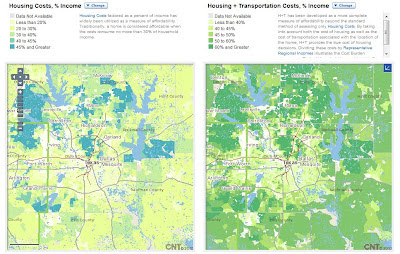
Hot Damn! Look how expensive housing gets when you factor in transportation. If you can't see or enlarge this graphic, darkest green is over 60% of pre-tax household income. Meaning after taxes, housing costs, and transportation, many people have nothing left to save or invest. Sweet system we're setting up. We couldn't sack this city any better if Attila were in charge.

Sherie Hammett, a mother of three who lives in a large Plano home, is one of many North Texans attracted to cozy suburbia for those reasons.

She said she sometimes drives up to 100 miles a day running errands. She keeps clean clothes and a small refrigerator stocked with water in the back of her Chevy Suburban.

“It’s the quality of life,” Hammett said. “It’s the safety of knowing your kids can be out front. You get a little bit of everything up here: The schools are good, you can get the space and still have money for others things.”

Lulz. This is the bit where we convince ourselves we love our captor. Nobody ever self-diagnoses Stockholm Syndrome. Extra money to spend on things like driving 100 miles per day. Life cycle of a highway section is only a few decades. This wasn't a down payment, but layaway. Bills are coming due.

Here is also a good point to show the data that sprawl is the least healthy, least safe place to live, particularly for kids. Diabetes and obesity are directly linked to sprawl. Oh, and the leading cause of death for teenagers? Car crashes. So if this woman is driving 100 miles per day, should we call Child Protective Services? (rhetorical)

We're rational people and Ms. Hammett made a rational decision, because it is better than the alternative, anything near the cities. Our policies don't allow us to build safe, desirable, attractive, walkable urban neighborhoods, which would proliferate if given half the chance.

Yet perhaps more than any other factor, the rise of big job centers amplified the pace and scale of development here.

Derp. Jobs follow housing, employment bases. People create demand

“He had the resources to do whatever it was he wanted to do,” said Robinson, who is now 72 and lives in Plano. “To build a city from scratch was just an incredible opportunity. It was just cow fields at the time.”

Little did Robinson and his boss think Legacy might jump-start an entirely new ring of suburbs. Combined, Legacy and Richardson’s nearby telecommunications corridor have almost as much office space as nine Empire State Buildings and are home to about 100,000 workers.

The corporate office campuses are failing badly. They needed a walkable core, hence Legacy Town Center. Not many places can pull off a Legacy Town Center. Not many places/people have the resources, land, will, and foresight to pull it off. Legacy Town Center will remain, much like Torrent, Spain exists. Everything around it has a far more uncertain future. Other sprawling municipalities will find the going much more difficult to recluster and will have to think differently while learning from Legacy's lessons both good and bad, while acknowledging they likely won't 1) have an EDS at its height nor 2) the 90's and 00's building/housing climate.

A commute from a subdivision in Prosper to downtown Dallas takes about 45 minutes without traffic. The drive from Prosper to Frisco is about 10 minutes.

If my aunt was my uncle she'd be my uncle. "Without Traffic." Let that one simmer a bit.

The funny thing about so many modernist policies is they establish some impossible ideal and frame that as reality. Free markets also function perfectly when no people are involved. Communism too. Pick your -ism.

These "corridors" funnel people toward certain roads thereby inducing traffic. There is very little route choice. Furthermore, since the hideously inhumane roads we build are sociofugal, meaning they decentralize and disperse us, meaning more and more Vehicle Miles Travelled for everybody. More cost for individuals, more infrastructure costs for cities, more taxes (eventually) on all of us. Have a nice day!

These are facts and they are indisputable. As proven by two recent studies. One by a Brown U. economist which showed every intra-city highway led to 18% population reduction (dispersal). And another showed that with every doubling of per capita lane miles, VMTs increased on a related 1:1 proportion. Double lane miles (with the intent of reducing traffic), people just end up driving more and further. And the bigger roads just fill up again with induced traffic. Mission: FAILED.

Dallas and Fort Worth have some of the highest lane-miles per capita in the country, trailing just Kansas City. This is badly misguided government spending at its worst. You'd think at a time like now, we'd choose pragmatism over profligacy.

The fundamental flaw in modernist road planning, building, and design is that it works best, optimally, when only one user is on the road. Everybody and everything else is an obstacle. This is why you (okay, I) get so subconciously angry whilst driving. Everyone else is the enemy. Someone to be bested.

Now, let's think about the real purpose of roads, of networks. And that is to facilitate social and economic exchange generating as much positive return on our investment as possible, with minimal "taxes" like congestion, delays, operations and maintenance of vehicles, etc etc.

If these roads work best when no one is on them, they are failing economically. When they are crowded, they cause traffic delays, congestions, wrecks, etc. and are failing socially.

Because property tax revenue is the lifeblood of local communities, cities are desperate to raise new cash through development. It is often the only option, as many Texas voters are averse to tax-rate increases.

Good thing our policies reduce tax base while increasing tax burden so your tax dollars go less and less far (snark). Walkability is a tax cut, people.

“Anyone who supports an increase in taxes is not a very good person and should not be re-elected,” jokedMichael Morris, transportation director for the Council of Governments. “So cities have to get their revenue from more development. … It’s hard for them to turn down any type of development.”

So let's plan, design, and fund transportation networks that ensure that development's life cycle will be as short as possible (snark). Integrated networks create opportunity, drive demand, ensure long-term utility and durability of an area, which manifests itself in development. Upward growth and maximization of land rather than outward growth.

Plano’s tax base has leveled off in recent years. So leaders have funneled millions in grants and tax abatements annually to encourage businesses to relocate, expand or just stay put. Collin County commissioners last year talked about granting tax breaks to almost every new business that opens its doors, an unprecedented measure. The county eventually settled on a scaled-down abatement.

You reap what you sow. Like there will always be another strip center, new and further down the road to cannibalize, there will always be another city willing to bet the farm on smokestack chasing. Meanwhile, other cities are experiencing an influx of talent and entrepreneurs, starting businesses, meeting demand, seizing opportunity, merely because they WANT to be somewhere. This lasts. Appealing to emotion is durable. Appealing to wallets is temporary. Necropolis.

“Texas has always been a very strong property rights and pro-growth state,” said Dave Gattis, historian for the Texas chapter of the American Planning Association. “It’s growth at any cost.”

The mindset of cancer cells.

Texas zoning laws have seen few changes since the 1920s, when a landmark U.S. Supreme Court case, Euclid vs. Ambler, laid the foundations for modern zoning practices.

Cut n pasted responses to industrialization.

Since then, most Texas cities have adopted rules that guide everything from setbacks and landscaping to the number of parking spaces required. Many also have drafted informal long-term visions for their communities.

Arbitrary, pointless, and often destructive themselves.

In many ways, the loose regulations complement this state’s long-standing culture of self-rule. Since the days of Sam Houston, Texas landowners have built as they have seen fit.

Which is why there was no sprawl until many of the restrictive policies and regulations were enacted, thus creating a singular homogenous product of sprawl. If the DMN is suggesting Texas libertarianism is the cause of sprawl, they couldn't be more off-base, ignorant, and misleading. Shameful.

The flip side is the perpetuation of a system that, from top to bottom, not only enables sprawl but encourages it.

“If there were no regulations at all, then people would be moving as far away as possible — assuming they could get public services,” said Gattis, who also serves as deputy city manager for Benbrook, a Fort Worth suburb. “There would be no protection of open space, no density. It would all be sprawl.”

See my last statement, this is wrong. 100% incorrect. Otherwise, they would be living in Montana or Alaska. Social and economic exchange, meeting our needs and wants is only possible around other people.

“You used to be able to tell the difference between McKinney, Allen, Plano, Richardson, Dallas. There was cropland between each one,” she said. “It’s all covered up in concrete now.”

And we're still running with the premise that this is market forces, that this is desirable, DMN? Hmmm? If you beat it into my head one more time I might start to believe it.

-------------------------------------------------------

Parts 2 and 3 to follow later this week as time permits.