Showing posts with label cars are murder. Show all posts

Thursday, May 20, 2010

CNU18 Highlights


I decided not to attend the yearly Congress of New Urbanism this year, perhaps still having had my full of Atlanta having lived there a decade ago. Here are the selected highlights of best soundbites that I've picked up off the various twitter feeds thus far:
-------------------------
New:

A cyclist can travel 3.5 miles on the energy of a 350-calorie slice of pizza. A car can go 100 feet.

How transit use correlates with physical activity: Transit users in Atlanta were found to be 3.42 times as likely as non-users to get their recommended 30 minutes a day of physical exercise.
Did some quick math of my own. If you burn .77 calories per kilogram of body mass per mile walked, I would be able to walk 5.64 miles on that same slice of pizza. Walkability wins!!! Of course, bikes can go faster.

In fact, now that I think about the ADT mph comparison from below, since bikes can travel at 20 mph (and much more safely) and can do so in denser "packs," we can therefore move more "traffic" ie greater Average Daily Traffic counts via roads designed for bikes.

And since bikes take less space, we need less infrastructure, of which bikes put much less eroding pressure upon, allowing for less maintenance costs. Dallas is having budget issues again by the way. Jus' sayin'.
-------------------------
Richard Jackson: If the whole country had Atlanta's rate of crash deaths we'd have an additional 15,000 deaths per year.
Apparently, it hasn't changed.
In Atlanta, traffic fatalities are leading cause of death from ages 3 to 33.
Displacing the Varsity, I presume.
Lawrence Frank - Proximity and connectivity are crucial predictors of obesity. Driving makes you fat.
You're fattest cities in America? Texas leads the way!! Let's add more pork (literally) to the highway trust fund.
David Byrne: Retailers want bike racks instead of car parking places in front of their shops b/c far more people can park...and large vehicles don't block the view of their storefront windows.
Charles Brewer: Taking the cars away means radically enhanced freedom for children.

Charles Brewer: I personally feel that most New Urbanists are such appeasers when it comes to cars.
A-effing-men.
Mike Lydon: Go out there and put cones up, show traffic engineers that roads will be fine and people will be happier.
Not unlike the Oak Cliff Better Block project. Do it. What we've also learned is that at higher speeds cars spread out. Meaning at 20 mph, the same amount of cars move through as at 45 mph. Since traffic engineers are worried about Average Daily Traffic counts, yet design for speeds of 45 or more, they are failing at their job by making streets LESS SAFE without moving more cars.

Since this suggests utter incompetence, take the power back. Reclaim your streets for your kids, your family, and your neighbors.

Thursday, March 11, 2010

The Danger Cars Pose

I've gotten some questions recently over at the Walkable DFW facebook group about what an average citizen can do about potentially unsafe or unwalkable roads in and around their neighborhoods and downtown. Not to plug too much, but the purpose of that group is to provide a forum for concerned citizens and activists to meet each other as well as engage directly with me seeking urban planning/organizational advice for the kind of information they need, who they need to talk to, as well as some general planning ideas for them to be empowered with some knowledge, information, and organization to start the ball rolling with their elected officials, no matter the municipality within the DFW metroplex.

With that in mind, the Infrastructurist has some startling graphics representing the toll roads take (get it?) on our bodies and minds.

Of course, cars and roads don't have to be unsafe, but the way they are designed is. While this is obviously a serious issue, I had to have some fun with it:
As in all cases, governing traffic speed via regulation/signage/enforcement is nonsensical and costly (when factored for policing, paperwork, etc.) Cars (w/drivers) will ALWAYS go as fast as the driver feels comfortable. Long, straight shot? Gun it. One way? Gun it. Turning radii allowing for high speed cornering and some dukes of hazzard style "wheelin' n' dealin'"? Gun it.
We certainly aren't meant to turn our brains off through lowest common denominator engineering currently driving road design. And evolutionary biology tells us that our eye-hand coordination and reflexes aren't adapted to 60 mph movement let alone 30.

I've discussed the issue of designing for dumb drivers and designing for smart drivers in the past:
Have you ever noticed how much safer and more polite Dallas drivers are when traffic lights are out, operating as blinking reds and the drivers are left to their own devices, responsible for their own safety. Interesting how they begin to cooperate with other drivers, no? Well, I have noticed.

Similarly, four-way stops are drastically much safer than any other form of regulated intersection. One reason is b/c of reduced speed in areas where stop signs are utilized rather than signals. The other primary contributive factor, is that (although not necessary due to literally written protocol for who goes first at 4-way stops) there is a necessary communication to some extent between the drivers: eye contact, a slow roll to indicate that "I'm moving. Hold back buddy," maybe even a honk or two...or this.

That communication, whether verbal or nonverbal, makes something infinitely more intelligent because there are now feedback loops.
Tightly controlling pedestrians with a view to improving the flow of car traffic just results in more and faster driving, and that makes life even harder and more dangerous for people on foot or on bikes.
Not to mention it allows drivers to tune out by funneling them virtually (and sometimes literally) into cattle chutes.
In fact, studies have shown that pedestrians are safer in urban areas where jaywalking is common than they are in urban areas where it is forbidden.
Essentially, it's creating some measure of chaos in the streets. Ewwwww, engineers hate chaos. Their theocratic formulas can't dictate. Their metrics can't measure. Can. Not. Compute. But, you can via safety statistics, measures of happiness, quality of place and real estate development on the street. For example - when the Champs Elysees went all travel lanes, all of the businesses died. When returned to parallel slip lanes w/ parking and wide sidewalks, it has become some of the most valuable floor space in the world.

To some extent, it is pushing the idea behind the Woonerf, or shared living space. The name comes from the fact that this is more residential in nature, the street as front yard for the residents, where children can play safely in the middle of the street w/ mother's watchful eye peering out the kitchen window. And they can, because the business (visually) of the street, the narrowness of the travel lanes, the lack of definition of the travel lanes (ie there are no 12' wide rights-of-way dictating direction), slows traffic. In sum, it's a free for all. See some pictures here (bottom of the post).
Which do you think it is, road design that turns your brain off? Or too many potentially incompetent or dangerous drivers on the road? Or a combination of the two?

Monday, December 14, 2009

Person without Veins?

Frankly, I don't know enough about the Vancouver Sun to tell whether or not it is a reputable rag. Articles like this one aren't helping however.

Some parts of their "Rethinking Green" series come off as purely contrarian (I too questioned recycling, focused on the dirtiness of the toxins in the materials getting recycled and the pretense of "doing something good,"), and then others like the linked above are just outright self-serving propaganda. I say that because of the singularity of opinion of those quoted in the article.

There are a million terrible definitions and interpretations of sustainability out there. What sustainability implies a system, one built upon a foundation of both economics and ecology, both of which are systems that are not fully understood. So therein, one can see the incredible difficulty in boiling down to what is sustainable and what isn't without a more wholistic view.

Not to take this into an ad hominem direction, but to only quote Cox and O'Toole is some shallow and self-serving "journalism." Neither are credible, on the payrolls of the road lobby, and are incredibly deceiving will their well-framed "statistics." Cox and O'Toole are notorious for taking incredibly narrow (and increasingly shrill) views of statistics that are intended to dumb down the debate into something little more than "OMG! Transit is so expensive!" So is caring for children, should we stop that?

My point isn't that transit is a magical panacea, nor that it is appropriate for cities of all shapes, sizes, and geographical contexts. It is that the debate is well beyond their, or this authors, scope. And to further narrow the stance to only include essentially two hucksters is to further drown the level of dialogue in the puddle beneath are feet (or tires if you wish). Why not include a real academic from your own neck of the woods like Tod Litman from VTPI?
------------------------------

The real issue that Cox, O'Toole and any other well-heeled faux libertarian simply cannot understand or argue with any sort of rigorous rhetoric effectively on their narrow view of statistics. Which is why you are seeing transit pick up steam the world over, and ironically generate more press for these two for anybody desperate for a sound bite in opposition.

"OMG, it's expensive!"

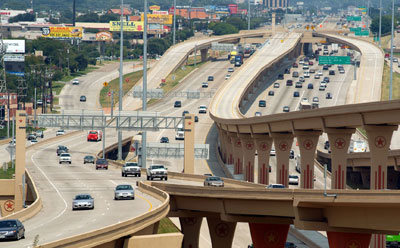
Simply put, car only subsidization has led to car only usage. Car only usage has led to incredibly wasteful projects like the high five in Dallas. While these types will argue that it improves economic development because it created jobs and improves connectivity and reduces traffic, , while it may temporarily reduce traffic (with nothing to say about the several years of construction and the resultant delays) the reduced traffic then has a negative effect by actually inducing more traffic b/c of the temporary gains, thus spreading people apart further. It also wrecks real estate values within any vicinity of it, because frankly, it is attrocious to be near (also, with nothing to say about the increased stress, birth defects, and respiratory issues by proximity to freeways).
http://tti.tamu.edu/publications/researcher/v44n1/images/dallas_high_five_lg.jpg

Transportation can never be looked at in a bubble. You can't isolate any particular system and suggest definitively whether it is "green" or not, whatever that means. The reason is because transportation, of any form, is inextricably linked and largely responsible for the resulant built-form of the city. The built form then interprets how the city functions.

To isolate the pro forma of any transportation system is like removing the arteries, veins, and capillaries from a human being and then wondering why the blood discontinued to flow. A doctor has to examine the health of the entire patient, to determine the health of the cardiovascular system and vice versa. If the City is unhealthy, the cardiovascular system (its transportation system) has to become more healthy.

Second, no form of transportation has ever "paid for itself." What these biased takes fail to understand is that the more governments subsidize road construction and sprawl, the more they have to subsidize transit, b/c the excessive road construction leads to fragmented, sparse, and disconnected land use, unsuitable for transit use, and therefore a failing transit system.

Relatedly, as transportation has a direct effect on land use, density, and the interrelationship between land uses, forms of transportation have multiplier effects that are incalculable in terms of sustainability and economy. The way to measure the "greenness" of transport is not in the functionality of transit systems but the built form and the emergent operations of the city sprung from it.

Car only-based transport policy leads to low density development which is more energy-consumptive, generates incredible amounts of waste thru increased air pollution from the car use, reduced water quality and environmental degridation from runoff, waste of man-hours in traffic jams, as well as increased refuse from a low-density lifestyle, and waste in supply-chains having to diffuse the distribution of goods to sparse, low density development.

This is bad for the economy as well for a number of reasons. The government builds roads that creates a low density form of development that, in turn, can not pay for the upkeep of the over-extended infrastructure. Furthermore, because of the fractured and disconnected development that emerges based on car-dominated transport policy, people think they are getting cheaper goods.

But, the fact of the matter is, extra costs have been externalized to the consumer and siphoned off every single trip by way of car ownership/maintenance, road construction and upkeep, health and productivity losses due to traffic and collisions. While creating a highway that links the Houston area to the Dallas area is a good thing, forcing all trips throughout the day to the confines of a car is wasteful and exclusionary of proportions never seen on this earth.

(Once again, with nothing to say about the 1.3 million people killed per year in traffic related collisions.)

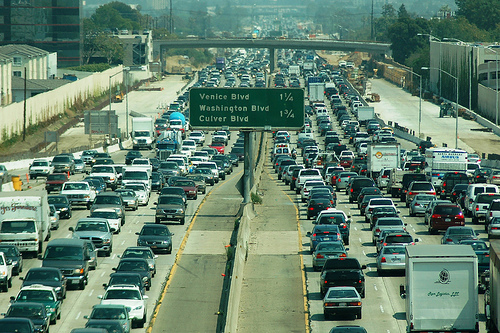
Lastly, and unfortunately for them, the ultimate decider in human decisions tends not to be an altruistic sense of right and wrong, and fortunately not even of $1 and 2$ but what makes life better? Would you rather live in a place like this?
http://www.greenprophet.com/wp-content/uploads/2008/12/highway-traffic.jpg

or a place like this?
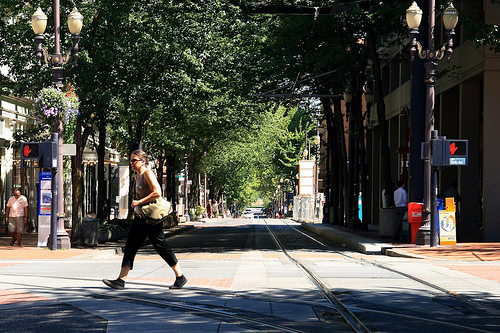
http://la.streetsblog.org/wp-content/uploads/2008/09_08/9_10_08_complete.jpg

One could say, "how can you compare those two things? Of course, I'm going to pick the pretty picture!" The reason is because these are the two end states of the divergent policies being debated. Should we craft policy that supports only the car, oil, and gas industry or one that the end result is people places?

A complete street, equitable to all transportation types and attractive enough to be livable, and in turn, entice density. The density then reduces Vehicle Miles Traveled, which reduces pollution, reduces the need for context-coerced car ownership, and reduces traffic. The density also makes business and retail more successful because there is a customer-base within a short distance at all times. A business can easily market from its storefront to a hundred residents that live above, or 500 pedestrians that walk past each day.

That is why THIS will eventually win the debate, suggesting it is time to the afforementioned cast of characters on IGNORE.