


Showing posts with label livable cities. Show all posts
Showing posts with label livable cities. Show all posts
Thursday, September 16, 2010
Diane Rehm Show
On right now, Diane Rehm is discussing Livable Cities, including one of this blog's favorite people, Super Dane Jan Gehl.


Monday, June 21, 2010
What is Livability
Any time a term rises from specialized fields to main stream dialogue, there tends to be a period of transition where the word lacks definition once it escapes the quarantine of academic or professional circles.
For example, sustainability now means everything from the high-tech (light-emitting diodes) to the decidedly low-tech (backyard vegetable gardens). Everybody and their brother describes themselves as an urban designer in the architecture and design world, which apparently the only qualification is counting parking spaces on a strip center or aligning a cloverleaf interchange. Truly urban indeed.
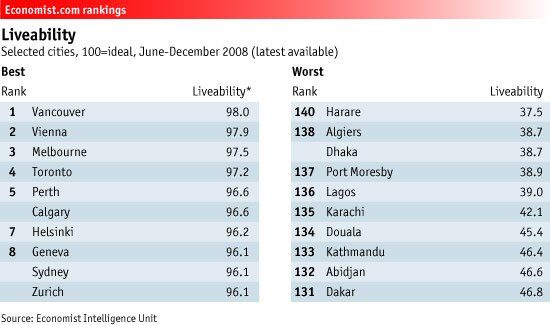
It only gets worse when that term readily escapes definition by its very reason for being. In this case livability. In the DMN's article about yours truly, a UT architecture professor mentions the term, but it gets little context. Every time there is a new ranking of world cities based on Livability, puzzlement ensues. Next American City wonders who gets to define it.
The problem is two-fold. First, our inherent need of language to have a set definition and to be so defined by an established authority. The second, and related to said "established authority," is the architecture profession's foolish Ayn Rand inspired need to be said authority, which ultimately and typically mucks up cities more than it does improve them.
Livability escapes definition because it means different things to different people, as it should. It is not top-down or bestowed, but bottom-up and created. Any good urban designer, city builder, developer, or city official's job is about providing the platform for that to occur: choice.
Represent your market as Howard Bloom states in his treatise and defense of Capitalism:
I would, and often do, argue that cities are the physical embodiment of economies. And economies are created and driven by human need. Therefore, human need written deep in our genetic code are the source for why cities are the way they are. Need creates Economy. Economy is City. Need is City.
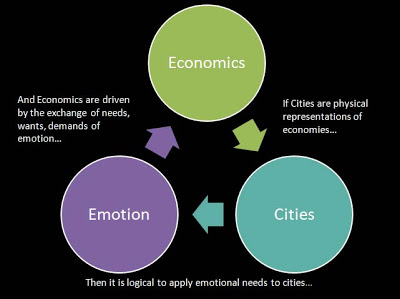
And these perpetually shift in the spiral of human progress and folly.
Human need is why the internet hasn't spelled the end of real, social interaction as many doomsayers feared we might be locked in a room interacting solely via chatroom. We need human interaction. So we molded the internet into a social tool, web 2.0. Now the web is used to enhance cities, because we need them.
It is why it took a pollster and statistician, Nate Silver of Five-Thirty-Eight.com to understand the variable nature of livability as he helped New York Magazine create a web-based application where people could adjust sliders based on how important certain factors are to them, such as good schools, housing affordability, nearby restaurants, nightlife, and mobility aka access to multiple modes of safe, efficient, distance-appropriate transportation.
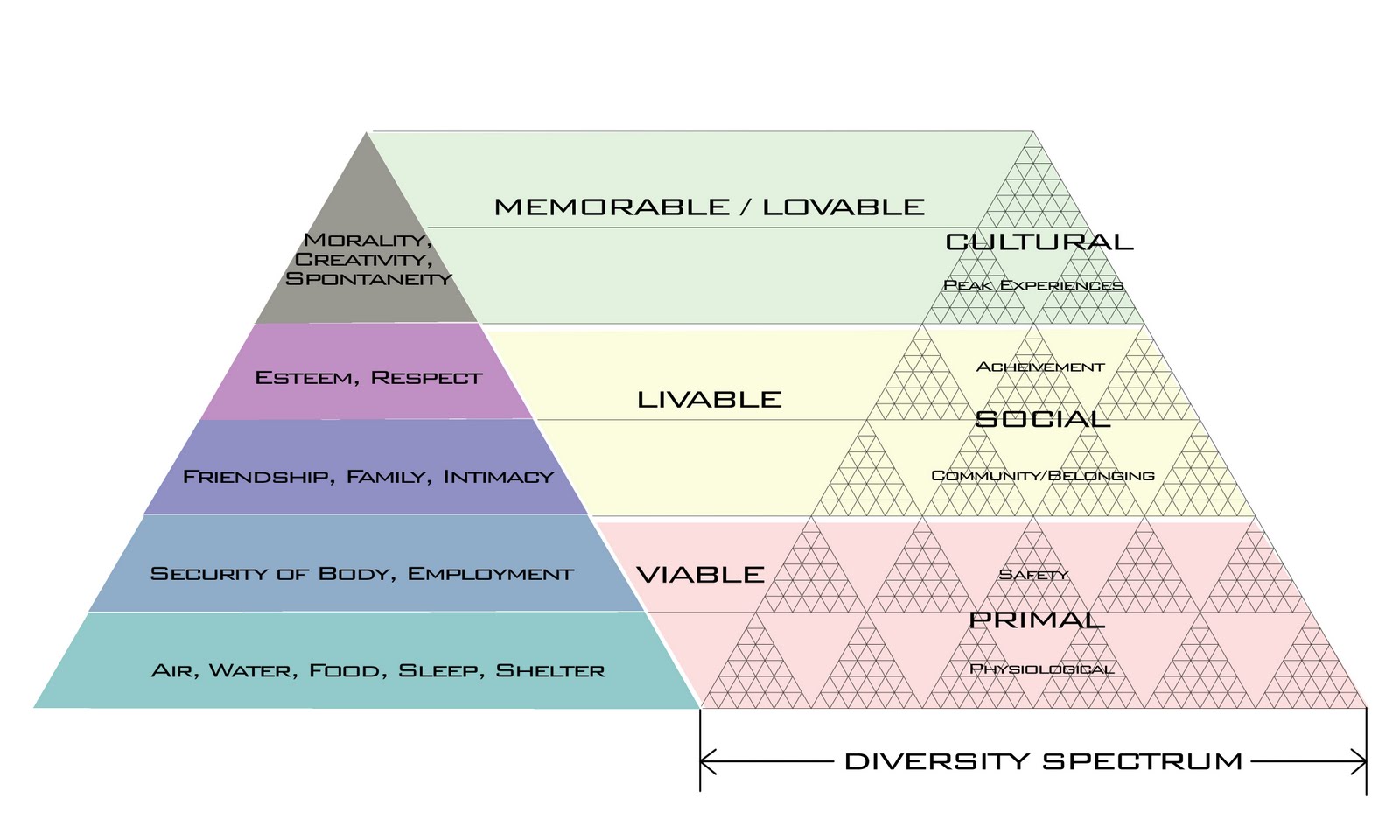
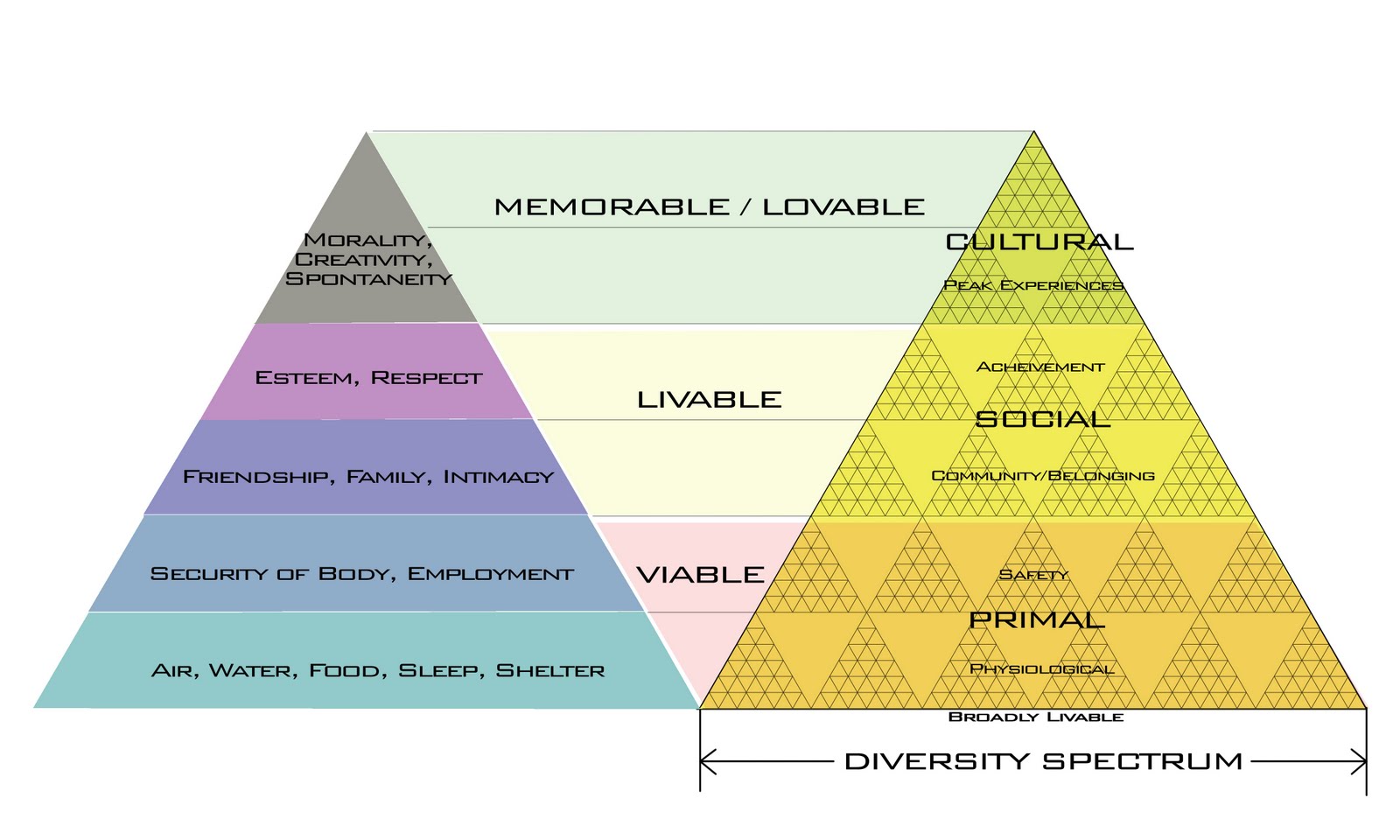
While we can safely assume there are certain factors we, as humans, universally require in determining a livable place (typically the bottom rows Maslow's pyramid, such as safety, hence being the widest for the most amount of people with such needs), the variability of such factors are based on our own prioritization process.
Unfortunately, we're incredibly bad when we're asked what we're looking for and surveys are often skewed by respondents answers influenced by their own expectation of what they expect the surveyor wants to hear. A far better indicator is the value we place on certain areas or parts of town. It means there can't be such pent up demand for walkable urbanism.
Of course, that requires real choice in the market place beyond which cul-de-sac you decide to lay your head within a stick-and-paper McMansion built to last less than twenty years. It also means mobility aside from the expert skill in deciphering which land is moving the most quickly during rush hour. And it is why the transect is important.
If you are wondering why Zurich, Copenhagen, and Munich rank so highly on livability, but aren't considered Global Cities, it is because they provide the greatest availability of education and opportunity to the widest range of its citizens. It is because they are safe and have a variety of housing types. They take care of the most basic of human needs with access to clean air, clear water, and healthcare. These are the lowest levels of Maslow's pyramid. They are the platform of livability.
We're busy caking on monuments to supposed culture without the availability of the most basic human needs. If a city is Maslow's Pyramid, no structure can stand without a foundation.
When I think about livable cities, I think back on some of my favorite childhood readings, choose-your-own-adventure books. In Livable Cities, you can choose your own adventure where each has the ability to live the way they want and has the faculties available to them to pursue such a life without diminishing the pursuits of others. In some cases, such as transportation, it is about the provision of all modes safely, effectively, and ideally...attractively.
Perpetual subsidies to the auto industry, the highway construction lobby, and towards unnaturally cheap gasoline is one very expensive obstruction.
Professor Almy lumped walkability in with livability and rightly so as it is integral to Livable Places. Walkable places are not those that you must drive to, valet your car, and proceed to walk around (although here in Dallas we have a funny way of describing such places as walkable). Walkable places are those you can walk to, not walk within. Malls are failing throughout the country for this very reason. Walkability is a necessary ingredient as it refers to interconnected, complete neighborhoods where all can participate and do so without lighting their hard-earned money on fire in an internal combustion engine.
With an economy heading towards one that is more individually customizable, cities are only bound to follow to a place that is more self-defined.
For example, sustainability now means everything from the high-tech (light-emitting diodes) to the decidedly low-tech (backyard vegetable gardens). Everybody and their brother describes themselves as an urban designer in the architecture and design world, which apparently the only qualification is counting parking spaces on a strip center or aligning a cloverleaf interchange. Truly urban indeed.
It only gets worse when that term readily escapes definition by its very reason for being. In this case livability. In the DMN's article about yours truly, a UT architecture professor mentions the term, but it gets little context. Every time there is a new ranking of world cities based on Livability, puzzlement ensues. Next American City wonders who gets to define it.
The problem is two-fold. First, our inherent need of language to have a set definition and to be so defined by an established authority. The second, and related to said "established authority," is the architecture profession's foolish Ayn Rand inspired need to be said authority, which ultimately and typically mucks up cities more than it does improve them.
Livability escapes definition because it means different things to different people, as it should. It is not top-down or bestowed, but bottom-up and created. Any good urban designer, city builder, developer, or city official's job is about providing the platform for that to occur: choice.
Represent your market as Howard Bloom states in his treatise and defense of Capitalism:
Visit neighborhoods and towns you've never seen. Do what saints and saviors do. Go among your people. People you've never imagined meeting. Get to know them. Stand up for them at meetings. Fight for them when plans are laid. Bring humanity new ways of being, new ways of seeing, and whole new forms of life and play.While that passage looks remarkably like it is about cities, the book only touches upon cities in a very general or anecdotal manner. In it, Bloom provides the historical and biological imperative of capitalism. So discussing economies why does it read like he's rabble rousing for the next public meeting regarding a new urban plan?
I would, and often do, argue that cities are the physical embodiment of economies. And economies are created and driven by human need. Therefore, human need written deep in our genetic code are the source for why cities are the way they are. Need creates Economy. Economy is City. Need is City.

And these perpetually shift in the spiral of human progress and folly.
Human need is why the internet hasn't spelled the end of real, social interaction as many doomsayers feared we might be locked in a room interacting solely via chatroom. We need human interaction. So we molded the internet into a social tool, web 2.0. Now the web is used to enhance cities, because we need them.
It is why it took a pollster and statistician, Nate Silver of Five-Thirty-Eight.com to understand the variable nature of livability as he helped New York Magazine create a web-based application where people could adjust sliders based on how important certain factors are to them, such as good schools, housing affordability, nearby restaurants, nightlife, and mobility aka access to multiple modes of safe, efficient, distance-appropriate transportation.
While we can safely assume there are certain factors we, as humans, universally require in determining a livable place (typically the bottom rows Maslow's pyramid, such as safety, hence being the widest for the most amount of people with such needs), the variability of such factors are based on our own prioritization process.
Unfortunately, we're incredibly bad when we're asked what we're looking for and surveys are often skewed by respondents answers influenced by their own expectation of what they expect the surveyor wants to hear. A far better indicator is the value we place on certain areas or parts of town. It means there can't be such pent up demand for walkable urbanism.
Of course, that requires real choice in the market place beyond which cul-de-sac you decide to lay your head within a stick-and-paper McMansion built to last less than twenty years. It also means mobility aside from the expert skill in deciphering which land is moving the most quickly during rush hour. And it is why the transect is important.
If you are wondering why Zurich, Copenhagen, and Munich rank so highly on livability, but aren't considered Global Cities, it is because they provide the greatest availability of education and opportunity to the widest range of its citizens. It is because they are safe and have a variety of housing types. They take care of the most basic of human needs with access to clean air, clear water, and healthcare. These are the lowest levels of Maslow's pyramid. They are the platform of livability.
We're busy caking on monuments to supposed culture without the availability of the most basic human needs. If a city is Maslow's Pyramid, no structure can stand without a foundation.
When I think about livable cities, I think back on some of my favorite childhood readings, choose-your-own-adventure books. In Livable Cities, you can choose your own adventure where each has the ability to live the way they want and has the faculties available to them to pursue such a life without diminishing the pursuits of others. In some cases, such as transportation, it is about the provision of all modes safely, effectively, and ideally...attractively.
Perpetual subsidies to the auto industry, the highway construction lobby, and towards unnaturally cheap gasoline is one very expensive obstruction.
Professor Almy lumped walkability in with livability and rightly so as it is integral to Livable Places. Walkable places are not those that you must drive to, valet your car, and proceed to walk around (although here in Dallas we have a funny way of describing such places as walkable). Walkable places are those you can walk to, not walk within. Malls are failing throughout the country for this very reason. Walkability is a necessary ingredient as it refers to interconnected, complete neighborhoods where all can participate and do so without lighting their hard-earned money on fire in an internal combustion engine.
With an economy heading towards one that is more individually customizable, cities are only bound to follow to a place that is more self-defined.
Sunday, June 6, 2010
READER FEEDBACK: Dallas Might Be Gaining People But Losing the Creatives
From long-time loyal reader and regular commenter Himanshu gets bumped from the comments section on Diversity as Livability Indicator to the headline cuz, like woah:
Over the last few years however, I have seen scores of talented people move away from Dallas to cities like Portland, Seattle, DC, Boston, and New York being the most common destinations. Given that this particular reader has the means to be able to live in and move from downtown Dallas to center city Philadelphia, these are the kinds of people that we don't want to be losing.
When we look at population figures stating that Dallas is gaining people and that the economy is holding steady or adding jobs, they never tell us what kind of jobs or who these new residents are. These are the definition of dumb statistics. Anecdotally, it feels like we are losing talented people and replacing them with people just looking for a job, any job. The difference between what we're gaining and what we're losing is the difference between a steady current economy and a strong future one.
If we are adding jobs, they are mostly towards the status quo businesses and the "Great Reset" (Richard Florida's term) is a repurposing (evolutionary biologist term) of the economy where the genotype (new generations) shed the phenotype (the past economy) in favor of a new and more serviceable one. Point being that the economy, and our cities in turn, will be very different in 20 or 30 years.
Those we seem to be losing on the negative end of the import/export equation are what Richard Florida might refer to as the Creative Class. While people might interpret Florida here suggesting that the term "creative" implies artisans such as musicians or sculptors or what not, my interpretation is that Florida, the demographer, only uses those as a measuring stick. Professions whereby improving the lives of those who have the means and ability to locate where they choose based on Quality of Life of a particular city meeting their particular needs. The more livable the place, the greater number of these types of people's needs will be met there, the more likely they are to relocate there.
These are the people we MUST be attracting and retaining. While I despise Ayn Rand for missing her own point (or being able to temper it within reality) and dreadfully long soliloquies, these people are the true fountainheads. They are the Structure Builders of the pillars of the future economy by which real, sustainable job growth and long-term prosperity can be founded upon.
They are the measuring stick for where our City will be in 20 years in relation to those where they are choosing to relocate. And we are losing them.
Himanshu mentioned Livability. Washington Post writer Neal Pierce discusses it as well today where he expresses frustration at the vague nature of the umbrella term but the necessity of the concept.
I will help him out. Livability, what people are looking for and where they are moving to are places where choice is in abundance; where people can live the way they want without fear of persecution; where people can find quality housing of the size and type suitable to their needs in neighborhoods of the character matching their desires. Multiple modes of transportation are available allowing for the universal access of all to their destinations. Then there are other kinds of access such as, to education for personal advancement and the CHOICE of careers and to healthcare and justice for well-being of body, mind, and soul.
This is precisely why I am driven crazy by "pro-business" policies. There is nothing about them that is about advancing business or the economy, but rather to protect the status quo. But, the status quo doesn't freeze happiness, comfort, rainbows and unicorns in place. You either progress or get left behind and the status quo ensures falling behind. Sometimes this can mean that a country's industry falls behind another or it can mean the country's people fall behind and are stuck with the bill. See: BP.
To bring this closer to home and back to the focus of this blog, I'm reminded of the new Tarrant County College "campus" in downtown Fort Worth (and one of FortWorthology's personal obsessions) where Kevin was told the anti-urban design was "just being realistic" about Fort Worth's car-orientedness. Status-quo. And here I thought, educational institutions were supposed to be thought leaders, shaping the future and the minds thereof.
This is the race to the bottom and it is time to start investing in people. It is people that create the economy and our cities not the other way around and our future depends upon it.

Well, you have an uncanny way or writing down things that I have been thinking. After having worked in downtown Dallas for the better part of the past decade, and having seen the areas of downtown and uptown get better, they still don't seem to catch the essense of what I'm looking for in my neighborhood. So, I'm moving to Center City Philadelphia--Society Hill, specifically. I look forward to ditching my car and walking to work and home, walking to all the bars and pubs and grocery stores, enjoying picnic lunches at Washington Square or Rittenhouse Square or Fitler Square, etc. Shopping on Walnut Street and Market Street and Reading Terminal Market. And doing all this in a place that has a sense of place, has livability, and walkability galore. Your old town, I suppose. But I will continue reading your blog from time to time. Keep it up! And perhaps you'll move (back) to Philly sometime in the future...Unlike some other regular readers, I have never met Himanshu personally (unless I'm unaware). While this blog doesn't get the kind of traffic that generates the kind of traffic to turn it into a giant money maker itself, it does get a loyal following, and an engaged, intelligent one focused on improving Dallas or general urban issues at that.
Over the last few years however, I have seen scores of talented people move away from Dallas to cities like Portland, Seattle, DC, Boston, and New York being the most common destinations. Given that this particular reader has the means to be able to live in and move from downtown Dallas to center city Philadelphia, these are the kinds of people that we don't want to be losing.
When we look at population figures stating that Dallas is gaining people and that the economy is holding steady or adding jobs, they never tell us what kind of jobs or who these new residents are. These are the definition of dumb statistics. Anecdotally, it feels like we are losing talented people and replacing them with people just looking for a job, any job. The difference between what we're gaining and what we're losing is the difference between a steady current economy and a strong future one.
If we are adding jobs, they are mostly towards the status quo businesses and the "Great Reset" (Richard Florida's term) is a repurposing (evolutionary biologist term) of the economy where the genotype (new generations) shed the phenotype (the past economy) in favor of a new and more serviceable one. Point being that the economy, and our cities in turn, will be very different in 20 or 30 years.
Those we seem to be losing on the negative end of the import/export equation are what Richard Florida might refer to as the Creative Class. While people might interpret Florida here suggesting that the term "creative" implies artisans such as musicians or sculptors or what not, my interpretation is that Florida, the demographer, only uses those as a measuring stick. Professions whereby improving the lives of those who have the means and ability to locate where they choose based on Quality of Life of a particular city meeting their particular needs. The more livable the place, the greater number of these types of people's needs will be met there, the more likely they are to relocate there.
These are the people we MUST be attracting and retaining. While I despise Ayn Rand for missing her own point (or being able to temper it within reality) and dreadfully long soliloquies, these people are the true fountainheads. They are the Structure Builders of the pillars of the future economy by which real, sustainable job growth and long-term prosperity can be founded upon.
They are the measuring stick for where our City will be in 20 years in relation to those where they are choosing to relocate. And we are losing them.
Himanshu mentioned Livability. Washington Post writer Neal Pierce discusses it as well today where he expresses frustration at the vague nature of the umbrella term but the necessity of the concept.
I will help him out. Livability, what people are looking for and where they are moving to are places where choice is in abundance; where people can live the way they want without fear of persecution; where people can find quality housing of the size and type suitable to their needs in neighborhoods of the character matching their desires. Multiple modes of transportation are available allowing for the universal access of all to their destinations. Then there are other kinds of access such as, to education for personal advancement and the CHOICE of careers and to healthcare and justice for well-being of body, mind, and soul.
This is precisely why I am driven crazy by "pro-business" policies. There is nothing about them that is about advancing business or the economy, but rather to protect the status quo. But, the status quo doesn't freeze happiness, comfort, rainbows and unicorns in place. You either progress or get left behind and the status quo ensures falling behind. Sometimes this can mean that a country's industry falls behind another or it can mean the country's people fall behind and are stuck with the bill. See: BP.
To bring this closer to home and back to the focus of this blog, I'm reminded of the new Tarrant County College "campus" in downtown Fort Worth (and one of FortWorthology's personal obsessions) where Kevin was told the anti-urban design was "just being realistic" about Fort Worth's car-orientedness. Status-quo. And here I thought, educational institutions were supposed to be thought leaders, shaping the future and the minds thereof.
This is the race to the bottom and it is time to start investing in people. It is people that create the economy and our cities not the other way around and our future depends upon it.
Thursday, May 27, 2010
Livability Indicator: Diversity
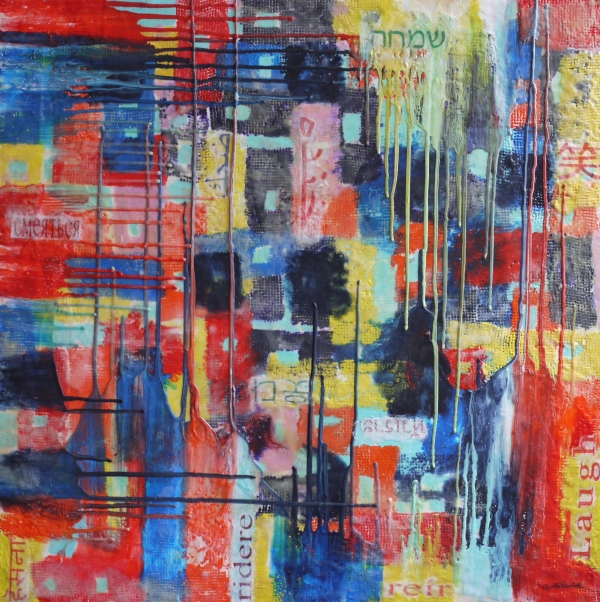
Painting by artist Heather Hennick.
I have often heard or read of planners suggesting that areas need diversity as if that quality is something you can will into existence with a magic wand, also known as the architect's magic
Is diversity absolutely necessary for creating livable places? The short answer is no.
In this post, I will show that diversity is more of a by-product of livability than it is a producer of livable places, which points to it as a very clear indicator of livability (an outcome). While there are certain design measures that can allow for diversity (accessibility, mobility, diversity of housing type), it cannot be willed into existence. However, it does contribute in other ways, which we will also examine.
Therefore, in areas in need of revitalization aka those in need of a greater degree of livability (or desirability), diversity can be a performance measure by which livability is measured. People often mistake revitalization for commerce. But commerce cannot exist sustainably and predictably without people, meaning livability. On the other hand, diversity is an absolute necessity for achieving higher levels of lovability or memorability as it comprises a broader base, the foundation authentic, upon which memorable places are built.
A biologist would say the greater amount of species in an ecosystem (diversity) the more complete the elaboration of life. In terms of cities, this means a broader base and the potential for a higher plane for what a City can be.
A rain forest (home to a greater array of kingdoms, phylums, families, orders, genuses, and speciese) serves as a natural metaphor as the most complete known elaboration of life. Not uncoincidentally, in many ways it provides life to everywhere else on the globe b/c it is such an exporter (resources, oxygen, co2 sink, etc.). A rain forest is the actualized city. These are the global cities bubbling over with culture and new ideas of thinking and being that are then exported to the rest of the world.
However, this also implies that life exists in lesser diverse situations, ie places deemed livable by various species. So how do we find that point and how does it apply closer to home? In Mercer's recently released Global Livable Cities rankings, they aren't ranking global "rain forests," but places where the more basic needs of all are met the best.
Using Maslow's hierarchy of needs as I am fond of, helps to determine exactly where and how a place might fit within the vague notion of livability. The pyramid is widest at its base where the most amount of people have those needs. We all need food, water, and air to survive. At the top, we don't all need peak experiences of culture to survive. So livability isn't about being "world class." It is about other things.
Because livability is such an elusive concept and one that is difficult to define. The best way is to take the simplest, evidence-based approach. Are people living there? If not, why not? And because Livability can mean different things to different people, are different types of people living there?
Can an individual find a job and afford a residence nearby?
Are senior citizens able to get around? Do they have mobility?
Can children play in the streets or ride their bikes without the constant supervision of helicopter parents or be run over by maniacal valets?
Do women feel threatened or unsafe walking the streets alone or at night? Since women and children typically require a greater degree of safety than say me or Mac from Always Sunny in Philadelphia because we work our glamour muscles, can roundhouse kick and have made a collection of video tapes from Project Badass.

Totally.
If the answers to these and many other questions are yes, chances are diversity has been attracted for these various basic needs. Therefore the place is Viable, the foundation of Livability because all of the primal needs are met.
The next question to be asked and answered is what defines diversity? While diversity is often associated with race, it can mean a variety of age, gender, income, cultural heritage, background, etc.
As mentioned earlier, design can allow for certain amount of diversity but there are other mitigating factors at play beyond that of mere urban design. For example, nationality or race tend to congregate in areas for comfort, familiarity, or because of language barriers.
Uptown is a livable place, but is fairly narrow in its social makeup. This is reflected in its elaboration, particularly in its neighborhood services, the outgrowths of the residents. The commercial and social experience is similarly narrow, mostly alcohol induced at the many bars that while they may seem different are all as homogenous as its patrons.
However, uptown remains Livable because of its walkability and density. It achieves Social needs. This might be revealed in comparison to conventional drive-to suburban development where services are even more homogenous (greater reliance on chains).

Since only a certain segment of the population are able to satisfy their more basic needs in uptown, shelter and the affordability thereof as the predominant factor, uptown is only livable for a few and the foundation of the neighborhood is quite narrow (at least in its current iteration) and its potential limited.
This can also apply to downtown Dallas. While it is probably more affordable (now that rental prices in downtown are finding their right value), a greater array of income levels are able to live in downtown, but less people find it safe or appealing (for a variety of reasons). So the foundation remains narrower than it needs or should be in order to be as successful as we want.
However, I find it suitable to my needs. Even without a car, I have mobility due to adequate transit and a willingness to erode shoe leather. I can afford space that I like and have a number of bars and restaurants nearby. In my particular subjective criteria, I find it livable.
For example, give me an Indian buffet, a soul food joint, a good sushi house, and a neighborhood bar and I'm a happy man. The proprietors of those establishments should have the ability to be a part of the neighborhood as well if they so choose. But not only the proprietors, but the various generations of their families and their workers should be able to find suitable homes there as well. This further embeds their stake in and stewardship of the community while making it all the more authentic, which I define as unique qualities or character as a direct outgrowth of an area's residents.
I once quipped that the only animals that existed in downtown Dallas were rats, carp, pigeons, and people. We're in good company. That was of course, over 5 years ago and the population has since doubled. You can compare us newcomers to the grackles. To get to the next level, we need our neighborhoods (of which downtown is one) to be a better habitat for more species, more types of people. Whether the diversity follows is irrelevant to livability, but it isn't to making Dallas a more memorable place and competing with the global "rain forests" of the world.
This City produces a preponderance of talent
If we want our city and our neighborhoods to be "rain forests" known and mentioned on the global scale, or to move up in the myriad of Livable Cities rankings sure to grow in number, we have to focus all areas on being livable for the greatest range of residents and do so with high quality, creative urban design. Who can then choose to live in the neighborhood that most suits the character for which they are looking. Where they can feel a sense of belonging.
This means ranges of housing types and affordability (shelter). It means access to transit and walkable neighborhoods (mobility). It means clean air, water, and I suppose I should say clean food. It means a free and fair political environment. It means safety through design (CPTED) and enforcement without sacrificing justice. It means fostering diversity and the opportunity for all to contribute what they have to offer the world through livability building a positive feedback loop where diversity uplifts livable systems (attracting diversity) into a more lovable, memorable City.
Monday, May 10, 2010
Reader Feedback - Woodall Rogers and Parks as Catalysts
After posting the discussion of Woodall Rogers Deck Park and Lessons on Return on Investment as catalyst for change or as cherry on top of an unmade sundae, I received this email from Brandon Hancock of GreenShoots Real Estate (published with permission):
Following the logic of demand-driven places, parks can be both. If a City decides that it wishes or needs a certain portion of town to revitalize, become safe, attract investment, then a new park can enhance the livability that is lacking, the reason for disinvestment. However, a park alone is rarely enough. It has to be one part of the plan including changes to the transportation network, typically to improve the "green infrastructure" or walkable/bikable access to the park, and possibly even financial incentives to reverse momentum in an area.
On the other hand, a park can be the finishing touch on a neighborhood, the cherry on top so to speak. This is also demand driven. If enough people agglomerate around one magnet that the distance, scale, or density of the new development creates the demand for an additional park or amenity closer to the recent development. This will create a new sub-center (or altogether new center of gravity) for the neighborhood. Does it become an entirely new neighborhood or a hierarchical place within the existing one is a place specific question.
So is Woodall Rogers a catalyst for change or a cherry on top? The answer is that it is (ought to be) a little bit of both. The new density requires some reasonable greenspace because the transportation network is unwalkable. AND, because the transportation network in the area is so bad, that the park can be the catalyst for transforming it into one that is more walkable, livable.
Although I’m a fan of the “park” for connectivity reasons (although, as you pointed out it may be more a visual connection than a walkable/bikeable connection), I completely agree with you on the ROI side of the equation. I believe a few projects bordering Woodall delivered faster b/c of the promise of the park, but I absolutely 100% believe the development would have happened without the park due to the location of the land (Uptown to the North and Arts District to the South).This is precisely the point I was implying. In a recent tweet, I stated that authentic places are always demand driven. So what does this mean for parks? Are they cherries on top or catalysts for change? Chemical reactions don't start on their own.
I think an interesting case study would be Discovery Green in Downtown Houston. I’m not sure how familiar you are with the park or Downtown Houston, but numerous government entities had invested close to a $1 billion in the East side of downtown to spur investment. First it was Minute Maid Park at a cost of $250 million in 2000. Then it was the $150 million convention center expansion in 2002, the $200 million Toyota Center and the $285 million convention center hotel in ’03. For all of that investment the city received a private sector investment in new or redeveloped properties of I’m guessing well under $100 million. The only development that occurred in the immediate vicinity of the new projects was a smallish boutique hotel across from the ballpark and the requisite sports bars surrounding the ballpark (although nothing that would sustain a healthy nightlife).
Since the 12 acre, $125 million Park was announced and after its subsequent opening in 2008, there has been numerous private sector developments built on the perimeter of the park. Two new office buildings, Houston’s first new ground up residential tower in decades (with a grocery store), and a hotel are all under construction or have been completed. Combined there is over $1 billion+ in new private sector development that can be directly attributed to a well programmed urban park. That is almost a direct inverse of the ROI generated by the public sector investments earlier in the past decade. And all this is happening in Houston, not exactly known as Portland when it comes to livability and outdoor activities.
I feel a well-funded public/private investment in a park similar to Houston’s Discovery Green in a depressed area of Downtown Dallas would do wonders for livability and investment in the downtown core. My vote would be for an area east of the convention center and south of city hall. If they eventually cap 30, that opens up the Cedars which in my opinion is the greatest chance we have for a close-in mixed income residential neighborhood in Dallas.
Regards,
Brandon
Following the logic of demand-driven places, parks can be both. If a City decides that it wishes or needs a certain portion of town to revitalize, become safe, attract investment, then a new park can enhance the livability that is lacking, the reason for disinvestment. However, a park alone is rarely enough. It has to be one part of the plan including changes to the transportation network, typically to improve the "green infrastructure" or walkable/bikable access to the park, and possibly even financial incentives to reverse momentum in an area.
On the other hand, a park can be the finishing touch on a neighborhood, the cherry on top so to speak. This is also demand driven. If enough people agglomerate around one magnet that the distance, scale, or density of the new development creates the demand for an additional park or amenity closer to the recent development. This will create a new sub-center (or altogether new center of gravity) for the neighborhood. Does it become an entirely new neighborhood or a hierarchical place within the existing one is a place specific question.
So is Woodall Rogers a catalyst for change or a cherry on top? The answer is that it is (ought to be) a little bit of both. The new density requires some reasonable greenspace because the transportation network is unwalkable. AND, because the transportation network in the area is so bad, that the park can be the catalyst for transforming it into one that is more walkable, livable.
Tuesday, May 4, 2010
How To: Fail? Temporarily, At Least

Given the notoriety local mega projects around the Metroplex have garnered, and rightly so in many instances (see: here, here, and here), I found a recent article on the perceived failings of a project in almighty Portland to be particularly interesting. Portland has been working on this thing we call "new urbanism" aka old urbanism but ideally without the freeways and more ideally without the phony, nostalgic architecture for much longer than we have. So they tend to get things right more often than Dallas has, but only through trial, error, and a better (or more willful) understanding of transportation policy/planning's implicit effect on urbanism.
To link to it once again, the article is We Built This City in the Portland Mercury about the South Waterfront in Portland, Oregon. The south waterfront sits somewhat isolated on a peninsula like sliver between the Willamette River and I-5, not unlike Delaware exists in relation to its downtown of Philadelphia.

If the article doesn't get at the primary issue within its body, it at least alludes to it in the title. No, it wasn't built on rock n' roll, but it was built on the faulty logic "that if you build it, they will come" that often torpedoes the best (and most ambitious) of intentions. It was a movie. It makes for a great soundbite, but as far as real estate strategy, if it isn't demand driven, it is likely doomed. Like in Field of Dreams, they built it and only ghosts came.
I like ambition as much as the next guy, but if it isn't tempered either by a deep understanding of urban dynamics (the kind of thing most in real estate either get only by intuition or luck) or extremely patient money, it is doomed to be considered a failure.
However, much like Las Colinas, the fundamental flaw with the South Portland waterfront is only one of timing and possibly ambition, not in fundamental (or unmanageable) failings in the vision or planning. Unlike Victory and Park Lane Place locally, the South Portland Waterfront got pretty much everything right. It just delivered too much product, too soon, to an overly narrow market segment. It has transit service, a grid of streets, and nigh flawless architecture (from an urban design perspective) that engages the public realm.

From a design perspective, its failings are of the nitpicking sort: the trees planted were mere saplings, some of the retail spaces are too withdrawn behind thick columns hindering visibility, but most importantly, many of the buildings are overscaled. Not just for the street, but for the market.
On this project in Portland, despite the architects' best efforts to accommodate the density in an engaging, urbane manner, the density and mass still overwhelms. High end "urbanism" often ends up being anything but urban. It is defensive. It doesn't interact with the street. It looks and feels exclusive, which when solated is fine, but when it dominates then it undermines the participatory interaction of urbanity. Portland is more of a middle class city, with middle class sensibility and middle class urbanism.
Its perceived failings are only that it was too ambitious. Market and timing are the flaws. So now it sits empty. But, it won't for long. The plan delivered a supply of only high end condos when that market was saturated. How many rich people are there in the world? Not everybody can purchase a $1 million condo. Other classes want the amenities of urbanism as well, but where is there product choice. The City does have plans for affordable housing in and around the development, none of which has yet to be delivered.
There is a worry of no retail and no grocery stores, but those are both eggs moreso than chickens within urbanism. They will come. As will more chickens, once land, housing, and construction prices find their right value. Particularly if a broader demographic range of residential fills in the blanks, which it will. The developer(s) just went for too much too soon. The scale of development is more befitting of Canary Wharf in London than it is Portland. However, Portland is still a desirable City, particularly for recent and soon-to-be graduates.
The worry now might only be that the intensity of development overvalues the rest of the land when the remaining development probably wants to be low- to mid-rise. See the remaining voids surrounding the initial phase of development below.

Eventually, it will be successful. Somebody will have to take the loss for when the high end condos get marked down, chopped up, or auctioned off to find where the market really is without the voodoo of a funny money housing bubble world.
To examine another worry, aka barrier, I want to step back for a moment to the contextual map. See how the South Waterfront has little to no context. It is in effect a cul-de-sac. In fact, the streetcar line even terminates and turns around within the development.
Healthy cities are represented by a typical conical shape to their skylines. They build up to something in the center. The point of highest interaction and desirability. The point(s) with the greatest metabolism in the exchange of goods, services, needs, wants, desires, laughs, and love. Yes, there can (and should) be multiple centers probably within the imposed hierarchy of a locally applied Zipf's law. Centers don't want to be at the end of the road.
The Pearl District, in aqua, is considered a huge success. Of course, it beat the bursting bubble to the punch and has largely been built out. But it also was right next to downtown and infilled with an appropriate scale. It had more to build upon.

Pearl District.
Just below is the South Waterfront, zoomed in. You can see how it is isolated. There is a possibility that because of the lack of context that it will never fulfill its promise, or saturate its supply (especially not at the prices pro forma'd). But, part of me still thinks that like Las Colinas, 20, 30, or 40 years down the road, its barriers will be removed as values change and as the City grows to a point that it needs Vancouver-style development within its geographic restraints. Cities like Vancouver, Seattle, Portland, Manhattan, and Hong Kong have nowhere to go but up.

The other issue is the scale of the development across the highway. It is all low-scale, 2- and 3-story single family homes, duplexes, townhomes, and small apartments. There is a disconnect between the two sides of the highway (beyond what the highway already does), that is of scale.
Two adjacent areas so at odds in scale and density are often incompatible. While they can be designed in a way to not negatively affect one another, the lower-scaled area rarely has the density to support the rents and retailers that the high density developers expect. Once again, the purpose of graduated density. Density is attracted to activity. In abstract, activity doesn't happen at the end of virtual cul-de-sacs, it occurs at intersections, at crossroads.


Will Portland's desirability and livability ensure that its population might double? Will the neighborhoods adjacent experience the pressure towards more density? Will I-5 be rerouted in order to stitch the neighborhood with the waterfront? Or at the very least be lowered much like it is through downtown? The only thing for certain is that proper urbanism and a flexible framework will allow such changes and the desirability of Portland will ensure that this particular area achieves livability if not lovability eventually.
Conclusion:
Timing aside, it is probably more density than the site wants to hold, which probably only means losses in the short-term for the investors of those specific buildings. In a much less exaggerated way, it is like me saying I want to build Vancouver in Italy, Texas. I could make it as "livable" as I like, but it has to be viable first. That isn't to say that Portland won't see the kind of influx of population to build that kind of demand, but it may just take a few decades.
In the shorter-term, there is certainly value in the remaining parcels for low- and mid-rise residential for middle income housing and below if the land prices can allow it. I think I would probably also recommend that the ground floor of the remaining buildings be "flex" at most, to allow the retail to properly fill in where it now sits empty and to ensure a concentration of retail as the new neighborhood matures.
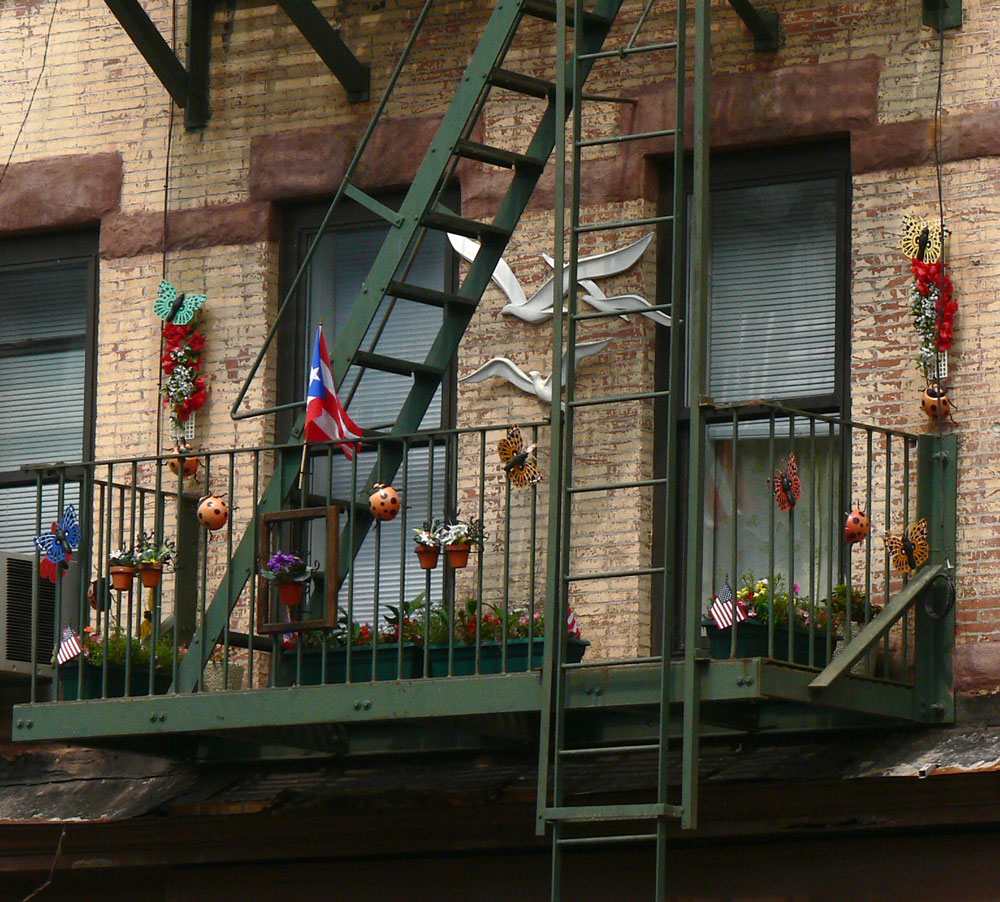
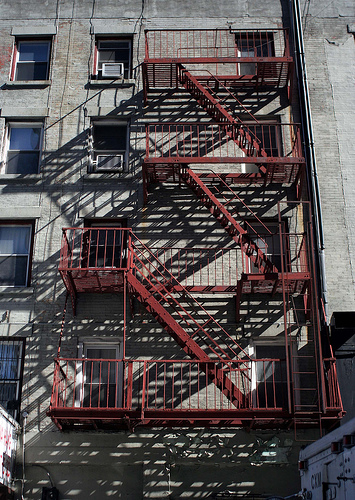
Livability Indicator #16: Fire Escapes

Fire escapes are a funny thing. Intended for safety, often proving to be anything but, are now little more than a vestige of a bygone era. They have been phased out of existence through increased fire safety and construction standards. Essentially, they were a cheap tack-on quick-fix. In other words, exactly the kind of thing you want in something intended to save your life, like a parachute stitched together out of tube socks.

A construction boom triggered by what Richard Florida has taken to calling the 1st reset of American cities adapting to the new economy of the time, industrialization, responded to the influx of workers from the agrarian economy of the 18th and 19th centuries to the promise cities provided. However, this is not to say that the buildings or cities of the time were terribly livable. As we know livability is reached only after viability. And industrialization was about jobs and roofs over the heads of the workers. We'll figure out livability later.
Product was delivered so quickly that only after numerous disasters was a fire safety mechanism invented. That being the exterior, wrought iron stair case, aka fire escape. Many (buildings) were constructed with the kind of logic you would expect given that context. Most often there were no doors, only windows accessible to the escape. So, in a time sensitive moment of extreme panic, it was as difficult as possible to escape.
This was done because they were, well tacked-on; constructed so poorly that it was unsafe to have more than a handful of people on at a time. By their very nature, they weren't intended to communicate well with the architecture, to be one with the building.
You know like when an entire building's occupants might want to escape a raging inferno, things like this happened, and a pulitzer prize for photographic journalism was awarded. Miraculously, the little girl survived having grabbed onto the swinging scaffolding of the collapsing fire escape. The woman sadly, did not.

On the other hand, merits of safety and sturdiness aside, they are not without their merits. Their nature was also intended to not avail themselves as accomplices to would be burglars. The main point of all of this is that they are a study in contrasts, in competing goals, purposes, flaws, and weaknesses.
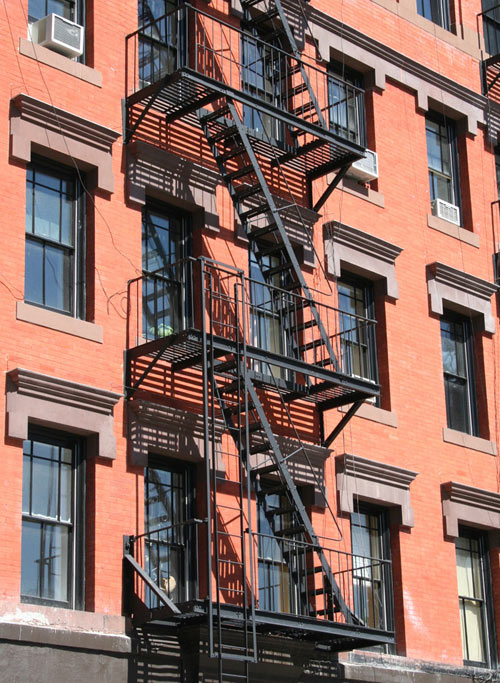
The primary reason I am attracted to the nostalgic presence of fire escapes is the rhythm of shadows and details they give to buildings, something that Hitchcock first played with in Rear Window. Some architects even skillfully incorporated them into the overall design and aesthetic of the building, utilizing their asymmetrical but rhythmic nature to balance a building yet provide texture that otherwise might not be apparent. See many residential buildings today, that either appear too flat or overly "dolled" up with planes as a reaction in the opposite extreme.
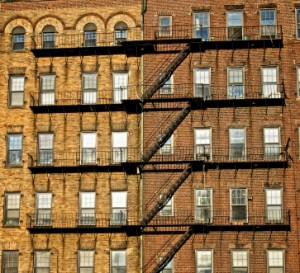
So if we're not evading the fuzz (click the link for an amazing story, btw) or fleeing from fiery infernos, how could they possibly be a livability indicator?
Today, they are primarily used as evidence of expression, of dueling human emotions. The desire to live in urban locations, amongst others, benefiting from the efficiency of shared resources of the many while maintaining a connection to the outdoors, to fresh air, and in some cases a platform for individual expression.
They represent something adapted. Like many things urban, intended for one thing that they are not even well suited for any longer. Perfectly willing to risk life and limb on potentially poor craftsmanship, people have found a use for them that responds to changing individual needs and emotions, providing the worn patina of a placed lived in, of desirability.
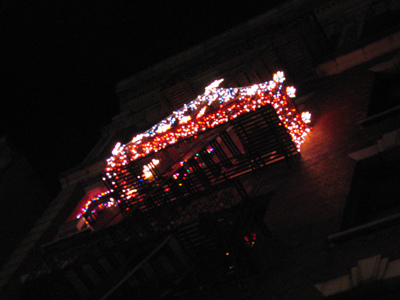
What were once fire escapes now exist as gardens, as balconies, as billboards of expression, as party platforms, , as smoke breaks, as roommate breaks (because in desirable cities people are more willing to take on roommates and put up with their sh!t to counter higher prices due to the demand of livable places), and most importantly, as a place to get away from the daily stresses of your daily city life but be relaxed by the machine-like processes of daily city life of others as viewed from the outside.
Are they cared for? Do they still have life, albeit in a transformed, repurposed manner? Or do they hang idly by rusting the days away loosely attached to a vacant building that cares not for its presence?


Wednesday, April 21, 2010
The Dallas Dynamic and Why Holding it Up to Vancouver Matters
[Warning: Prepare yourself for a long-A squiggle squiggle post.]
Recently, I received an email that could generally be described as somewhere between angst-ridden and soaked to saturation in rage-a-hol. The general gist expressed a feeling of helplessness while the City of Dallas, one in which the person obviously loved and had a passion for, was being torn asunder for more endless seas of paving, parking lots, and overly engineered contrivances.
The following was my best effort to rationally and analytically (with a great deal of insider knowledge) weave the tale of the City by the stinky-apparently flood of ark-necessitating proportions river. Afterwards, a few other nationally and internationally recognized colleagues/experts chipped in with a telling contrast between Vancouver and Dallas, which will follow my posted email.
But before you run off on the "omigod we're not Vancouver you hippy commie" reactionary tangent, let me explain the relevance within the comparison.
People are people. And because our underlying needs and desires, the way we are wired, are the same no matter where we are, city form and the processes therein function similarly. Because individuals are different, the way we flavor our cities is driven by the unique identity of the various individuals. Urbanity is the platform for expression. Urbanity is science, expression is art. In the science of cities, yes you can compare various places.
Recently, as you may know Vancouver hosted the Olympics. Dallas has on occasion chased the dream of one day hosting the Olympics as well. My recollection is that they never curried enough favor with the USOC to be considered a viable candidate to win over its grandaddy, the IOC.
Dallas also likes to talk in terms of "World Class Cities." We get all self-congratulatory when hypocritical hacks like Kotkin and Brueggman tell us we are the paragon. I don't think it would be a stretch of the imagination to say that one relatively objective status indicator as "World Class City" is membership in the prestigious club of having hosted an Olympic Games. There have certainly been more Olympics held than there are World Class Cities in the world (how else do you think Atlanta got them - oh, right...bribery and corruption), but taking a look at some of the distinguished cities on the list, it is obviously a good start (just recent and future sites):
I believe in honesty. Science and understanding require it. Improvement requires understanding. It also requires deep affection. I love the City of Dallas and all of its eccentricities and eccentric individuals. I too want it to be a world class city, but you can't get there without first being honest with yourself. Just like you can't achieve self-actualization without deep, honest introspection. The emotion is there. The direction is not.
So in the vein of achieving "World Class" thru introspection and understanding (edited to make appropriate for the blogosphere):
Recently, I received an email that could generally be described as somewhere between angst-ridden and soaked to saturation in rage-a-hol. The general gist expressed a feeling of helplessness while the City of Dallas, one in which the person obviously loved and had a passion for, was being torn asunder for more endless seas of paving, parking lots, and overly engineered contrivances.
The following was my best effort to rationally and analytically (with a great deal of insider knowledge) weave the tale of the City by the stinky-apparently flood of ark-necessitating proportions river. Afterwards, a few other nationally and internationally recognized colleagues/experts chipped in with a telling contrast between Vancouver and Dallas, which will follow my posted email.
But before you run off on the "omigod we're not Vancouver you hippy commie" reactionary tangent, let me explain the relevance within the comparison.
People are people. And because our underlying needs and desires, the way we are wired, are the same no matter where we are, city form and the processes therein function similarly. Because individuals are different, the way we flavor our cities is driven by the unique identity of the various individuals. Urbanity is the platform for expression. Urbanity is science, expression is art. In the science of cities, yes you can compare various places.
Recently, as you may know Vancouver hosted the Olympics. Dallas has on occasion chased the dream of one day hosting the Olympics as well. My recollection is that they never curried enough favor with the USOC to be considered a viable candidate to win over its grandaddy, the IOC.
Dallas also likes to talk in terms of "World Class Cities." We get all self-congratulatory when hypocritical hacks like Kotkin and Brueggman tell us we are the paragon. I don't think it would be a stretch of the imagination to say that one relatively objective status indicator as "World Class City" is membership in the prestigious club of having hosted an Olympic Games. There have certainly been more Olympics held than there are World Class Cities in the world (how else do you think Atlanta got them - oh, right...bribery and corruption), but taking a look at some of the distinguished cities on the list, it is obviously a good start (just recent and future sites):
Rio, London, Athens, Vancouver, Sydney, Beijing, Turin, Athens, Barcelona.../once lived in Atlanta. Left.
I believe in honesty. Science and understanding require it. Improvement requires understanding. It also requires deep affection. I love the City of Dallas and all of its eccentricities and eccentric individuals. I too want it to be a world class city, but you can't get there without first being honest with yourself. Just like you can't achieve self-actualization without deep, honest introspection. The emotion is there. The direction is not.
So in the vein of achieving "World Class" thru introspection and understanding (edited to make appropriate for the blogosphere):
I think the palpable rage expressed here represents the way many (most?) Dallasites feel about the multitude of projects happening around the City. The citizenry feels misled at best and disobeyed at worst. The funny thing about Dallas is that there are many people/groups in positions of power (of various forms), but at the same time nobody is in charge. Very few get along or have been marshaled into a singular direction or vision. Filling the void is the standard operating procedure, which comes in the form of road widening and highway expansion under the guise of "road improvements" or alleviating congestion or "economic development." All of which provide temporary relief, but long-term create more problems than when they were started.As promised my email was then responded to by Professor Patrick Condon of UBC with a comparison between Dallas and Vancouver (published with permission):
Because the rabble is starting to wise up to the way they are treated as a third world country in need of vast infrastructural projects (many of which are unnecessary and bankrupt the city of the long-term), they become further cloaked under a new "guise," public parks and green space. Who could say no to parks right?
Well, eventually Dallas citizens realized that the park was simply another way to appease the masses in order to build another highway, which not so ironically would further disconnect the City from the River improvements. Slowly but surely under intense local pressure the "parkway" was removed from the Oak Cliff side of the channel to only the Dallas side. Step 1 in the right direction. Pressure endured.
Now, a new project emerged which is the widening of Industrial Blvd and renaming to Riverfront Blvd. I had a long convo with somebody directing one of the design processes yesterday who felt the "improved" Industrial might signal a fall back plan and that under the increased and growing scrutiny the Trinity Toll Road is DOA. Of course, Industrial-turned-Riverfront is still a widening project under a guise of "complete street" and laughably gets compared to Champs Elysees...without being the Main Street for a global Capital and the cultural totems of an entire nation, unless of course if you count Lew Sterrett Jail (read into that what you will).
In sum, all of the projects: Pegasus, Woodall Rogers Deck Park, multiple Calatrava bridges, the Arts District, are all projects that, fall under misguided attempts at economic development. Sure, they might generate some, but in the long-term, I believe many to be overstated in their effect. For example, the Deck Park has the nearly fully built out Arts District on one-side and LoMac to the north side. What is left? Perhaps the improvement of one more block to the north side, which will engage McKinney Ave before the park anyway. That would be maybe a $60 million project leveraged by a $60 million park.
The "connectivity" people suggest it will add is overstated as well, as one of the three connecting roads between uptown/downtown has been removed. Removing all of these local, "grid" connections in favor of the overly hierarchical dendritic pattern is a mistake, cutting off the neural network of local economies in favor of a system where any traffic jam acts as a stroke is no way to build a city, which is simply the physical representation of a local economy.
Furthermore, because Dallas is bounded by other municipalities, unlike Houston which annexed all of its growth, the highways act as the lifeline for the suburbs to leach the life from Dallas, who gets stuck with the carnage and the bill.
For those who don't know, LoMac (Lower McKinney) is a lot of density and very little urbanity. It was driven by the recent housing boom and the residential towers are insular and have little to no relation to a very bad street network, which is the foundation of all of the problems. The street design and transportation framework that is guided by increasing capacity and flow creates roads that go through places but never to places. The result is that any and all development is hurt by the countervailing pressures to be both near traffic but away from it.
The funny thing is that so many of the recent projects at the large scale: Victory and Park Lane Place, or the individual buildings such as the Ritz Carlton in LoMac will not reach their full potential/value for some time as they were designed to be "exclusive" both in terms of market and urban form. They didn't connect with their surrounding fabric, meaning they severed the bond between properties ensuring mutual stewardship, care.
If a city is a hierarchical pyramid where Lovability is founded upon Livability which rests on a foundation of Viability, 20th century economic development reigns supreme still in Dallas: big projects as an attempt at Lovability or in a phrase Dallasites are fond of "a world class city." The problem is that these huge projects require subsidy and that since they ignore the second step of livability, we then have to go back and subsidize efforts towards livability as well.
Rather, this so-called fiscally conservative state should be focused with their "economic development" subsidies directed at the small-scale, as incremental "acupuncture" to stimulate the livability of the neighborhoods. Once that is jump-started the private market will flock and lift areas from viable to livable to lovable, just as what happened in State-Thomas/Uptown, now a fully mature neighborhood where new businesses and neighborhood character are outgrowths of the neighborhood.
The best way to do this is to reduce vehicular capacity of the road network, increase capacity of other forms of transit, recapture ROW which can be used as incentive to roll into private development. So many areas are so fractured by repellent forces, highways, poorly designed arterials, etc. that some extra room will be both helpful and necessary to generate some critical mass.
I was referred to in this email as a local optimist. Sometimes it is difficult, but I am always imbued by the inertia Dallas generates when it puts its collective mass behind a meme (for better or worse). When it does something, it goes all the way. I see my task as marshaling that capacity for momentum under the guiding "pattern" of livability.
Later, somebody else mentioned the following contrast in transit planning/difficulties:Dallas and Vancouver. Night and Day.On this thread, and the tragedy of Dallas, I provide a reminder to all that some might find inconceivable. The City of Vancouver somehow survives without any freeways.None in the downtown.None in the surrounding neighborhoods.None in the industrial districts.None.There are no proposals to build one within the city.In twenty years the number of jobs in the city has increased dramatically and the population grown by over 100,000 or 25%. In that same period commuting times have fallen (the only region in the country where that has happened) and the number of car trips into and out of the downtown has declined.This is no pedestrian nirvana. Per capita car ownership in Vancouver rivals that of LA. But a robust system of four lane arterial streets (the legacy of the streetcar period located at half mile increments or a ten minute walk apart) keeps things moving, albeit slowly.There are no proposals to add freeways within the city. The Board of Trade gave up lobbying for that in the 1970s.While the Province, much to the dismay of many, continues to press forward on various highway widening and extension projects in the suburbs, even there they represent a minuscule fraction (on a per capita basis) of what is happening in Dallas.Before moving here from Minnesota i would never have imagined it possible to have a major and rapidly growing center city without a freeway. How dumb i was not to realize that a distributed system of streetcar arterials was the more resilient and "right sized" way to do it.Come up and see for yourselves.You simply will not believe it.I didn't.Not at first.
And speaking of Dallas and Vancouver, here are two interesting articles that juxtapose the former region's crumbling plans to build a classic sprawl-scaled rapid transit system with the latter region's promising plans in progress to determine the most appropriate transit technology to build in a "ripe" urban corridor.
Dallas:
http://www.thetransportpolitic.com/2010/ 04/21/its-big-system-plans- now-stretched-too-thin-dallas- considers-ways-to-cut-back/
Vancouver:
http://www.thetransportpolitic.com/2010/ 04/20/can-vancouver-afford-to- abandon-skytrain-for-its- broadway-route/
Friday, April 16, 2010
What World Class Cities Do
Do we want to keep up or continue self-delusions and pat ourselves on the back?
What World Class Cities don't do: they don't build new intra-city highways (as opposed to inter-city highways which are important in connecting regional economies). In fact, they learn from their mistakes and are all systematically removing them, restoring the neural network of local economies and instilling increased livability. Continuing the metaphor, if your economy is reliant on intra-city highways, every traffic jam (often caused by "accidents"), in effect, is like a cerebrovascular accident, aka a stroke.
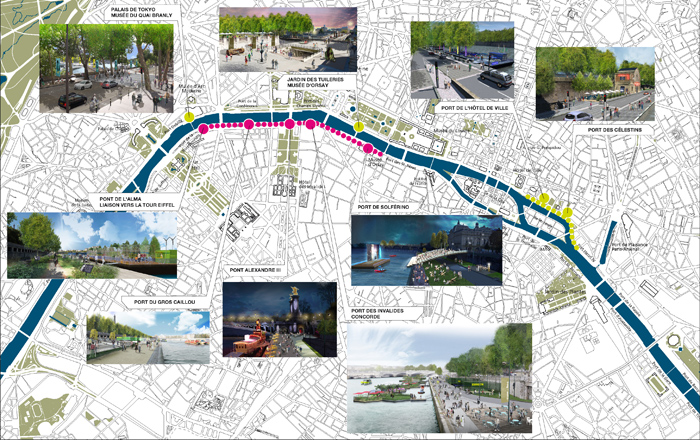
Here is the translation of a French article about the Parisian mayor's most recent plans to upgrade his City's livability.
What World Class Cities don't do: they don't build new intra-city highways (as opposed to inter-city highways which are important in connecting regional economies). In fact, they learn from their mistakes and are all systematically removing them, restoring the neural network of local economies and instilling increased livability. Continuing the metaphor, if your economy is reliant on intra-city highways, every traffic jam (often caused by "accidents"), in effect, is like a cerebrovascular accident, aka a stroke.
Here is the translation of a French article about the Parisian mayor's most recent plans to upgrade his City's livability.
Reclaiming the banks of the Seine
On April 14th, 2010, Bertrand Delanoe unveiled the proposed redevelopment of embankment roads. The mayor of Paris offers a different treatment of both sides. Specifically, the left bank will be closed to vehicular traffic for more than 2 km of Solferino in Alma. The right bank, this "expressway" will be transformed into a Parisian boulevard, modern and harmonious, with red lights, allowing the coexistence of pedestrians, motorized traffic and cars. For Mayor Delanoe it represents the continuation of "evolving towards the use of beauty and pleasure of living". Discover the future embankment roads and join the citizens' forum by offering your ideas for management and use of these new places.
"To allow Paris to find his relationship to the river" (ed: Hey, we've got a river with zero relationship to the City...)
"If we realize this ambition, it will really change Paris. We must continue in the second term, to change practices, practices with a little something pleasurable, the side of beauty and enjoyment of life" said Bertrand Delanoe. He recalled that he had long wished that Paris "found its relationship with its river." This should be done within two years.
The idea is to continue to reduce car use and decrease pollution. "This is not to punish but to reduce traffic and provide an opportunity for happiness".
Bertrand Delanoe discussed the dissociation of the Left Bank and Right Bank projects: "We are seeing much less traffic on the left bank than the right bank." Completely close down the banks of the right bank could cause "congestion of Paris which will strip the project of its viability. The additional traffic associated with the closure of the left bank would however be absorbed by the high platforms.
In total it is 15 hectares, of which 4 acres will be fully provided to users without cars. Organized around several points, including culture, sport and nature, these new banks should also leave room for night life.
For magic, stands at Solferino, which descend to the river, with a clear view on the Grand, the Petit Palais and the Louvre. " (ed: I would love to provide a better translation here, but I have no idea what the intent is here.)
The mayor stressed that these areas would evolve over time with use and needs: "we will install a basketball court for two years and turn it into lawn bowling(?) if necessary.
The first deputy Anne Hidalgo, who will lead this major project of urban development, stressed the public input that will accompany these developments: "The citizen forum online paris.fr must be a forum for discussion and ideas. We do not want to exclude the main users, including families, youth, seniors.
The reconstitution of low platforms on the right bank
A redevelopment of the wharf right bank, which is currently an urban freeway, reducing them to speed through the establishment of at least 5 traffic between the Pont de Jena and the Pont de Sully, by reducing the width of pavements and restating public space, which will facilitate access to the waterfront and reappropriation by the Parisians;
Closure to traffic of the dock bottom left bank, between the Musée d'Orsay and the Pont de l'Alma, will allow the installation of year-round activities accessible to all.
This configuration has been studied as well as many other scenarios, the services of the Directorate of Roads and travel to the City of Paris. Similarly, budget planning and operation has been unveiled and is available on Paris.fr.
"The new embankment roads and delaying traffic: where, when, how?
A first discussion will be presented to the Council of Paris in July 2010, to present the design principles and allow launch various feasibility studies. By June, the exchange will be held with district mayors and the communities along the metropolitan dimension to the project is affirmed.
In his part of Paris, the project will be implemented within two years: developments on both sides will be made and delivered later in the summer of 2012.
Monday, April 12, 2010
Emergent Urbanism in Oak Cliff


I've been planning a post on graffiti as a livability indicator for a long time, but haven't quite found the exact narrative for which to frame the argument. The general gist would be that like its urban sisters density and gentrification, it comes in various forms: good, bad, destructive, harmless, or helpful. Because their meanings are so broad and contextually driven, these words often end up being code words masking other intent.
As with the above, sometimes it can be art. Sometimes it can be crude but so illuminating when shown in contrast. The contrast highlighted here is one of mere local sentiment but deeper represents the disconnect between goals and the policies that are failing to see the vision realized, preventing real neighborhood vitality from taking place.
Yesterday, at the invite of Jason Roberts of multiple fames: Bike Friendly Oak Cliff, Build a Better Block Project, and band Happy Bullets, I was able to head down to X+ in Oak Cliff and check out their "citizen's arrest" of an untamed public street. In this case, it was the quasi-guerilla conversion of Tyler Street into a "complete street" that has been getting some publicity in local media circles.
What is a complete street you ask? It is a street that dedicates equal priority to various forms of transportation (or the opposite of) within the right-of-way (or building face to building face). This might include just vehicular travel, parking, sidewalk, and outdoor seating. In busier locations, it could also include various forms of transit such as dedicated bus or other mass transit lines. The purpose is to regain the necessary safety for pedestrian life to occur by limiting the domination of spaces by car travel and the infrastructural design supporting dangerous speeds through places.
In action, the conversion of just one block of Tyler Street had a profound effect on safety (at least perceived), enjoyment, livability, AND commerce for the local businesses. Jason relayed to me that the local bookstore, Cliff Notes, had their best sales day ever on Saturday, the first day of the staged "complete street."
In conceptual terms, what Roberts and others did was to apply greater differentiation to the street hierarchy. In the traffic planning world, hierarchy is fairly simple. Each street generally gets one classification (arterial, connector, local, etc.) and that is that. The street is generally designed to be the exact same no matter the location or context. What this has done is effectively flip the natural order of things: where the most traffic is, the most density wants to be, and the most activity happens. Our street design was so car-oriented that the streets cutting through neighborhood centers such as this one became repellents rather than attractors; barriers to activity and economic development.
What occurred over the weekend at Tyler Street was the intuitive application of a second (and necessary) metric to street design hierarchy, that of Place. Using a two-dimensional tool for street design is a growing concept in both Australia and in Great Britain, places similarly afflicted by poor street design and transportation planning, but not to the extend here.

(graphic pulled from this presentation by Prof. Peter Jones)
I find it far more effective in appropriating design based on the dual purpose of streets which is the backbone of the report by the same name: Link and Place which details that public rights-of-way can be one or the other, or even both. If both is the goal then certain design elements are critical to allowing link and place to occur simultaneously considering efforts at "saving time" can often be in conflict with the desire to "spend time."
Because the transformation of Tyler Street occurred only on one block the contrast between street as Link and street as Place was striking. See for example this picture looking south along Tyler where the Street remained untouched:

Wide. Narrow, inconsistent sidewalks. No parking except off-street. It isn't a stretch of the imagination for you to take my word for it that these cars were driving in excess of 45 mph despite their static pose for this shot. We know that speed regulation and enforcement is an utter failure of policy and expenditure of resources. Cars and their operators will only drive as safe as the conditions and design of the street allow them to feel comfortable to do so.
So what happened when these cars hit something out of the ordinary?

Break lights.

Are those break lights? Sure look like it.

Let's look closer at the third car... yep, those are break lights. In fact, the cars would drive so slowly through the "Better Block" that people felt comfortable enough to "jaywalk" and even blindly cross the street without even looking for oncoming traffic. That's a safe street. The environment ensured it. This delay of possibly an extra 15 seconds of each driver's life was reacted to not with rage but more often of admiration and amazement. One overheard comment, "I wish my street was like this."


People of all ages showed up to socialize, people watch, and "spend time," representative of "slow" living that allows us to take time and enjoy life and the company of others, differentiating us as humans from the assembly line logic of traffic planning.


Above: yes, that is a set of turntables on a mounted rig on a bike. Below, adding to the ambience of urbanism, the sensory experience whether it was tastes from the Brownies in a Jar from around the corner, or the sounds of bongos played on the sidewalk, or the smells emanating from the coffee shop, the complete street fostered a participatory environment where businesses, residents, and visitors all took part, whether as performer or passive observer. All enjoyed experiencing the life so missing from so many parts of the City. All prevented by written policy. This was Jason Roberts' point.


Above: the painted bike lane with on-street parking at such a distance to avoid conflict between door openings and bike traffic.

One interesting lesson was that the street had been so effectively narrowed that the bike lane in effect was merely a rhetorical prop, much like the traffic lights. The kid in the above photo felt fully comfortable riding in circles on the street, as did his parents nearby. However, it should be pointed out that the bike lane would increase in efficacy as it lengthens and extends further along the street defining the place for bike traffic as a street morphs in various forms or design sections based on its place within the Link/Place matrix.


It has yet to be listed or defined as a livability indicator, but the presence of bicycles clearly is one that relates to Babies! or AYFs. It is one that is predicated upon safety. At Tyler Street yesterday (and presumably the day before) there were strollers and bicycles a plenty.
Once safety, lowest on the Maslow Hierarchy of Needs, is achieved (when cars, the most deadly of transportation modes, no longer have priority of space) only then can culture be meaningfully introduced. With the right urbanity, the right platform, it occurs naturally through citizen created vitality. Art and Music were both present in a place we could call a real arts district, where more people (and culture) were on each day of the weekend than the named Arts District (which illuminates the challenge of the Dallas Arts District).
This can't just happen anywhere however. As I pointed out to Jason yesterday, these will be most successful in the areas where it is most inconvenient, areas with the most convergence, which naturally form the centers of neighborhoods.
[The sound you just heard was not another stadium implosion, but the brains of ten traffic engineers exploding as their world, their belief system is no longer valid. Their bibles for how to move cars are instantly irrelevant.]
Neighborhoods throughout the city deserve similar experiences, places to go that are within walking distance and spend an afternoon cheap on the wallet but valuable to the soul, with family and old friends, or new ones (hopefully just friends, but for the single folk, perhaps make new families too. Walkable DFW does not sanction polygamy.). However, the transportation system deters this from happening. In our attempt to allow for the most amount of traffic through our neighborhood centers, we eliminated the ability to have the most amount of traffic (foot traffic), and in turn, do the most business.
Will these compete with malls or power centers in terms of sales receipts? No, but neighborhood scaled activity hubs are central to our every day lives. This is real economic development that doesn't take the nonsensical public spending on highways, but rather by eliminating the barriers to real urbanism is what economic development should be all about. As I have said before, intra-city commerce can occur in any form, it is up to us to determine the right transportation network to build and foster the formats which we would prefer.
What the Tyler Complete Street represents:
The last part is the scariest. It gives the most credence to the growing notion that centralized planning is defunct. In some ways it is, but only in the way Frank Gehry and others understand the 20th century version of planning. To say all public/government led planning is failed and that this version is the only ideal version is also false. As I've said before, it is about eliminating the barriers to both economic and community development. In most cases, this means undoing the "planning" of the 20th century: the highway and arterial system.
- Citizens taking their streets back. They've paid for them, and are unhappy with the way their streets have been mismanaged and designed in a way that hinders quality of life.
- Street behavioralism at work - and its interrelated connection with "place" creation.
- And relatedly, the utter failure of traffic and transportation policies and how they relate with city form and urban design.
See New York City where Transportation Commissioner Janette Sadik-Khan is transforming that City with some paint and jersey barriers, redefining the public realm to prioritize pedestrian activity rather than vehicular movement. It is the difference between buying a potted plant and actual gardening. It is about creating the platform, fostering and tending to places to encourage vibrancy rather than attempting to bestow it. And the public sector has the onus on removing the barriers by correcting its mistakes. It will be paid off in spades with a real "World Class City" rather than one that we so often incorrectly label as one.
In many ways, fostering urbanism is about letting go of control. Gardens and ecosystems don't grow optimally with over pruning. A world class city is one that people love. People loved what was happening at X+ yesterday and in Bishop Arts with the Arts Crawl. I know I loved it.
Subscribe to:
Posts (Atom)

 Posts
Posts


