Showing posts with label Boa Constrictor Death Grip. Show all posts

Thursday, March 26, 2009

Woodall Rogers Deck Park: Consider it Stimulated


From the Real Estate Council:
Transportation Enhancement Stimulus Funds Awarded to Woodall Rodgers Freeway Deck Plaza

Landmark Dallas Project Moves Forward
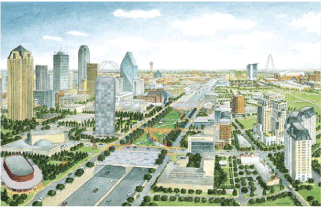
DALLAS (March 26, 2009) - The Woodall Rodgers Park Foundation will receive $16.7 million in federal stimulus funds toward constructing a deck plaza over the Woodall Rodgers Freeway in downtown Dallas. The Woodall Rodgers deck plaza is a "shovel-ready" transportation enhancement project that will create approximately 1,000 immediate jobs and will stimulate additional economic development and job growth in the future.

The project will provide a vital pedestrian and bicycle connection between both sides of the existing freeway, connecting Downtown Dallas, the Arts District, and the Uptown and Victory residential districts. The Woodall Rodgers Park will be a 5-acre urban park built on top of the deck plaza structure.
And, far more importantly...it is a way to ameliorate the catastrophic effect highways have on property and, in turn, cities.

Although, I'm currently working on a series of diagrams to show how a systematic deconstruction of the inner downtown ring can really leverage private development, job growth, and a much much better city.

[Addendum: I forgot to add that RTKL won an AIA award for presenting the idea of decking Woodall Rogers with a park...in 1979.]

Monday, February 23, 2009

Quote for the Day

A critic such as Frederick Ackerman in 1925 could dryly note that "a community with a stable population is now referred to as a dead one." Interestingly, this was in a paper titled "Our Stake in Urban Congestion," noting that contemporary proposals to "solve" urban congestion by building elevated and limited access highways would kill the golden goose, which is based on the ability to tax the increases in land value and specialized transactions that cities create.

Wednesday, February 4, 2009

Links

Pretty sure I posted part 1 of this "Saving the Suburbs" series in the NYT blog, but here is part 2.

I have to admit, I didn't find anything of real substance in part 2. Here is my comment referencing the super happy save the world suburb (of like twenty houses in car-friendly Austin):

The Sol project is as net energy zero as the cars are that access the development. Not to say there is anything particular wrong with that, but to say this particular project in a sea of tract houses doesn’t actually prove anybody right or wrong.

The real issue is that American cities grew in size/land area, but not in the requisite population, i.e. they didn’t grow organically, aggregating new development with all the services and community infrastructure to be successful in addition to existing development. Rather, we robbed Peter to pay Paul, leaving our downtowns and cities to rot while we all moved into suburban neighborhoods that were principally bankrupt and were only about delivering product to the market place, not making real places with lasting value, socially, environmentally, or ecologically.

See my post on Valencia, ESP for a city and suburbs that work and grew organically to do so:

http://carfreeinbigd.blogspot.com/2008/06/valencia-spain.html

The primary issue is that there is an appropriate choice for housing types and living environments and that is represented by the current city form in Valencia. In the US, you generally have one place to live, trapped on your cul-de-sac and behind the wheel.

I’m sure the car, road building, oil/gas industries love having a captive market.
Link to a new website that catalogs Freeway Teardowns. But, the real gem is this article pasted on the site, from Induced Demand to Reduced Demand, which is exactly the issue incapsulated into one neat and tidy heading.
This is what transportation planners call "induced demand." Building freeways encourages people to drive longer distances: in the short run, people begin to drive to regional malls rather than local stores, and in the longer run, they move to lower density neighborhoods where they have to drive further for all their trips.
The convenience of driving has become our [and its] own worst enemy.

Road construction, in the attempt to alleviate the pressure further spreads people out and thus creates its own demand to fill the newly created supply, so we're back to square one...only amplified. The real answer is demand side solutions that reduce the need for trips and driving for every facet of life. As my post yesterday suggests, our happiness and well-being depends upon it.

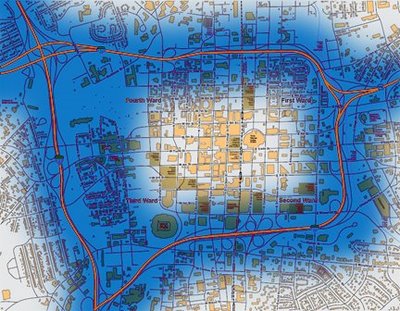
If you're tired of me b!tching about the highway problem affecting downtown Dallas, move to Charlotte...no, wait a minute. Don't do that. Check this figure ground of downtown Charlotte and how it has essentially been wiped out except for the very center that is in itself buffered by distance and an eroding urban fabric (much like the four blocks of Main Street that work in Dallas):
Thursday, January 22, 2009

No Comment

DMN: Dallas City Council hears about benefits of planning denser neighborhoods (link)

I've cited Chris Leinberger a few times here. This is what he had to say:
...urban planner and Brookings Institution fellow Christopher Leinberger urged the council to select about seven areas in Dallas of several hundred acres or more and to use zoning regulations to encourage those areas to densely develop with residences, shopping and offices.
Hmmm...what was City Council's response:
Council member Angela Hunt called Wednesday's forum "an incredible meeting" that brought forth a flood of new ideas about urban planning for Dallas.
I can no longer bite my tongue...new ideas? This is the shit you should've been doing years ago. Here is a big idea, Downtown Dallas will never be fully functional and reach its full potential until AT LEAST one of the freeways choking it off from the rest of the world is removed. The deck parks are a mere $60 million dollar band-aid.

Two wrongs, don't make a right. Or should I say, two expensive projects, one a horrific mistake and a deep chasm through the heart of the city and one a $60 million dollar band-aid, do not achieve a great return on investment.

SNAKE ATTACK!


Kunstler mentioned this week his belief that:
Americans will have to live somewhere, of course, but the terrain of North America faces a very comprehensive reformation. The biggest cities will contract; the small cities and small towns will be reactivated, the agricultural landscape will be inhabited differently, and the suburbs will undergo an agonizing decades-long work-out of bad debt and true asset re-valuation. Since the loss of so much vested "wealth" is implied by the crash of suburbia, this may be a source of revolutionary political violence moving deeper into the Obama administration.
If he is to be believed, which I believe there is some logic to, specifically when you see small and medium-sized cities rededicating themselves to their "Main Streets" and downtowns (and not just at a token level, but making real hard decisions, like OKC that is removing Highway 77 from its downtown. Well, the city is converting it to a boulevard, clearing up substantial amount of land both directly and indirectly for new urban development, new high quality neighborhoods.

Will OKC surpass Dallas as a great place to live? Remains to be seen, but if Dallas leadership wants to keep its head in the sand, leave the tunnels open, maintain the wide one-way streets, allow those streets to be dominated by speeding valets and vagrants, allow surface parking within the downtown core, and think this inner highway loop is positive in any way, this city will remain the as it is for decades to come until some leadership is ready, to uhhh, ya know...lead.

Sorry, I'm in a foul mood today after walking across Main Street this morning and noticed that the ummm MAIN street in the City's views to the East end in a highway and those to the West finish in a jail! Happy times. I shouldn't care so much.
-------------------
edit: I should give credit where credit is due:
"We need to focus on areas we want to develop [densely], identify them, put a boundary around them. Then we need to identify areas we want to protect. Too often it's a battle between developers and neighborhoods," she said.
This is a correct statement on her part. Of course, I did this three years ago in the City of Springfield, IL and received the Daniel Burnham Certificate of Merit from the Illinois state AIA chapter.