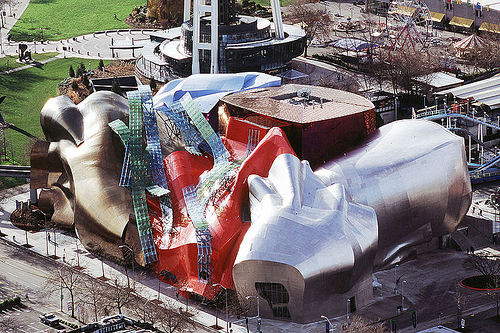
Good ol' Frank. Littering the world with his crumplestiltskins.


Oh snap! Wait. That was us that caught the stinging end of the whip.I've been to Bilbao, which is a good urban and architectural experience. It appeals to most people experientially. One can analyze its urban and architectural qualities and discuss why that is, but it's not necessary to articulate those to experience them. One can also explain why one prefers Classical buildings, without insisting that Bilbao is poorly done.I could crit Bilbao about what would make the experience of it as an urban building, for example, better or worse.I've never been to a Zaha building that works on the same experiential level as Bilbao. I would find it impossible to be on a jury for a Zaha building and to make comments about what would make it better.They seem to me to function on two levels. An intellectual, esoteric one which ignores the senses. An experiential level like Libeskind's designed to produce an uncomfortable and unhappy experience.Leon (Krier) believes there are modern buildings like this that we experience as bad -- but then the New York Times tells us it is good, and we become reverse Pavlovian dogs. Something makes us feel bad and we say "that's good."This is not the same as wanting to feel bad - it's confused signals.On top of that, when you spend your life in beautiful surroundings (if you live in Venice, for example), beauty becomes your norm - you see and make beauty more easily, and are turned off by ugliness.When you live in north Dallas amid the WalMarts, ugliness becomes your norm, and ugly eventually becomes good.
Every time we criticize that Koolhaas...thing we're written off as "anti-Dallas" or "anti-modern." At least we're not alone.I expect to receive some of the same scorn, "ahhh, I'm insulting their heroez. Oh noez!" The thing is that the building isn't about modernism or Dallas. In fact, it is an insult to both.
Noooo, you just don't get it, maaaaann.No, broheim. You don't get the way of the world. This building represents the worst of what the Architectural or City Building professions have become, utterly disconnected from their customers. Any profession that reviles its own audience is doomed to failure.
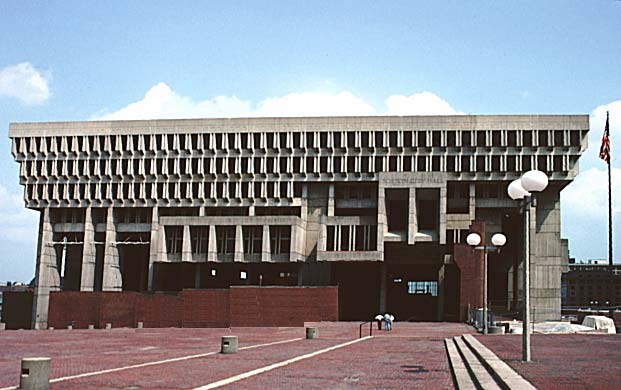
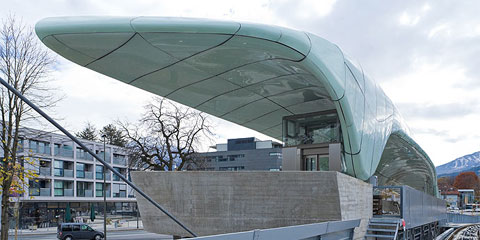
Heretofore, you are to be made aware that forms like this will sweep across the world like an architectural nerve gas. Suspension of disbelief necessary before proceeding.
These are always fun. You may have read my point-counterpoint responses to literal tools (of the sprawl industry/status quo) like Randall O'Toole before, but there are a strain of architects out there still wandering down dead ends while the rest of us move down the path towards more logical and coherent cities for the people, rather than bestowed upon them.
The following is over at Architects Journal and is written by Patrik Schumacher, an unfortunate soul who still thinks that style matters. Not coincidentally he toils under Zaha Hadid, unabashed fashion designer as far as the city building world is concerned.
In my Parametricist Manifesto of 2008, I first communicated that a new, profound style has been maturing within the avant-garde segment of architecture during the last 10 years.
Red flag: "We're the avant garde. Therefore you are inferior and must listen to us." This is precisely how they see themselves. It is a dying breed as cities move towards crowd-sourcing based placemaking. The idea of the singular genius has failed miserably. Quit reading the Fountainhead. Unless of course, you suffer from insomnia and desperately are in need of a 200-page soliloquy in place of sheep.
The term ‘parametricism’ has since been gathering momentum within architectural discourse and its critical questioning has strengthened it. So far, knowledge of the new style has remained largely confined within architecture, but I suspect news will spread quickly once it is picked up by the mass media. Outside architectural circles, ‘style’ is virtually the only category through which architecture is observed and recognised. A named style needs to be put forward in order to stake its claim to act in the name of architecture.
Holy patronizing Batman. First of all, an unknown word has been strengthened through criticism. Fair enough, we'll take your word for it. And we should, because he knows that once we are touched with the divinity of his understanding of such a profound concept (of something so superficial as style), it will take over the world and all of the great cities of the world will be replaced with the singularity of his vision.
Not to jump too far ahead of myself, but this really highlights the fundamental problem facing architecture: its disconnection from reality. The willful exclusion of the rest of society to work solely within a select peer group and only FOR that select peer group. Where the goal is to get a building on the cover of Architecture Record rather than a place that nourishes and supports its users, the City.
Can we please bring in REX or OMA again to defile our City? These people despise their customers. They look down upon them. This is the death nail of any profession turned insular.
The concept of style deserves to be defended
Does it?
The concept of style has for a long time been losing traction within architectural discourse. To let this concept wither away would only impoverish the discourse, and a powerful asset for communicating architecture to society would be lost. However, the resuscitation of this drained and battered concept requires conceptual reconstruction in terms that are intellectually credible today.
Perhaps its withering should tell you something. People have grown weary of these "style wars" driven by little more than ideology so utterly disconnected from reality. And their cities have suffered for it.
What stands in the way of this is the tendency to regard style as merely a matter of appearance, as well as the related tendency to confuse styles with superficial, short-lived fashions. Although aesthetic appearance matters enormously in architecture and design, neither architecture nor its styles can be reduced to mere matters of appearance. Neither must the phenomenon of styles be assimilated to the phenomenon of fashion.
Even if, at its absolute, very best, style was a direct response to a timely problem; the physical manifestation of a deeper underlying genome resolving some ill. It is still responding to the issues of that particular time. And times change. Therefore, once again IF (big if) "style" is a response to the needs and demands of the day (should-do rather than can-do), then style would have to adapt to changing times. Perpetually changing. Once again, the idea of timeless "style" is moot. And frankly, irresponsible if not intellectually dishonest.
The concept of style must therefore be sharply distinguished and cleansed of these trivialising and distracting connotations. It denotes the unity of the difference between the architectural epochs of gothic, renaissance, baroque, classicism, historicism and modernism. The historical self-consciousness of architecture demands the revitalisation of the concept of style as a profound historical phenomenon that can be projected into the future. For this purpose I have proposed that architectural styles are best understood as design-research programmes, conceived in analogy to the way paradigms frame scientific research programmes.
Fair enough. It has taken us an awfully long time to get to this point in the article hasn't it?
A new style in architecture and design is akin to a new paradigm in science; it redefines the fundamental categories, purposes and methods of a coherent collective endeavour. Innovation in architecture proceeds via the progression of styles so understood. This implies the alternation between periods of cumulative advancement within a style, and revolutionary periods of transition between styles. Styles represent long, sustained cycles of innovation, gathering design-research efforts into a collective movement so that individual efforts are mutually relevant,spurning and enhancing.
I can't disagree with this either. However, before we get started, let us also understand that adopting one style means the rejection of all others. Although changes in style predates this notion, inherent within "style" is the cynical notion of planned obsolescence. The acceleration of the metabolic rate at which one style devours another to a speed that exceeds all and any response to the world around it. To me, suggests that the pushing of any certain style wouldn't be directly responsive to the needs and demands of the people, but rather the selfish, grandiose visions of those pushing it. If you are really responding to an actual need, just say that and the style (as long as it is beautiful or lovable) should speak for itself.
Parametricism offers a credible, sustainable answer to the crisis of modernism that resulted in 25 years of stylistic searching
OK. Prove it, but I'll say right now that I'm skeptical of any outgrowth of an architectural movement based solely on "out-weirding" each other until a personal stake has been claimed on one particular outcome of ideological experimentation.
From the inside, within architecture, the identification of parametricism demarcates and further galvanises a maturing avant-garde movement, and thus might serve to accelerate its progress and potential hegemony as a collective research and development effort. As a piece of retrospective description and interpretation, the announcement of parametricism seems justified after 10 years of consistent, cumulative design research. Prospectively, the announcement of the style should further consolidate the attained achievements and prepare the transition from avant-garde to mainstream hegemony. Parametricism finally offers a credible, sustainable answer to the drawn-out crisis of modernism that resulted in 25 years of stylistic searching.
But if it goes from avant-garde to mainstream will you immediately reject it like any hipster might the mass adoption of any particular meme?
Parametricism is the great new style after modernism
Declarative. I'll give him that. Despite passive sentence after passive sentence within the text.
Post-modernism and deconstructivism were mere transitional episodes, similar to art nouveau and expressionism as transitions from historicism to modernism. The distinction of epochal styles from transitional styles is important. In a period of transition there might emerge a rapid succession of styles, or even a plurality of simultaneous, competing styles. The crisis and demise of modernism lead to a deep and protracted transitional period, but there is no reason to believe that this pluralism cannot be overcome by the hegemony of a new unified style.
This is all very true. Let me guess, that style will be yours...
The potential for such a unification is indeed what we are witnessing.
Oh for F's sake.
Beyond the modernist paradigm of separation and repetition
The modernist order of separation and repetition is being supplanted by the parametricist order of continuous differentiation and intensive correlation. Within the broad new paradigm of parametricism, many subsidiary styles might be expected to enrich and progress the coming epoch of parametricism.
We need a Jules from Pulp Fiction appearance, "ENGLISH M-Fer! DO YOU SPEAK IT?"
Modernism’s crisis does not mean an end to unified styles
Modernism’s crisis and its architectural aftermath has led many critics to believe we can no longer be expected to forge a unified style. Did the profound developmental role of styles in the history of architecture, as evidenced in the gothic-renaissance baroque historicism- modernism sequence, come to an end? Did history come to an end? Or did it fragment into criss-crossing and contradictory trajectories? Are we to celebrate this fragmentation of efforts under the slogan of pluralism?
Aimless rambling. /irritatingly tapping fingers on desk.
Architecture today is world architecture
Every architectural project is immediately exposed and assessed in comparison to all other projects. Global convergences are possible. This does not mean homogenisation and monotony.
Quickly, he comes to the defense of what he must realize is the obvious weakness in his statement towards a hegemony of style somehow not equating to homogeny. Perhaps, sub-consciously aware of a shift back towards regionalism (sourcing local materials and responsive to local climates and cultures) and away from global architecture where you can't tell whether a building (or more importantly place) is in Dubai or Dallas?
It merely implies a consistency of principles,ambitions and values to build upon so that different efforts add up, are relevant to each other and compete constructively with each other, to establish the conditions for progress rather than pursuing contradictory efforts that battle over fundamentals.
True. I could have said the same thing, which is why I often state that style is irrelevant. So that doesn't define a style.
This is the idea of a unified style;
ummmm...
initially as a unified avant-garde design-research programme, and eventually as a unified system of principles, ambitions and values that constitute global best practice.
Ok, but how is that a style rather than a set of objective criteria or a pattern?
The new generation
The consistency of the style as a collective design-research programme depends upon the unfailing adherence to the strictures and impositions of parametricism. The good news is that a whole generation of young architects is already adhering to this.
obey.
Actually, I see a "whole generation" desiring to be more socially responsible and responsive. I think outside of measurable objective criteria found within urbanism, space syntax, et al., that may be all that is necessary. Once again, let style be as adaptable as your rigid notion of adaptability as style (I peaked ahead).
Many theorists - like Charles Jencks, for example - presume that the demise of modernism ushered in an era of stylistic pluralism.
The biological search engine. This is no different than any other field establishing that the status quo is no longer adequately serving the needs of society and like worker bees we all go off in different directions looking for the new patch of honey. Once we found our particular "honey patch" or style, we come back to the swarm and sing and dance about how great it is. We create a competition between them to find the most useful. Eventually, perhaps after a few wrong turns via overly-convincing shysters, we eventually find the most useful. Until that is no longer useful.
I'm getting the sense that we have a worker bee version of a used car salesman here.
Accordingly, the search for a new, unified style is seen as an anachronism. Any style today - so it seems - can only be one among many other simultaneously operating styles, thus adding one more voice to the prevailing cacophony of voices.
What did I just say?
The idea of a pluralism of styles is just one symptom of the more general trivialisation and denigration of the concept of style. I repudiate the complacent acceptance (and even celebration) of the apparent pluralism of styles as a supposed sign of our times. A unified style has many advantages over a condition of stylistic fragmentation.
The need for pluralism, however is the necessary constant testing of the usefulness of any current paradigm. Therefore it is necessary.
Parametricism aims for hegemony and combats all other styles.
What about all that "not homogenous" talk? My way or the highway. We'll be the judge of that. Of course, you don't want us to be. You want YOU to be. Sorry. I'm afraid that isn't how the world works.
While I agree that there are rules for how cities function, how buildings merely look is related specifically to the aesthetic tastes of ever-changing demographics.
Parametricism’s crucial ability to set up continuities and correspondences across diverse and distant elements relies on its principles holding uninterrupted sway. The admixture of a post-modernist, deconstructivist or minimalist design can only disrupt the penetrating and far-reaching parametricist continuity. The reverse does not hold, because there is no equivalent degree of continuity in post-modernist, deconstructivist or minimalist urbanism.In fact, parametricism can take up vernacular, classical, modernist, post-modernist, deconstructivist and minimalist urban conditions, and forge a new network of affiliations and continuities between and beyond any number of urban fragments and conditions.
I have a headache. Please state how. Please. I can just as easily state that I can leap the tallest buildings (even in Dubai).
Preparing for the style war
What are the current styles that must be combated by parametricism? Is there really still some kind of stylistic pluralism, as posited by Jencks?
Well, you have just spent a thousand words stating that there is. At this point, I would presume so.
In fact, post-modernism has disappeared, and the contributions and advances of deconstructivism have been incorporated within parametricism. The mainstream has, in fact, returned to a form of pragmatic modernism with a slightly enriched palette; a form of eclecticism mixing and matching elements from all modernism’s subsidiary styles. The inability of post-modernism and deconstructivism to formulate a new viable paradigm led to the return of modernism in the guise of minimalism as the only consistent, ideologically stringent style that confronts parametricism today.
So now you're telling me that there isn't a preponderance of competing styles? Why did I just read the last thousand words?
The primary confrontation in the struggle for stylistic hegemony is thus between parametricism and minimalism.
Parametricism claims universal validity.
It cannot be dismissed as eccentric signature work that only fits high-brow cultural icons.
Sounds defensive. I'm guessing that it absolutely can.
Parametricism is able to deliver all the components for a high-performance contemporary life process. All moments of contemporary life become uniquely individuated within a continuous, ordered texture.
HOW?!?!
The latest built works from Zaha Hadid Architects are much more than experimental manifesto projects; they succeed as high performance projects in the real world.
Please tell me how Hadid projects can help the affordable, urban housing crisis in this country? Or this dislocative qualities of unlivable cities perpetuated by hostile transportation systems?
The Nordpark Cable Railway stations in Innsbruck are a good example. No other style could have achieved this coincidence of adaptive variation to the different site conditions with genotypical coherence across those phenotypical variants. Parametricism is ready to go mainstream. The style war has begun.
No, it hasn't. It has always been on-going. Often pointlessly.
Patrik Schumacher is a partner at Zaha Hadid Architects
Ahh. Now I see. This, in fact, IS an entire pointless rambling screen masking its true intentions of advertising to the well-to-do and want-to-be intelligentsia. Of course, it is full of as much doo-doo as my doggie after a long night's sleep.
What is parametricism?
Parametricism implies that all architectural elements and complexes are parametrically malleable. This implies a fundamental ontological shift within the basic, constituent elements of architecture. Instead of classical and modern reliance on rigid geometrical figures - rectangles, cubes, cylinders, pyramids and spheres - the new primitives of parametricism are animate geometrical entities - splines, nurbs and subdivs. These are fundamental geometrical building blocks for dynamical systems like ‘hair’, ‘cloth’, ‘blobs’ and ‘metaballs’ that react to ‘attractors’ and can be made to resonate with each other via scripts.
Parametricism aims to organise and articulate the increasing diversity and complexity of social institutions and life processes within the most advanced centre of post-Fordist network society. It aims to establish a complex variegated spatial order, using scripting to differentiate and correlate all elements and subsystems of a design. The goal is to intensify the internal interdependencies within an architectural design, as well as the external affiliations and continuities within complex, urban contexts.
The avoidance of parametricist taboos and adherence to the dogmas delivers complex order for complex social institutions.
Negative principles (taboos)
Positive principles (dogmas)
He might have been the perfect critic for the boom years, when looks were the selling point, but this formal, global approach seems incongruous in a downturn. His evaluative criterion was never clear to me until I embarked on this essay; in re-reading him, I found frequent defenses of one quality: the new.True. Further:
Local residency should be a requirement for the Times architecture critic as it is for city police officers and politicians. Ouroussoff must have moved here in 2004, when he was hired from the Los Angeles Times to replace Herbert Muschamp, but I don’t recall him ever referring to his neighborhood, to a favorite park or plaza or to the pedestrian everyday city that the rest of us occupy.Fair enough, but why?
Alice Twemlow argued recently on Design Observer that the best design criticism is based on user experience and unpretentious language, and the same standard can be applied to architecture criticism.Ahh. Now we have a point (and a trap that I admittedly have fallen into). Beyond simply critique, we have to change the frame of who the audience is. Architects have long since taken a wrong turn down a windy, path as each races past the other to be "more different," while the rest of us are still trudging along on Main Street wondering, "where the hell are those guys going?!"
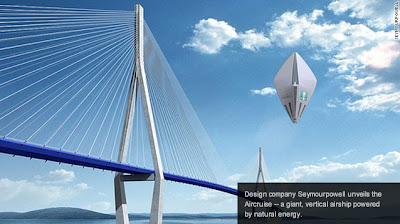
I'm gonna make a zoo in a submarine at the bottom of the ocean! Won't it be great?!
Because theories can be wrong, architects need to be able to evaluate how good their theories are in practice, since the repetition of theoretical error - as in much of the modernist housing programme - will inevitably lead to the curtailment of architectural freedom.
Hey look! Tons of people, that must be how it's gonna be! And, they're all young, healthy, thin and white! This building will create a magical dreamland!(author of this blog does not endorse any of this quote)
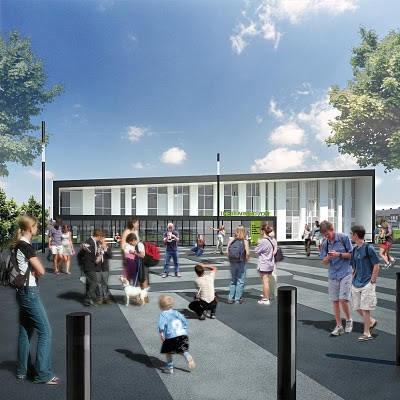
How can city building respond to a difficult market in a difficult time?How can I address the problem of sprawl with infill housing, when conventional building methods/materials or existing financial mechanisms prove antiquated or preventative?How can I be green and still build affordably?How do we address the issue of mobility in a sprawled out, unwalkable city without suffacating the project's design AND budget in "required parking"?How do we repurpose our hyper-efficient dying, assembly line industries to meet the massive pent up and as yet unmet demand for in-town affordable housing with access to choice of transportation mode?How can we overcome the financial instruments behind real estate and their demand for quick return on investments when the best buildings and cities are long-term, shared benefits?How can I meet market demand for all of the above and still execute it elegantly?


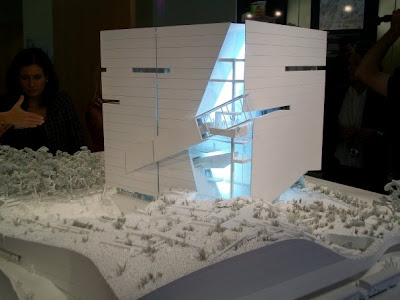
Invoking Roman ruins, he said the aim was to demonstrate "Nature taking over building" and that the hope was to include plants and living material in the exterior finish. Talley Associate's landscape design already incorporates a grove of trees, native Texas plantings, and, as Mayne described it, "a savannah" on the north side of the building....so lemme translate. In this dreamt post-apocalyptic world when all of our silly messiness of humanity is extricated from their beautiful works of art can this place exist as it is meant. They're so ahead of our time. By the way, a "savannah" has nothing to do with local Dallas ecology. Why don't we just make it a cotton field and get it over with.
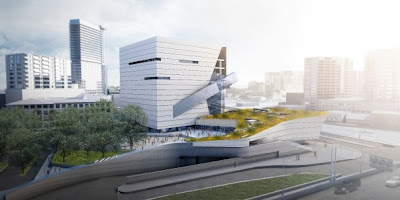
The design is conscious of its proximity to downtown, with a transparent atrium on the corner of the building providing dramatic views of the skyline. The semi-exposed elevator shaft on the outside of the building encourages visitors to ascend vertically and then work their way back down through the Museum. (Shades of the Guggenheim, maybe?)
It is very conscious of being near downtown. Perhaps too self-aware, like a Highland Park tourist periodically stopping by the Neiman Marcus flagship. There are views, the building can see downtown, but not be a part of, and is distinctly seperate. As in at least an arm's length away at all times from that messiness that is true urbanity.
But, maybe we don't want that in Dallas. Perhaps we don't want places where we actually can all come together and coexist. We want divergent socio-economic classes and 21st century apartheid. If so, we better be aware of the repercussions and prepared to pay for the taxes to support the physical disconnects and the policing to preserve such divisions. We want to be able to talk about our great city but not mean it. We want to live in our McMansion, but we don't want the hour commute, the surly neighbors, or the fat, stupid kids that we ignorantly weren't aware came as a side helping.
Simply put, we pretend we are addressing problems, throwing money at them, but not really be honest with ourselves about the underlying issues. Sounds like the hubristic lexicon of starchitecture-ese, no?
Drilling out the cavities so to speak. I can donate the money, if it's enough maybe get my name on a brick or something, drive into the city, park in the garage, see a show, and never step foot outside. Aint it great? Now step on it before these city folk spread their diseases, like diversity and tolerance!
And good grief...the Guggenheim? Really? You know what the Guggenheim has? It has New York City around it, providing the life, the vitality, the interaction, and the backdrop for something different to stand out and be outstanding. Without city fabric, something merely stands. And furthermore, the City (and the people) were there first and the City then arose to the point culturally demanding such facilities; the horse appropriately ahead of the cart.
There is still work to be done. (The Museum estimates that it needs to raise another $60 million or so.) But it is clear that we have another dramatic work of architecture on our horizon.Sidenote: why does every museum have to be so literally representative of the displays inside these days anyway? Yet, remarkably they all manage to look the same yet with each particular architect's not-so-subtle accoutrements.
As for it being "another dramatic piece of architecture," any singular piece of architecture aka object is not and can never be dramatic. It is by definition static, a postcard. The life of a place, the genius loci, alchemically induced by the city fabric is dramatic when appropriately orchestrated to allow the "city" aka the residents to instill their own lives into the place. Places live when they adapt over time. Or we can falsely imply the passage of time and the fate of civilization

That may mean that no matter what governments do, oil prices will act as a governor on the world's (or at least America's) economic engine. Growth above a certain rate will be sufficient to boost oil demand and prices up, dampening consumer spending and slowing expansion—potentially keeping the American economy from growing at a rate sufficient to decrease unemployment. That will be the dynamic until dependence on oil is sufficiently wrung out of the economy, which could take some time. This is yet another point arguing in favour of a prolonged and shallow recovery for the American economy.Every aspect of our economy, and in turn, our cities (and vice versa) are defined by the cheap oil of the 20th century. Cities have lasted so long as the primary organization of human civilizations for so long because they are so inherently durable due to their diversity. A homogenous economy/city defined by one potentially volatile element in the equation is foolhardy. Just ask Detroit.
They seem to think this mass exercise in pretend will resurrect the great march to the WalMarts, to the new car showrooms, and the cul-de-sac model houses, reignite another round of furious sprawl-building...Or as the Daily Reckoning adds the words to my worries over the last five years pre-dating the collapse, (once again, my emphasis in bold):
So I'll end with the oft cited, and over-represented Churchill quote:The process of de-leveraging will be slow. Maybe five years. Maybe 15. Maybe 25. It will go up and down…with high unemployment (businesses will cut their wage costs as sales fail to recover)…low prices (at least in real terms)…low profits…and slow growth, or none at all.
Is that bad? No, not at all. It’s good. Economies need to adjust to the new realities of the post-credit bubble world. It will take time. And with the world’s financial authorities fighting it every step of the way…it could take a LONG time.
We shape our buildings, thereafter they shape us.As I stated previously, however, in reality we shape policy, which shapes economies, which then shapes our cities, which then shape us. And that shape is globular and slovenly.
Was this another one of Brad Pitts ideas?
Have you people not watched Dollhouse? Your self-contained habitat needs to be built underground. Duh.
Because why should Dubai get all the gargantuan monstrocities?
All these eco-retarded structures that are coming out now are such a waste of time and computing power. As others have pointed out these pieces of crap will never be built, never. And obtw weren't we supposed to be in flying cars by now anyways?
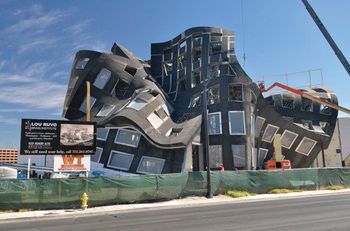
Art is made to disturb.
It (ed: San Jose in this context) is an example of what David Barringer, in an article entitled "The New Urban Gamble" (ed: Not as in CNU "New Urban," but more like "New" as in nuevo) in The American Prospect, called "THE CARNIVAL STRATEGY" (my caps).
Cities build a performing arts center, an aquarium, and a sports stadium and hope that the crowds will materialize to fill in the rest of the city. I am extremely dubious about this strategy. Things like art museums and aquariums are great as the capstones to successful places, as amenities and accessories. But trying to make them an economic foundation is to confuse the role of the foundation of a building with that of a decorative window on it.
A museum can be a great reward for a successful region, as can central libraries and other public works. But, even if the crowds appear, they will not replace or even draw the people or businesses that make a center city truly a place.
"Under what theology does this work?! Where is the empirical evidence that these street designs make for a better place."Well, there is a similar battle in the architecture field as well. I thought I might cross-post Michael Mehaffy's email to the Professional Urbanist Listserv, where he significantly expands on my riff against tall buildings (well, not so much against, but more as a voice of moderation to the hyper-density crowd -- I'm merely against them as the ONLY solution) to a broader discussion pointing out the obvious flaws (sometimes fatal) in "green" modernism.
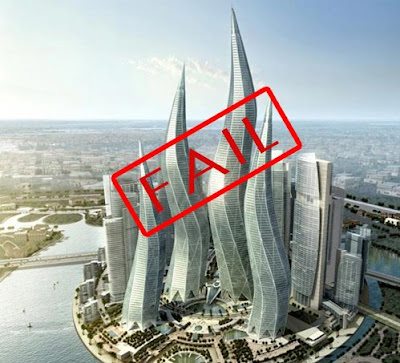
A blending of greenwash and Corbusier. This is not a good direction.But, this is the only way the self-absorbed dinosaur architects representing all that just failed know. And my firm can be part of the problem as well. Check out our website: nothing but flashy, hard to build object buildings. There is nothing more complicated ingrained into the DNA of these places than trying to be different. That is it. They are the opposite of timeless. They are fashion. And, fashions go out of style. Place IS timeless.
steven 'hole' just keeps getting worse.Also, when helping a friend search for a new TV, I was also struck by how the customer comments were far more helpful than the consumer reports or site editor's comments. Despite their expertise, there was a sense of uneasiness that it could easily be corrupted or bought off by a product manufacturer; that you could no longer trust their information.
the other building that rem did, and that holl did, as well as most of the new garbage built in china nowadays, should have burned with that fire last week
the chinese motto: if it doesn't suck, we won't do it
Towers-in-the-Park. Hello 1961. Jane Jacobs, never heard of her.
urban planning travesty
Assuming the sun can get through Chinese smog. [ed: LOL]
This is hideous. In the pretentiousness / ugliness stakes, Steven Holl is now giving long-time front-runners like Libeskind and Eisenman a run for their money. [amen]
Believe what you want. Be as optimistic as you like. What should we care if you want to go around fooling yourself that this is anything other than bullshit. It's your life to waste as you please.
China seems to becoming the dumping ground for these pseudo-theoretical piss artists like Holl and Libeskind. They get suckered into buying ideas that failed in the US. - On the plus side, at least their crap doesn't get built here any more.
But Cloepfil (ed. note: the architect of Booker T. Washington High School) says it might be misguided to expect Jane Jacobs-style urbanism to sprout in north Texas, and that isn't necessarily a bad thing. Dallas might have to accept the arts district as a successful destination, not a way of life. "I'm trying to be a realist to other urban types," he says. "I do think there are other models of urban success that we may not want to believe are successful.""Other models of urban success," huh? LOL. I guess anything can be a success depending upon what the goals are. If the goal is a vibrant place, it sure as he11 has not and will not achieve it on its current course. I can't decide if he is being glib with the intended (or unintended?) backhanded compliment to Dallas or not...
"They wanted to build 'the world's biggest this' and 'the world's biggest that,' but these buildings have almost zero long-term economic benefit," economist Huang said.
Moreover, the makeover of Beijing for the Olympics led to an estimated 1.5 million residents being evicted from their homes, according to the Geneva-based Center on Housing Rights and Evictions.
When the architect Andres Duany and his wife and partner, Elizabeth Plater-Zyberk, recently received the Driehaus Prize, given annually to honor traditional architecture, Duany delivered a talk in which he mocked modern architects for having “explored every shape that could be hyper-cantilevered, crashed, randomized, slashed, perforated, upturned, bent, dematerialized, dissed or otherwise transgressed.” He didn’t say he was thinking of Koolhaas’s CCTV building, but he might have been, since its shape is about as irrational, and as self-consciously bizarre, as you could imagine.

 Posts
All Comments
Posts
All Comments


Heavy, severe, anti-social, anti-human, scaleless, leaden, joyless, drab, prison-like, ..... these are the words that come to mind when I see this project.
And in their quasi-intellectual pretensions, these are the same words Holl's deluded staff of poseurs will try to say are the project's virtues. - Yes, I forgot cold, inhuman formalism has always been the stuff of great architecture ... right? [ed: This commenter gets my point that this is phony intellectualism. Their language makes no sense if you really break it down. There is no real depth to this other than being different.]