Showing posts with label Bizarro Keynesianism. Show all posts

Thursday, January 7, 2010

Sociality (not Facebook) is what will Not Kill but Wound the Auto


The New Republic has been picking up steam lately in output with regards to issues of this blog's interest. The newest is the absurdly titled, Will Facebook Kill Off the Automobile?

Even worse, I suppose, is the actual title in the web address, suggesting we BLAME Facebook. This paints a pretty clear picture of the conscience of the nation, or at least, the national media's lack of understanding of THE most prescient issue of the day and media's inherent nature behind the social curve: it is not so much cars, but our frenzied if not corrupt overshoot supporting the automobile industry and its resultant (if not catalytic) infrastructure.
See this article on a bridge twice its necessary capacity. Induced demand anyone? This is what the cult of engineers would deem "improvements," which really improve nothing but their companies balance sheet. Peddling harmful product on a willing or unwary population; growing wealthy. Not unlike drug dealers me thinks.
Back to the article, which is really just providing superficial commentary on this report from Earth Policy which discusses the idea of "peak car." This really shouldn't be that complicated of an idea given all of the discussion regarding peak oil and the surplus of hundreds of thousands of brand new cars sitting at ports along our coasts. While TNR overreacts to the assertion that Facebook in particular is "the problem," facebook is simply emblematic of social media, which in and of itself is just a subculture within the movement back towards...well...each other, a more social way of living and being.

This was always the error of 90s doomsayers suggesting the internet would turn us into a generation of automatons. In fact, the opposite has occured. The younger generations utilize the power of the web 2.0 to increase social contact electronically as well as in person, while baby boomers are stuck in traffic jams communicating via toots, honks, and hand gestures of varying intent and hostility.

Who is the automaton now?

To tie this back together, I'm reminded of an interview with ethno-botanist /slash/ cultural anthropologist /slash/ cool freakin' guy, Wade Davis of the National Geographic, as he discussed the manner in which various drugs affected and in turn were accepted into cultures. I realized that cars were similar to the picture he painted about drugs in society, in that when they are newly introduced, they create a period of dislocation in that culture.

[277_cartoon_oil_addict_large.gif]

After a certain amount of time, eventually culture overcomes the overshoot created by any new substance, which could be seen as cultural experimentation or knowledge seeking, which is necessary for the culture to come to terms with it as it eventually becomes a matter of choice. The specific example he cites (my transcription):
I can honestly tell you that I've been on the edge of the drug culture, certainly in the 70s and late 60s and our museum at Harvard was the center for narcotic, toxic, and hallucinagetic drugs. And, in all that time, I've never met anyone who's choice to use or not use illicit drugs had anything to do with their legal status.

If draconian laws could keep people from using illicit drugs and solve the problem, which is created by people buying the drugs and then fueling the cash economy of the criminal element, if we could stop pepole by invoking powerful laws, then the draconian laws would've already done it. But they're not doing it because people make their decisions based on drug use on their own criteria. 90% of Americans have tried illicit drugs, about 5 million are regular users, but the interesting part is that 85 million Americans have been exposed to illicit drugs but don't use them anymore.

The old adage is that there are not good or bad drugs, just good or bad ways of using drugs, and one of those ways is abstinence, which 85 million Americans have chosen to do, not because their legal status, because if it was their illegality they wouldn't have used them in the first place. But rather their own personal relationship with the drugs to no longer use them.
Now substitute cars or highways in that passage for drugs and you begin to see my point. Cars hit European cities just as hard, particularly between the 60s and 80s, choking many of the cities in traffic and pollution. European cities have proven more resilient than American cities in coping with the new substance that was automobile use. I'm guessing this had little to do with the actual construction of the cities at the time, because post WWII many European cities were essentially clean slates, while Detroit was the Paris of North America.

Also, for locals in the DFW area, do yourself a favor and pick up the book Dallas: Rediscovered if you want a heart attack. This city destroyed so many beautiful buildings in the name of verticality, "mobility" (read: highways), and the requisite parking for those skyscrapers.

My how times have changed.

I would actually argue that European cities resilience comes more from two things. First, the age of the cities and the cultures that inhabited them. In many ways, they've seen and adapted to many, many, many more influences over millennia than American cities that are little more than one hundred or two hundred years old.

Second, and perhaps more controversially, I would suggest that there might be greater reticence towards "Corporatism," which in many ways offered the dynamite and the spark for World War II. Germany pulled out of its crippling post first World War uber-depression, with equal measures of nationalism and industrialism: building highways, cars, planes, tanks, etc. Sound familiar?

This is what I call bizarro Keynesianism; the lure of quick returns. Spending on bombs rather than schools. Short term spending rather than long-term gains. This is our challenge of the current recession (potentially eventual depression). Will we build more highways despite our horrific overshoot? Or will we wisen up and allow demographics to trump short-term business interests of the status quo?

Do we really want to take one step forward and two steps back? Having been on I-30 near Rockwall the other day, and seeing the absolute abomination of taxpayer dollars towards another mega- rollercoaster-like highway interchange death trap, I'm not sure anybody in Texas is really ready to make the right choice or step in front of the bulldozer tank and demand a stop to new highway construction in favor of people, and main street, and education, and crime reduction, and livability.

See John Norquist, former mayor of Milwaukee and himself a highway to boulevard vanquisher, suggests the smart money would be on Main Street.

And then compare that to TxDOT thinking about taxing VMTs, which seems logical, but like Texas' use of toll roads, it is for all the wrong reasons: ie more road and highway construction. Seem backwards to you? Measures to reduce dependence on cars and roads, only to add more roads and cars? Yes, you'd be right. It's as backwards as a palindrome (note: not a reference to a certain former governor).
“We need to think differently about how we fund transportation,” Texas Transportation Commission Chairwoman Deirdre Delisi said at a Texas Taxpayers and Research Association forum in November.
No, ma'am. With all due respect, you, as CHAIR, need to think differently about transportation. Next time you are on the highway, think about how much it costs for me to walk across the street for a cup of coffee, or lunch, or to the library, or to the park, all within two blocks of where I live. Unfortunately, and here is the real issue, there is so little supply of high quality urbanism and so much pent up demand that can't be achieved specifically because of local, state, and federal transportation policies, particularly the highways.

Congratulations, you've achieved engineering valhalla. No congestion in downtown...because noone (besides me) lives there any longer as your policies have achieved the unintended goal of creating unlivable environments except for rats, cockroaches, pigeons, homeless, and a handful of wackos like me.

I'm not suggesting that we all go car-free (that would undermine the point of free choice, no?) or that we try pedestrian only precincts (the US has tried that and failed rather miserably - even malls). Rather, this polemic is to suggest that we implement dovetailing policies that dramatically shift bulging DOT budgets towards local livability investments which includes alternative mobility, while systematically and incrementally transitioning highways out of the core, a conversion to boulevards, arterials to complete streets, and walkable/livable downtown streets. This is the best investment we can make as a community.

[274874.jpg]
(Not Copenhagen)

Copenhagen is obviously the primary example used by today's pedestrian and bicycle advocates. But it only got to where it is today (as the most livable and valuable city in the world) because of its own collective automobile induced overshoot. Furthermore, the status quo, being the local business owners fought tooth and tail against removing cars from their streets. We see who turned out to be correct there.
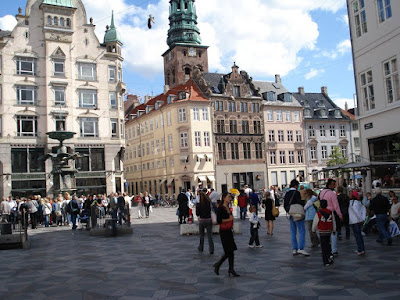

(is Copenhagen)

Tuesday, November 24, 2009

Ask the Carless Guy Vol. II

Not really a question, but I received an email from a former colleague with this article attached, and this particular quote called out:

George Ablah, a prominent real estate developer who was a leader on the steering committee in 1989, foresaw a parking problem — and still sees it.

He said the old rules of development were "location, location, location, location." Now it's "location, parking, no social problems, location."

He said he suggested that the city buy vacant and blighted buildings, tear them down and use the land for parking.

Development would follow, he said.

But that didn't happen.

"We would have had a booming area," he said. "I could be wrong. But we didn't do it, so we can't prove it."

Or, you might be a dinosaur of the 20th century economy. While certainly a smart and savvy developer, this guy doesn't know the first thing about cities. And I'm talking about understanding the underlying dynamics at work shaping cities. The following is really my general advice to understanding articles like this:

Whenever you read quotes from somebody or an op-ed, or any article for that matter, you have to understand the person's point of view. W hat's their angle? Ablah, is a developer, so he's looking for the city to make his life easier by assembling land, writing down his costs, and providing parking, that is all costs the developer doesn't have to bear in his pro formas.

It's certainly one strategy, and not a terrible one (b/c i can't comment on the state of the buildings he is referring to), but it is one of a different era as I will describe. I will tell you that anybody that says any city "needs more parking," they really don't know how city evolution works.

It worked for Portland, catalyzing development by building sub-grade publicly funded parking garages, b/c they were systematically removing the blight on neighborhoods and development that parking is. Furthermore, they are, again, removing a hard cost the developer would normally bear as parking is externalized from the development.

In this circumstance, however, I get the feeling that this particular developer is (to some degree) thinking about retail (since he's harboring sentiment from the 1989 masterplan) and making the parking accessible for suburbanites to come in once in a while to this imaginary downtown shopping wonderland is a mistake. When what is really needed is a vast influx of residential (of broad market segments), repositioned into walkable, livable downtowns, cutting the transportation barriers out of the local economy, and allowing the retail/commercial/jobs to "emerge" or follow the new market created via the demand of new residents.

But most importantly, b/c most cities right now are too broke to be assembling land and tearing down buildings. There are however, creative policy measures that incentivize (or "incent" if you prefer actual English) the selling of underperforming land at prices much lower than the owner imagined they would be getting in the condo boom of the past ten years (or if they were holding on cash generating business that drags down the City and, in turn, the City's economy, i.e. privately owned/managed surface parking lots).

These strategies (without getting into particulars) include varying degrees of carrots and sticks if you will, that amortize the carrots in favor of bigger sticks the longer you go. This is somewhat counter-intuitive to the common wisdom of incentivizing initial catalyst developments via a variety of subsidies and then voila! the market will be established and naturally fill in the rest.

When what we've actually found is that the market gets set by the subsidy and the city gets held at the barrel of a gun for similar subsides on every single project. (See: Dallas and the Merc, then the Convention Center Hotel)
=====================
Second piece of news: nobody asked me this, but I'll opine anyway. Dallas feels left out of new $1.85B highway bill. Frankly, Dallas should feel so lucky. The LAST thing any Texas city needs is more highway construction. Unfortunately, people are too stupid or corrupt and think spending taxpayer money for short term jobs and long-term disasters is good economic policy.


Friday, November 20, 2009

Friday Free Beer Happy Hour - Guess the City

Downtown Dallas edition in order to see the lights and the new park grand opening, and due to that, we have another BIZARRO BEER FRIDAY!!!!

**edit: Perhaps as readership expands beyond an email list, perhaps I should advertise the Happy Hour location. A personal fav, the Cheers! of downtown Dallas residents: City Tavern.
=============================

Yes, Lindsay gets it!


==========================================

For this BIZARRO BEER FRIDAY, we'll take a tour to an example of what happens when pegging goals/actions to meaningless, abstract statistics such as GDP; the blind creation of unnecessary infrastructure and the epitome of overly centralized planning and development. The opposite of a favela, if you will.


Lacking understanding of emergent nature of cities and the economic foundation underpinning population demand driven evolution.


Not wholly unlike the creation of edge cities in the US decades ago a la Las Colinas - of course, people had to go bankrupt first, and somebody will do so here as well.


Creating an architect's fantasy land, a clean slate, a blank canvas for ahem self-gratification architectural expression.


I'd show more, but I'm afraid you may have seen them plastering every page of architectural record since a google image search of the city turns up a smorgasbord of unbuilt architectural portraiture, ignorant of all/any context, the type of humanizing and participatory complexity of urbanity. But of course, there is no context. Next stop, city building in Siberia!

ZOMG! Behold our masterpiece of arbitrary geometric shapes!


The world will know thy name!


In the end, it is too rightly ordered, too overly masterplanned to ever be usable in its current form.


"Novelty is often mistaken for progress."

Tuesday, November 10, 2009

Post Monday Linkages


Kunstler discusses the eventual collapse of the Rube-Goldberg machinery of all American institutions and the potential outcomes:
Reality unfolds emergently, and this ought to interest us. For instance, I have maintained for many years that we are approaching the twilight of the automobile age - and the implications of this for daily life in the USA are pretty large. For a long time, I had assumed that this change of circumstances would proceed from our problems with the oil supply. But reality is sly. It has thrown two new plot twists into the story lately. America's romance with cars may not founder just on the fuel supply question. It now appears that our problems with capital are so severe that far fewer people will be able to borrow money from banks to buy cars at the rate, and in the way, that the system has been organized to depend on. Our problems with capital are also depriving us of the ability to pay to fix the hypercomplex system of county roads, interstate highways, and even city streets that make motoring possible. What will we do?
He goes on...
For now, a cashless government gives out cash-for-clunkers, which is basically a self-esteem building program designed to make the government feel better about itself because it is ostensibly taking 11-miles-per-gallon cars off the road and replacing them with 27-miles-per-gallon cars, thus forestalling scary problems with climate change.
Except a new report suggests the Cash for Clunkers program hasn't been nearly as successful as those numbers imply. (I don't know if those are pulled from thin air by JHK or were goals set forth by the administration.) Notice this report has nothing to do with the $24K claim that is the main talking point for the bickering:
The single most common swap — which occurred more than 8,200 times — involved Ford F-150 pickup owners who took advantage of a government rebate to trade their old trucks for new Ford F-150s. The fuel economy for the new trucks ranged from 15 mpg to 17 mpg based on engine size and other factors, an improvement of just 1 mpg to 3 mpg over the clunkers.
--------------------------------------
Andrew Sullivan opens up an IEA report on peak oil.

"Many inside the organisation believe that maintaining oil supplies at even 90m to 95m barrels a day would be impossible but there are fears that panic could spread on the financial markets if the figures were brought down further. And the Americans fear the end of oil supremacy because it would threaten their power over access to oil resources," he added.

A second senior IEA source, who has now left but was also unwilling to give his name, said a key rule at the organisation was that it was "imperative not to anger the Americans" but the fact was that there was not as much oil in the world as had been admitted. "We have [already] entered the 'peak oil' zone. I think that the situation is really bad," he added.

-------------------
Thankfully, there is growing support for legislation to end this "too big to fail" nonsense.
"The lesson of Lehman should not be that the government should have prevented its failure," David Einhorn, head of hedge fund Greenlight Capital, said in a recent speech. "The lesson of Lehman should be that Lehman should not have existed at a scale that allowed it to jeopardize the financial system."
All that matters here, is that anything that is "too big to fail" is SO big that it equates to an agglomeration of wealth and power that they (singular individuals or the corporations they represent) are above any justice system and can either bribe or threaten the very foundations this country was founded upon. Once again, as soon as something approaches "too big to fail" it immediately means that it is "too big to exist."
---------------------
And more from the BackAsswards land of bizarro Keynesianism and stupid or corrupt economic development:
But it was the odd story of a parking structure in Columbia Heights, built by the city with $40 million of taxpayers' money, that may be the most pertinent data point in the future of parking. Here was a classic case of how good intentions can get fouled up with old-fashioned civic extortion. The retailer Target demanded the garage as a condition of moving to the city. The city built it. But something strange happened along the way: The expected hordes of drivers didn't materialize. They came by foot, by Metro, but not in cars, at least not in the numbers projected, and now the lot is losing money, costing the city some $100,000 per month.
Lesson: it rarely pays to bend over for any business, let alone one with a suburban business model in an urban setting.

Thursday, November 5, 2009

Lazy? Or Lack of Time?

More articles. What can I say, good week in the wonderous world of the interwebs all about building real, sustainable economies. Not the imaginary kind.

Mostest excellent article in the Financial Times today about taking the economy back from finance:
In the 1980-2007 era of cheap credit and deregulation, banks had every incentive to move from real-economy projects, yielding a profit, towards lending against rising asset prices, yielding a capital gain...

A promising policy avenue is tax reform. During the asset boom of the last decades, taxes on capital gains in the US, UK and most other OECD economies have fallen sharply relative to value added tax and labour taxes. When the banks have recovered, they need a regulatory and policy climate that discourages the pursuit of capital gains for their own sake, and which favours growth of the real economy. Finance should be the economy’s handmaiden, not the other way round.
--------------------
For the last damn time, quit trying to make vertical farms. They're the equivalent of parking garages and we have plenty of arable land near cities...just so happens they're beneath schlocky tract homes that will begin crumbling upon themselves in, oh...about five more years and change.
A farmer can expect his land to be worth roughly $1 per square foot...if it's good, fertile land. The owner of a skyscraper, on the other hand, can expect to pay more than 200 times that per square foot of his building. And that's just the cost of construction. Factor in the costs of electricity to pump water throughout the thing and keep the plants bathed in artificial sunlight all day, and you've got an inefficient mess.
See my Valencia post for proper allocation of food as well as industrial production in relation to the City.
---------------------
Speaking of water, cash strapped governments are looking to the negawatt to save water and energy (negawatt = the cheapest form of energy, the kind that never gets used.)
Chasing negawatts, the energy that you don't use, is a popular pursuit these days for cash-strapped states, and California is turning out to be excellent at it. Negawatts (a term Amory Lovins came up with) can offer a lot more bang for the buck, so to speak, then building new power. And asSteve Fleischli at HuffingtonPost reports, when faced with choosing a $550 million salination plant that would require lots of water and lots of power but produce fresh water, or a Coastal Restoration $187 million project to swap out 455,000 existing urinals for waterless alternatives and save water and generate negawatts
Waterless urinals are the future...speaking of water...
---------------------
Lastly, and most depressingly, more on cities/counties/states chasing businesses thru various forms of buyoffs. In Milwaukee which has more access to fresh water than the city itself needs, is offering cheap water to businesses. Ok, so what. No harm no foul. Until the whammy:
Cities and states routinely use tax incentives, loan guarantees and infrastructure investments to entice companies to relocate operations. Iowa last year offered IBM $52 million in tax incentives to create 1,300 jobs, while Michigan recently gave Johnson Controls $148 million to create 500 jobs for a battery facility.
Jumpin' Jeezus on a Dinosaur! That's $296,000 per job that Michigan forked over. I'd like to think each of those positions would make more than that. How else does that make any fiscal sense whatsoever for the state of Michigan? As I tweeted about this the other day, I suggested why not just go to the top of the tallest building and drop cash on people with balloons filled with smilex gas. That should have the same effect.

When will governments ever learn? At least in the current business climate, 1) the best investment is to invest in your citizenry, meaning a) training programs/education b) if your going to offer incentives offer low-interest loans w/ bankruptcy protection and c) big businesses are only getting smaller. The way towards job growth is investing in small businesses (right now). There are an awful lot of talented people out there, that can be competitive if you lessen the burden of startup (and failure).

Entrepreneurism. The REAL American Way.