


According to its transportation network (via # of trips):
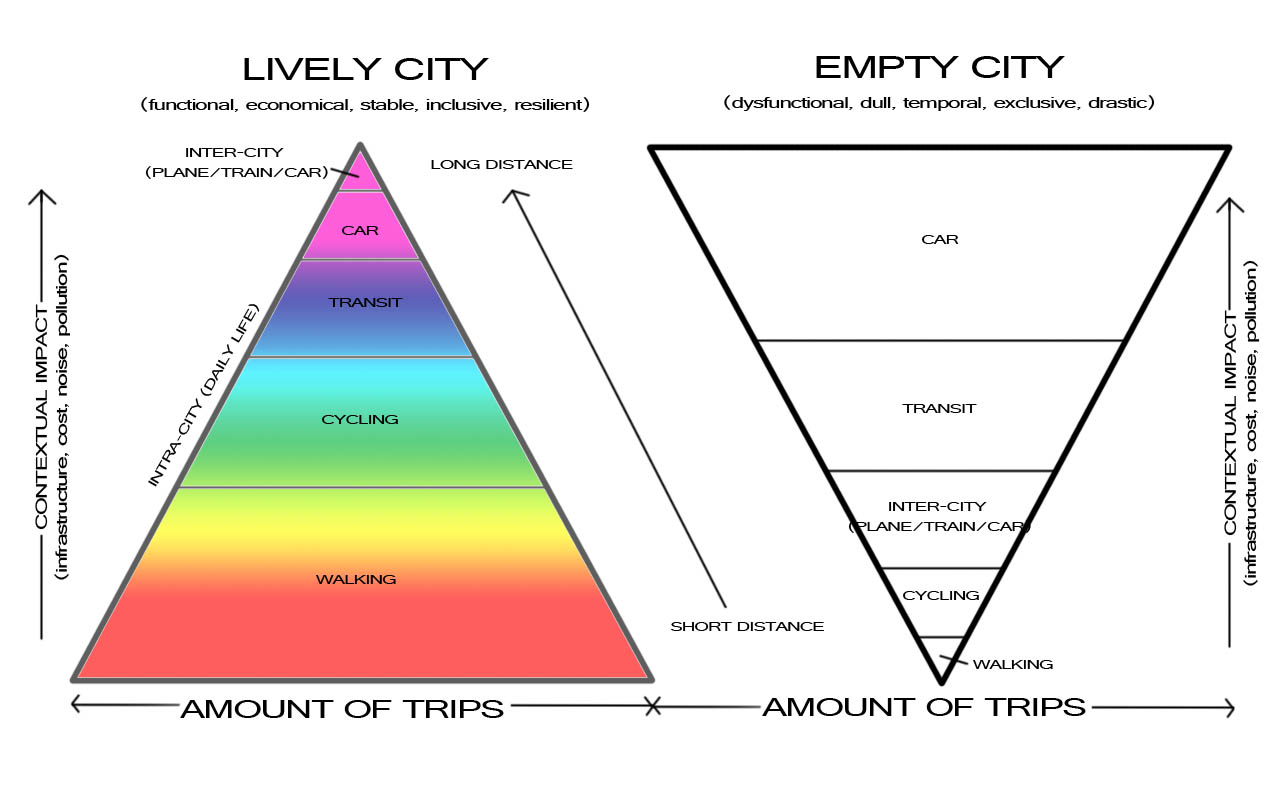
Click to embiggen.
Pay particular attention to the vertical y-axis, what I'm calling contextual impact. The transportation network has certain inputs and outputs, such as cost and infrastructure (input) as well as noise and pollution (output), which form a circular multiplier effect. These outputs reduce the quality of space, meaning reduced safety and desirability. The result is even less pedestrians. As a body politic we then turn and say, "well, there's no pedestrians and we have traffic, build more roads!"
We lose.
We lose:
Our wallets.
Our sanity.
Our quality of life.
Talent looking for a place to live and work.
Businesses looking for places for their employees to live.
Major events looking for a venue.


 Posts
Posts


3 comments:
How does one create this?
Remove zoning rules so that retail/manufacturing/residence hybridizes or spaces become heterogeneous?
1) disincentivize driving - thru increased user fees (whether they be tolls or gas/mileage taxes), as what user fees there are only pay for about 50% of road construction/maintenance.
2) Reduced state/federal spending on new road capacity and instead, if there is still x amount spent, spend it towards reducing demand for car travel and essentially coerced automobile ownership.
3) eliminate or reduce tax breaks for new single family home purchases (perhaps only in outlying areas?)
4) move away from Euclidean 2-dimensional zoning that isolates by use and instead favor more of a form based zoning that only regulates noxious uses into isolated areas (heavy industry, etc)
5) A personal favorite of mine, is for cities to create split tax zones in areas where they want to encourage high intensity development wherein the tax rate for improvements is separated from the land. It would drastically cut the tax rate on improvements, but increase the rate on land to be more of a pigovian or consumptive tax, thereby instilling incentive to do something with your land.
6) market-rated parking.
And that is pretty much just scratching the surface, but you can see how endemic the policies are against cities.
Great post, but whose pyramid graph is that? I'd like to use it in my talks, but want to properly credit the artist or owner.
Thanks! - Storm Cunningham
([email protected])
Post a Comment